
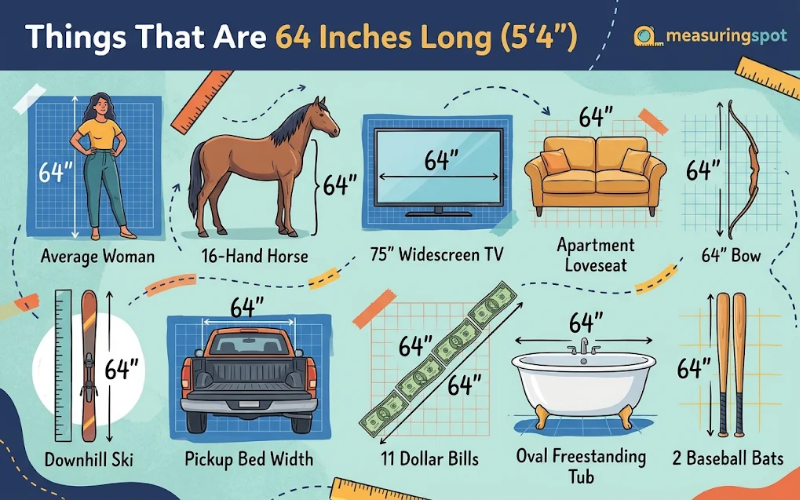
When you plan home improvement projects, pack a trunk for a road trip, or redecorate a living space, tape measures often run short or vanish into garage clutter. Knowing everyday benchmarks helps you estimate dimensions quickly without searching for lost tools.
The dimension of 64 inches sits right between common furniture standards and human physical statistics. By grounding this measurement in recognizable objects that you interact with daily, you can gauge distances, check clearances, and select the right furniture pieces with total confidence.
Quick Answer: How Long is 64 Inches?
How long is 64 inches? In standard measurements, 64 inches equals exactly 5 feet 4 inches (5.33 feet), 162.56 centimeters, or 1.6256 meters.
To gauge this span without a tape measure, think of the height of an average American woman, the typical width of a two-cushion apartment loveseat, or a standard 70-inch television measured from side to side.
Biowiki Reference Chart: The 64-Inch Standard
The table below compiles quick specifications, conversions, and typical applications for 64 inches across common design and spatial contexts:
| Parameter | Specification | Notes and Context |
| Exact Imperial Length | 64 inches (in) | Equal to 5 feet 4 inches (5’4”) |
| Metric Conversion (cm) | 162.56 cm | Rounded commonly to 162.6 cm |
| Metric Conversion (m) | 1.6256 m | Roughly 1.63 meters |
| Equine Measurement | 16 hands (hh) | Standard wither height for draft and large riding horses |
| Common TV Diagonal | ~72 to 75 inches (16:9) | Yields an actual horizontal width close to 64 inches |
| Apparel Classification | Regular adult garments | Approximate height baseline for petite-to-average outerwear |
| Interior Design Use | Medium entryway console | Ideal runner and console table width for standard foyers |
| Standard Volume Analogy | ~11 standard dollar bills | Laid end-to-end lengthwise |
| Everyday Comparison | Adult ski or longbow | Common length for recreational archery and winter sports |
10 Common Everyday Things That Are 64 Inches Long
1. The Height of an Average American Woman
Human height provides one of the easiest biological measuring sticks. According to long-term demographic data from the Centers for Disease Control and Prevention (CDC), the average adult woman in the United States stands right around 5 feet 3.5 inches to 5 feet 4 inches tall.
When you picture a woman of typical height standing upright, you see an exact representation of 64 inches from the soles of her shoes to the crown of her head. If you need to verify whether a sofa, a mattress, or an entertainment center will fit along an empty wall, having someone of average height lie down or extend their reach gives you an immediate spatial estimate.

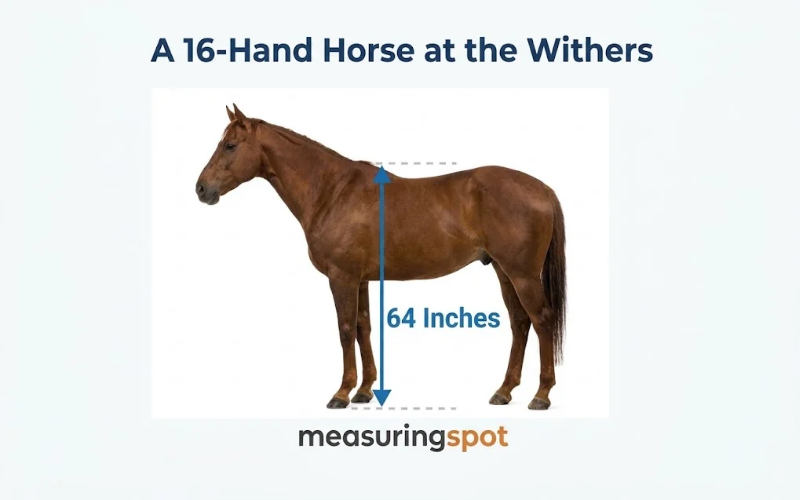
2. A 16-Hand Horse at the Withers
Equestrian enthusiasts measure horses using “hands,” where one hand equals exactly 4 inches. A horse that measures 16 hands tall stands precisely 64 inches at the withers, which is the ridge between the shoulder blades where the neck joins the back.
Breeds such as Thoroughbreds, Warmbloods, and many Quarter Horses frequently hit this 16-hand benchmark. When standing beside a horse of this build, an average adult looks straight across at the horse’s shoulders. The 64-inch marker represents a critical threshold in equestrian sports, separating medium-sized horses from heavy draft animals.
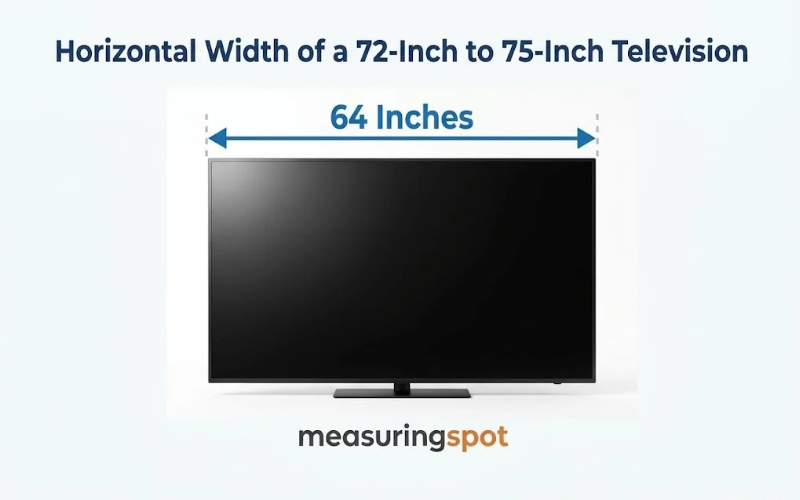
3. The Horizontal Width of a 72-Inch to 75-Inch Television
Television marketing categorizes screens by their diagonal corner-to-corner measurement rather than horizontal span. A modern widescreen television with a 16:9 aspect ratio and a 72-inch to 75-inch diagonal display measures almost exactly 64 inches from the left edge of the bezel to the right edge.
Homeowners frequently purchase television consoles that match their screen diagonal, only to discover their furniture is too narrow. A 75-inch display needs an entertainment credenza that spans at least 68 to 72 inches across so the screen does not overhang the furniture edges. Remembering that the physical width of this screen class is 64 inches prevents costly living room layout mistakes.
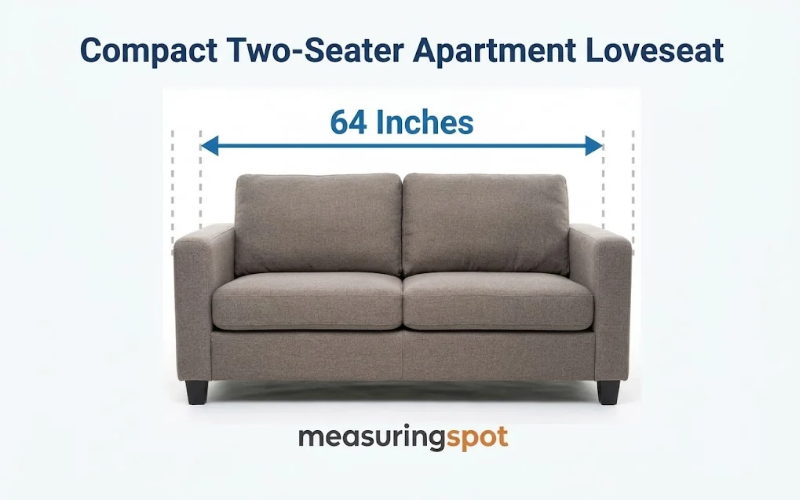
4. A Compact Two-Seater Apartment Loveseat
Furniture builders design compact loveseats specifically to fit tight urban floor plans and smaller living rooms. While deep three-seater sofas routinely span 84 inches or wider, standard two-cushion loveseats commonly measure 64 inches from the outer edge of one armrest to the other.
This 64-inch profile provides ample seating space for two adults while sliding comfortably into alcoves, bay window recesses, or against short partition walls. Interior decorators rely on this specific dimension because it allows comfortable clearance around walking paths in compact apartments.
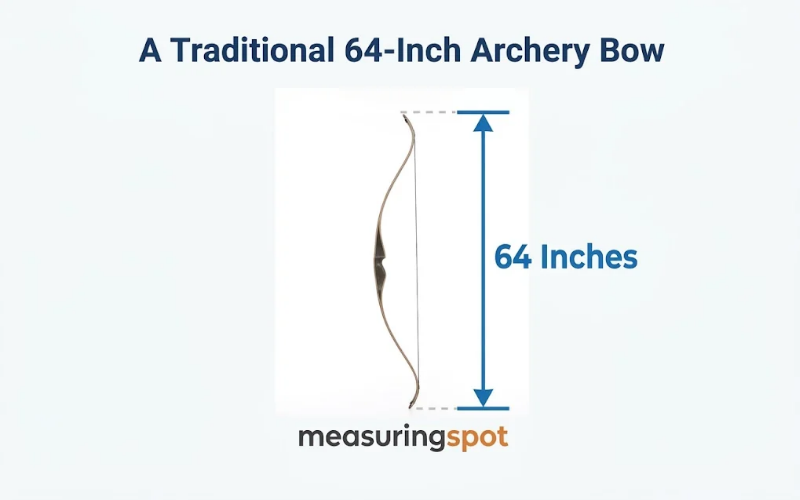
5. A Traditional 64-Inch Archery Longbow or Recurve Bow
In traditional archery, bowyers build bows to match the archer’s draw length and physical stature. A 64-inch recurve bow or traditional English longbow remains one of the most popular configurations for adult archers with draw lengths between 27 and 29 inches.
The 64-inch bow length strikes a clean balance between shooting stability and maneuverability. Shorter bows can pinch an archer’s fingers at full draw, while longer 68-inch and 70-inch target bows can prove unwieldy in brushy field environments. Many hunting recurves and competition barebows feature this exact 64-inch tip-to-tip span.
6. Standard Intermediate Downhill Snow Skis
Downhill skis line up directly with skier height, weight, and skill level. Adult skiers between 5 feet 7 inches and 5 feet 10 inches tall routinely ride skis that measure roughly 160 to 165 centimeters in length.
Because 162.5 centimeters equals 64 inches, an all-mountain carving ski designed for intermediate skiers hits this dimension right on the mark. When standing on end in a ski lodge rack or a garage storage corner, these skis demonstrate exactly how tall a 64-inch post stands off the floor.

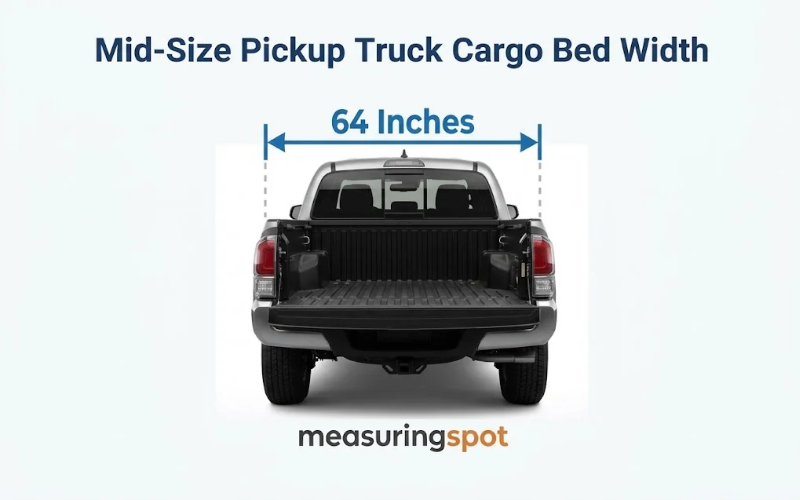
7. Mid-Size Pickup Truck Cargo Bed Width
Vehicle utility relies heavily on standardized cargo bed dimensions. Full-size pickup trucks boast wide beds designed to swallow four-foot sheets of plywood flat between the wheel wells, but mid-size trucks, like the Toyota Tacoma, Ford Ranger, and Chevy Colorado, feature total bed wall-to-wall interior widths right around 60 to 64 inches.
While the space between the wheel wells drops down to roughly 44 inches, the open space near the tailgate and upper bed rails spans roughly 64 inches across. Landscapers and contractors use this upper dimension to determine whether pre-assembled building materials, pipes, or ladders can lie flat across the top rails.
8. Eleven Standard United States Dollar Bills
If you lack a tape measure and need a quick, highly reliable measuring system, reach for paper currency. The United States Bureau of Engraving and Printing manufactures all denominations of modern Federal Reserve notes to uniform dimensions: 6.14 inches long by 2.61 inches wide.
When you lay eleven dollar bills end to end on a flat surface, the combined row measures 67.54 inches, while ten bills equal 61.4 inches. A line of ten bills plus half of an eleventh note reaches 64.47 inches. This wallet-friendly trick gives you a reliable reference point when checking furniture or appliance clearances at garage sales.

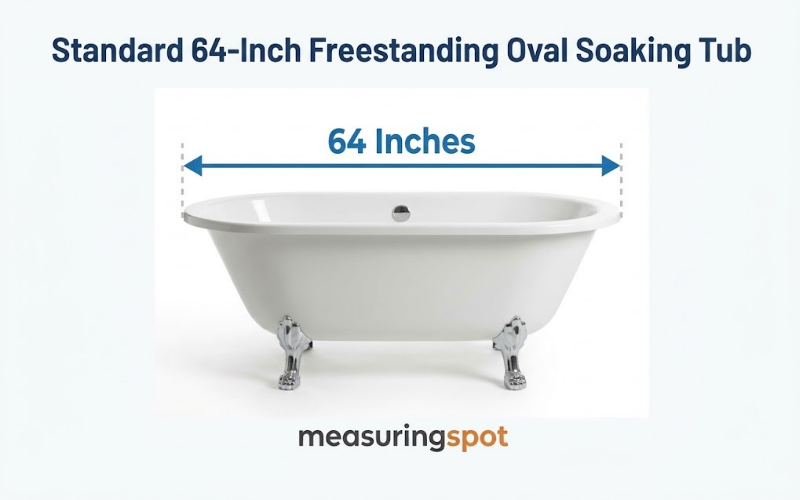
9. A Standard 64-Inch Freestanding Oval Soaking Tub
Bathroom remodeling requires precise spatial planning, particularly when installing freestanding soaking tubs. While compact alcove tubs typically measure 60 inches long, luxury oval freestanding bathtubs frequently measure 64 inches from outer rim to outer rim.
A 64-inch basin allows an adult of average height to recline fully with submerged shoulders without sliding uncomfortably down into the water. Plumbers and bathroom designers view 64 inches as the ideal sweet spot for primary suite bathrooms, delivering luxury ergonomics without overwhelming floor layouts.
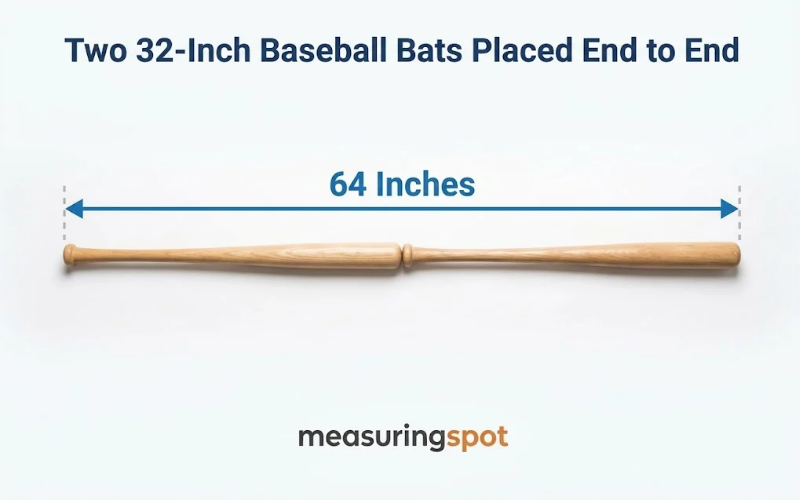
10. A Pair of Standard Baseball Bats Placed End to End
Major League Baseball regulations dictate that professional bats must not exceed 42 inches in length, but the vast majority of adult players swing bats that measure either 32, 33, or 34 inches.
Among high school, college, and recreational adult league hitters, the 32-inch bat remains an enduring standard. Placing two 32-inch adult bats knob-to-barrel in a straight line produces a total span of exactly 64 inches. If you coach youth sports or keep sports gear in your vehicle, two bats give you a rigid yardstick for field layouts and trunk packing.
Practical Applications: When Does 64 Inches Matter?
Understanding the 64-inch dimension helps in several practical scenarios where guesswork leads to headaches:
Furniture Layout and Room Flow
Interior design guidelines recommend maintaining a walking clearance of at least 30 to 36 inches between major furniture pieces. When you position a 64-inch loveseat or television credenza, you must ensure the adjacent walls provide at least 124 inches (roughly 10.3 feet) of continuous run if you plan to flank the piece with side tables or floor lamps.
Doorway and Hallway Clearances
Moving a 64-inch sofa through tight apartment corridors requires careful angling. Most residential interior doors provide clear openings between 30 and 32 inches wide, with ceilings standing at 96 inches (8 feet). Because 64 inches falls well below standard ceiling heights, standing a 64-inch piece upright on one armrest lets movers pivot it through sharp turns without gouging drywall.
Hanging Art and Mirrors
Galleries follow the standard 57-inch to 60-inch eye-level rule when mounting artwork. When hanging a tall 64-inch full-length mirror, positioning the midpoint at approximately 60 inches off the floor allows anyone between 5 feet and 6 feet tall to see their complete reflection from head to toe without crouching.
Frequently Asked Questions About 64 Inches
How many feet and inches are in 64 inches?
There are 5 feet and 4 inches in 64 inches. You calculate this by dividing 64 by 12, which yields 5 with a remainder of 4.
What is 64 inches converted to the metric system?
In metric units, 64 inches converts to 162.56 centimeters, 1,625.6 millimeters, or approximately 1.63 meters. To convert inches to centimeters manually, multiply the inch value by 2.54.
Can a 64-inch item fit in the back of an SUV?
Most mid-size and full-size SUVs easily accommodate a 64-inch item when you fold the second-row seats flat. The cargo floor length behind front bucket seats in vehicles like the Ford Explorer, Jeep Grand Cherokee, or Subaru Outback typically spans between 70 and 75 inches. Always measure the diagonal opening of the rear hatch to ensure the item clears the rear threshold.
Is 64 inches a common height for a refrigerator?
Many standard top-freezer and apartment-sized refrigerators stand between 64 and 66 inches tall. This makes 64 inches a common vertical clearance requirement in older home kitchens where overhead cabinets sit lower than modern construction standards allow.
How many yards is 64 inches?
There are 1.78 yards in 64 inches. Because one yard contains 36 inches, dividing 64 by 36 yields 1.777 recurring yards, or roughly 1 yard, 2 feet, and 4 inches of fabric.
Related Posts
- 10 Common Everyday Things That Are 49 Inches Long
- 10 Common Everyday Things That Are 51 Inches Long
- 10 Common Things That Are 52 Inches Long
- 10 Common Things That Are 53 Inches Long
Conclusion
Recognizing how 64 inches translates into everyday objects eliminates the guesswork from spatial planning. Whether you reference the height of an average woman, the span of a compact loveseat, or two baseball bats placed end to end, these physical markers give you reliable measurements on the spot.
Keeping these benchmarks in mind saves time during home renovations, furniture shopping trips, and vehicle loading. Once you anchor abstract numbers to tangible items in your environment, evaluating clearances and floor plans becomes simple, accurate, and completely tool-free.
FOR MORE MEASUREMENTS VISIT: MEASURINGSPOT