
When someone throws out a measurement like 16 meters, it is easy to nod along while having virtually no mental image of what that looks like in the real world.
Unless you carry a surveyor’s tape measure in your back pocket, metric lengths beyond your own body height get fuzzy fast. Exactly how long is 16 meters, and where do you encounter it in everyday life?
Whether you are trying to estimate property lines, map out an athletic drill, buy materials for a fence, or simply satisfy your curiosity, grounding distance in physical objects makes all the difference.
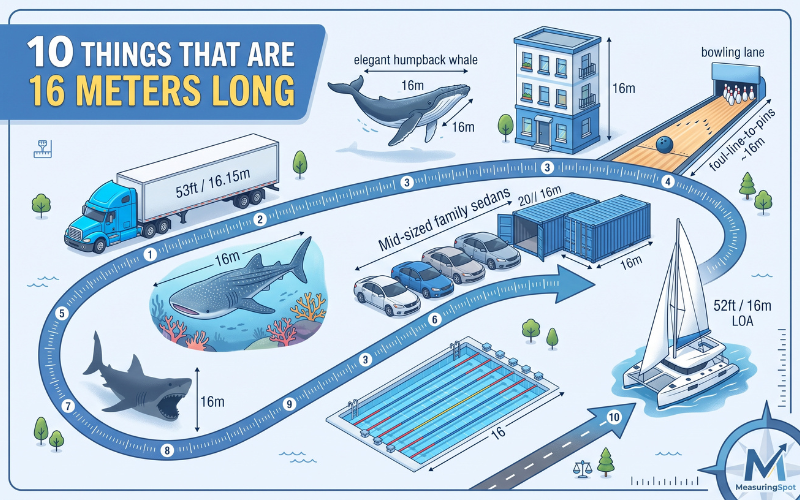
Here is everything you need to know about this specific measurement, complete with conversion benchmarks, visual rules of thumb, and 10 familiar items that measure right around 16 meters from end to end.
Quick Reference: How Long is 16 Meters at a Glance
If you need immediate figures without the math drill:
- In Feet: 52.49 feet (approx. 52 feet, 6 inches)
- In Yards: 17.5 yards
- In Inches: 629.92 inches
- In Centimeters: 1,600 cm
- In Kilometers: 0.016 km
- Average Adult Walking Paces: ~20 to 22 normal strides
- Fast Rule of Thumb: Roughly the length of a standard 53-foot semi-truck trailer or a four-story residential building laid flat on its side.
Understanding the Scale: How Long is 16 Meters?
To understand how long is 16 meters, it helps to convert the distance into both imperial units and everyday human movements.
The Conversion Math
The metric system defines one meter as roughly 3.28084 feet. When you scale that up:
$$16 \text{ meters} \times 3.28084 \text{ ft/m} = 52.4934 \text{ feet}$$
Fifty-two and a half feet puts you right in the middle territory of architectural spaces. It is longer than any single standard room in an ordinary family home, but noticeably shorter than a competition swimming pool or a soccer pitch penalty area.
Visualizing Through Human Movement
If you want to measure out 16 meters right now without equipment, use your feet:
- Paces: An average adult male stride length while walking casually is about 0.76 to 0.79 meters (around 2.5 feet). Counting 21 to 22 steady paces will land you within inches of 16 meters.
- Body Lengths: If an average adult stands roughly 1.75 meters (5 feet 9 inches) tall, laying nine adults head-to-toe covers almost exactly 16 meters (15.75 meters).
- Car Lengths: An average midsize sedan (like a Honda Accord or Toyota Camry) measures about 4.9 meters bumper to bumper. Park a little over three sedans tight together, and you have reached 16 meters.
Quick Comparison Table: The 16-Meter BioWiki
Here is a side-by-side breakdown of 10 common items, animals, and structures that measure right around 16 meters, along with their category, exact metric length, and imperial equivalents.
| Object / Subject | Category | Metric Length | Imperial Length (Feet) | Primary Context |
| 53-Foot Semi-Trailer 🚛 | Transportation / Freight | 16.15 m | 53.0 ft | North American long-haul logistics standard |
| Mature Humpback Whale 🐋 | Marine Biology | 15.0 – 16.5 m | 49.2 – 54.1 ft | Adult female humpback (Megaptera novaeangliae) |
| Four-Story Building Height 🏢 | Architecture | ~14.0 – 16.0 m | 46.0 – 52.5 ft | Ground-to-roof residential urban structure |
| Regulation Bowling Lane 🎳 | Sports Facilities | 18.28 m (Foul to pins: ~16.0 m) | 60.0 ft (Play surface) | Pin deck to foul line active roll area |
| Adult Female Whale Shark 🦈 | Marine Biology | 14.5 – 16.0 m | 47.5 – 52.5 ft | Largest confirmed non-mammalian vertebrate |
| Four Mid-Sized Cars Parked End-to-End 🚗 | Daily Sight | ~16.0 – 16.5 m | 52.5 – 54.0 ft | Standard family sedans parked bumper to bumper |
| Two Standard Shipping Containers (20-Foot) 🚢 | Industrial / Freight | 12.2 m (or 1 × 45-ft + extra) | 52.5 ft (Combined setup) | Intermodal freight logistics |
| Prehistoric Megalodon Shark 🦈 | Paleontology | 15.0 – 16.5 m | 49.0 – 54.0 ft | Estimated average adult apex predator size |
| Half the Length of a Short-Course Pool 🏊 | Recreation / Athletics | 12.5 m (Standard pool width: 15–16 m) | 49.2 – 52.5 ft | Competition pool widths or 8-lane lane lines |
| Large Modern Sailing Catamaran ⛵ | Marine Recreation | 15.5 – 16.2 m | 50.0 – 53.0 ft | 50-to-53-foot offshore cruising catamarans |
10 Common Things That Are Approximately 16 Meters Long
1. A Standard 53-Foot Semi-Truck Trailer
If you have driven on any North American highway, you pass 16-meter objects constantly. The classic long-haul dry van or refrigerated trailer pulled by a tractor unit is manufactured to an industry-standard exterior length of 53 feet, which translates to 16.15 meters.
When thinking about 16 meters, disregard the tractor cab at the front. Focus solely on the cargo box resting on the rear wheel bogie. From the kingpin bulkhead where it connects to the truck down to the swing doors at the back, that entire enclosed rectangular space is just a hair over 16 meters. Standing next to one at a rest stop or loading dock gives you an immediate physical perspective of how far 16 meters stretches horizontally.

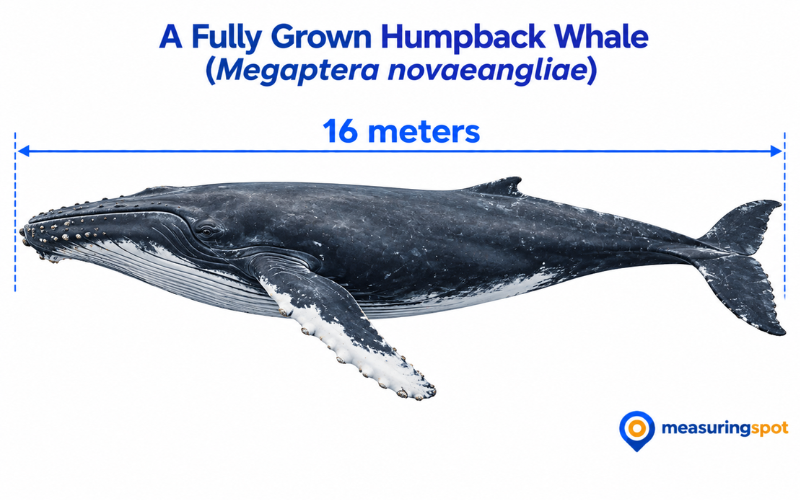
2. A Fully Grown Humpback Whale (Megaptera novaeangliae)
In the marine world, 16 meters is a milestone for baleen giants. While blue whales easily double this length, a mature female humpback whale commonly reaches 15 to 16.5 meters in total body length.
Female humpbacks are slightly larger than males to support gestation and calving. An individual measuring 16 meters can weigh up to 35 to 40 metric tons. If such a whale were placed on a city street, its massive pectoral flippers—which alone measure up to 5 meters each—would stretch across both lanes of traffic, while its body would extend past three full storefront lots.
3. The Height of an Average Four-Story Building
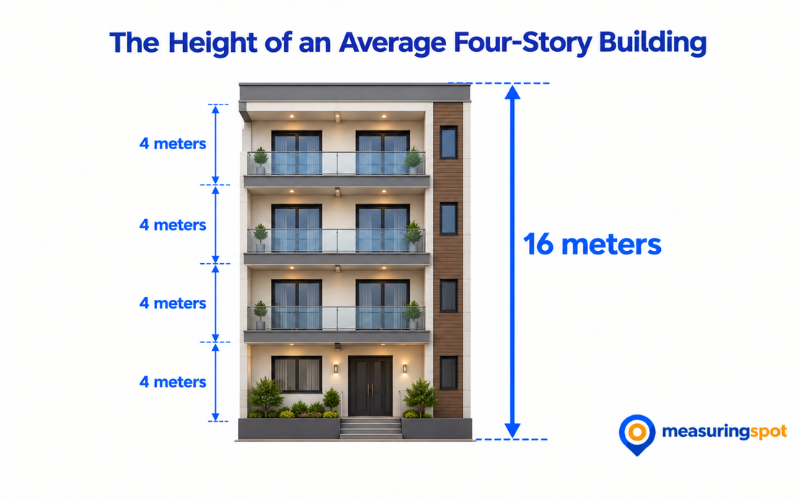
Turn your gaze upward to see 16 meters as vertical elevation. Standard construction codes for modern residential and mixed-use apartments typically design ceiling heights between 2.7 and 3.0 meters per floor, plus floor slabs, joists, and roof parapets that add an extra 0.4 to 0.6 meters per story.
A typical four-story walk-up or mid-rise apartment complex sits between 14.5 and 16.2 meters above street level. Looking down from a fourth-story balcony to the sidewalk below gives an exact sense of what a 16-meter drop or vertical distance represents.
4. A Tenpin Bowling Lane (Foul Line to Headpin)
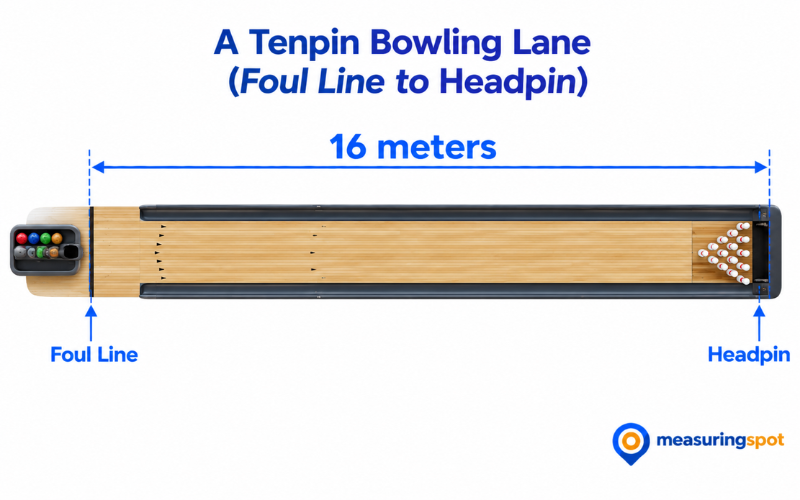
Anyone who has ever rolled a bowling ball has tested their aim across roughly 16 meters of polished maple and pine.
While the total wooden structure of a bowling lane—including the approach area and pinsetter mechanics—spans just over 21 meters, the actual active playing surface from the foul line to the center of the number-one headpin is precisely 60 feet (18.28 meters).
However, if you measure from the foul line to the start of the pin triangle deck, the flat glide path the ball travels through the oil pattern before it hits the pocket is almost exactly 16 meters. The next time you line up a strike shot, you are peering across a 16-meter expanse.
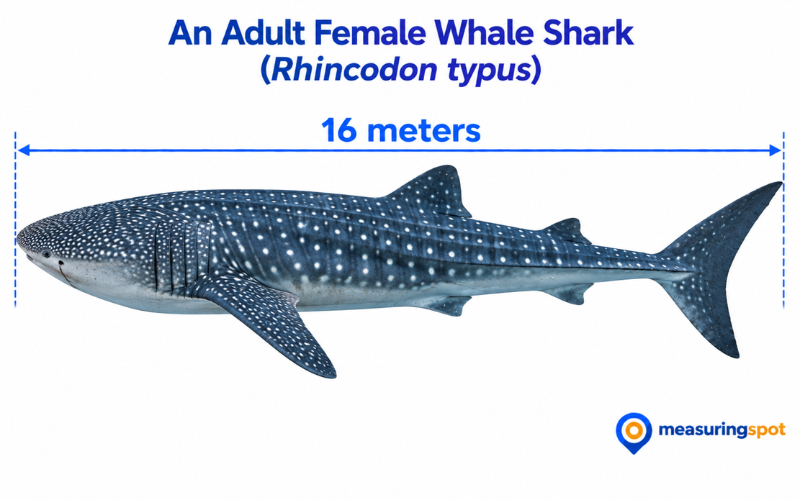
5. An Adult Female Whale Shark (Rhincodon typus)
Whale sharks are the largest living fish in the world’s oceans. While the average juvenile and young adult seen by divers around reefs measures between 8 meters and 10 meters, fully grown, mature females reach up to 15.5 to 16.2 meters in total length.
Encountering an animal of this size in open water is surreal: a 16-meter whale shark possesses a dorsal fin that can rise over a meter into the water column and a mouth opening over 1.5 meters wide. Swimming beside one would take a human several minutes of vigorous kicking just to move from its tail fluke to its snout.
6. Four Mid-Sized Family Sedans Parked Bumper-to-Bumper
Need an everyday benchmark you can see from your front window? Take a look at suburban street parking.
The standard modern four-door midsize family car—such as a Toyota Camry, Honda Accord, or Volkswagen Passat—has an overall vehicle length of approximately 4.88 to 4.92 meters (around 16 feet).
If you park three of these sedans bumper-to-bumper, you get roughly 14.7 meters. Add just one small compact hatchback (like a Mini Cooper or Fiat 500, roughly 3.6 meters) or allow a modest 0.4-meter gap between each car, and four family vehicles in a line span precisely 16 meters. If your house lot has street frontage wide enough for four parked cars, your curb measures approximately 16 meters wide.

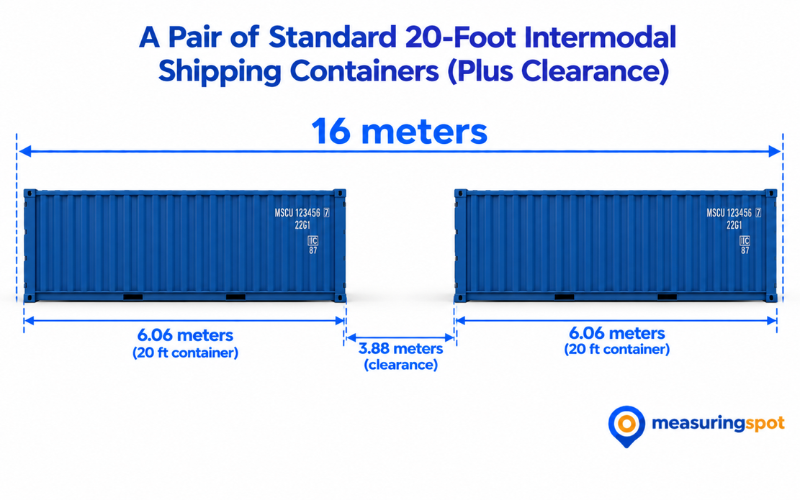
7. A Pair of Standard 20-Foot Intermodal Shipping Containers (Plus Clearance)
Global trade runs on standardized intermodal steel shipping boxes. The standard twenty-foot equivalent unit (TEU) container measures 6.06 meters (20 feet) long, while forty-foot containers measure 12.19 meters.
When logistics yards arrange containers, or when architects build container homes, they frequently work in multi-unit footprints:
- Placing two 20-foot containers end-to-end creates a 12.12-meter line.
- However, when shipping carriers stack a 45-feet high-cube container (13.7 meters) with service walkway buffers, or combine a standard 40-feet box with a mini storage pod, the operational footprint lands squarely at 16 meters.
- In container modular construction, three 20-foot units staggered with entry porches create a classic 16-meter residential frontage.
8. The Upper Estimated Size of the Prehistoric Megalodon (Otodus megalodon)
Few extinct creatures capture human imagination quite like Otodus megalodon, the massive neogene shark that ruled prehistoric oceans.
While pop culture movies often exaggerate its size to absurd proportions (claiming 25 to 30 meters), evolutionary biologists and marine paleontologists calculate the real biological ceiling of adult female Megalodons based on tooth enamel height and vertebral centra:
- Most adult specimens averaged between 14.2 and 15.3 meters.
- The very largest individuals, representing the absolute apex of the species, reached estimated lengths of 16.0 to 16.5 meters.
At 16 meters, a Megalodon was long enough that its jaws could easily swallow an entire modern great white shark whole, with teeth measuring over 7 inches (18 cm) diagonally.

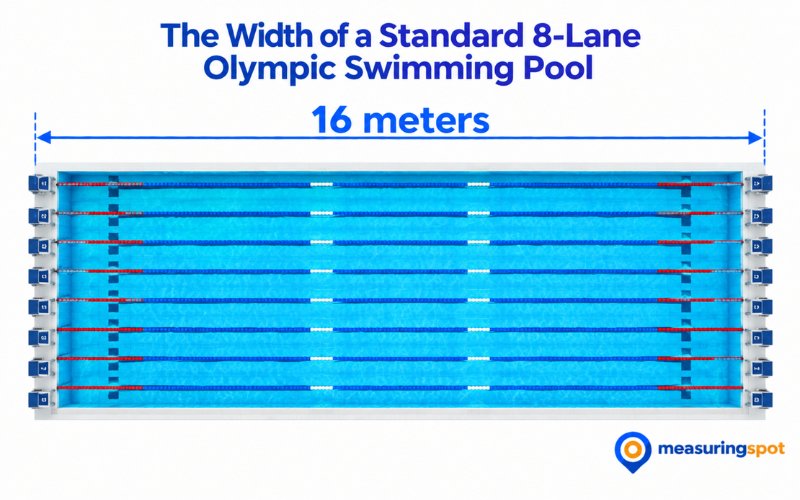
9. The Width of a Standard 8-Lane Olympic Swimming Pool
While everyone knows an Olympic racing pool is 50 meters in length and a short-course pool is 25 meters, few people think about the width across the water.
World Aquatics (formerly FINA) rules dictate that competition pools must provide individual lane widths of 2.5 meters, along with buffer spaces on the outer margins. In many multi-purpose municipal competition aquatic centers, a standard 6-to-8 lane setup results in a pool deck-to-deck water width between 15.0 and 16.0 meters.
If you stand on the side edge of a community competition pool and look across the lane dividers to the opposite deck, you are gazing across a span of 16 meters.
10. A 52-Foot Blue-Water Cruising Catamaran
In maritime recreation, luxury sailing catamarans designed for transatlantic crossings and offshore living are commonly categorized by feet in the 50-to-55 range.
Models like the Lagoon 52 or the Fountaine Pajot Aura 51 feature a hull length overall (LOA) measuring 15.8 to 16.2 meters. These vessels feature twin hulls connected by an expansive bridgedeck salon. Stepping aboard from the stern sugar-scoop swim platform and walking forward past the helm, trampoline nets, and forward cockpit to the bow crossbeam covers 16 full meters of deck space.

Practical Applications: When Does 16 Meters Matter?
Understanding 16 meters is not just an academic exercise; it plays an active role across several practical fields:
Residential Property & Zoning
In suburban land planning, lots are frequently subdivided into metric increments. A standard medium-density urban lot often features a frontage or backyard depth between 15 meters and 18 meters. Knowing how to gauge 16 meters helps prospective home buyers immediately understand setbacks, garden lines, and how much fencing is needed without unrolling a tape.
Fire Safety & Evacuation
Building safety codes in many jurisdictions dictate that dead-end corridors in commercial structures should not exceed approximately 15 to 16 meters before occupants reach a branch toward an emergency exit staircase. This ensures that someone moving through low-visibility conditions is never more than 20 to 22 steps away from a life safety route.
Heavy Vehicle Maneuvering
Urban planners and highway engineers design roundabouts, delivery bays, and intersection turning radiuses based on the tracking paths of 16-meter tractor-trailers. If a road cannot accommodate a swept turn of 16 meters, heavy freight transport cannot legally service the retail businesses along that corridor.
Frequently Asked Questions (FAQs)
How long does it take to walk 16 meters?
At an average human walking speed of roughly 1.4 meters per second (around 5 km/h or 3.1 mph), walking 16 meters takes approximately 11 to 12 seconds. If you are jogging or sprinting, you can cover this distance in under 3 to 4 seconds.
How many steps is 16 meters?
For an adult of average height (around 5 ft 9 in or 175 cm), a natural walking step or pace is roughly 0.75 to 0.78 meters. You will cover 16 meters in approximately 20 to 22 normal steps.
Is 16 meters longer than a school bus?
Yes. A typical full-size Type D American school bus measures between 10.7 and 12.2 meters (35 to 40 feet) long. A 16-meter line is significantly longer—you would need a school bus plus an additional compact car parked behind it to reach 16 meters.
How many square meters is a 16-meter square?
If you have a square area where every side measures 16 meters, you calculate the area by multiplying length by width ($16 \text{ m} \times 16 \text{ m}$). This equals 256 square meters (or 2,755.5 square feet), which is roughly the total interior living space of a spacious four-bedroom suburban house.
What sports use a 16-meter distance?
- Field Hockey: The defensive clearance line from the backline is known formally as the “16-yard hit,” which is officially standardized in metric rules as 14.63 meters (often loosely rounded in conversation).
- Football (Soccer): The standard penalty area (18-yard box) extends 16.5 meters forward from the goal line into the pitch. When a goalkeeper commands their penalty area, they control a 16.5-meter zone from their line.
Related Posts
- 10 Everyday Things That Measure 8 Meters Long/ Tall
- 10 Everyday Things That Measure 7 Meters Long/ Tall
- 10 Everyday Things That Measure 6 Meters Long/ Tall
- 10 Common Things That Are 5 Meters Long/ Tall
Conclusion
Getting a clear mental picture of how long is 16 meters comes down to anchoring the number to things you already know: picture a 53-foot highway semi-trailer, the glide of a bowling ball down the lane, or four standard family sedans parked nose to tail along a curb. At roughly 52.5 feet or about 21 brisk human strides, it is an accessible distance that bridges the gap between everyday living spaces and commercial-scale architecture. Whether you are mapping out a backyard boundary, reviewing building blueprints, or estimating highway freight clearances, keeping these real-world comparisons in mind makes evaluating 16 meters simple, accurate, and completely intuitive.
FOR MORE MEASUREMENTS VISIT: MEASURINGSPOT