

Fifty meters sounds straightforward on paper, but estimating that distance in open space often tricks the human eye. Unless you spend your weekends pacing out construction sites or swimming competitive laps, metric measurements can feel abstract.
When people ask how long is 50 meters, they are usually looking for practical reference points. Grounding distance in everyday objects helps your brain instantly map size, scale, and travel time without reaching for a tape measure.
Whether you want to visualize a track sprint, plan an outdoor project, or satisfy pure curiosity, this guide breaks down 50 meters using ten everyday objects, landmarks, and animals you can easily picture.
Quick Answer: How Long is 50 Meters?
Fifty meters equals 164.04 feet, 54.68 yards, or roughly 0.031 miles.
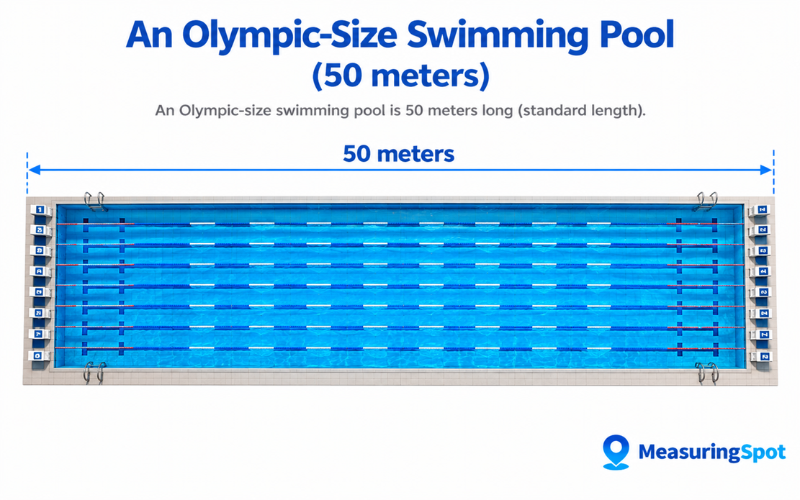
If you want an instant mental picture, 50 meters is the exact length of an Olympic-size competition swimming pool.
It is also equivalent to:
- Half the length of a standard 100-meter track sprint
- Just over half of an American football field (including end zones)
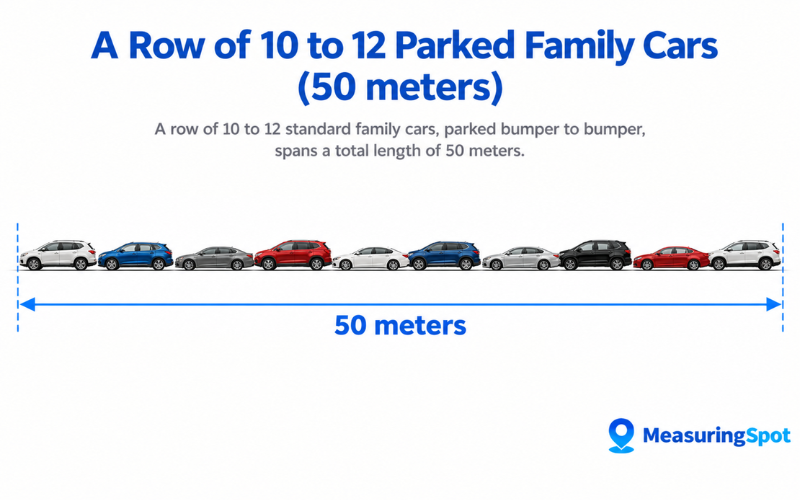
- Roughly 10 to 12 family sedans parked bumper to bumper
- About 60 to 70 normal walking steps for an average adult
Metric to Imperial Fast Facts (BioWiki Reference)
| Metric / Attribute | Measurement / Equivalent | Practical Context |
| Standard Length | 50 meters (50 m) | Base measurement unit |
| Feet | 164.042 feet | 164 ft 0.5 in |
| Yards | 54.681 yards | A little over half a football pitch |
| Inches | 1,968.5 inches | Total linear inches |
| Miles | ~0.031 miles | Fractions of a roadway mile |
| Human Steps | ~65 walking paces | Based on an average 30-inch stride |
| Walking Time | ~35 to 40 seconds | Casual walking speed (5 km/h or 3.1 mph) |
| Sprinting Time | ~6 to 8 seconds | Fast human running speed |
| Sound Travel Time | ~0.145 seconds | Speed of sound at sea level (20°C) |
1. An Olympic-Size Swimming Pool
The single most universally recognized benchmark for 50 meters is an Olympic competition pool. World Aquatics regulations mandate that long-course pools measure exactly 50.0 meters from touch pad to touch pad.
Why the Swimmer’s View Matters
When standing on the starting block, looking down a 50-meter lane gives you an exact perspective of what 164 feet looks like across open water. Elite freestyle sprinters can cross this distance in roughly 21 to 24 seconds, while recreational swimmers generally take anywhere between 40 to 60 seconds per lap. If you have ever watched the Summer Olympics or swum in a community sports center, you have looked directly at a 50-meter marker.
Dimensional Breakdown
- Length: 50.0 meters (164 feet)
- Standard Width: 25.0 meters (82 feet)
- Total Water Volume: Approximately 2.5 million liters (over 660,000 gallons)
2. A Row of 10 to 12 Parked Family Cars
Vehicles offer one of the easiest tools for sizing up streets and parking structures because you interact with them daily.
Sizing Up Standard Sedans
A typical mid-sized family car—such as a Toyota Camry, Honda Accord, or Ford Fusion—measures roughly 4.8 to 4.9 meters from the front bumper to the rear exhaust. If you park ten of these sedans end-to-end with normal street-parking gaps of roughly 30 centimeters to 40 centimeters between them, you hit the 50-meter mark almost on the nose.
Compact vs. Full-Size Layouts
If you look at smaller compact hatchbacks like a Volkswagen Golf (around 4.3 meters long), you need roughly 11 or 12 cars lined up bumper to bumper. For large pickup trucks like a Ford F-150 SuperCrew (close to 5.9 meters), eight vehicles span the exact same distance.
3. Half of a Canadian or American Football Field
Sports fields serve as universal yardsticks because their lines provide clear visual boundaries.
Breaking Down the Gridiron
An American football field measures 120 yards in total length, which includes both 10-yard end zones, or 100 yards of active playing turf. Converted to metric, 100 yards equals 91.44 meters.
Fifty meters works out to 54.68 yards. If you look at an NFL or college football field, starting at one back end-line and looking across to the opposing 45-yard line puts you almost precisely at 50 meters.
The Yard-Line Cheat Sheet
- Goal line to opposite 45-yard line: ~50.3 meters
- 50-yard line to goal line (plus half an end zone): ~50.2 meters
- Center of midfield to back of either end zone: ~55 meters

4. Half the Wingspan of the Spruce Goose (Hughes H-4 Hercules)
Aviation creates astonishing scales that push human perception. The Hughes H-4 Hercules, famously nicknamed the “Spruce Goose,” held the record for the largest wingspan of any aircraft for over seven decades.
Wingtip to Centerline
The Spruce Goose boasts an overall wingspan of 97.54 meters (320 feet 11 inches). If you stand directly underneath the center fuselage of this massive wooden flying boat and walk out along one single wing to its tip, you cover approximately 48.8 meters.
That single wing structure comes within arm’s reach of the full 50-meter target, illustrating just how colossal twentieth-century aviation engineering really was.

5. The Arc de Triomphe (Vertical Height)
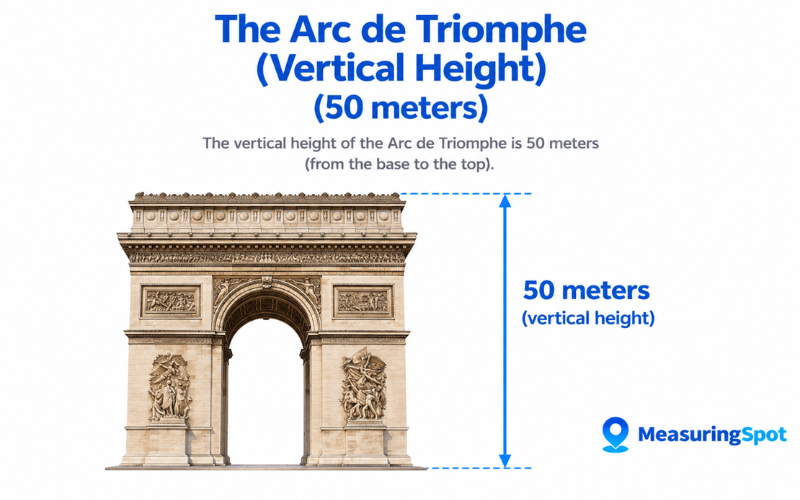
Fifty meters does not merely run flat along the ground; looking upward at vertical structures changes how height hits your senses. Paris’s famous Arc de Triomphe provides one of the cleanest architectural examples of 50 meters in height.
Architectural Scale in Paris
Commissioned by Napoleon Bonaparte to honor French military victories, the monumental triumphal arch stands 50 meters tall, 45 meters wide, and 22 meters deep.
When you stand at the base of the monument on the Place Charles de Gaulle, looking straight up toward the top balustrade gives you the exact sensation of 50 vertical meters. Pedestrians climbing the 284 interior stairs to reach the panoramic roof terrace ascend that exact 164-foot vertical rise.
6. The Height of the Leaning Tower of Pisa (Low Side)
Historic bell towers throughout Europe often fall close to the 50-meter bracket. The world-famous Leaning Tower of Pisa in Tuscany, Italy, fits the description directly.
The Geometry of a Tilt
Because the tower settled unevenly into unstable subsoil during construction, its height varies depending on which side you measure:
- High side: 56.67 meters (185.9 feet)
- Low (sunken) side: 55.86 meters (183.3 feet)
- Foundation to base rim: Sits right around 50 meters above the surrounding piazza lawn level.
When tourists walk along the lower outer arc of the tower’s foundational marble columns, they are looking up at slightly over 50 meters of tilted masonry and Romanesque arches.

7. Two Full-Grown Adult Blue Whales Lined Up
The blue whale (Balaenoptera musculus) is the largest known animal ever to exist on Earth, far eclipsing even the most massive sauropod dinosaurs in overall bulk.
Sizing Up Marine Giants
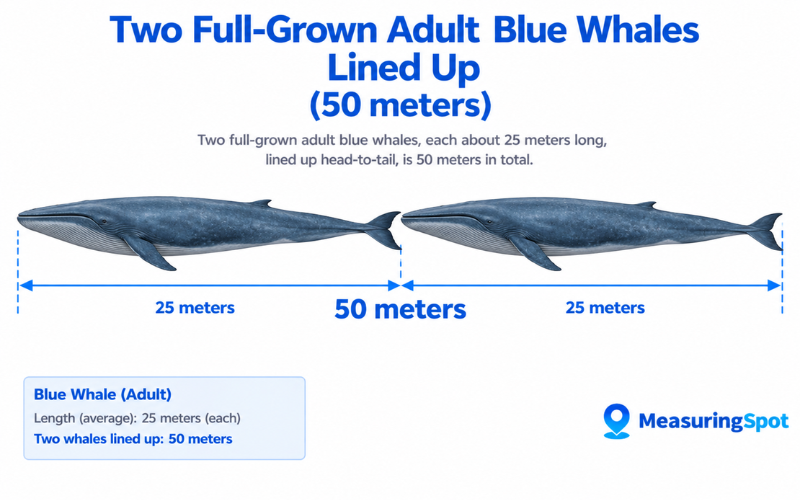
Mature blue whales can reach lengths of 24 to 27 meters (80 feet to 90 feet), with rare Antarctic females measuring slightly past 30 meters.
If you place two mature 25-meter blue whales nose-to-tail, their combined bodies stretch the entire length of a 50-meter zone. A human swimmer would have to cross both colossal ocean mammals from fluke to snout just to cover this distance.
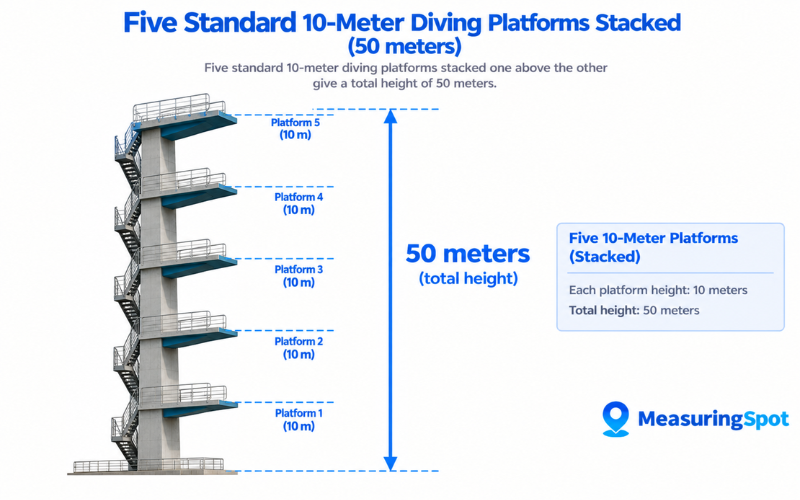
8. Five Standard 10-Meter Diving Platforms Stacked
Anyone who has stepped onto a competitive aquatic diving board remembers how high the top tier feels. High-diver platforms stand at precise heights determined by international competitive codes.
Vertical Multipliers
The highest Olympic diving board platform sits at exactly 10 meters (32.8 feet) above the water surface.
- Two 10-meter platforms equal a 20-meter drop.
- Stacking five of these 10-meter competition diving towers on top of one another totals exactly 50 meters.
Looking down from a 50-meter vertical cliff into the water below means looking down at five times the height of the scariest platform at an Olympic aquatic center.
9. A Train of 2.5 Standard North American Rail Boxcars
Freight trains run across every continent, carrying raw materials and consumer goods. While modern rail cars vary based on their freight purpose, standard boxcars follow strict manufacturing guidelines.
Freight Car Dimensions
In North America, standard boxcars typically measure 50 feet to 60 feet in exterior length (roughly 15.2 to 18.3 meters).
- 50-foot boxcar: Exactly 15.24 meters long.
- Three 50-foot boxcars coupled together stretch roughly 46 to 48 meters, including couplers.
- If you look at modern 60-foot high-cube boxcars (18.3 meters), roughly two and a half cars hooked together match 50 meters of heavy steel rail stock.
The next time you wait at a railroad crossing, watch two and a half boxcars pass the signal lights; that split-second stretch marks out 50 meters of train line.

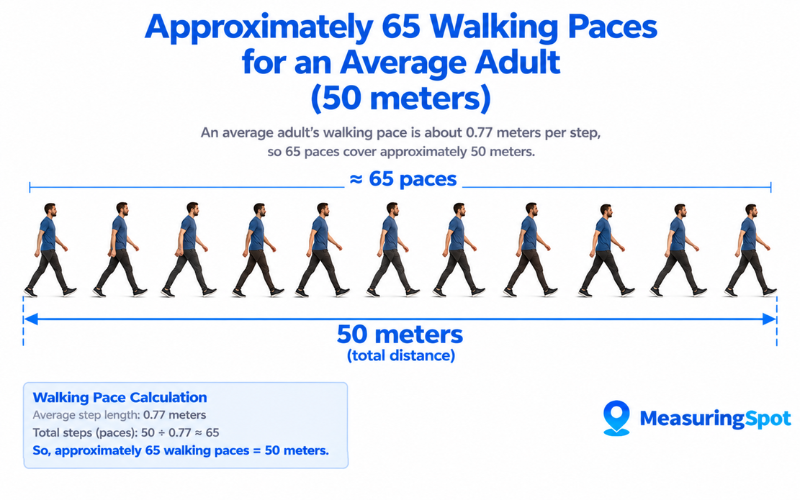
10. Approximately 65 Walking Paces for an Average Adult
Sometimes you do not have landmarks, swimming pools, or parked cars around you. When evaluating land plots, sports fields, or construction yards, your own feet become your best measurement tool.
Calculating Human Stride Length
An average adult man has a walking stride length (the distance from the heel strike of one foot to the heel strike of the opposite foot) of roughly 78 centimeters (30.7 inches). An average adult woman has a stride length of roughly 70 centimeters (27.5 inches).
| Height Group | Average Pace / Stride | Steps to Hit 50 Meters |
| Shorter Stature (5’0″ – 5’4″) | 65 cm (25.5 in) | ~75 to 77 steps |
| Average Stature (5’5″ – 5’10”) | 74 cm (29.1 in) | ~67 to 68 steps |
| Taller Stature (5’11” – 6’3″+) | 82 cm (32.2 in) | ~60 to 62 steps |
If you step out at a natural, steady pace without overstriding, counting roughly 65 paces gets you remarkably close to a true 50-meter line.
How Fast Can You Cross 50 Meters?
Realizing how quickly an animal, athlete, or machine covers 50 meters provides a practical sense of momentum and velocity.
Human Running Speeds
World-record sprinters like Usain Bolt hit top running speeds exceeding 44 km/h (27.7 mph). During his 100-meter sprint records, Bolt regularly crossed the intermediate 50-meter mark in roughly 5.5 to 5.6 seconds from a static start block. An athletic amateur running a basic 40-yard dash covers an equivalent 50-meter sprint in roughly 6.5 to 8.0 seconds.
Animals and Acceleration
- Cheetah: Hits 50 meters from a dead stop in roughly 2.5 seconds, reaching full highway speed midway through.
- Greyhound: Blasts through 50 meters in roughly 3.2 seconds.
- Thoroughbred Racehorse: Gallops across 50 meters in roughly 3.0 to 3.5 seconds at race pace.
Everyday Travel Rates
- City Driving (50 km/h / 31 mph): Your car eats up 50 meters in just 3.6 seconds.
- Highway Speed (100 km/h / 62 mph): Your vehicle covers 50 meters in a brief 1.8 seconds. This rapid travel time explains why defensive driving courses suggest leaving at least three to four seconds of space behind the vehicle in front of you.
Practical Applications: When You Need to Know 50 Meters
Understanding 50 meters helps in plenty of practical real-world situations outside of school science tests.
1. Suburban Land Surveying and Real Estate
Many rural building parcels, suburban road setbacks, and public easements measure in round metric numbers. Knowing that 50 meters spans roughly 164 feet allows property owners to gauge boundary lines, fence lines, and pasture runs without unrolling long surveyor tapes across dirt terrain.
2. Drone Flights and Local Aviation Laws
Aviation authorities worldwide impose line-of-sight and clearance rules on civilian drone pilots. Many municipal drone codes restrict flying within 30 to 50 meters of buildings, busy roads, or uninvolved bystanders. Recognizing this distance from the ground prevents hefty fines and collisions.
3. Sports Coaching and Field Setup
Soccer coaches, track trainers, and fitness boot camps frequently lay out agility grids, hill intervals, and shuttle runs. If you lack marker flags, pacing out roughly 65 long walking steps lets you build an accurate 50-meter shuttle course in minutes.
Frequently Asked Questions
How many feet are in 50 meters?
Fifty meters equals precisely 164.042 feet. In imperial construction notation, that converts to 164 feet and one-half inch.
Is 50 meters the same as 50 yards?
No. Fifty meters is longer than 50 yards. One yard equals 0.9144 meters, meaning 50 meters equals 54.68 yards. When running or measuring 50 meters, you travel roughly 4.7 yards (14 feet) further than you would in a 50-yard dash.
How many steps does it take to walk 50 meters?
For an adult of average height walking at a natural pace, 50 meters takes roughly 65 to 70 steps. Taller individuals with longer legs can cover it in about 60 steps, while shorter walkers may need 75 steps.
How many seconds does it take to walk 50 meters?
At a standard casual walking speed of 5 kilometers per hour (3.1 mph), an adult covers roughly 1.4 meters per second. This means you will walk 50 meters in approximately 35 to 37 seconds.
How high is a 50-meter building?
A standard residential or commercial building floor averages roughly 3 to 3.5 meters in height (accounting for slab thickness, ceiling plenums, and ducts). Therefore, a 50-meter building typically stands between 14 and 16 stories high.
Gaining an intuitive grasp of physical distances saves time and sharpens your spatial judgment. The next time you try to determine how long is 50 meters, you do not have to guess or rely on complex formulas.
Look at a long-course Olympic pool, count roughly a dozen parked cars along the sidewalk, or walk out 65 natural paces across an open lawn. These simple real-world baselines turn dry metric numbers into reliable measurements you can use anywhere.
Related Post
- 10 Common Things That Are 30 Meters Long / Tall
- 10 Everyday Things That Are 20 Meters Long/ Tall
- 10 Common Things That Are 19 Meters Long/ Tall
- 10 Everyday Things That are 18 Meters Long/ Tall
Conclusion
Gaining an intuitive grasp of physical distances saves time and sharpens your spatial judgment in everyday life. Whether you are mapping out property boundaries, planning a sprint workout, or gauging clearance for a project, the metric number becomes far easier to navigate once you tie it to real-world objects.
The next time you want to evaluate how long is 50 meters, you do not have to pull out a tape measure or rely on conversion formulas. Simply call up familiar benchmarks: look down the lane of an Olympic swimming pool, glance at a row of ten parked sedans, or pace out roughly 65 walking steps across the grass.
Connecting abstract units to concrete landmarks keeps measurements simple and practical. Keep these reference points in mind, and you can size up any 50-meter span instantly, accurately, and without second-guessing yourself.
FOR MORE MEASUREMENTS VISIT: MEASURINGSPOT