
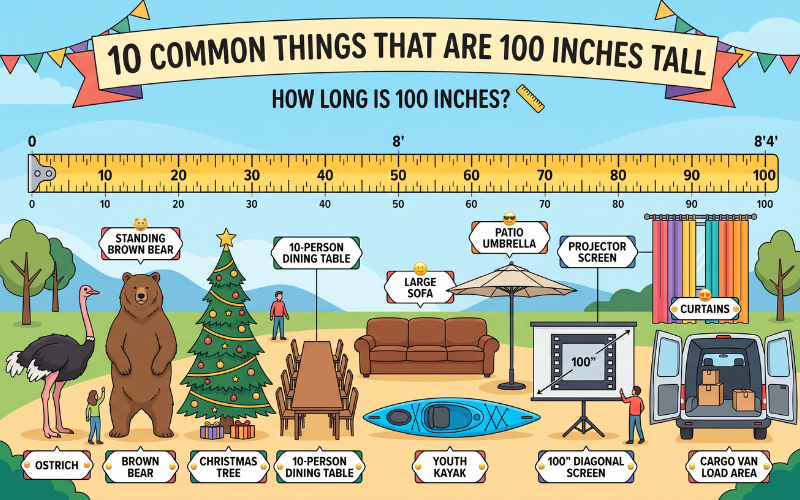
Have you ever tried to estimate the size of an object just by looking at it? We often use feet or meters when talking about large items, but inches can give us a much more precise measurement. When a number hits triple digits, it can be hard to visualize. So, what exactly does a 100-inch measurement look like in the real world? 📏
In this article, we will look at everyday items, animals, and household objects that hit this exact measurement. Whether you are buying furniture, planning a room layout, or just trying to satisfy your curiosity, having a visual reference makes a huge difference.
Quick Facts Summary ⚡
Before we list the specific items, here is a quick section highlighting the basics of this measurement:
- In feet: 100 inches is equal to 8 feet and 4 inches.
- In centimeters: 100 inches converts exactly to 254 centimeters.
- In meters: It is exactly 2.54 meters.
- In yards: It is roughly 2.77 yards.
- Practical application: Knowing this measurement helps with buying oversized furniture, determining ceiling clearance, and renting moving trucks.
How Long is 100 inches?
If you do not have a tape measure handy, it can be frustrating to figure out spatial requirements. So, exactly how long is 100 inches when compared to average human traits?
The average adult male in the United States is about 5 feet 9 inches tall, which is 69 inches. To reach 100 inches, you would need to stack an average man and then add another 31 inches—which is roughly the height of a standard kitchen counter. Another way to think about it is by looking at a standard interior door. Most residential doors are 80 inches tall. If you took a standard door and added 20 inches (about the length of two standard rulers end-to-end), you would reach the 100-inch mark.
For sports fans, think of a basketball hoop. The rim sits at 120 inches (10 feet) above the floor. If you drop down 20 inches from the rim, you are looking right at 100 inches. Using these mental shortcuts makes it much easier to estimate space without needing a ruler in your pocket. 🏀
Biowiki Table: Quick Reference Guide 📊
Here is a helpful biowiki table that breaks down the 10 items we will cover, detailing their exact dimensions and common categories.
| Item / Subject | Category | Average Size / Height | Notes |
| 10-Person Dining Table | Furniture | 100 inches long | Seats 4 on each side, 1 on each end. |
| Recreational Youth Kayak | Sports & Outdoors | 100 inches long | Designed for stability and flat water. |
| Retail Window Curtains | Home Decor | 100 inches tall | Standard size for rooms with high ceilings. |
| Large Three-Seat Sofa | Furniture | 100 inches wide | Often includes wide armrests and deep seats. |
| Outdoor Patio Umbrella | Garden | 100 inches tall | Measured from the base to the top finial. |
| Adult Male Ostrich | Animal | 100 inches tall | The tallest living bird species on Earth. |
| Projector Screen (Diagonal) | Electronics | 100 inches diagonal | Popular size for home theater setups. |
| Standing Brown Bear | Animal | 100 inches tall | When standing fully upright on hind legs. |
| Large Christmas Tree | Holiday Decor | 102 inches tall | Usually sold as 8.5 feet (close to 100 inches). |
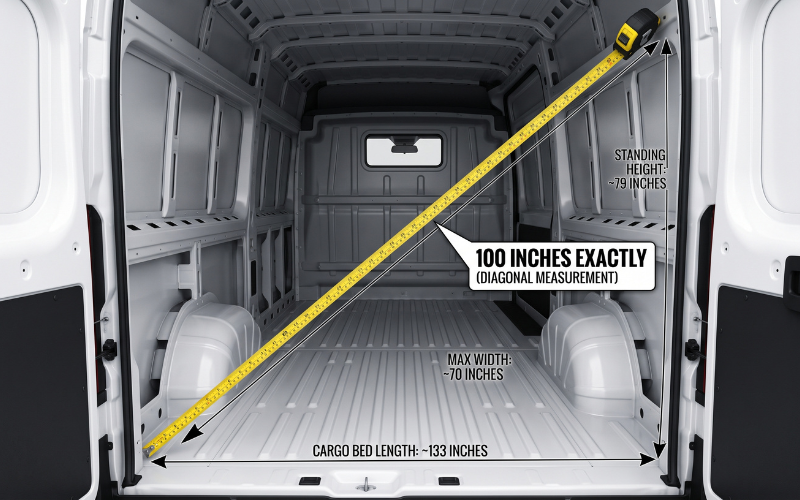
| Cargo Van Load Area | Vehicles | 100 inches long | Standard interior floor length for moving vans. |
10 Things That Measure 100 Inches
Now let’s look at the specific items that naturally hit this triple-digit measurement. You have likely interacted with many of these objects without ever realizing exactly how big they are.
1. A 10-Person Dining Room Table 🍽️
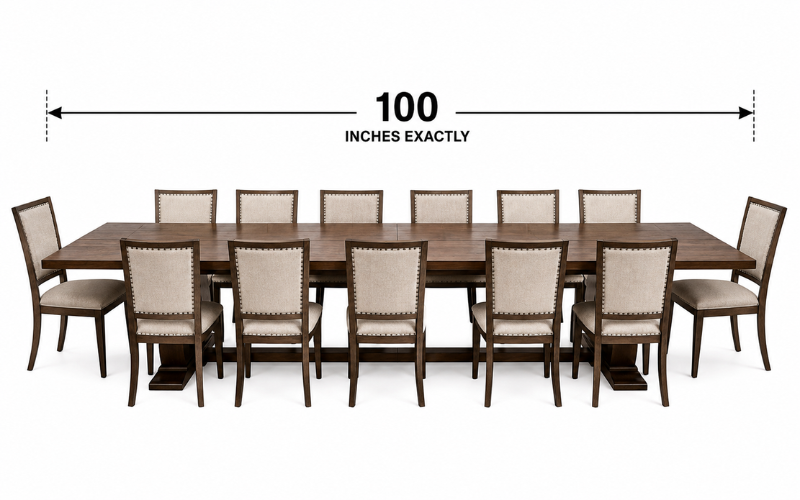
When shopping for dining room furniture, table length is the most important factor for seating capacity. A standard rectangular dining table designed to seat 10 people comfortably is almost always 100 inches long.
This specific length allows for four chairs to be placed along each of the long sides, with one chair at each head of the table. Furniture makers rely on this measurement because each seated adult requires about 24 inches of elbow room. Four people times 24 inches equals 96 inches. The remaining four inches account for the table legs and structural overhang. If you are ever at a large dinner party sitting at a long wooden table, there is a very high chance you are eating off a 100-inch surface.
2. A Recreational Youth Kayak 🛶
Water sports equipment comes in highly specific sizes based on the weight and skill level of the user. While adult touring sea kayaks can stretch up to 14 or 16 feet, a standard recreational kayak meant for youth or smaller adults is often exactly 100 inches long (8 feet 4 inches).
Manufacturers choose this length for entry-level boats because it provides the perfect balance of tracking (the ability to paddle in a straight line) and maneuverability. A 100-inch kayak is also incredibly practical for storage. It is short enough to stand vertically in a standard garage with a 9-foot ceiling, and it easily fits into the bed of a pickup truck with the tailgate down.

3. Custom Retail Window Curtains 🪟
Window treatments are heavily standardized in the home decor industry. If you walk into a home goods store, you will typically see curtain panels sold in lengths of 63 inches, 84 inches, 96 inches, and 108 inches. However, 100-inch curtains are a highly sought-after custom retail size for modern homes.
Many newer homes are built with 9-foot (108-inch) ceilings. Interior designers often recommend hanging curtain rods a few inches below the ceiling line rather than right above the window frame to make the room feel taller. A 100-inch curtain panel drops perfectly from a high rod down to the floor without puddling too heavily, creating a clean, tailored look.

4. A Large Three-Seat Sofa 🛋️
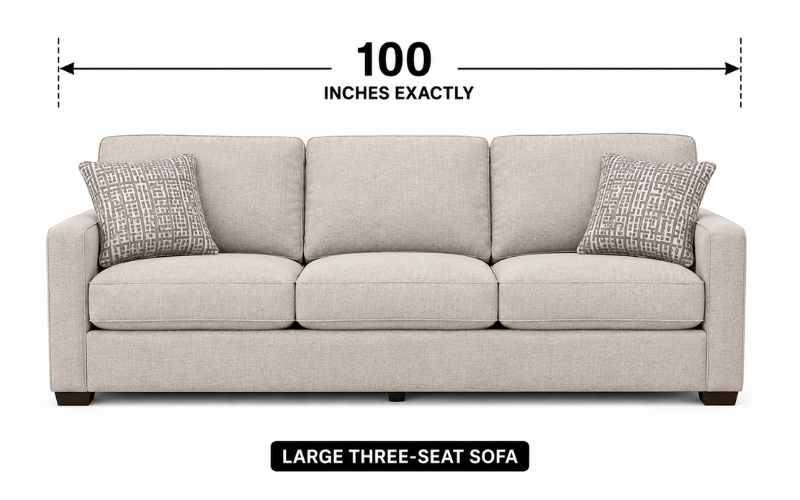
Sofas come in all shapes and configurations, but a large, oversized three-seat sofa frequently hits the 100-inch mark from armrest to armrest.
Standard sofas usually measure around 84 inches. But when you move into the “grand” or “oversized” furniture categories, the dimensions expand. A 100-inch sofa provides roughly 80 inches of seating space (divided into three large cushions) plus two 10-inch bulky armrests. This size is ideal for napping, as even a tall adult can lie down completely flat without their feet hanging over the edge. Moving a 100-inch couch can be difficult, which is why they are usually placed in large, open-concept living rooms.
5. A Standard Outdoor Patio Umbrella ⛱️
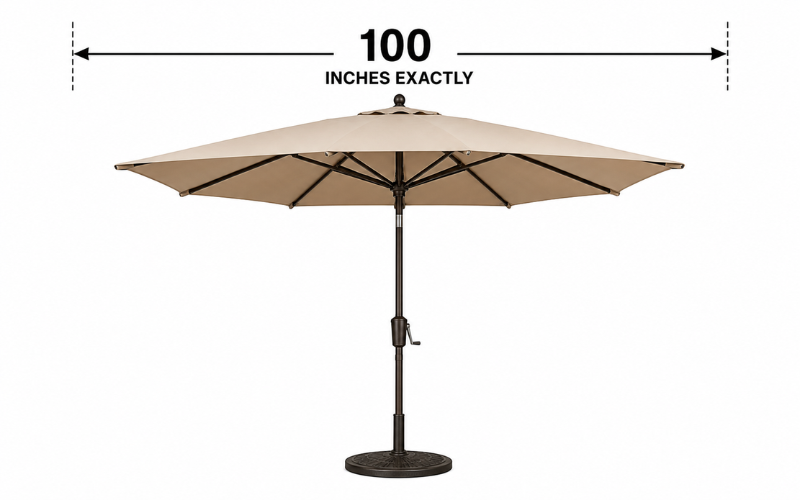
If you have a backyard setup with a dining table and an umbrella in the center, you are likely looking at an object that is 100 inches tall.
Standard market umbrellas usually have an 8-foot or 9-foot canopy diameter, but the actual center pole height is frequently capped right around 100 inches (8 feet 4 inches). This specific height serves two practical purposes. First, it is tall enough that even the tallest adults can stand up and walk under the edges of the canopy without hitting their heads. Second, it is short enough to remain structurally stable in windy conditions. If the pole were much taller, the umbrella would act like a sail and snap under wind pressure.
6. An Adult Male Ostrich 🦅
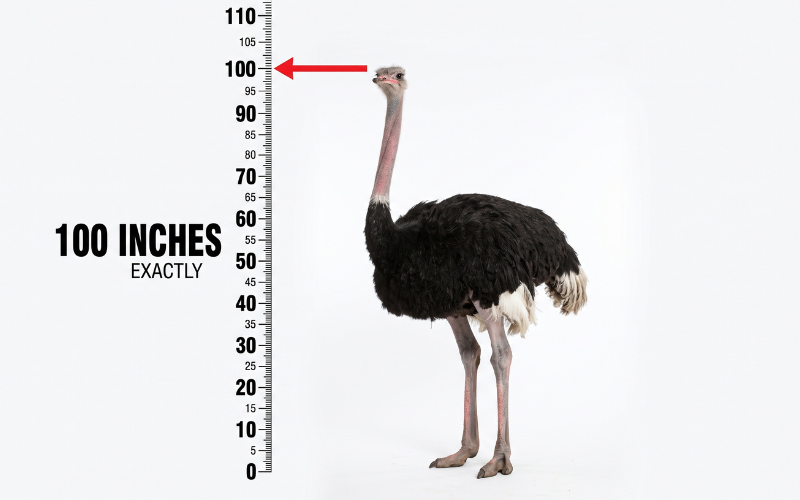
Moving away from household objects, let’s look at the animal kingdom. The ostrich is the largest and heaviest living bird in the world. An adult male ostrich typically stands right around 100 inches tall (8 feet 4 inches).
A large portion of this height comes from their incredibly long legs and elongated necks. Their legs alone can be 4 feet long, allowing them to cover 10 to 16 feet in a single stride when running. They can reach speeds of up to 43 miles per hour. While females are generally a bit shorter, a fully grown male observing its surroundings in the African savanna is a perfect natural representation of a 100-inch height.
7. A 100-Inch Diagonal Projector Screen 🍿
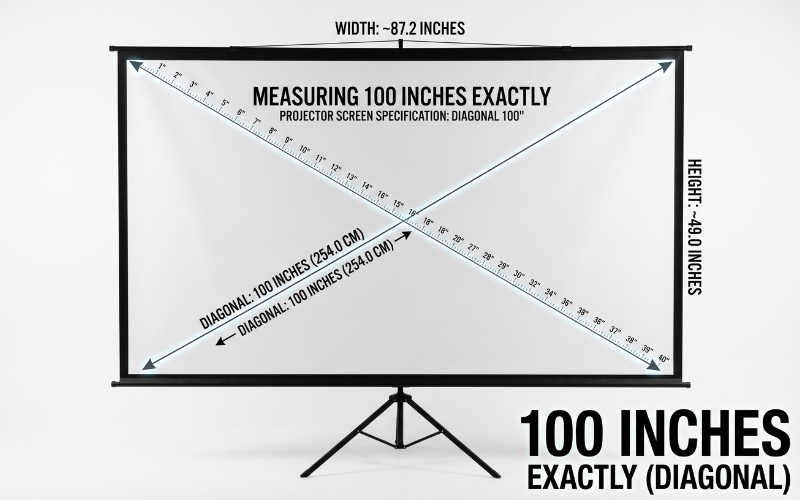
When we talk about electronics, measurements change slightly. A 100-inch projector screen does not measure 100 inches in width or height; instead, the 100 inches refers to the diagonal measurement from one corner to the opposite corner.
Despite this technicality, it is one of the most common 100-inch items consumers buy. For a standard 16:9 aspect ratio (widescreen), a 100-inch diagonal screen is roughly 87 inches wide and 49 inches tall. This size is considered the “sweet spot” for home theaters because it provides a massive cinematic experience while still fitting comfortably on a standard living room wall without touching the floor or the ceiling.
8. A Standing Brown Bear 🐻
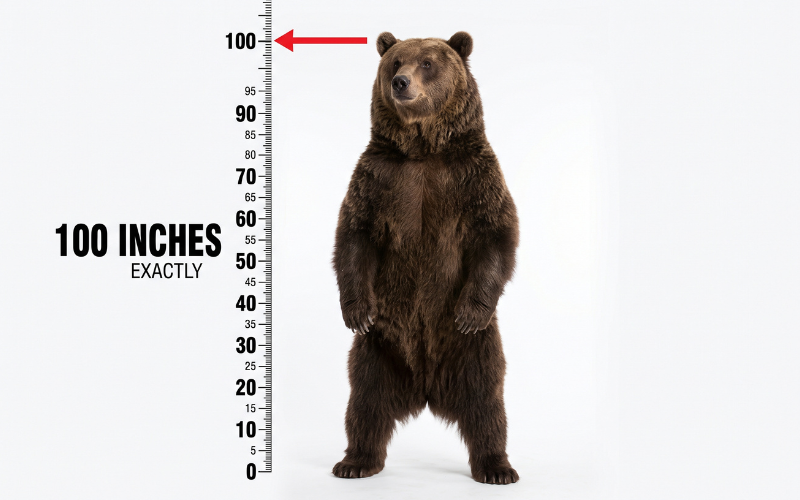
If you ever encounter a brown bear standing fully upright on its hind legs, you are looking at an animal that can easily measure 100 inches tall.
While they usually walk on all fours, brown bears (including grizzlies) will stand on their back legs to get a better view of their surroundings, smell food from a distance, or display dominance. A large adult male brown bear standing upright reaches between 8 feet and 8.5 feet (96 to 102 inches). This massive size is an evolutionary trait that helps them intimidate rival predators and reach high branches for foraging.
9. An 8.5-Foot Artificial Christmas Tree 🎄
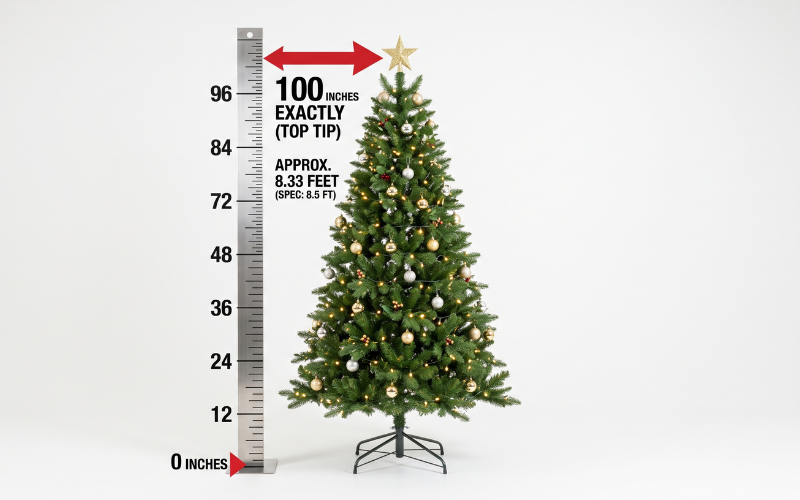
During the holiday season, sizing a tree for your home is a major decision. Standard artificial trees are sold in strict height categories: 6.5 feet, 7.5 feet, and 8.5 feet. An 8.5-foot tree is exactly 102 inches tall, missing the 100-inch mark by just two tiny inches.
These trees are specifically designed for homes with high ceilings. Because most standard living rooms have 8-foot (96-inch) ceilings, an 8.5-foot tree will simply not fit in an average room. They are manufactured for homes with vaulted ceilings or standard 9-foot clearances, leaving just enough room at the very top for a star or angel tree topper.
10. A Standard Cargo Van Load Area 🚐
If you are moving apartments and decide to rent a standard cargo van rather than a large box truck, the load area inside the back is often engineered to be exactly 100 inches long.
Automotive engineers design these cargo spaces carefully. A 100-inch floor length allows tradespeople to lay standard 8-foot (96-inch) pieces of lumber, drywall, or plywood flat on the floor with just enough clearance to close the rear doors safely without damaging the cargo. It is a highly deliberate measurement that balances the exterior drivability of the van with maximum interior utility.
Why 100 Inches is a Magic Number in Manufacturing 🏭
You might notice a pattern in the items listed above. Furniture, vehicles, and textiles often gravitate toward this specific size. There is a very good reason for this. In the manufacturing world, creating objects that fit inside standard shipping containers and residential homes is critical.
Standard residential building codes heavily influence how big items can be. Because the average modern hallway is 36 inches wide, and standard room ceilings are between 96 and 108 inches, making an item exactly 100 inches means it is the absolute maximum size that can realistically be navigated through a home. A 100-inch sofa can be tilted vertically to fit through a doorway. A 100-inch table can be rotated around a tight corner. If these items were 110 or 120 inches, they would be impossible to deliver without removing doors or windows. Therefore, 100 inches represents the physical limit of standard domestic logistics.
How to Measure 100 Inches Without a Tape Measure 📐
If you need to know if a 100-inch item will fit in your space but you do not have a tape measure, you can use your own body to get a surprisingly accurate estimate.
For the average adult, the distance from the tip of your nose to the fingertips of your outstretched arm is about 36 inches (one yard). If you do this three times, you have measured 108 inches. Subtract roughly a hand’s width from that total, and you will have marked out exactly 100 inches on your floor or wall.
Another method is to use standard printer paper. A standard sheet of letter paper is 11 inches long. If you line up nine sheets of paper end-to-end, you will get 99 inches. Just add one single inch to the end of the last paper, and you have perfectly mapped out a 100-inch space. This is a highly effective trick when you are in an empty room trying to visualize how much space a large sofa or dining table will consume.
Frequently Asked Questions (FAQs) ❓
Is 100 inches longer than 8 feet?
Yes. Eight feet is equal to 96 inches (8 x 12). Therefore, 100 inches is exactly 8 feet and 4 inches, making it slightly longer than 8 feet.
How many centimeters are in 100 inches?
There are exactly 254 centimeters in 100 inches. The math is simple: 1 inch equals 2.54 centimeters, so you just multiply by 100.
Can a 100-inch sofa fit in an apartment elevator?
It depends on the elevator, but usually, yes. Standard freight elevators can easily accommodate this size. For standard passenger elevators, a 100-inch sofa must usually be stood up vertically on its end. Since most modern elevator ceilings are at least 8.5 feet (102 inches) tall, the sofa should fit snugly if placed straight up.
How do I know if my ceiling can fit a 100-inch object?
Most modern homes are built with either 8-foot (96-inch) or 9-foot (108-inch) ceilings. If your ceiling is 8 feet tall, a 100-inch object will not fit standing up. You must measure from the floor to the ceiling using a tape measure to verify.
Does a 100-inch TV screen mean it is 100 inches wide?
No. Television and projector screens are always measured diagonally from the bottom corner to the opposite top corner. A screen with a 100-inch diagonal measurement is approximately 87 inches wide and 49 inches high.
Related Posts
- 10 Common Things That Are 80 Inches Tall
- 10 Common Things That Are 70 Inches Tall
- 10 Common Things That Are 60 Inches Long
- 10 Common Things That Are 50 Inches Long
Conclusion
Understanding measurements by connecting them to everyday objects makes dealing with large dimensions much easier. By visualizing a ten-person dining table, an adult male ostrich, or a large recreational kayak, you can accurately estimate space without constantly relying on a measuring tape. Whether you are shopping for oversized furniture, setting up a home theater system, or just expanding your spatial awareness, knowing the physical reality of exactly 8 feet and 4 inches is a highly practical skill that helps you make better layout decisions in your daily life.
FOR MORE MEASUREMENTS VISIT: MEASURINGSPOT