
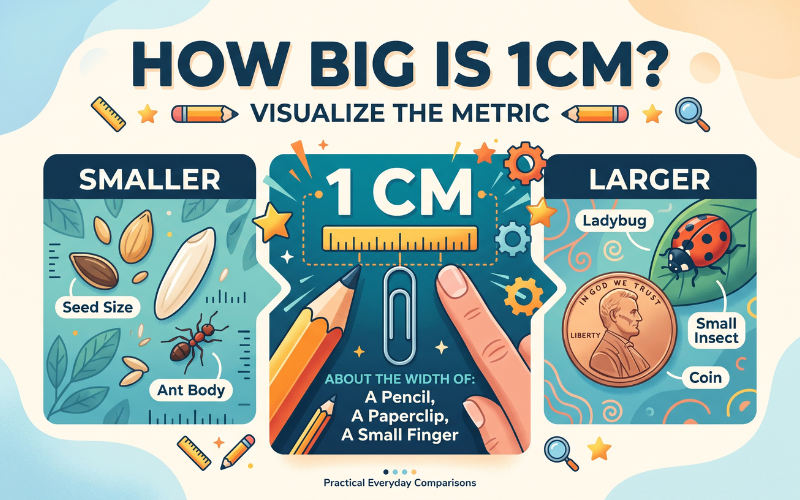
We have all been in a situation where we need to figure out the size of an object, a gap, or a piece of material, but there is no ruler or measuring tape in sight. Whether you are shopping online and trying to understand the dimensions of a product, working on a weekend craft project, or simply trying to follow a specific recipe, having a mental reference for basic measurements is incredibly helpful.
The centimeter is a fundamental unit of length in the metric system, used by the vast majority of the world. Even if you live in a country that relies on the imperial system, you will frequently encounter centimeters in medical fields, science, technology, and international commerce. Visualizing exactly what one centimeter looks like can save you time and frustration. The easiest way to train your brain to recognize this measurement is by comparing it to everyday objects you already know.
Below, we break down ten ordinary items that you likely have in your home, office, or pantry right now that are exactly—or incredibly close to—one centimeter in length or width.
Quick Section: 10 Items at a Glance ⚡
If you are in a rush and just need a fast mental reference, here are ten household items that measure one centimeter:
- The width of a standard AAA battery
- A small standard shirt button
- The plastic head of a regular pushpin
- An average roasted coffee bean
- A single green pea
- The width of a standard metal paperclip
- A single Cheerio cereal loop
- The width of an adult index fingernail
- A standard small sugar cube
- A Mini M&M candy
BioWiki Data Table 📊
For a fast comparative overview, here is a breakdown of these objects, their category, and how you can use them for quick reference.
| Item Name | Category | Exact Size (approx.) | Everyday Reference Use |
| AAA Battery (Width) | Electronics | 10.5 mm | Measuring small gadget compartments |
| Small Shirt Button | Clothing | 10.0 mm | Checking seam allowances in sewing |
| Pushpin Head | Office Supplies | 10.0 mm | Spacing items on a corkboard |
| Coffee Bean | Food/Pantry | 10.0 mm | Visualizing small organic measurements |
| Green Pea | Food/Produce | 9.5 – 10 mm | Portioning ingredients in recipes |
| Standard Paperclip | Office Supplies | 8.0 – 10 mm | Estimating document margins |
| Single Cheerio | Food/Pantry | 10.0 mm | Teaching kids about measurements |
| Index Fingernail | Anatomy | 10.0 mm | Measuring anything when empty-handed |
| Small Sugar Cube | Food/Pantry | 10.0 mm | Visualizing cubic volume (1 cubic cm) |
| Mini M&M Candy | Food/Snacks | 10.0 mm | Quick baking estimations |
Detailed Breakdown of 1 Centimeter Objects 🔍
To truly understand how to use these items as a reliable mental ruler, it helps to know a little bit about why they are the size they are. Manufacturing standards, agricultural grading, and even human biology play a role in making these items consistent reference points.
The Width of a Standard AAA Battery 🔋
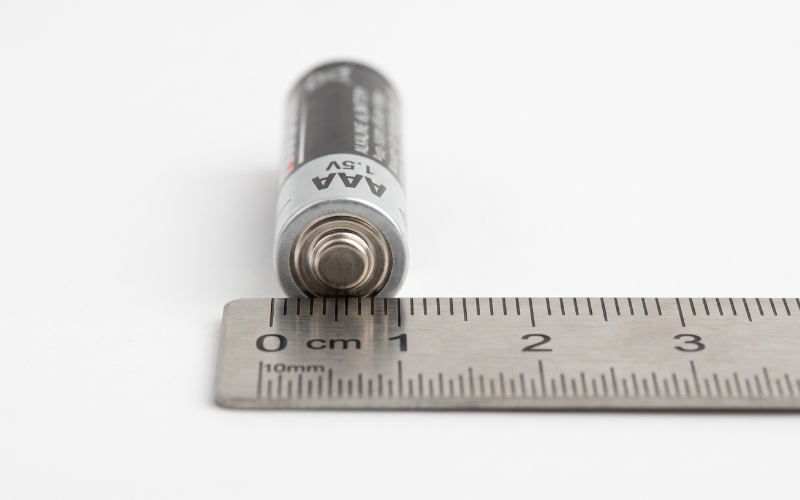
The AAA battery is a staple in almost every household, powering everything from television remote controls to small children’s toys and wireless computer mice. According to international manufacturing standards set by the International Electrotechnical Commission (IEC), a standard AAA battery has a diameter of exactly 10.5 millimeters. Since 10 millimeters make up a centimeter, this leaves us with an object that is just half a millimeter over our target size.
When you need to measure a small gap, you can place a AAA battery vertically on its flat end. The distance straight across the circular base provides a highly accurate one-centimeter marker. Because these batteries are manufactured in massive, highly regulated factories, you can trust that a battery bought in Tokyo will be the exact same width as a battery bought in Toronto.
A Small Standard Shirt Button 👔
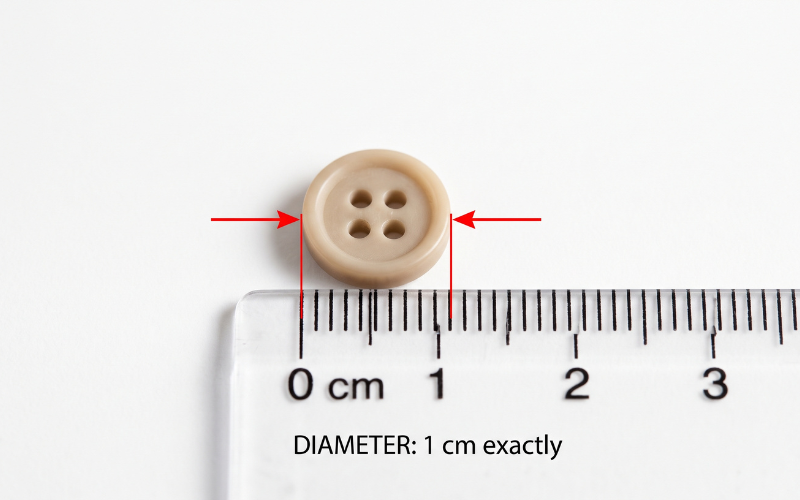
If you look in your closet at a standard button-down dress shirt, you are looking at dozens of tiny measuring tools. In the tailoring and clothing manufacturing industry, buttons are measured using an old unit called “Lignes” (often abbreviated as L). A standard small button used for shirt collars and cuffs is usually a 16L button.
A 16 Ligne button converts to almost exactly 10 millimeters, or one centimeter, in diameter. Next time you are out shopping and need to estimate the width of a small jewelry item or the thickness of a wallet, just look down at your shirt cuffs. The distance straight across that small plastic or mother-of-pearl circle is exactly the one centimeter you are looking for.
The Head of a Standard Pushpin 📌
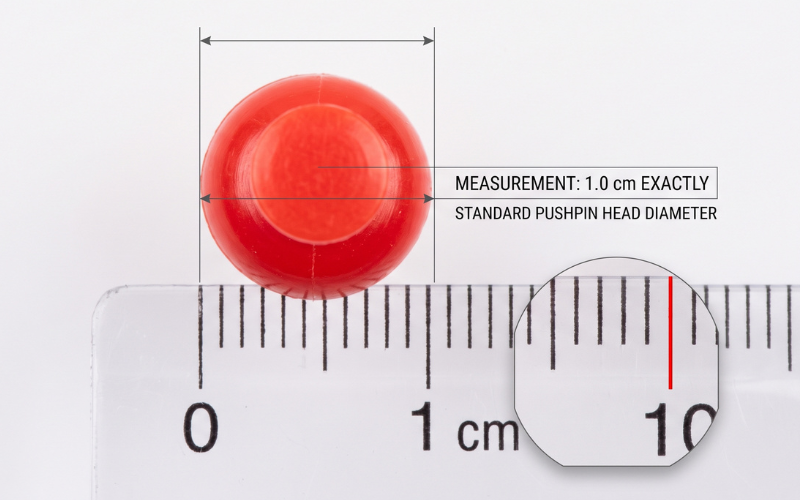
Walk into any office space, classroom, or home study, and you will likely find a bulletin board covered in standard plastic pushpins. While the sharp metal tack of a pushpin is usually a bit longer (around 11 to 12 millimeters), the colored plastic head you grip with your fingers is universally manufactured to be one centimeter across.
This standardized size is not an accident. Office supply companies designed the pushpin head to be just large enough to be comfortably pinched by an adult thumb and forefinger without obscuring too much of the paper it is holding up. If you are ever trying to measure a small photo or a business card, lining up a few pushpins side-by-side will give you a very accurate count in centimeters.
An Average Roasted Coffee Bean ☕
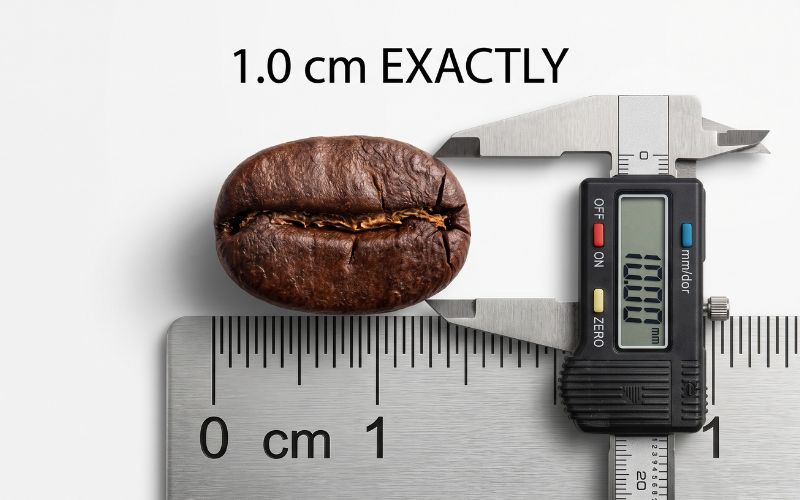
For the coffee lovers out there, your morning brew is made of thousands of tiny, one-centimeter objects. While raw, green coffee beans are quite small and dense, the roasting process changes their physical structure. As the beans are heated to temperatures exceeding 200°C, the moisture inside them turns to steam, causing the beans to expand and crack.
By the time a standard Arabica coffee bean has reached a medium roast, its length has expanded to an average of one centimeter. While there will naturally be some minor variations due to the agricultural nature of the product, pulling a random bean out of your coffee bag will yield a reliable one-centimeter reference point. This makes coffee beans excellent visual aids when you are trying to estimate sizes in the kitchen.
A Single Green Pea 🫛
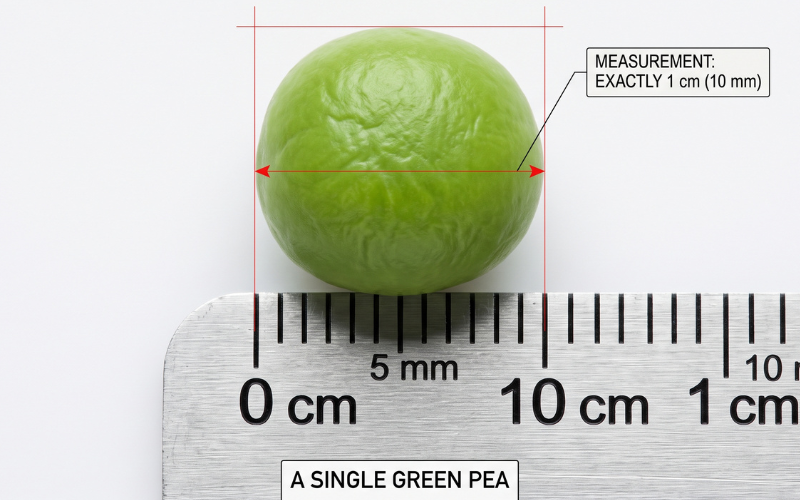
Similar to coffee beans, green peas offer a fantastic natural measuring tool. In commercial agriculture, vegetables are heavily sorted and graded before they ever reach the frozen food aisle or the canning facility. Peas are passed through large vibrating sieves with specifically sized holes to ensure uniformity in the final packaged product.
The standard size for a premium, mature green pea is between 9.5 and 10 millimeters in diameter. If you place a single, fully rounded pea on a cutting board, the distance from one side to the other is a centimeter. This uniform size helps food manufacturers predict cooking times accurately, and it helps you visualize small measurements while preparing meals.
The Width of a Standard Paperclip 📎
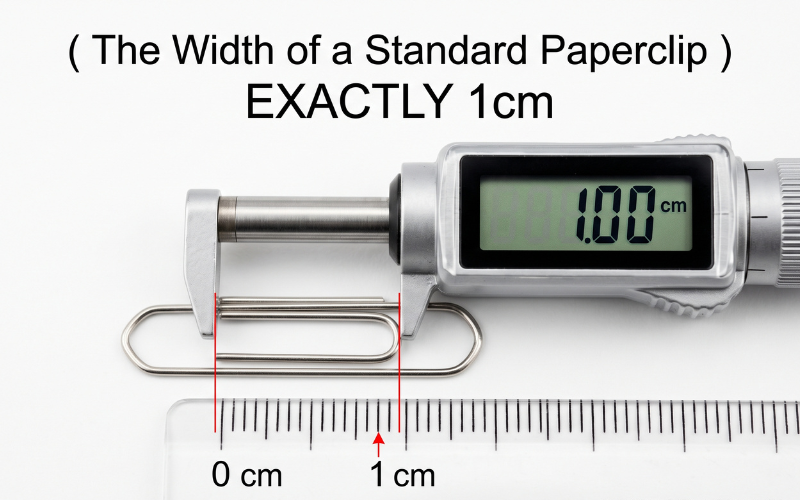
The paperclip is a marvel of simple engineering. The most common design, known as the “Gem” paperclip, has been in continuous production for over a century. While standard paperclips are about three centimeters long, it is their width that we are interested in here.
If you look at a standard, small paperclip, the width of the larger metal loop at the bottom is consistently right around one centimeter wide. Because they are made from stiff steel wire, they hold their shape incredibly well. You can slide a paperclip over the edge of a document or a piece of fabric to quickly gauge a one-centimeter margin without ever having to reach for a ruler.
A Single Cheerio Cereal Loop 🥣
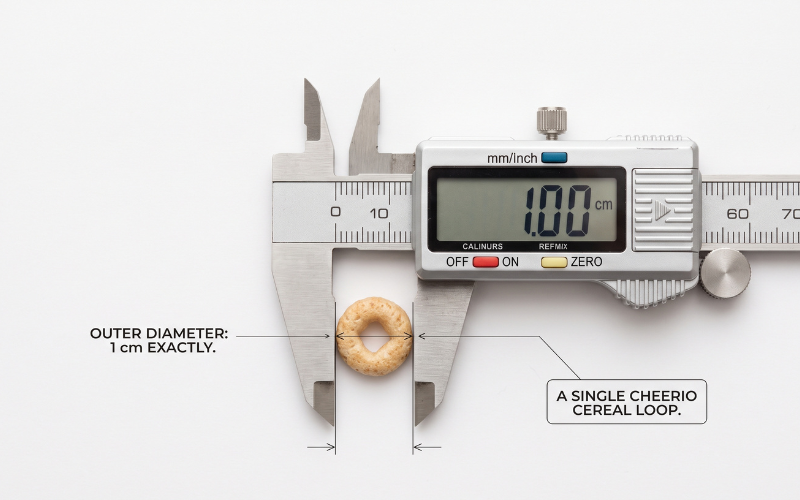
General Mills introduced Cheerios in 1941, and the manufacturing process has been highly refined over the decades. The oat dough is pushed through a specialized die to form the iconic O-shape, and then it is puffed to its final size.
Due to strict quality control in the factory, an average Cheerio comes out to exactly one centimeter in diameter. This makes the cereal not only a popular breakfast food but also a common tool used by elementary school teachers. Educators frequently use Cheerios in the classroom to help young students grasp the concept of the metric system, as placing ten Cheerios in a row perfectly illustrates a ten-centimeter line.
Your Index Fingernail Width 🖐️
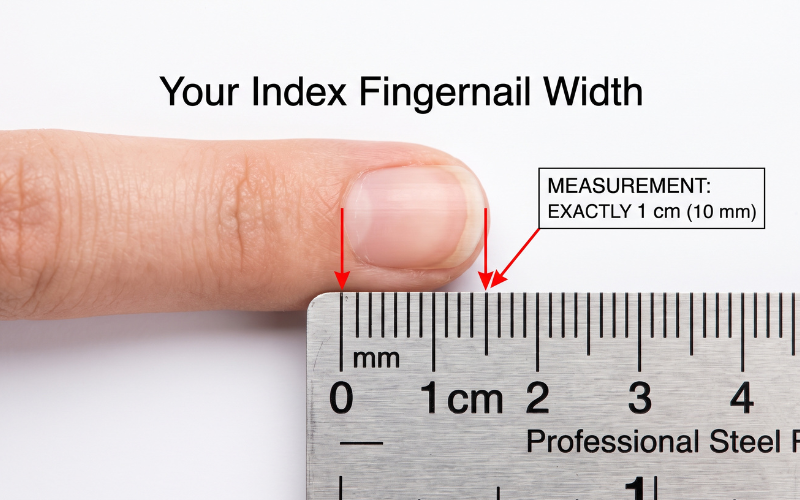
While human bodies vary wildly in shape and size, the width of an adult index fingernail is astonishingly consistent. For the average adult, the distance across the nail bed of the index finger (the finger right next to your thumb) is about one centimeter.
This is arguably the most useful reference point on this entire list because you carry it with you everywhere you go. If you are at a hardware store trying to quickly assess the size of a screw, a bolt, or a piece of trim, you can simply hold your index finger up to the object. If the object matches the width of your nail, you know instantly that it is a centimeter wide.
A Small Sugar Cube 🧊
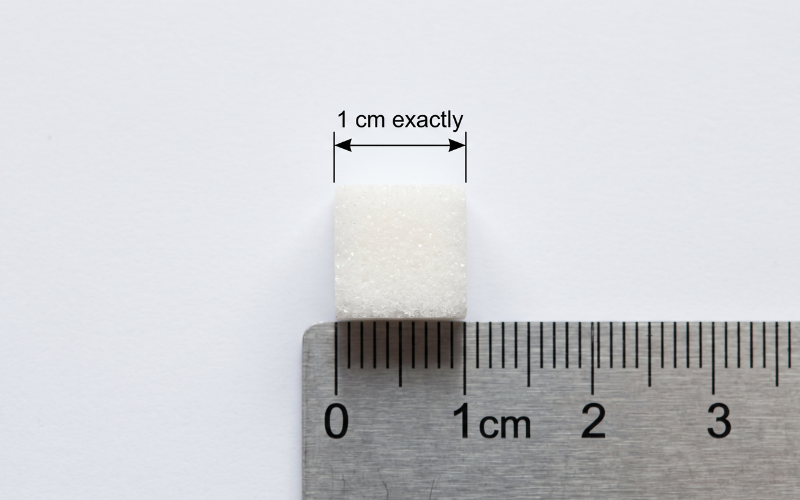
Sugar cubes are a classic addition to tea and coffee, particularly in European cafes. While you can buy rough-cut or artisanal sugar lumps in varying sizes, the standard, commercially pressed small sugar cube is an excellent example of cubic measurement.
Many small sugar cubes are exactly one centimeter wide, one centimeter long, and one centimeter high. This gives them a total volume of one cubic centimeter. Looking at a sugar cube is not only a great way to understand linear length, but it provides a perfect physical representation of volume in the metric system.
A Mini M&M Candy 🍫
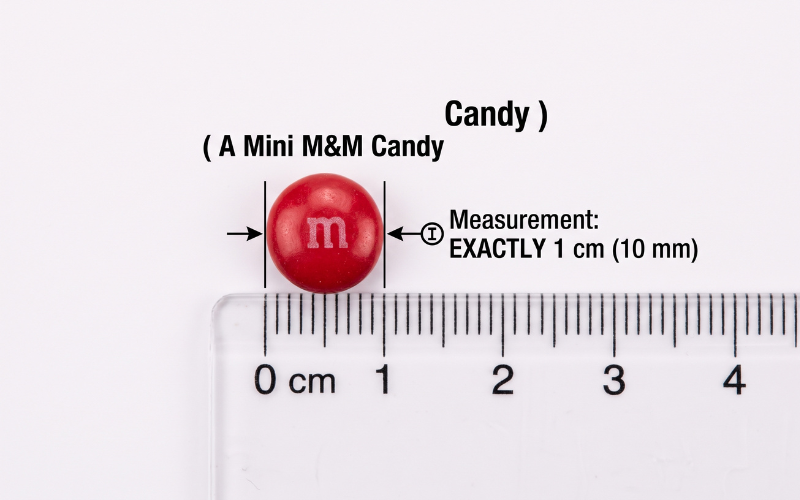
Candy manufacturers rely on precise molds to ensure that their products fit neatly into packaging and provide a consistent experience for the consumer. While a regular M&M is a bit larger, the Mars Wrigley company designed the “Mini” version of the popular candy to be noticeably smaller and more bite-sized.
A Mini M&M has a diameter of exactly 10 millimeters, hitting our one-centimeter mark perfectly. They are uniform, completely round on the edges, and easy to line up. If you are baking and a recipe calls for an ingredient to be diced into one-centimeter cubes, thinking of the size of a Mini M&M is a great way to ensure you are chopping your ingredients to the correct proportions.
The Science of Visualizing Measurements 🧠
Why is it so hard for humans to accurately guess measurements without a reference? Cognitive psychology tells us that the human brain is highly adaptable, but it struggles with absolute values. If someone asks you to draw a line that is exactly one centimeter long on a blank piece of paper, you will likely draw it either too long or too short. Our brains simply do not store mathematical units well in a vacuum.
However, the brain excels at relational memory. We are incredibly good at comparing one object to another. When you associate a mathematical unit (like a centimeter) with a physical object you interact with daily (like a pushpin or a button), you bridge the gap between abstract math and physical reality.
This technique is known as creating a “heuristic,” which is a mental shortcut that helps you solve problems quickly. By committing just two or three items from the list above to memory, you are giving your brain a reliable heuristic to use whenever you need to estimate a small distance.
The Metric System: A Brief Context 🌍
To fully appreciate the centimeter, it helps to understand where it comes from. The metric system was born out of the French Revolution in the late 18th century. Before this time, regions across Europe used wildly different systems of measurement, often based on arbitrary things like the length of a local king’s foot or the weight of a specific type of grain. This made trade, science, and construction incredibly difficult.
French scientists sought to create a system that was based on universal natural laws rather than human whims. They originally defined the “meter” as one ten-millionth of the distance from the North Pole to the Equator.
Because the metric system is a base-10 system, it scales up and down effortlessly.
- A centimeter is exactly one-hundredth of a meter.
- There are 10 millimeters in a centimeter.
- There are 100 centimeters in a meter.
- There are 100,000 centimeters in a kilometer.
This logical, highly structured system is why 95% of the global population uses the metric system today. Knowing the physical size of a centimeter anchors you to this global system of mathematics and commerce.
Practical Everyday Applications 🛠️
You might be wondering when you will actually need to use these mental reference points. The truth is, small measurements pop up in our daily lives far more often than we realize. Here are a few common scenarios where knowing the size of a centimeter by heart comes in handy.
Online Shopping and E-Commerce
When buying jewelry, watches, or small electronics online, product descriptions heavily rely on millimeters and centimeters. A retailer might state that a pendant is 2 centimeters wide, or that a watch strap is 10 millimeters (1 centimeter) thick. If you know that a centimeter is the width of your index fingernail, you will not end up disappointed by ordering an item that turns out to be much smaller or larger than you expected.
Cooking and Food Preparation
Many modern recipes, especially those translated from European or Asian chefs, require precise knife work. A recipe might ask you to slice carrots into one-centimeter rounds or to grate exactly two centimeters of fresh ginger. Using the visual reference of a green pea or a coffee bean allows you to prep your food correctly without needing a ruler on your cutting board. Proper ingredient sizing ensures that food cooks evenly at the right speed.
Home Crafting and DIY Repairs
If you are doing basic home maintenance, such as patching a hole in drywall or buying a replacement screw for a loose cabinet door, estimating the size of the hardware is essential. If a gap looks to be about the width of three standard AAA batteries stacked side by side, you know you are dealing with a three-centimeter space. This helps you communicate accurately with hardware store employees so you purchase the correct materials the first time.
Sewing and Tailoring
In clothing alterations, seam allowances are crucial. A standard seam allowance in many patterns is around 1 to 1.5 centimeters. If you are pinning fabric together and lack a seam gauge, you can place a small shirt button or the base of a paperclip along the edge of the fabric to ensure your stitches remain perfectly straight and evenly spaced.
How to Practice Spatial Awareness 🎯
If you want to improve your ability to judge measurements, it only takes a few seconds of practice a day. Next time you are sitting at your desk, try this simple exercise:
- Look at a small object nearby, like a coin, an eraser, or a lip balm tube.
- Guess its length in centimeters based on your memory of the ten objects listed above.
- Take out a physical ruler or measuring tape and check your guess.
Over time, your brain will naturally adjust, and your estimations will become sharper. You will begin to notice that spatial awareness is like a muscle; the more you actively use it, the stronger and more accurate it becomes.
Frequently Asked Questions (FAQs) ❓
How do you convert centimeters to inches?
One inch is exactly equal to 2.54 centimeters. If you have a measurement in centimeters and want to find out how many inches it is, you simply divide the number of centimeters by 2.54. Conversely, if you have inches and need centimeters, multiply the inches by 2.54. As a quick mental rule of thumb, two and a half centimeters roughly make up one inch.
How can I measure something accurately without a ruler on my phone?
If you do not have a physical ruler, you can use the built-in augmented reality (AR) measuring apps available on most modern smartphones. Both Apple’s iOS and Google’s Android have native apps called “Measure.” By pointing your phone’s camera at an object, the software maps the physical space and can give you a surprisingly accurate measurement in centimeters. However, if your phone battery is dead, you can always revert to using your index fingernail or a paperclip.
Are there exactly 10 millimeters in a centimeter?
Yes, the metric system is strictly based on multiples of ten. There are exactly 10 millimeters (mm) in 1 centimeter (cm). This makes conversions extremely simple. If an object is 45 millimeters long, it is 4.5 centimeters long. You just move the decimal point one place to the left.
What is the easiest way to measure 5 centimeters?
If one centimeter is the width of an adult index fingernail, 5 centimeters is roughly the width of four fingers held tightly together (excluding the thumb). You can also look at standard credit cards or ID cards; the shorter side of a standard credit card is just slightly over 5 centimeters (specifically, it is 5.39 centimeters).
Why do medical professionals measure in centimeters instead of inches?
The medical and scientific communities operate globally, requiring a standardized language that avoids confusion. The metric system provides highly granular units (like millimeters and centimeters) that make measuring small things—such as skin lesions, pupil dilation, or medication doses—much more precise. Using a base-10 system significantly reduces the risk of mathematical errors during critical medical evaluations.
Is a penny exactly one centimeter?
No, a standard United States penny has a diameter of 1.905 centimeters, making it almost two centimeters wide. If you need a reference closer to two centimeters, a penny is a great tool, but it is far too large to represent a single centimeter.
How large is a cubic centimeter compared to a milliliter?
In the metric system, volume and length are beautifully connected. One cubic centimeter (1 cm³) is completely identical in volume to one milliliter (1 mL). If you have a small syringe that holds 5 milliliters of liquid, it is holding exactly 5 cubic centimeters of liquid. This seamless conversion is why the metric system is favored by scientists worldwide.
Related Posts
- 10 Common Things That Are 80 Inches Tall
- 10 Common Things That Are 70 Inches Tall
- 10 Common Things That Are 60 Inches Long
- 10 Common Things That Are 50 Inches Long
Conclusion 🏁
Understanding the exact length of a centimeter without relying on a physical ruler is a surprisingly practical skill that can simplify your daily routines. By anchoring this basic metric unit to common household items—whether it is the width of your index fingernail, a small shirt button, or a single green pea—you empower yourself to make quick, accurate estimations in cooking, home repairs, and online shopping. The next time you find yourself needing to gauge a small space or verify a product dimension on the fly, you can skip the frantic search for a measuring tape and confidently rely on the everyday objects already surrounding you.
FOR MORE MEASUREMENTS VISIT: MEASURINGSPOT