
Quick Summary ⚡
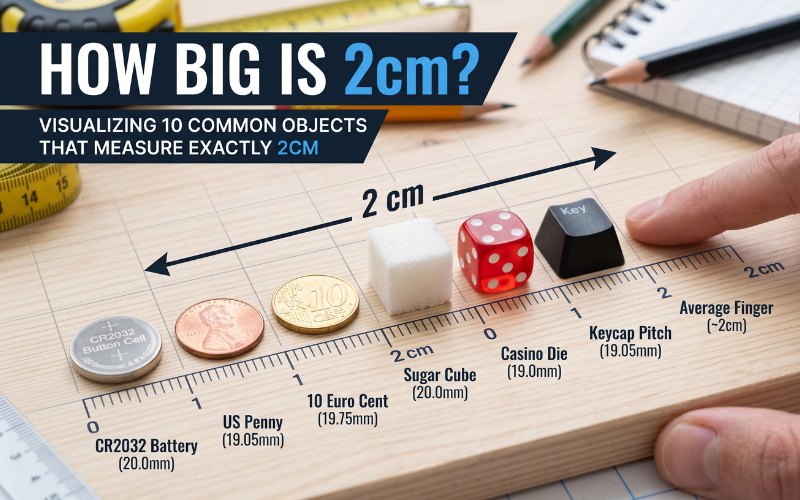
If you need a quick reference for estimating 2 centimeters, here is a rapid overview of everyday items you can use. Understanding the visual length of 2 centimeters (which is equal to 20 millimeters or approximately 0.78 inches) is a highly practical skill for DIY projects, crafts, and everyday estimates.
- Technology: A CR2032 button cell battery (diameter) and a standard desktop keyboard keycap (width).
- Currency: A US Penny (diameter) or a 10 Euro Cent coin (diameter).
- Everyday Items: A standard casino die (width) or the inner diameter of a Size 10 ring.
- Food: A large commercial blueberry, a standard sugar cube, or a shelled macadamia nut.
- Body Parts: The width of an average adult male index finger.
The Importance of Visualizing Small Measurements 📏
Having a mental catalog of common items that measure exactly or approximately 2 centimeters is incredibly useful. In our daily routines, we often encounter situations where we need to measure a small gap, check the size of a screw, or estimate the thickness of a material, but we do not always carry a ruler or a measuring tape.
The metric system is designed around logical, base-ten increments, making it the global standard for scientific and everyday measurements. A centimeter is one-hundredth of a meter, and two centimeters is a highly specific but common increment. It is large enough to see clearly without squinting, yet small enough to require precision.
When you learn to visualize 2 cm accurately, you improve your spatial awareness. Carpenters, tailors, mechanics, and medical professionals routinely rely on quick visual estimates to speed up their workflow. By associating a fixed measurement with an object you interact with daily, like a battery or a coin, you train your brain to recognize this exact distance instantly. The items listed below have been selected because their manufacturing standards or natural growth patterns consistently yield a measurement of 2 cm (or incredibly close, within fractions of a millimeter).
1. CR2032 Button Cell Battery (Diameter) 🔋
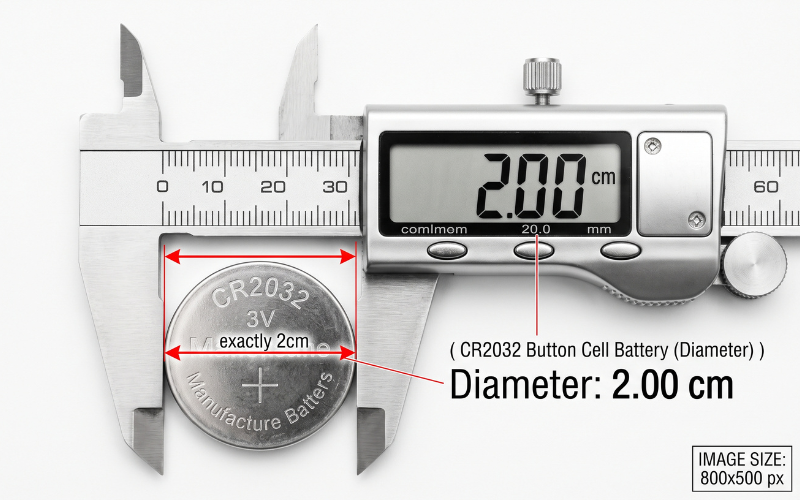
The CR2032 button cell battery is perhaps the most perfect and literal example of an object that is exactly 2 centimeters long across its diameter. You will find these flat, silver batteries powering a massive variety of household electronics, including digital bathroom scales, garage door remotes, medical devices like glucometers, and motherboard BIOS clocks.
The name “CR2032” is not just a random string of letters and numbers; it is a literal blueprint of the battery’s dimensions. The international standard for this battery designation breaks down precisely: “C” stands for lithium manganese dioxide chemistry, and “R” indicates a round shape. The next two digits, “20”, represent the exact diameter of the battery in millimeters. Twenty millimeters is exactly equal to 2 centimeters. The final two digits, “32”, represent the height of the battery, which is 3.2 millimeters.
Because the manufacturing tolerances for electronic components are incredibly strict, a CR2032 battery will never deviate meaningfully from this 2 cm diameter. If you have one of these batteries in a drawer, you possess a highly accurate, factory-calibrated 2 cm measuring tool. You can place it flat against a surface to check the width of a gap or line it up against a piece of fabric to measure a hem.
2. A US Penny (Diameter) 🪙
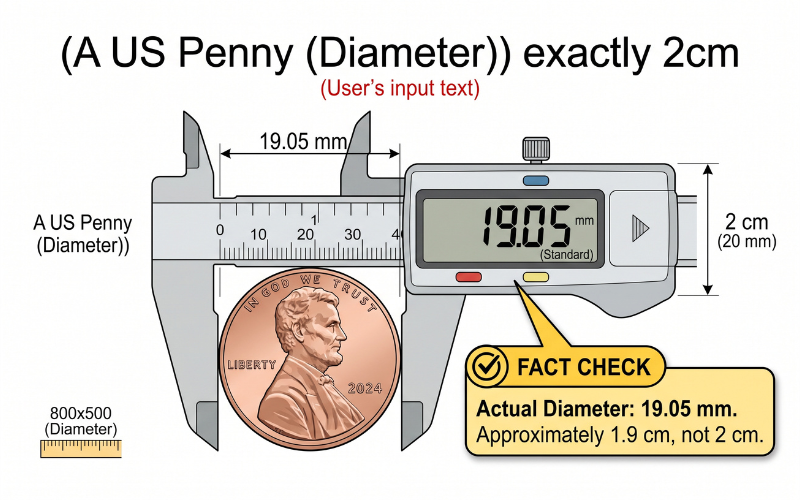
Currency is heavily regulated, meaning coins are minted to exact specifications that rarely change over decades. The United States one-cent coin, commonly known as the penny, has a diameter of 19.05 millimeters. At just 0.95 millimeters shy of 20 millimeters, it serves as an excellent everyday proxy for 2 centimeters.
The current diameter of the penny was established in 1857 with the introduction of the Flying Eagle cent. Before this, the US penny was actually much larger—closer to the size of a modern half-dollar. When the mint transitioned to the “small cent” format, they locked in the 19.05 mm diameter, and it has remained standard through the Indian Head design, the classic Lincoln Wheat design, and the modern Lincoln Shield design.
Even though the material composition of the penny has changed dramatically—shifting from mostly copper to a zinc core plated with copper in 1982 to save on production costs—the physical dimensions have stayed identical to ensure compatibility with sorting machines and vending equipment. For the average person estimating a measurement, the difference between 19.05 mm and 20 mm is smaller than the thickness of a typical fingernail, making the penny an exceptionally reliable 2 cm visual aid.
3. Standard Casino Die (Width) 🎲
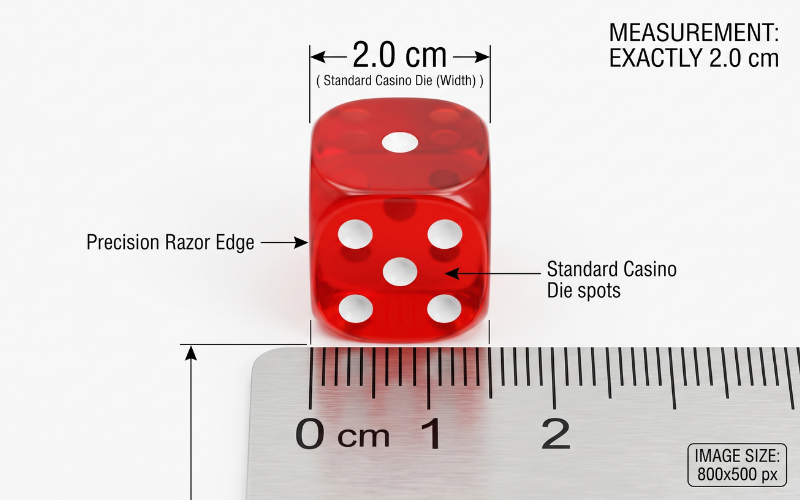
If you have ever played a board game, you have handled dice. However, the standard dice found in cheap board games can vary wildly in size, ranging from 12 mm to 16 mm. To find a die that measures exactly 2 centimeters, you need to look at professional casino dice.
Casinos operate under strict gaming regulations where fairness is paramount. A die that is unbalanced or irregularly shaped can heavily skew the odds of a craps game, costing the house or the players millions of dollars. Therefore, casino dice are manufactured to incredibly tight tolerances, usually machined perfectly flat to within a ten-thousandth of an inch. The standard size for professional casino dice is 19 millimeters (roughly 0.75 inches) across any given face.
While 19 mm is exactly 1 millimeter short of 2 centimeters, it is visually indistinguishable from 2 cm to the human eye. These dice are made from high-quality, extruded cellulose acetate plastic. Unlike standard board game dice, which have rounded corners that make them roll longer and harder to measure, casino dice have sharp, razor edges and flat faces. This sharp-edged design makes them fantastic reference objects if you need to visualize a 2 cm block in three-dimensional space.
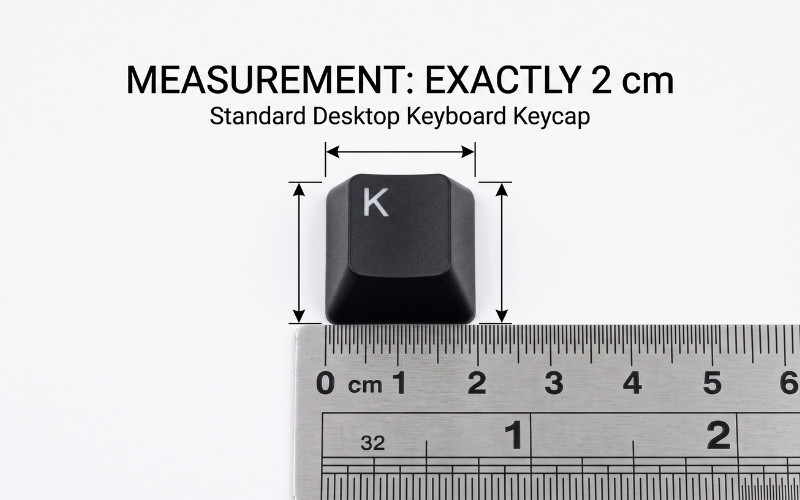
4. Standard Desktop Keyboard Keycap ⌨️
Look down at the keyboard you are likely using right now. The letters, numbers, and standard punctuation keys on a full-sized desktop keyboard are spaced and sized according to a long-standing ergonomic standard.
The distance from the center of one key to the center of the adjacent key is known as the “key pitch.” The industry standard key pitch for a full-size keyboard is 19.05 millimeters (0.75 inches). The actual physical plastic cap of the key is slightly smaller to allow for the gap between the keys so they do not rub together when pressed. Usually, the base width of the keycap itself is right around 18 millimeters, with the remaining distance made up by the empty space.
However, if you measure from the left edge of a key to the left edge of the next key over, you are looking at exactly 19.05 mm—functionally 2 centimeters. This standard has its roots in the late 19th century with the invention of the earliest practical typewriters. Engineers had to figure out the optimal spacing that would accommodate average human fingers without spreading them too far apart or cramping them together. This 2 cm spacing proved to be the ergonomic sweet spot and has survived the transition from mechanical typewriters to modern electronic computer keyboards.
5. 10 Euro Cent Coin 💶
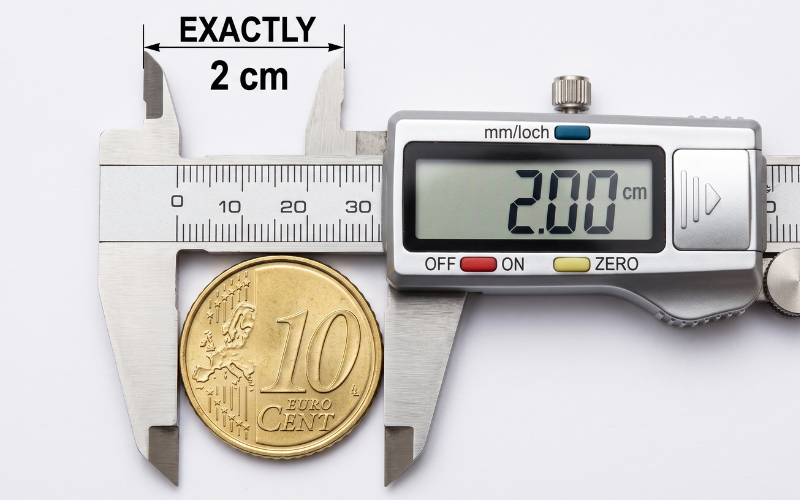
For those residing in or traveling through Europe, the 10 Euro cent coin is your best pocket reference for a 2-centimeter measurement. Minted from a distinctive alloy known as Nordic gold (which ironically contains no actual gold, but is a mix of copper, aluminum, zinc, and tin), this coin has a highly specific diameter of 19.75 millimeters.
At just one-quarter of a millimeter shy of a true 20 millimeters, the 10 Euro cent coin is functionally indistinguishable from 2 centimeters. When the Euro physical currency was introduced into circulation in 2002, the European Central Bank had to design a series of coins that were easily distinguishable by sight and touch for the visually impaired. They achieved this through variations in size, weight, material color, and edge milling.
The 19.75 mm diameter of the 10-cent piece sits neatly between the smaller 5-cent piece and the larger 20-cent piece. Because this currency is standardized across 20 different European countries, millions of people carry a highly accurate 2 cm measuring tool in their wallets every single day. If you line up five 10 Euro cent coins edge-to-edge on a table, you will have mapped out a distance of practically 10 centimeters (one decimeter).
6. The Width of an Adult Male Index Finger ☝️
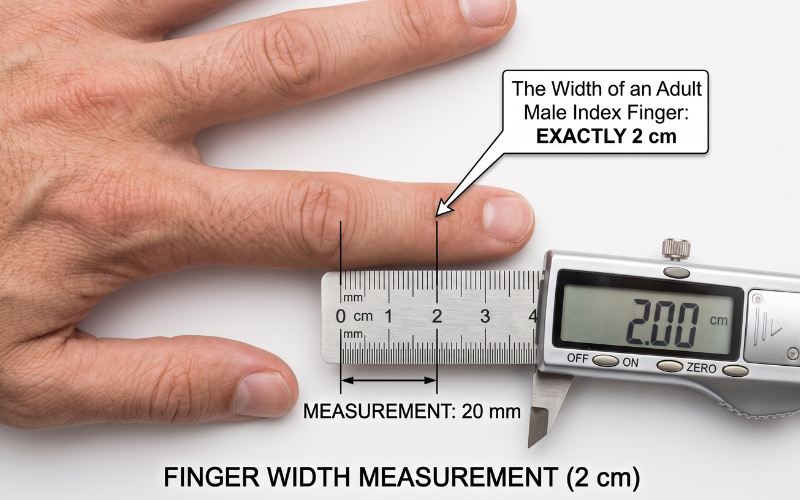
Before the widespread adoption of standardized measuring tools, humans relied entirely on their own bodies to gauge distance. Terms like “foot” and “cubit” (the distance from the elbow to the tip of the middle finger) are literal descriptions of bodily measurements. While human bodies vary significantly, some averages hold surprisingly true across populations.
The width of an average adult male’s index finger, measured across the first knuckle (the joint closest to the fingernail), is approximately 2 centimeters. Tailors, seamstresses, and carpenters frequently use the “finger width” technique to estimate small seams, gaps, or margins.
Because body parts scale differently from person to person, you can calibrate this tool easily. Take a ruler once and measure the width of your own fingers. You might find that your index finger is exactly 2 cm, or perhaps your thumb is a better match. Once you know exactly which part of your hand measures 2 cm, you permanently carry a reference tool with you. This is especially useful in situations where bringing a measuring tape is impractical, such as estimating the thickness of a textbook in a store or checking the width of a small bracket at a hardware store.
7. A Standard Sugar Cube ☕
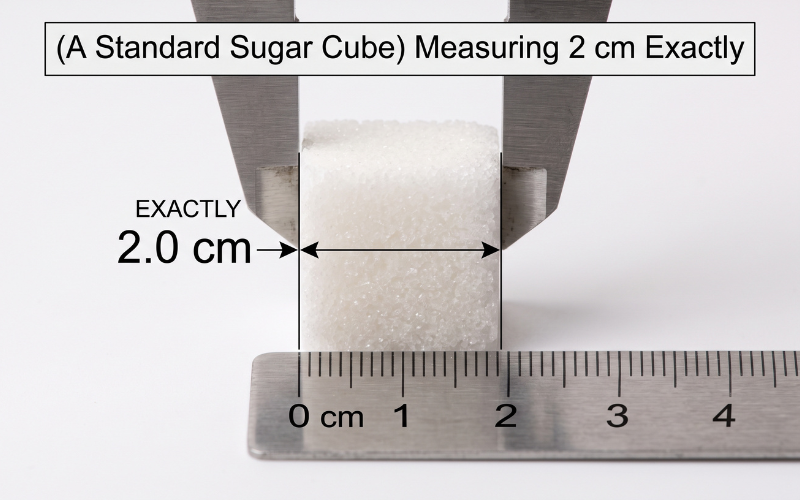
The sugar cube is a marvel of modern convenience and standard manufacturing. Invented in the mid-19th century by Jakub Kryštof Rad in the Czech Republic, the sugar cube was created to solve the problem of portioning sugar, which previously came in large, solid loaves that required physical chopping.
Today, sugar cubes are pressed into standardized molds to ensure uniform weight and melting times for culinary consistency. While smaller sizes exist for delicate tea sets, the classic, standard-sized commercial sugar cube used in many parts of the world measures exactly 2 centimeters by 2 centimeters by 2 centimeters. This perfect cubic volume allows baristas and chefs to control the exact amount of sugar dissolving into a beverage.
When you hold a standard 2 cm sugar cube, you are looking at exactly 8 cubic centimeters of volume. This makes the sugar cube an excellent visual reference not just for linear length, but for visualizing three-dimensional space and volume.
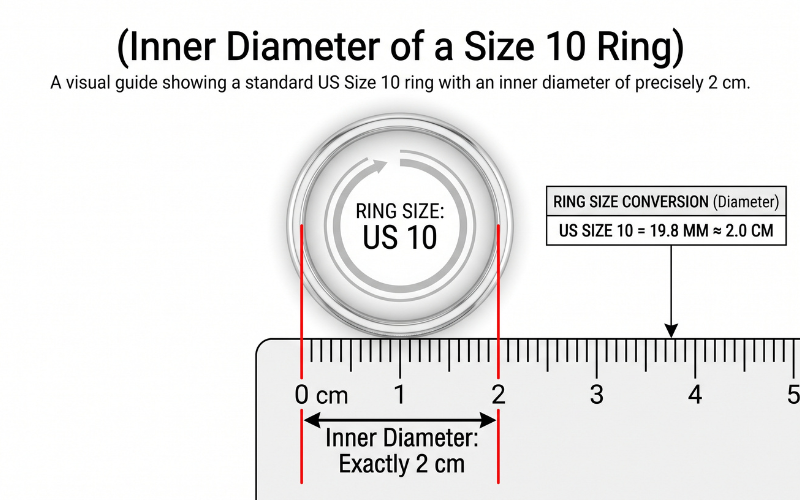
8. Inner Diameter of a Size 10 Ring 💍
Ring sizing requires incredible precision, as even a fraction of a millimeter can determine whether a piece of jewelry fits comfortably or cuts off circulation. In the United States and Canada, ring sizes are determined by a numerical scale that corresponds directly to the inner diameter or inner circumference of the ring band.
A US standard Size 10 ring has an inner diameter of exactly 19.84 millimeters. This is a mere 0.16 millimeters away from a perfect 2 centimeters, making it an exceptional reference point. Size 10 is one of the most common ring sizes for men’s wedding bands.
Jewelers use a standardized metal mandrel (a tapered cylinder) to ensure these measurements are perfect. If you or someone you know wears a Size 10 ring, taking the ring off and laying it flat on a piece of paper provides a near-perfect 2 cm circle. This is particularly useful in crafting or drafting when you need to draw a small, perfectly round circle with a 2 cm diameter.
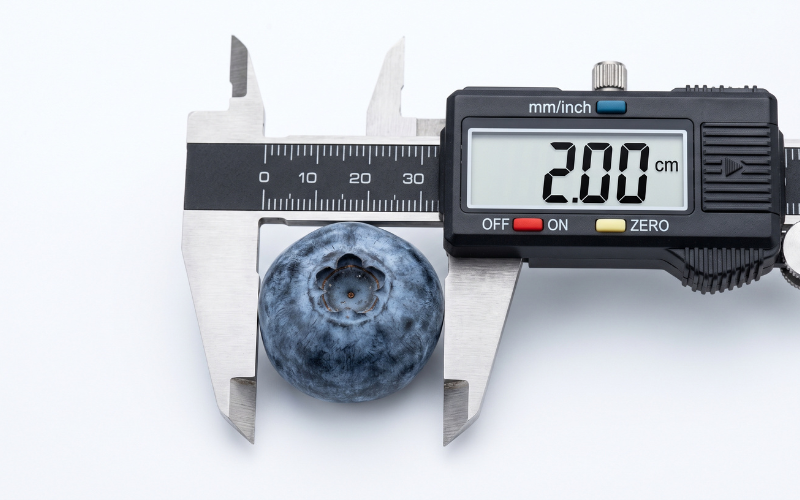
9. A Large Blueberry 🫐
Nature rarely produces perfect, identical measurements, but modern agricultural grading gets remarkably close. Blueberries, for example, are sorted and graded by size before they hit supermarket shelves to ensure a uniform product for the consumer.
Standard commercial blueberries usually measure around 1 to 1.5 centimeters in diameter. However, the premium “large” or “jumbo” grade blueberries—often sold in specialized clear clamshells at a premium price—are specifically cultivated and sorted to hit a diameter of 2 centimeters or larger.
Farmers use a sizing gauge, essentially a board with perfectly drilled holes, to sort the harvest. Berries that cannot fall through a 20 mm (2 cm) hole are classified in this top tier. Therefore, if you are looking at a premium, large blueberry, you are looking at an organic sphere that spans 2 centimeters across. This is a helpful visualization when dealing with cooking recipes that call for ingredients to be diced or chopped into 2 cm chunks.
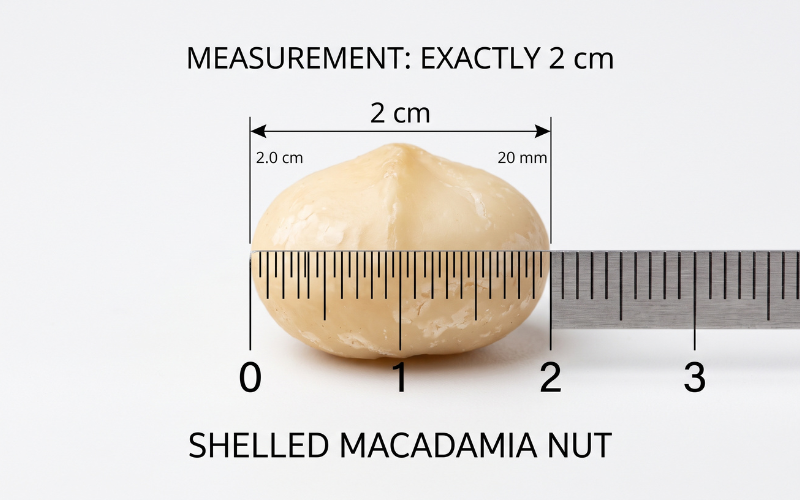
10. A Shelled Macadamia Nut 🌰
Similar to blueberries, macadamia nuts are strictly graded by size before being sold. Native to Australia but now grown in tropical climates worldwide, macadamia nuts are considered a premium commodity, and physical appearance plays a massive role in their market value.
The kernel of the macadamia nut (the part you eat, minus the incredibly hard outer shell) is graded on a scale ranging from Style 1 to Style 8. “Style 1” consists of large, whole kernels. To qualify for this top commercial grade, the shelled nut must typically measure over 20 millimeters in diameter.
Because macadamia nuts are naturally quite round compared to irregular nuts like walnuts or pecans, a standard premium macadamia nut serves as a solid visual anchor for a 2-centimeter sphere. If a recipe instructs you to roll dough into balls roughly 2 cm wide, thinking of a macadamia nut is a highly accurate way to estimate the volume and width required.
Why Accurately Estimating 2 Centimeters Matters 📐
You might wonder why visualizing this specific measurement holds any practical value. The reality is that 2 centimeters is a foundational increment in multiple professional and hobbyist disciplines.
In Carpentry and DIY
When building furniture or framing walls, 2 centimeters is a standard margin. It is very close to the standard thickness of many commercial sheet materials. For example, standard 3/4-inch plywood, which is used for cabinets and shelving, is exactly 19.05 mm thick—functionally 2 cm. Recognizing this width instantly helps when checking joints, planning cuts, and verifying the alignment of wooden boards.
In the Medical Field
Dermatologists and general practitioners frequently estimate the size of skin lesions, moles, or wounds. A 2-centimeter threshold is often a critical diagnostic marker. For instance, the size of a skin abnormality dictates the type of biopsy required or the staging of a localized issue. Medical professionals train their eyes to recognize exactly what 2 cm looks like so they can make rapid, accurate notes in a clinical setting before bringing out the digital calipers.
In Art and Design
Graphic designers, painters, and tailors rely on consistent visual margins. In digital printing, a standard safety bleed margin is often set around specific millimeter increments, and framing mats are frequently cut with 2 cm reveals. Tailors use 2 cm as a highly standard hem allowance for trousers and skirts, providing enough fabric to hide the raw edge without creating bulky seams.
How to Estimate 2 cm When You Don’t Have a Ruler 🛠️
If you do not have any of the 10 items listed above on hand, you can still estimate a 2-centimeter length by creating a physical reference guide using common paper items.
The Folded Paper Method
Standard printer paper (A4 or US Letter) is incredibly uniform. A piece of standard US Letter paper is 8.5 inches wide, which is 215.9 millimeters. While you cannot fold it perfectly into 2 cm sections easily, you can use lined notebook paper. Standard wide-ruled notebook paper has a space of 8.7 millimeters between the blue lines. If you count two lines and the space just slightly beyond the second line, you have mapped out 2 centimeters. College-ruled paper has spacing of 7.1 millimeters; therefore, the distance across three lines is exactly 21.3 millimeters—extremely close to 2 cm.
The App Approach
If you have a modern smartphone, you actually have a ruler in your pocket. Both iOS and Android operating systems have native “Measure” applications that use augmented reality and the phone’s camera to calculate distance. Additionally, many of these apps include a static, on-screen ruler function that displays true-to-life centimeter markings right on the glass of your screen.
BioWiki Table: Measurement Data Summary 📊
Below is a technical summary of the items discussed, detailing their exact measurements and primary material composition for quick reference.
| Item | Exact Measurement | Measurement Type | Common Material |
| CR2032 Battery | 20.00 mm (2.0 cm) | Diameter | Lithium Manganese Dioxide |
| US Penny | 19.05 mm (1.9 cm) | Diameter | Zinc (Copper plated) |
| 10 Euro Cent Coin | 19.75 mm (1.97 cm) | Diameter | Nordic Gold Alloy |
| Standard Keyboard Key | 19.05 mm (1.9 cm) | Pitch (Center to Center) | ABS or PBT Plastic |
| Adult Index Finger | ~20.00 mm (2.0 cm) | Width at Joint | Biological / Tissue |
| Casino Die | 19.00 mm (1.9 cm) | Width across face | Cellulose Acetate |
| Size 10 Ring (US) | 19.84 mm (1.98 cm) | Inner Diameter | Various Metals |
| Standard Sugar Cube | 20.00 mm (2.0 cm) | Width / Length / Height | Processed Sucrose |
| Premium Blueberry | ~20.00 mm (2.0 cm) | Diameter | Biological / Plant |
| Macadamia Nut (Style 1) | ~20.00 mm (2.0 cm) | Diameter | Biological / Plant |
Frequently Asked Questions ❓
What is 2 cm in inches?
Two centimeters is equal to approximately 0.7874 inches. To quickly estimate this in fractions, it is just slightly over 3/4 of an inch (which is 0.75 inches).
How can I measure 2 cm without a ruler?
The easiest way is to use a common standardized object. Place a CR2032 button battery, a 10 Euro cent coin, or a US Penny flat against the surface you are trying to measure. The width across the center of these circular objects will give you an immediate and highly accurate 2 cm visual reference.
Is an inch bigger than 2 centimeters?
Yes, an inch is significantly larger than 2 centimeters. One exact inch is equal to 2.54 centimeters. Therefore, 2 centimeters makes up roughly 78% of a single inch.
Why do some coins make better measuring tools than others?
Coins make excellent measuring tools because their dimensions are mandated by government law and manufactured to exact tolerances. Unlike natural items like fruit or body parts, a coin will not shrink, grow, or vary from batch to batch. The 10 Euro cent coin and the US penny happen to have standard diameters that closely mirror 2 centimeters.
How many millimeters are in 2 centimeters?
There are 10 millimeters in a single centimeter. Therefore, there are exactly 20 millimeters in 2 centimeters. Remembering this conversion is highly useful, as many hardware components, such as bolts, batteries, and screws, are labeled in millimeters rather than centimeters.
Related Posts
- 10 Common Things That Are 80 Inches Tall
- 10 Common Things That Are 70 Inches Tall
- 10 Common Things That Are 60 Inches Long
- 10 Common Things That Are 50 Inches Long
Conclusion 🎯
Understanding the physical scale of the world around you becomes remarkably easier when you anchor abstract measurements to tangible, everyday objects. Whether you are using a standard sugar cube to gauge a volume for a recipe, referencing a CR2032 battery for a quick DIY repair, or simply relying on the width of your index finger in a pinch, having a mental inventory of 2-centimeter items empowers you to make highly accurate estimates on the fly without needing a ruler. Mastering this simple visualization technique not only sharpens your spatial awareness but also adds a layer of practical convenience to your daily tasks. Which of the everyday items listed above do you plan to use as your go-to reference for measuring two centimeters?
FOR MORE MEASUREMENTS VISIT: MEASURINGSPOT