
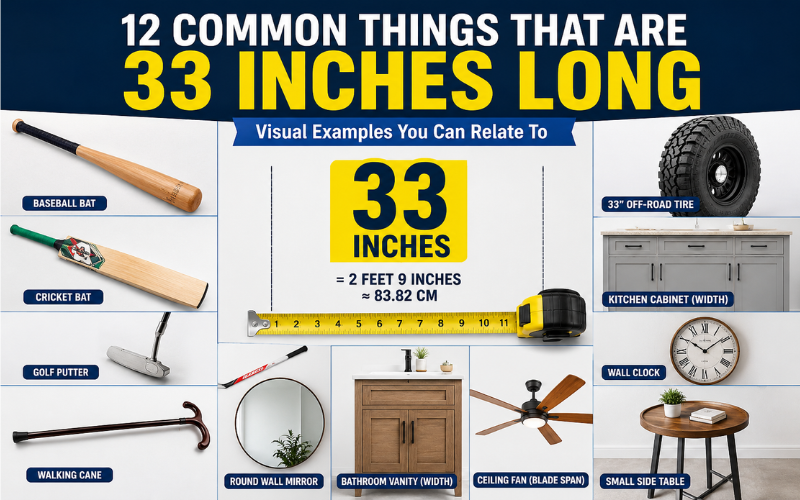
Have you ever wondered what 33 inches looks like in real life? A measurement can be difficult to visualize when you only see it written on a tape measure. Knowing a few familiar objects that are close to 33 inches long makes the measurement much easier to understand.
It is equal to 2 feet 9 inches, or about 83.8 centimeters. It is a useful size to picture because it falls between the length of many everyday household items and larger recreational equipment.
Whether you are checking the size of a piece of furniture, comparing an object before buying it, planning a DIY project, or simply trying to understand it, familiar examples can give you a practical reference point.
In this guide, we will look at 12 common things that are around 33 inches long or have a dimension. Some examples are designed specifically in this size, while others commonly come close depending on the model, brand, or intended use.
Quick Answer: 12 Things That Are Around 33 Inches Long
Here is a quick look at the objects covered in this article:
| # | Common Thing | Approximate 33-Inch Dimension |
| 1 | Baseball Bat | Length |
| 2 | Cricket Bat | Length |
| 3 | 33-Inch Off-Road Tire | Overall diameter |
| 4 | Golf Putter | Length |
| 5 | Walking Cane | Overall length |
| 6 | Youth Hockey Stick | Length |
| 7 | Kitchen Cabinet | Width |
| 8 | Bathroom Vanity | Width |
| 9 | Round Wall Mirror | Diameter |
| 10 | Wall Clock | Diameter |
| 11 | Ceiling Fan | Blade-span diameter |
| 12 | Small Side Table | Width or diameter |
These examples are especially useful because they are objects you can encounter in homes, garages, sports equipment stores, workshops, and everyday life. 📏
How Long Is 33 Inches?
Before comparing it with familiar objects, it helps to convert the measurement into a few other units.
It equals:
- 2 feet 9 inches
- 2.75 feet
- 83.82 centimeters
- 838.2 millimeters
- 0.8382 meters
A standard 12-inch ruler would need to be placed almost three times end to end to cover it.
Another easy way to think about it is this: 33 inches is 3 inches shorter than 3 feet. Since 3 feet equals 36 inches, simply imagine a yardstick or 3-foot length and remove 3 inches.
That makes it considerably longer than a typical school ruler, but much shorter than many full-size household pieces of furniture.
1. A 33-Inch Baseball Bat ⚾
One of the easiest sports-related examples of this is a baseball bat.
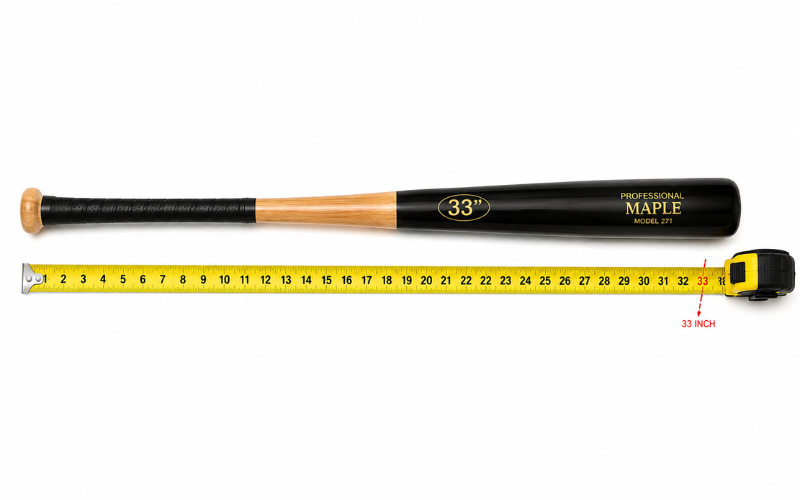
Baseball bats are manufactured in a wide range of lengths depending on the player’s age, height, weight, league, and hitting style. A 33-inch bat is a very familiar size, particularly among older youth players, high-school players, college players, and adult players.
If you hold a baseball bat vertically, it reaches roughly 2 feet 9 inches from end to end. That makes it a convenient real-world object for visualizing this measurement.
The exact bat length is normally measured from the very end of the knob to the end of the barrel. A bat labeled 33 inches is therefore a particularly useful physical reference when you need to understand how long it actually is.
Why a Baseball Bat Is a Good Comparison
A baseball bat is:
- Long and relatively narrow
- Easy to measure from end to end
- Commonly available in multiple specific lengths
- Easy to compare against a tape measure
- Familiar to many people
If you have access to a baseball bat, it can serve as one of the simplest physical references for this measurement.
2. A 33-Inch Cricket Bat 🏏
A cricket bat is another useful example of an object that can be close to 33 inches long.
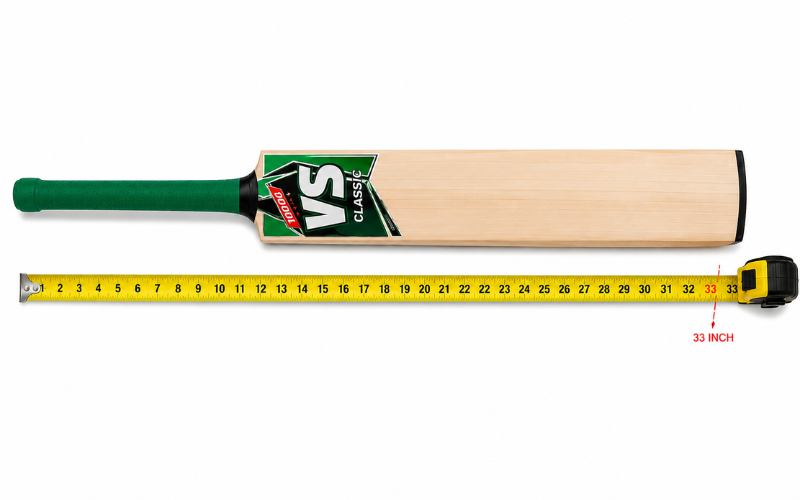
Full-size cricket bats are commonly around the low-to-mid 30-inch range, although their exact dimensions vary by manufacturer and bat size. Many adult cricket bats are roughly 33 to 35 inches long.
A cricket bat therefore gives you a very practical way to visualize a length of 33 inches.
Unlike a baseball bat, a cricket bat has a much wider blade and a flatter hitting surface. When you measure it from the bottom of the handle to the bottom of the blade, the overall length can be close to the 33-inch range.
How to Use a Cricket Bat as a Reference
Place the bat flat on the floor and put the zero mark of a measuring tape at the bottom. Extend the tape along the bat toward the top of the handle.
If the bat measures, you now have a physical representation of the length you are trying to understand.
This is especially useful for people familiar with cricket equipment. 🏏
3. A 33-Inch Off-Road Tire 🚙
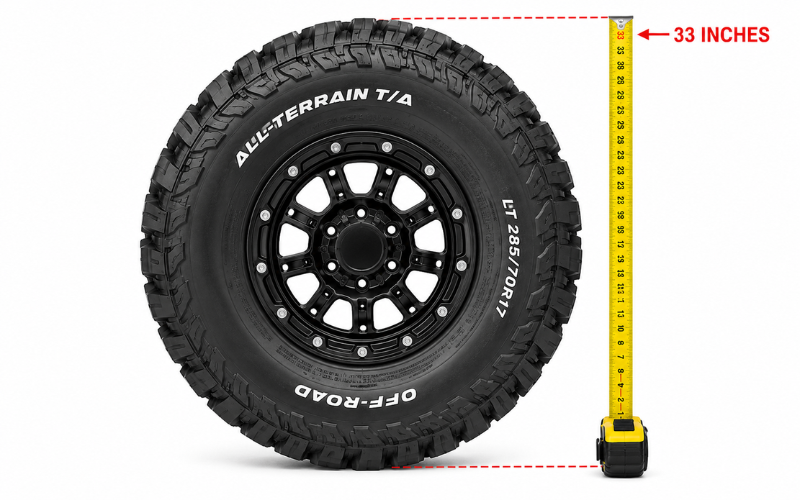
A off-road tire is a particularly interesting example because the 33-inch measurement refers to the tire’s approximate overall diameter, rather than its side-to-side width.
In the world of trucks and off-road vehicles, “33-inch tire” is a familiar description. Actual measured diameter can vary depending on the manufacturer, tire model, inflation pressure, wheel size, and load.
A tire advertised can therefore provide a strong visual reference for the size of 33 inches.
Imagine placing the tire upright on a flat surface. Its overall height from the ground to the highest point can be close to 33 inches.
Why a Tire Makes a Useful Comparison
A tire demonstrates something important about measurements: 33 inches does not always mean an object is 33 inches from one end to another in the same way.
For a tire, the measurement describes its approximate outside diameter.
This makes a tire a great example for understanding circular dimensions.
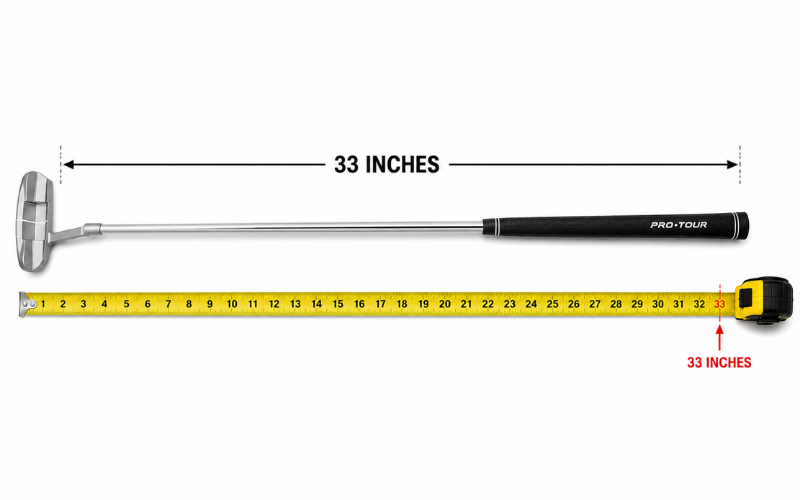
4. A 33-Inch Golf Putter ⛳
Golf putters come in a range of lengths, and 33-inch putters are a common size.
A putter is measured along its shaft from the end of the grip down to the sole of the club. A putter is therefore almost exactly 2 feet 9 inches long.
For someone who plays golf, this is one of the easiest ways to understand it.
A putter is noticeably shorter than many standard adult drivers and woods, yet it is long enough to make 33 inches immediately recognizable when you hold it.
Comparing a Putter With 33 Inches
If you place a putter beside a tape measure, the end of the grip should reach the 33-inch mark when the club is positioned according to the appropriate measurement method.
Golf clubs are particularly helpful for visualization because their lengths are often specified in inches when discussing equipment specifications.
5. A Walking Cane 🚶
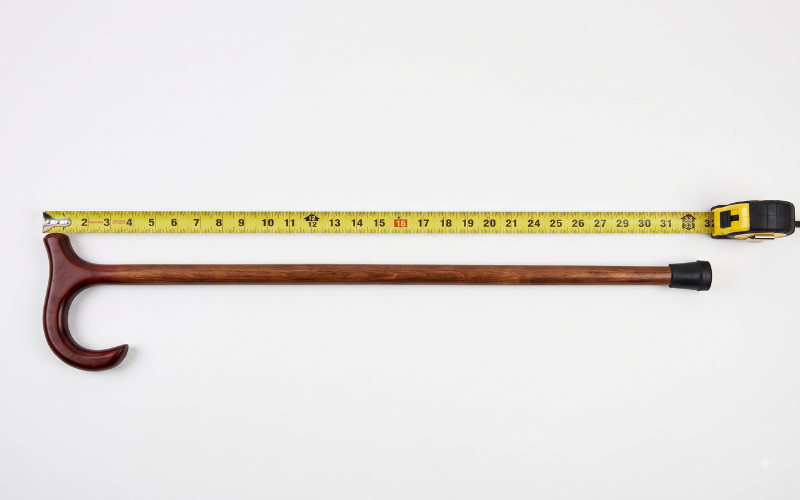
A walking cane around 33 inches long is another familiar example.
Cane length depends heavily on the user’s height and the style of the cane. Many canes are adjustable, so they can be set to different lengths. A cane adjusted to gives you a convenient physical example of this measurement.
A cane is also useful because it is usually a simple, straight object. There is no need to account for a complicated shape when comparing its length.
Why Cane Length Matters
Unlike some decorative objects, the length of a walking cane has a practical purpose. It needs to correspond appropriately to the user’s height and intended use.
For that reason, canes are often manufactured or adjusted to specific lengths rather than being one universal size.
If you have a cane set to 33 inches, you can use it as a quick everyday reference for understanding the measurement.
6. A Youth Hockey Stick 🏒
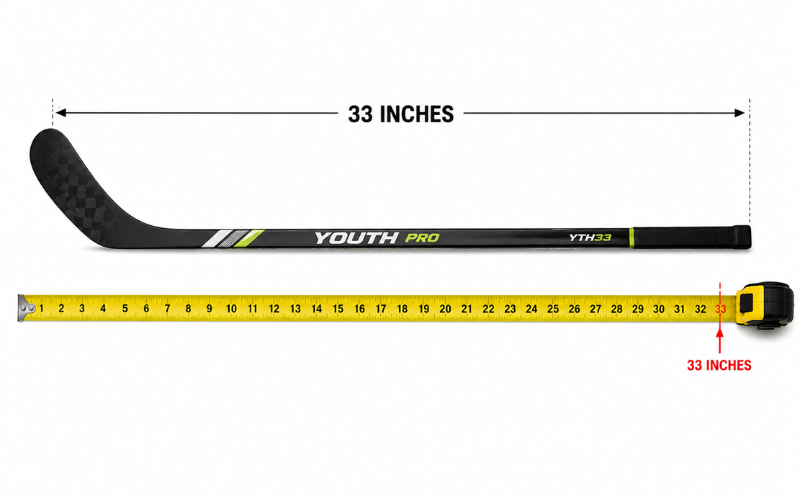
Some youth and junior hockey sticks can be around 33 inches in length, depending on how the stick is measured and the player’s equipment category.
Hockey stick sizing varies considerably. Manufacturers produce sticks for different ages, heights, playing positions, and skill levels. Therefore, it should not be considered a universal hockey-stick length.
Still, a hockey stick in this range is another excellent visual reference.
The long, straight shaft makes the length easy to compare with a measuring tape. Because hockey sticks are designed in several different sizes, it is always better to check the manufacturer’s listed measurement rather than assuming every youth stick is 33 inches.
A Useful Measurement Tip
If you are comparing a hockey stick with 33 inches, check whether the listed specification refers to the shaft measurement, total stick length, or another manufacturer’s measurement method.
This small detail can make a noticeable difference.
7. A 33-Inch-Wide Kitchen Cabinet 🏠
Not every example of it needs to be a long, narrow object.
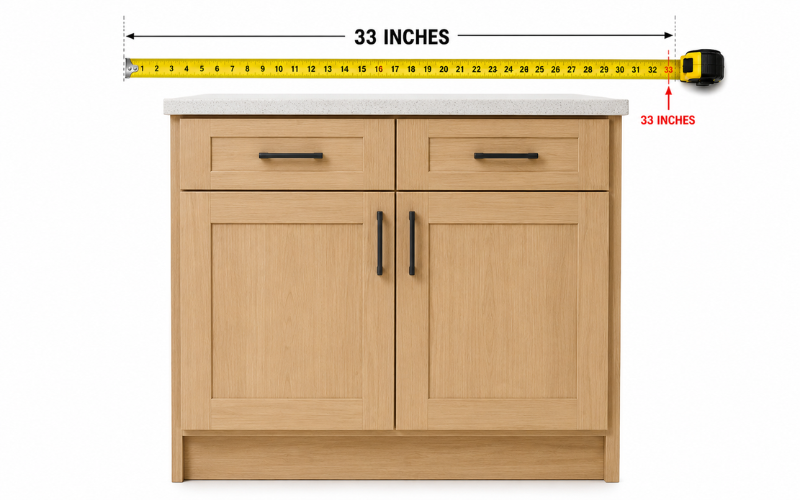
A kitchen cabinet approximately 33 inches wide is another useful example.
Kitchen cabinets are available in many standard and semi-standard widths, and 33-inch-wide cabinet units are available for certain layouts and applications. However, cabinet dimensions vary widely depending on the manufacturer and cabinet type.
If you have a cabinet that is about 33 inches from one side to the other, that width gives you a great reference for the measurement.
33 Inches in Kitchen Planning
A cabinet can occupy a noticeable amount of wall or floor space. When planning a kitchen, a few inches can make a difference because cabinets must work with appliances, countertops, doors, drawers, and walking areas.
For that reason, homeowners should always measure the actual cabinet rather than relying only on a product description.
A width can also help you visualize how much horizontal space 2 feet 9 inches takes up.
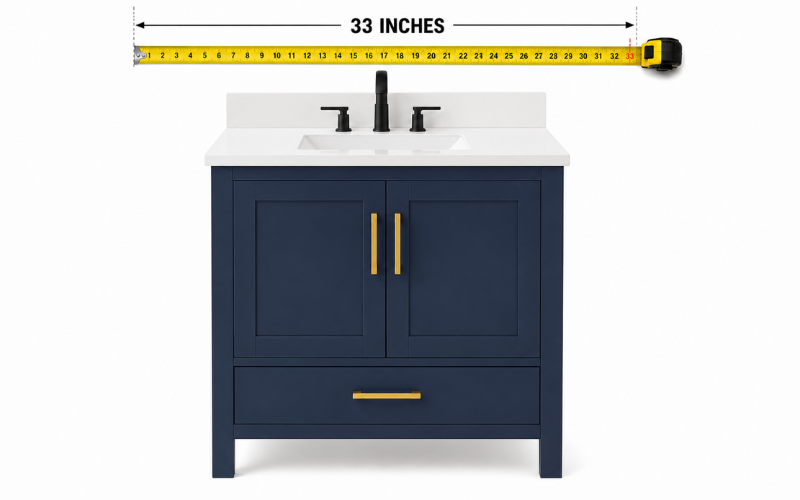
8. A 33-Inch Bathroom Vanity 🛁
Bathroom vanities come in numerous widths, and a vanity around 33 inches wide can be a practical size for certain bathrooms.
Unlike a baseball bat or golf club, the 33-inch measurement here describes width, not overall length.
A vanity that is wide can provide enough space for a sink and countertop while remaining more compact than many larger double-sink units.
Where 33 Inches Can Matter
Bathroom dimensions are often tight. A vanity that is several inches wider or narrower can affect:
- Door clearance
- Walking space
- Sink placement
- Toilet spacing
- Storage
- Countertop area
- Plumbing location
This makes vanity a useful household comparison for understanding how much horizontal space 33 inches occupies.
If you’re replacing a vanity, measure the available opening carefully rather than assuming a labeled size will fit perfectly.
9. A 33-Inch Round Wall Mirror 🪞
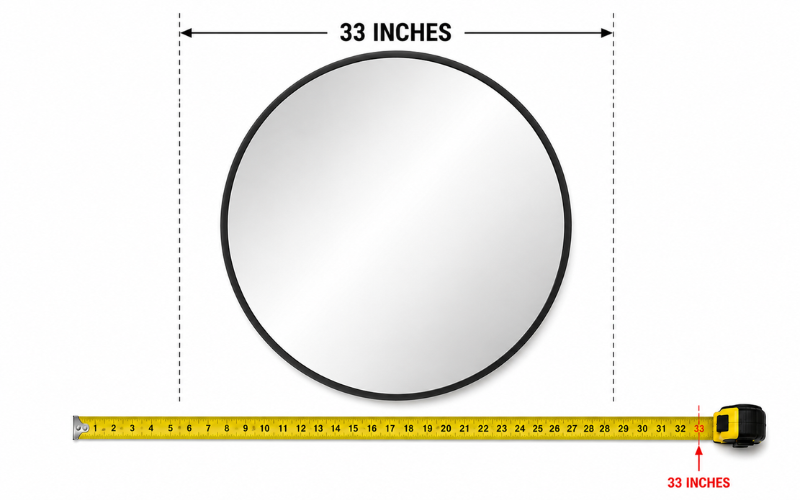
A round wall mirror provides another easy visual comparison.
In this case, 33 inches usually describes the diameter of the mirror. The diameter is the straight-line distance from one edge of the circle through the center to the opposite edge.
Imagine placing a measuring tape across the center of a circular mirror. If the measurement from one outside edge to the other is 33 inches, the mirror has a 33-inch diameter.
How Big Is a 33-Inch Mirror?
A mirror is large enough to become a noticeable feature on a wall without being as wide as many full-length or oversized decorative mirrors.
The circular shape also makes it a useful example of why measurements need context. Its diameter is not the same thing as a 33-inch straight object, even though both involve the same numerical measurement.
If you are trying to visualize it on a wall, a round mirror is an especially helpful example.
10. A 33-Inch Wall Clock 🕒
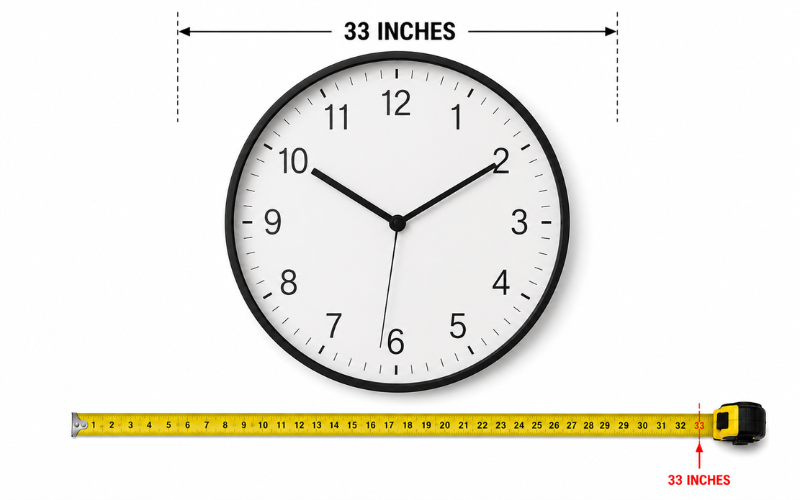
Large decorative and statement wall clocks are sometimes available with diameters around 33 inches.
A 33-inch clock is quite different from a small desk clock. At almost 3 feet across, it can become a prominent feature in a living room, office, dining area, hallway, or commercial space.
Again, the 33-inch measurement generally refers to the clock’s diameter.
Visualizing the Clock
Think of a large circular clock mounted on a wall. From the leftmost edge to the rightmost edge, it spans about 2 feet 9 inches.
That is a useful way to understand how much space 33 inches can occupy.
A 33-inch wall clock can also help you visualize the difference between length and diameter. Although the object is circular, its widest point still measures 33 inches.
11. A 33-Inch Ceiling Fan 🌬️
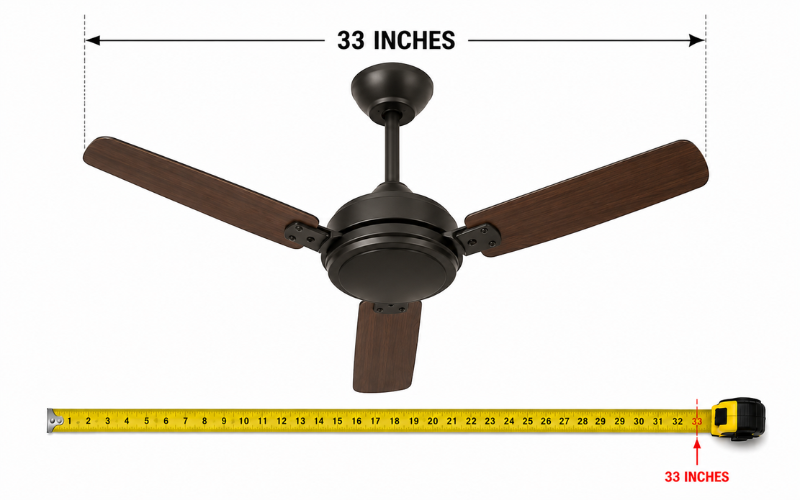
Small ceiling fans can be available with an overall blade span of approximately 33 inches.
The measurement of a ceiling fan is usually based on the diameter or blade-span measurement from one side of the rotating area to the opposite side. Exact sizing varies by fan design.
A fan is considerably smaller than many common full-size ceiling fans, which makes it useful for compact rooms and spaces where a larger fan would be impractical.
Why Fan Size Is Worth Understanding
When shopping for a ceiling fan, simply knowing that it is “33 inches” is not always enough. You should confirm what the manufacturer means by the measurement.
It may refer to:
- Blade span
- Overall housing dimensions
- Mounting dimensions
- Another specified measurement
For room-planning purposes, the blade span is generally the most useful dimension to consider.
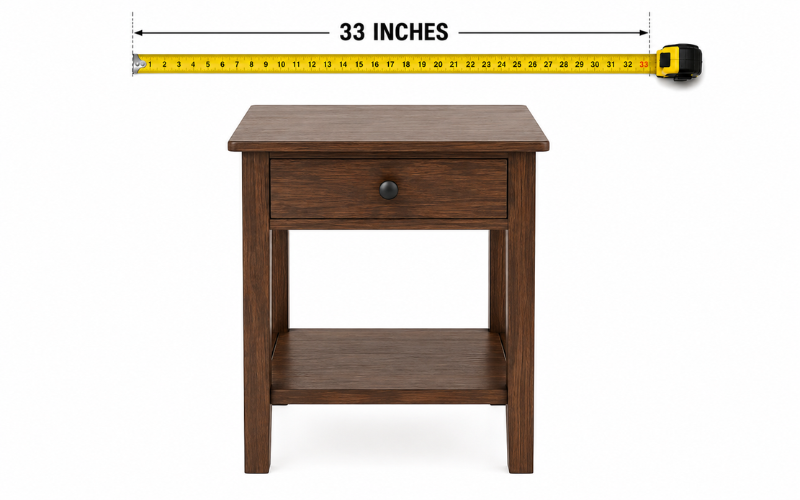
12. A Small Side Table 🪑
A small side table around 33 inches wide or in diameter can also provide a good real-world comparison.
Side tables vary enormously in design. Some are compact and square, while others are round, rectangular, or unusually shaped. A table with a width or diameter of approximately 33 inches is large enough to provide useful surface space but still relatively compact compared with a dining table.
Imagine standing beside a circular or square table measuring 33 inches across. The distance from one side to the opposite side is just 3 inches shorter than 3 feet.
Where a 33-Inch Table Can Work
A table around this size may be useful as:
- A living-room accent table
- A small game table
- A plant table
- A decorative display table
- A compact workspace
- A bedside or occasional table
The exact suitability depends on its height, shape, and intended purpose.
33 Inches Compared With Common Measurements
Understanding 33 inches becomes easier when you compare it with measurements you already know.
| Measurement | Equivalent |
| 33 inches | 2 feet 9 inches |
| 33 inches | 2.75 feet |
| 33 inches | 83.82 cm |
| 33 inches | 838.2 mm |
| 36 inches | 3 feet |
| 33 inches compared with 36 inches | 3 inches shorter |
The last comparison is particularly easy to remember:
33 inches = 3 feet minus 3 inches.
That simple relationship can help when you don’t have a measuring tape nearby.
Why 33 Inches Is a Useful Measurement
Thirty-three inches appears in many different contexts because it is a practical middle-sized dimension.
It is:
- Long enough for many sports and recreational items
- Wide enough for certain household fixtures
- Large enough for decorative wall objects
- Small enough to fit into many compact spaces
- Easy to compare with a 3-foot measurement
The measurement also demonstrates how the same number can describe completely different dimensions.
For example, a 33-inch baseball bat is measured along its length, while a 33-inch tire is measured across its diameter. A 33-inch cabinet may refer to width, and a 33-inch wall clock may refer to diameter.
So whenever you see “33 inches,” it is important to ask what part of the object is being measured?
How to Measure 33 Inches Correctly 📏
If you need an object to be approximately 33 inches, using a measuring tape is the most reliable approach.
Start at the 0-inch mark, not at the physical end of the tape housing. Extend the tape to the other end of the object and check where it reaches.
For a straight object such as a bat or cane, keep the tape aligned with the longest dimension.
For a circular object such as a mirror or clock, measure straight across the center from one edge to the opposite edge.
Measuring Curved or Irregular Objects
Some objects are more difficult to measure because their shape is curved.
In those cases, decide whether you need:
- Overall length
- Straight-line distance
- Diameter
- Width
- Height
- Circumference
These measurements are not interchangeable.
For example, a circular object can have a 33-inch diameter but a much larger circumference.
Can You Estimate 33 Inches Without a Ruler?
Yes, although an estimate will not be as accurate as a measuring tape.
Since 33 inches equals 2 feet 9 inches, you can use a known 3-foot object and mentally subtract approximately 3 inches.
Another simple method is to visualize three 11-inch sections:
11 + 11 + 11 = 33 inches.
You can also remember that 33 inches is approximately 84 centimeters.
If precision matters, such as when installing furniture, cutting material, selecting a replacement part, or checking whether an object will fit, always use an actual measuring tool.
33 Inches vs. 30 Inches
Three inches may not sound like much, but the difference can be noticeable.
A 30-inch object is:
- 2 feet 6 inches long
- About 76.2 cm
A 33-inch object is:
- 2 feet 9 inches long
- About 83.82 cm
So 33 inches is 10% longer than 30 inches.
For furniture, sports equipment, and storage spaces, those extra 3 inches can be important.
33 Inches vs. 36 Inches
The comparison with 36 inches is even easier.
Since 36 inches equals exactly 3 feet, a 33-inch object is simply:
3 inches shorter than 3 feet.
If you have a yardstick, measuring stick, or another 36-inch reference, you can use it to approximate 33 inches by leaving a 3-inch gap.
This is one of the easiest mental references for the measurement.
33 Inches in Everyday Life
You might encounter a 33-inch measurement when shopping for sports equipment, home furnishings, vehicle components, decorative objects, or household fixtures.
The measurement can describe:
- Length, as with a baseball bat
- Diameter, as with a tire or round mirror
- Width, as with a cabinet or vanity
- Blade span, as with a ceiling fan
- Club length, as with a golf putter
That is why product descriptions should always be read carefully.
A statement such as “33 inches” by itself does not tell you whether the item is 33 inches tall, wide, long, or across.
A Simple 33-Inch Visual Guide
If you want a quick mental image, remember these three comparisons:
33 Inches Is Almost 3 Feet
It is only 3 inches shorter than 36 inches.
33 Inches Is About 84 Centimeters
If you normally use the metric system, think of a little less than 85 centimeters.
33 Inches Is 2 Feet 9 Inches
This is probably the easiest imperial measurement to remember.
Together, these comparisons make 33 inches much easier to visualize.
Interesting Facts About 33 Inches
There are a few simple facts that make this measurement easier to remember. 📐
- 33 inches is 2.75 feet.
- It is exactly 3 inches shorter than 3 feet.
- It is approximately 83.82 centimeters.
- It is approximately 838.2 millimeters.
- It is approximately 0.84 meters.
- Three equal sections of 11 inches add up to 33 inches.
- A 33-inch object is 10% longer than a 30-inch object.
- A 33-inch object is about 8.3% shorter than a 36-inch object.
These simple relationships are useful when estimating dimensions without immediately reaching for a calculator.
Things to Remember When Comparing 33-Inch Objects
The examples in this article are intended to help visualize the measurement, but real products can vary.
A baseball bat advertised at 33 inches is designed to be a specific length, while a 33-inch tire may have an actual measured diameter that differs slightly from its advertised size.
Similarly, furniture dimensions can vary by manufacturer, and decorative items may have measurements that include or exclude frames, handles, bases, or other components.
When exact dimensions matter, always check the manufacturer’s specifications and measure the actual item.
BioWiki Table: 33-Inch Objects at a Glance
| Item | Approximate Measurement | Type of Measurement | Common Use |
| Baseball Bat | 33 inches | Length | Baseball |
| Cricket Bat | Around 33 inches | Length | Cricket |
| Off-Road Tire | Around 33 inches | Diameter | Trucks/off-road vehicles |
| Golf Putter | 33 inches | Club length | Golf |
| Walking Cane | Around 33 inches | Overall length | Mobility support |
| Youth Hockey Stick | Around 33 inches | Length | Hockey |
| Kitchen Cabinet | Around 33 inches | Width | Kitchen storage |
| Bathroom Vanity | Around 33 inches | Width | Bathroom |
| Round Wall Mirror | 33 inches | Diameter | Home décor |
| Wall Clock | Around 33 inches | Diameter | Home décor |
| Ceiling Fan | Around 33 inches | Blade span | Home cooling |
| Small Side Table | Around 33 inches | Width/diameter | Furniture |
Frequently Asked Questions About 33 Inches
Is 33 Inches Exactly 2 Feet 9 Inches?
Yes. 33 inches is exactly 2 feet 9 inches because one foot contains 12 inches, and 24 + 9 equals 33.
How Many Centimeters Is 33 Inches?
33 inches equals 83.82 centimeters. For everyday estimation, you can round this to about 84 centimeters.
Is 33 Inches Close to 3 Feet?
Yes. 33 inches is only 3 inches shorter than 3 feet, since 3 feet equals 36 inches.
What Sports Equipment Is 33 Inches Long?
A 33-inch baseball bat and 33-inch golf putter are useful examples. Some cricket bats and youth hockey sticks can also be around this length, although exact dimensions vary.
Is a 33-Inch Tire Really 33 Inches?
Not necessarily. A tire marketed as a “33-inch tire” is generally referring to its approximate overall diameter. The actual measured diameter can vary depending on the tire model, wheel, inflation, load, and other factors.
What Household Items Can Be Around 33 Inches?
Household examples include 33-inch-wide cabinets, bathroom vanities, round mirrors, wall clocks, ceiling fans, and small tables. The exact dimension depends on the product.
How Can I Visualize 33 Inches Without a Measuring Tape?
Remember that 33 inches is 2 feet 9 inches, or 3 feet minus 3 inches. You can also think of it as three sections of 11 inches.
Is 33 Inches a Long Measurement?
It depends on what you are measuring. For a sports bat or golf club, 33 inches is a practical length. For furniture, 33 inches can be a moderate width. For a wall decoration, 33 inches can be quite large.
How Does 33 Inches Compare With 30 Inches?
33 inches is 3 inches longer than 30 inches, making it 10% longer overall.
How Does 33 Inches Compare With 36 Inches?
33 inches is 3 inches shorter than 36 inches, which is exactly 3 feet.
Can I Use a 33-Inch Object as a Measuring Reference?
Yes, if the object’s actual dimension is known and consistent. A 33-inch baseball bat, for example, can provide a useful reference. However, use a measuring tape when accuracy is important.
Why Do Different Objects Use 33 Inches for Different Dimensions?
Because an object’s most useful measurement depends on its shape and purpose. A bat is measured by length, a tire by diameter, a cabinet by width, and a ceiling fan by blade span.
Related Posts
- 10 Common Things That Are 32 Inches Long
- 10 Common Things That Are 31 Inches Long
- 10 Common Things That Are 30 Inches Long
- 10 Common Things That Are 29 Inches Long
Final Thoughts
It is a surprisingly easy measurement to understand once you connect it with familiar objects. It is equal to 2 feet 9 inches, 83.82 centimeters, or 0.8382 meters, making it just slightly shorter than 3 feet.
A baseball bat, golf putter, and appropriately sized cricket bat can help you visualize the measurement as a straight length. Meanwhile, a tire, round mirror, or wall clock shows how the same measurement can describe a diameter. Household examples such as cabinets, bathroom vanities, ceiling fans, and small tables demonstrate how 33 inches can also represent width or span.
The most important thing to remember is that 33 inches is not tied to one particular type of object. It can describe length, width, diameter, height, or another dimension depending on the item.
So the next time you see a product described as 33 inches, think 2 feet 9 inches or about 84 centimeters. That simple reference makes the measurement much easier to picture and can help you make better decisions when comparing sizes, planning spaces, or checking whether something will fit. 📏
FOR MORE MEASUREMENTS VISIT: MEASURINGSPOT