
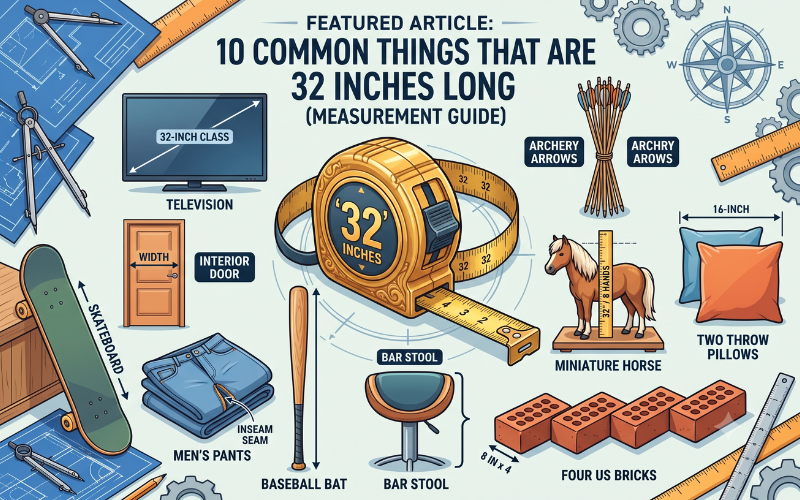
Understanding measurements can be challenging when you do not have a tape measure on hand. Often, the easiest way to figure out the size of a space or an object is by comparing it to something you already know.
If you are trying to figure out what 32 inches looks like in the real world, you are looking at a measurement that equals exactly 81.28 centimeters, or roughly 2.66 feet. This specific length is incredibly common in manufacturing, clothing, home construction, and sports equipment. It strikes a balance between being large enough to serve a functional purpose but compact enough for easy handling.
This guide will break down ten everyday items that measure exactly or approximately 32 inches. By relating this number to tangible objects, you will be able to estimate lengths accurately without ever needing a ruler.
Quick Section: 32-Inch Items at a Glance ⚡
If you need the information fast, here is a rapid rundown of common items that measure exactly or very close to 32 inches in length or height:
- Television Screens: A standard 32-inch class TV (measured diagonally).
- Interior Doors: Standard bedroom and bathroom doors.
- Men’s Pants: The classic 32-inch inseam.
- Skateboards: Standard street deck length.
- Baseball Bats: Typical high school and adult size.
- Bar Stools: Standard seat height for commercial bars.
- Red Bricks: Four standard US bricks placed end-to-end.
- Archery Arrows: Standard adult target arrow length.
- Miniature Horses: Maximum height requirement (8 hands).
- Throw Pillows: Two standard 16-inch pillows placed side-by-side.
BioWiki Table: 32-Inch Reference Guide 📊
Use this reference table to quickly understand the context and precise measurements of the items discussed in this guide.
| Item | Category | Exact / Approximate | Additional Context |
| Television Screen | Electronics | Exact (Diagonal) | Actual width is usually around 27.9 inches. |
| Interior Door | Construction | Exact | Listed architecturally as a “2/8” door (2 feet, 8 inches). |
| Pants Inseam | Clothing | Exact | Fits average male heights (5’10” – 6’1″). |
| Skateboard Deck | Sports Gear | Approximate | Ranges from 31.5 to 32.5 inches. |
| Baseball Bat | Sports Gear | Exact | Standard drop-3 bat weighs 29 ounces. |
| Bar Stool Height | Furniture | Exact | Pairs with 40 to 42-inch high counters. |
| Four US Bricks | Building | Exact (End-to-End) | Nominal length of one brick is 8 inches. |
| Archery Arrow | Sports Gear | Approximate | Cut to fit standard adult draw lengths. |
| Miniature Horse | Animal | Approximate | 32 inches equals 8 “hands” in equine terms. |
| Two Throw Pillows | Home Decor | Exact (Combined) | Standard 16×16 decorative pillows. |
1. A 32-Inch Television Screen 📺
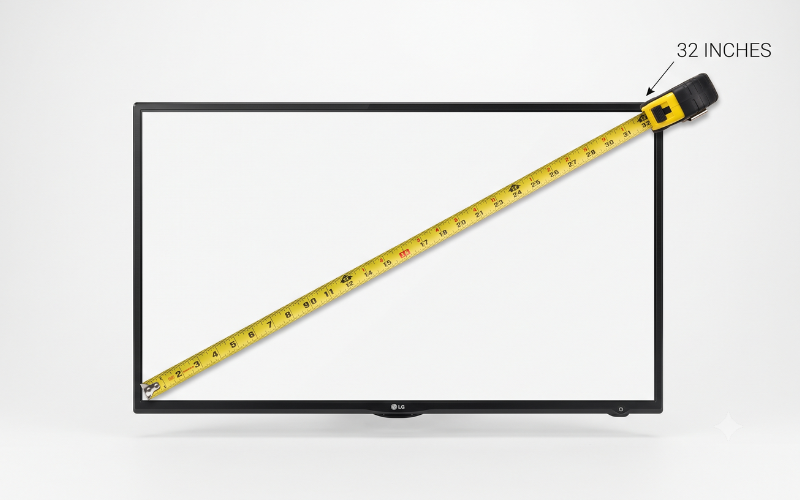
When people think of the number 32, one of the first objects that comes to mind is a television. For many years, the 32-inch screen was the standard size for living rooms around the world. Even as massive screens take over home theaters, this size remains highly popular for bedrooms, kitchens, and dorm rooms.
The Diagonal Measurement Rule
It is vital to understand how screens are measured. The 32 inches does not refer to the horizontal width of the television. Instead, screens are measured diagonally from one corner to the opposite corner. If you take a tape measure from the bottom left corner of the screen (ignoring the plastic bezel) to the top right corner, you will get exactly 32 inches.
Because modern televisions use a 16:9 widescreen aspect ratio, the actual horizontal width of a 32-inch TV is about 27.9 inches, and the vertical height is about 15.7 inches. Knowing this difference is highly useful if you are trying to fit a new television inside a custom cabinet or a tight shelving unit.
Evolution of TV Sizes
Back in the era of CRT (cathode-ray tube) televisions, a 32-inch set was considered a massive, premium luxury item. These older televisions weighed over 100 pounds and took up a significant amount of floor space. Today, thanks to LED and OLED technology, a 32-inch television weighs less than ten pounds and can be mounted flush against a wall. It serves as a perfect, easily recognizable benchmark for visualizing lengths.
2. Standard Interior Door Width 🚪
If you are sitting in a house or an office right now, you likely have a perfect 32-inch measuring tool right next to you. In residential construction, interior doors follow strict sizing standards to ensure consistency across the building industry.
Architectural Standards
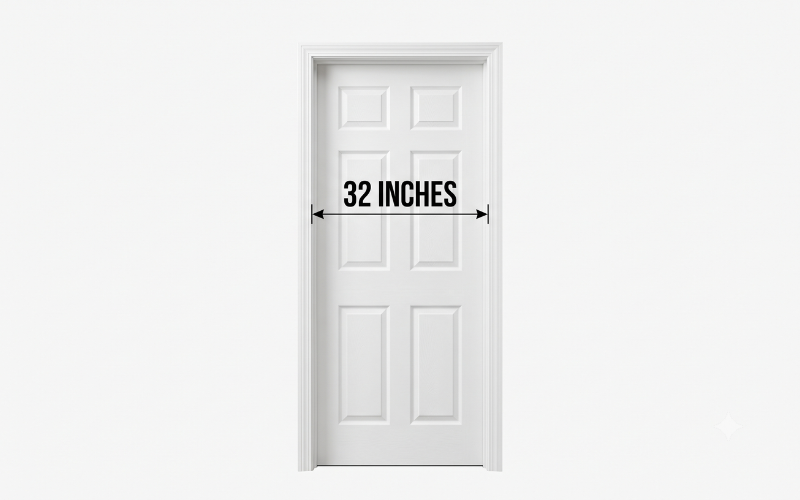
The most common width for a standard interior door—such as those used for bedrooms, bathrooms, and closets—is 32 inches. In the construction trade, contractors and architects often refer to this as a “2/8 door,” which translates to 2 feet and 8 inches.
When visualizing this, remember that the 32 inches refers to the physical door slab itself. The door frame, hinges, and the rough opening cut into the drywall will be slightly wider, usually by about two inches.
Accessibility and Clearances
While 32 inches is standard for older homes and general interior use, modern accessibility guidelines often prefer slightly wider spaces. The Americans with Disabilities Act (ADA) requires a “clear width” of 32 inches for wheelchairs to pass through comfortably. To achieve a 32-inch clear opening when a door is open at a 90-degree angle, the actual door slab usually needs to be 36 inches wide. However, for everyday visualization, looking at the width of a standard bedroom door will give you a highly accurate sense of what 32 inches looks like.
3. The Classic Men’s Pants Inseam (32L) 👖
Shopping for men’s clothing relies heavily on two specific numbers: the waist and the inseam. The inseam measurement dictates the length of the pant leg, and the 32-inch inseam is arguably the most common size found on retail shelves worldwide.
Understanding the Inseam
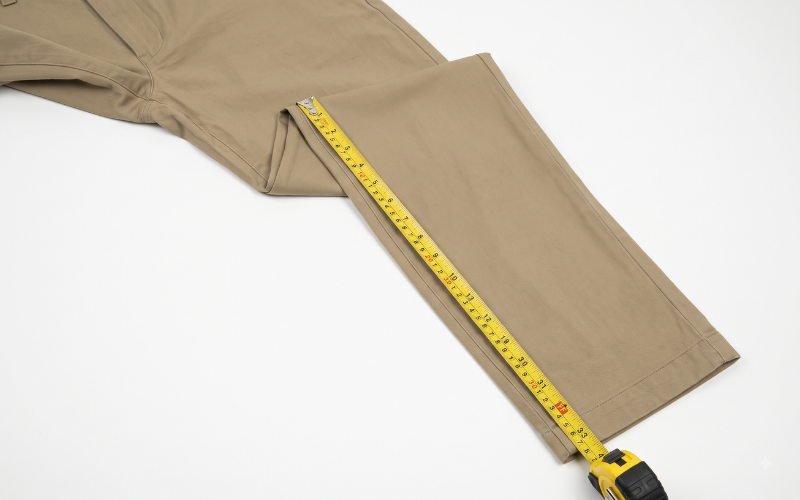
The inseam is measured from the crotch seam (where the fabric intersects between the legs) down the inside of the leg to the bottom hem of the pants. If you grab a pair of men’s jeans that have a “32L” on the tag, that internal leg seam is exactly 32 inches long.
This length is considered the industry standard because it comfortably fits men of average height, typically those standing between 5 feet 10 inches and 6 feet 1 inch, depending on their torso length and how they prefer their pants to break over their shoes.
Why 32 is the Golden Standard
Clothing manufacturers build their inventory around the bell curve of human height. Producing pants with a 32-inch inseam guarantees a product that fits the largest demographic of consumers. If you ever need to visualize 32 inches, simply look at the leg length of an average pair of men’s jeans. Stretching that pant leg tight against a flat surface gives you an excellent, makeshift measuring tape.
4. Standard Skateboard Deck Length 🛹
Skateboarding culture has its own set of precise hardware standards. While skateboards come in many shapes—from tiny penny boards to massive longboards—the traditional “street” skateboard deck has a very specific length standard.
Anatomy of a Skateboard
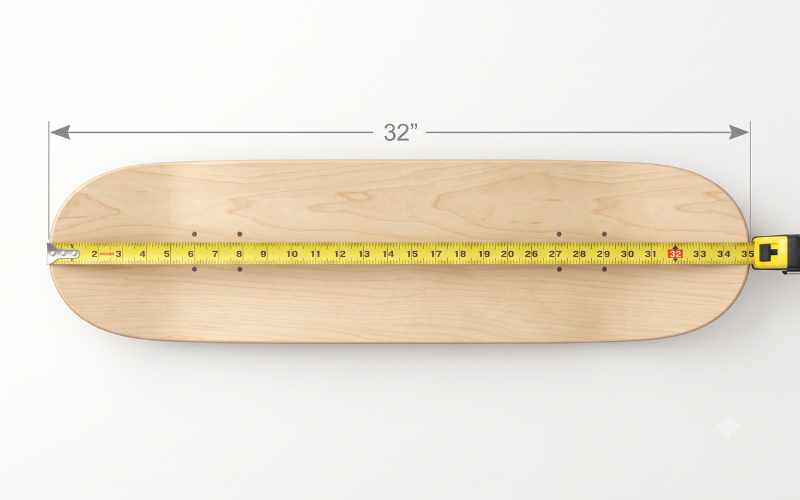
A standard street skateboard is typically between 31.5 and 32.5 inches long. For visualization purposes, assuming a skateboard is 32 inches from the tip of the nose to the edge of the tail is incredibly accurate.
This specific length allows the rider to have a wide enough stance for balance while keeping the board short enough to easily flip, spin, and maneuver. The length is divided into three main sections: the nose (front), the wheelbase (the flat middle section between the trucks), and the tail (back).
Length Versus Width
Interestingly, while the length of a skateboard hovers consistently around 32 inches, skaters usually choose their boards based on width. Board widths vary from 7.5 inches to 8.5 inches. However, no matter what width a street skater prefers, the overall length of the wooden deck remains locked right around that 32-inch mark, making it a reliable visual reference.
5. High School and College Baseball Bats ⚾
Baseball is a game of inches, and the equipment used is manufactured to incredibly strict specifications. As players grow out of youth leagues and move into high school and collegiate sports, the size of their baseball bat changes to match their physical development.
The BBCOR Standard
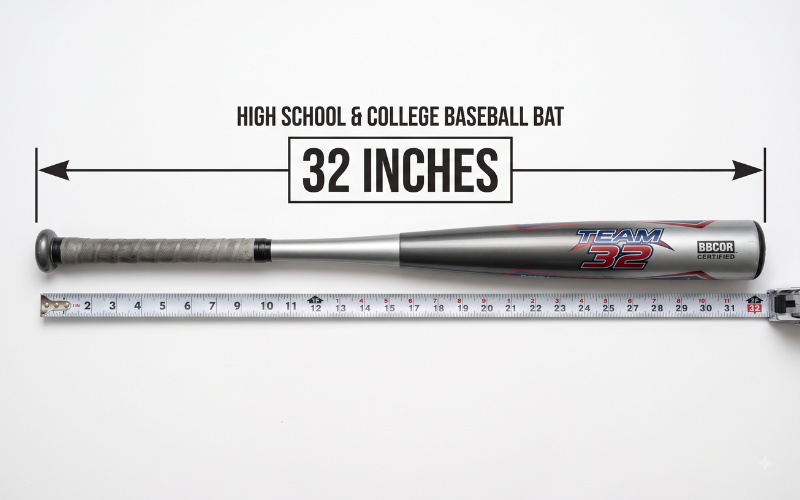
In high school and college baseball, players are required to use bats that meet BBCOR (Bat-Ball Coefficient of Restitution) standards. The most common size chosen by players in these leagues is a bat that is exactly 32 inches long.
A 32-inch bat provides the perfect balance of plate coverage and swing speed for a developing athlete. When stood upright on the ground, a 32-inch baseball bat will typically reach the upper thigh or hip area of an average adult.
The Drop Weight Ratio
When you see a bat listed as 32 inches, you will usually see a “-3” next to it. This is known as the “drop weight.” It means the bat weighs three ounces less than its length in inches. Therefore, a standard 32-inch baseball bat weighs exactly 29 ounces. Knowing the exact dimensions of this common piece of sporting equipment makes it an excellent real-world measuring tool.
6. Traditional Bar Stool Height 🪑
Furniture design is entirely based on standard human ergonomics. If furniture measurements vary too wildly, tables become unusable and chairs become uncomfortable. Because of this, seating heights are strictly standardized, giving us another great 32-inch reference point.
Counter Height vs. Bar Height
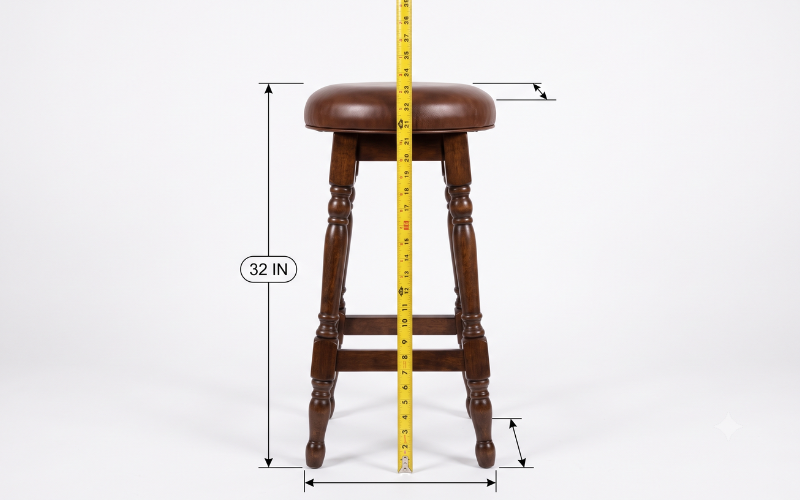
It is necessary to differentiate between different types of high seating. “Counter height” stools, meant for standard kitchen islands, usually have a seat height of 24 to 26 inches. However, true “bar height” stools—the kind you find in commercial restaurants, pubs, and basement bars—have a seat that rests between 30 and 32 inches off the ground.
Ergonomics of Seating
Why 32 inches? A standard commercial bar top is built 40 to 42 inches off the floor. Human ergonomics dictate that we need about 10 to 12 inches of space between our seat and the surface we are eating or drinking on. A 32-inch stool perfectly accommodates a 42-inch bar top, allowing enough room for the legs to rest comfortably without feeling squeezed. If you stand next to a commercial bar stool, the seat will likely hit you exactly 32 inches up your leg.
7. Four Standard US Red Bricks 🧱
Sometimes, finding a 32-inch measurement requires doing a little bit of simple math with highly standardized building materials. The traditional red clay brick used in American construction is a perfect example of modular design.
The Modular Brick System
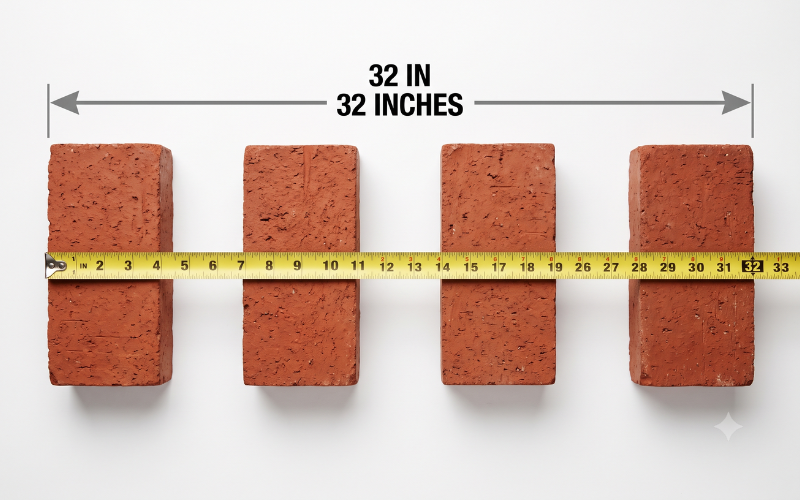
In the United States, the standard modular brick has a nominal length of exactly 8 inches. Its height is 2.25 inches, and its depth is 3.625 inches. Because the length is exactly 8 inches, you can easily multiply this to estimate larger distances.
If you take four standard US bricks and lay them end-to-end on the ground, they will measure exactly 32 inches long (8 inches x 4 = 32).
Construction Math
It is worth noting the difference between “nominal” and “actual” sizes in masonry. The actual physical length of a single brick is often 7.625 inches. The remaining 3/8 of an inch is allocated for the mortar joint. When masons lay bricks, the combination of the brick and the mortar joint equals 8 inches. So, four bricks laid in a wall with their mortar joints will span precisely 32 inches of horizontal space.
8. Adult Target Archery Arrows 🏹
Archery relies on precise body mechanics, and the equipment must be tailored to the specific size of the archer. One of the most common standard sizes for sporting equipment in this field revolves around our magic number.
Calculating Draw Length
An arrow’s length is determined by the archer’s “draw length,” which is the distance they pull the bowstring back. To find a person’s draw length, you measure their wingspan (arm tip to arm tip) and divide by 2.5. For a tall adult male with a wingspan of 75 inches, their draw length is 30 inches.
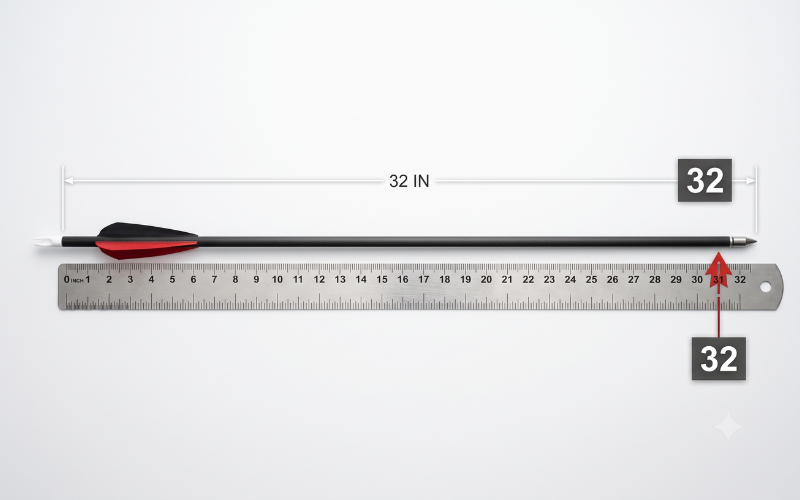
For safety reasons, arrows must be cut slightly longer than the draw length so they do not fall off the arrow rest when fully drawn. Therefore, standard full-length adult arrows, particularly for target practice, are very commonly cut to 32 inches.
Arrow Materials and Spines
Whether made from carbon fiber, aluminum, or traditional wood, you will find raw arrow shafts sold in bulk at 32-inch lengths. Archers buy these 32-inch shafts and then trim them down if they need a shorter arrow. If you hold a raw, uncut carbon arrow shaft, you are holding a perfect 32-inch measuring stick.
9. The Height of a Miniature Horse (8 Hands) 🐴
Moving into the animal kingdom, we find that the 32-inch measurement serves as an important classification threshold in the equestrian world.
Measuring Equines in Hands
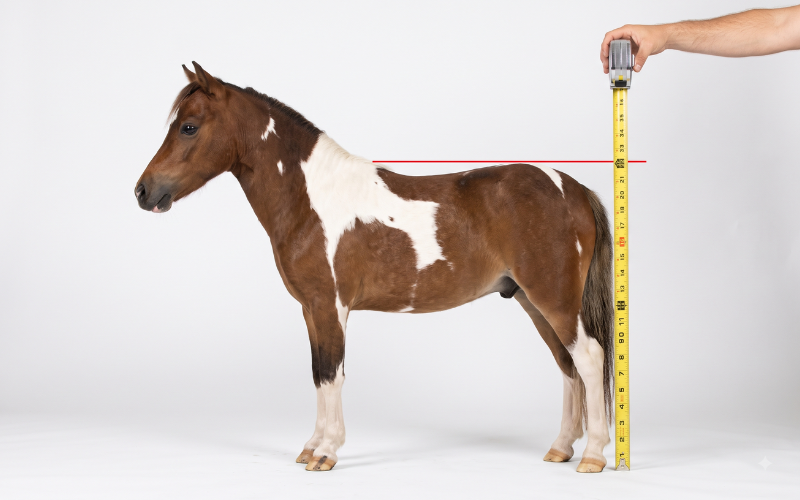
Horses are not measured in feet or inches; they are measured in “hands.” This traditional unit of measurement dates back centuries and is based on the width of an adult human male’s hand. Today, one “hand” is standardized to equal exactly four inches. Horses are measured from the ground to the highest point of their withers (the ridge between their shoulder blades).
If you do the math, 8 hands multiplied by 4 inches equals exactly 32 inches.
Breed Standards and Characteristics
This 32-inch measurement is highly significant. In many equestrian registries, a horse must be under a certain height to be officially classified as a miniature horse rather than a pony. The American Miniature Horse Association requires that animals stand no taller than 34 inches, making a 32-inch height (8 hands) incredibly common for these animals. Visualizing an animal that comes up to your mid-thigh is a fun and unique way to estimate this measurement.
10. Two 16-Inch Throw Pillows 🛋️
For our final item, we look at interior decorating. Standardized sizes in textiles make manufacturing pillow inserts and covers much easier for the global market.
Interior Design Basics
When buying decorative throw pillows for a sofa or a bed, the most ubiquitous size available is the 16×16 inch square. This size is large enough to show off decorative patterns but small enough not to overwhelm standard seating furniture.
Styling Your Space
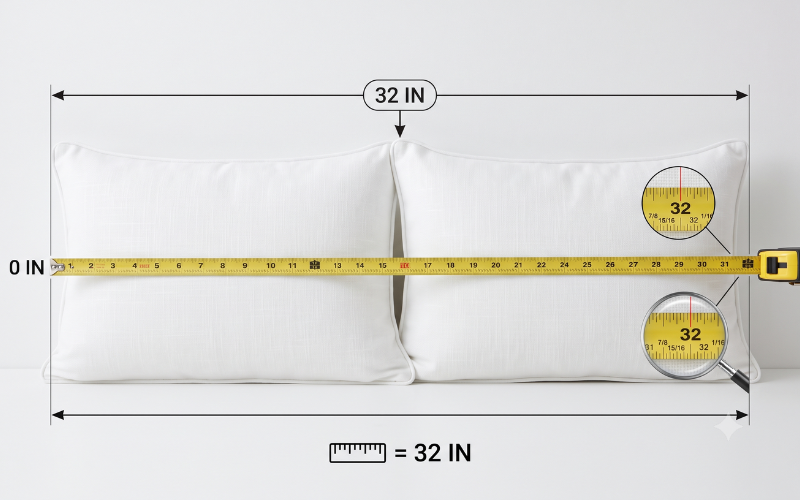
If you take two standard 16-inch throw pillows and place them side-by-side on your couch so their edges touch, the total width they cover will be exactly 32 inches. This is a very helpful mental trick when shopping for furniture. If you know you want to buy a small loveseat or a bench and you want to visualize the seating space, just picture how many 16-inch pillows could sit side-by-side on it. Two pillows equal 32 inches, three pillows equal 48 inches, and so on.
Practical Ways to Estimate 32 Inches 📐
If you find yourself needing to measure a space and you do not have any of the ten items listed above, you can still estimate 32 inches using your body or everyday surroundings.
Using Your Body
Human proportions are surprisingly consistent. For an adult of average height (around 5 feet 8 inches to 5 feet 10 inches), 32 inches is roughly the distance from the floor to the top of your hip bone.
Another trick is the “arm span” method. For most adults, the distance from the tip of your fingers to the center of your chest is roughly 36 inches (one yard). If you extend your arm and look at the spot a few inches back from your fingertips, you will be looking at roughly 32 inches.
Using Common Objects
You can also use standardized paper to find 32 inches. A standard piece of US Letter paper is 11 inches long. If you place three pieces of paper end-to-end, you get 33 inches. Simply overlap the last piece by one inch, and you have a perfect 32-inch template.
Similarly, standard floor tiles are often 16×16 inches. Standing across two of these standard square tiles will give you a 32-inch footprint.
Why 32 Inches is a Manufacturing Sweet Spot 🏭
You might wonder why so many things—from pants to doors to skateboards—happen to measure exactly 32 inches. The answer lies in a combination of historical mathematics and human proportions.
The Imperial System Legacy
In the imperial system, numbers that are easily divisible are favored. Thirty-two is a highly divisible number. You can halve it to 16, halve that to 8, halve that to 4, then 2, then 1. This makes mathematical calculations in construction and manufacturing incredibly simple. When carpenters are laying out studs for a wall, standard spacing is often 16 inches on center. Two stud bays equal exactly 32 inches. This mathematical cleanliness makes 32 a preferred number for engineers and designers.
Human Proportions
Furthermore, objects are built to fit humans. A 32-inch door is exactly wide enough for an adult carrying a box to walk through without turning sideways. A 32-inch pant leg fits the natural bone structure of the majority of the male population. A 32-inch baseball bat fits the swing mechanics of a young adult. The measurement is not arbitrary; it is a direct reflection of our own physical scale.
Frequently Asked Questions (FAQs) ❓
How many centimeters are in 32 inches?
There are exactly 81.28 centimeters in 32 inches. To convert inches to centimeters, you multiply the number of inches by 2.54.
Is 32 inches equivalent to 3 feet?
No, 32 inches is not 3 feet. One foot contains 12 inches. Therefore, 3 feet is equal to 36 inches. 32 inches is exactly 2 feet and 8 inches, making it four inches shy of a full three feet.
How can I measure 32 inches without a tape measure?
The easiest way is to use a standard interior bedroom door, as they are typically 32 inches wide. You can also lay out three sheets of standard US Letter paper (11 inches long each) and subtract one inch from the total length. Alternatively, find a pair of men’s pants with a 32-inch inseam and measure along the inside leg seam.
What size box do I need to ship a 32-inch item?
If your item is exactly 32 inches long (like a baseball bat or a skateboard), you will need a box that is at least 34 to 36 inches long. This extra space allows room for protective packing materials like bubble wrap or packing peanuts at both ends of the item to prevent transit damage.
Is a 32-inch waist the same as a 32-inch inseam?
No. While they share the same number, they measure completely different parts of the body. A 32-inch waist measures the circumference around the midsection or hips. A 32-inch inseam measures the vertical length from the crotch down to the ankle.
Related Posts
- 10 Common Things That Are 20 Inches Long
- 12 Common Things That Are 19 Inches Long
- 12 Common Things That Are 18 Inches Long
- 10 Common Things That Are 17 Inches Long
Final Thoughts 🎯
Visualizing measurements without a tape measure is a highly practical skill for everyday life. By anchoring numbers to physical objects, you build a mental catalog of sizes. The next time someone asks you how wide a hallway is, or if a piece of furniture will fit in a specific corner, you won’t need to guess. You can simply look at the space and ask yourself: Could a standard bedroom door fit there? Could I lay a skateboard across that gap?
By keeping these ten common 32-inch items in mind—from televisions and bar stools to baseball bats and bricks—you will always have a reliable frame of reference ready to go.
FOR MORE MEASUREMENTS VISIT: MEASURINGSPOT