
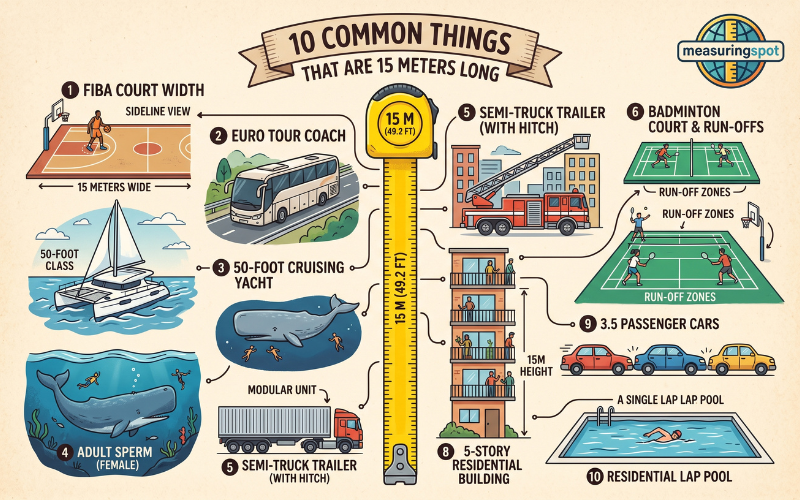
When you look at a blueprint, an athletic court, or a shipping lot, measurements can feel abstract. Numbers on paper do not always translate into what your eyes see on the street. If someone asks you, “How Long is 15 Meters?”, the short mathematical answer is straightforward: 15 meters equals exactly 49.21 feet, 16.4 yards, or 1,500 centimeters.
In practical reality, that distance covers roughly five full stories of a standard residential building laid flat on the ground, or three and a half standard family sedans parked bumper to bumper.
Whether you are planning a landscape project, estimating construction space, or just curious about real-world scales, comparing dry dimensions to everyday items makes physical space intuitive. Let us explore the exact equivalents of this distance and examine 10 common things that measure right around 15 meters in length 🚗.
Quick Reference: How Long is 15 Meters at a Glance?
If you need a fast conversion chart before looking at real-life items, here is how 15 meters translates across major measurement systems:
- In Feet: 49.2126 ft (roughly 49 feet and 2.5 inches)
- In Yards: 16.404 yd
- In Centimeters: 1,500 cm
- In Millimeters: 15,000 mm
- In Inches: 590.55 inches
- Average Human Paces: Approximately 19 to 21 normal walking strides for an adult
- Vertical Perspective: Equivalent to the height of an average 4.5 to 5-story apartment complex
BioWiki: Measurement Specifications & Quick Data
| Attribute | Specification Details |
| Measurement Unit | Meter ($m$) – Base unit of length in the International System of Units (SI) |
| Imperial Equivalent | 49 feet, 2.55 inches (49.21 ft) |
| Distance in Yards | 16.404 yards |
| Metric Subdivisions | 1,500 centimeters / 15,000 millimeters |
| Time to Walk (Normal Pace) | Approximately 10.5 to 12.0 seconds at 1.4 m/s |
| Direct Sports Analogy | Width of an international FIBA basketball court |
| Direct Maritime Analogy | 50-foot mid-size cruising sailboat or motor yacht |
| Direct Heavy Transport Analogy | Standard European three-axle long-distance touring coach |
| Visual Benchmark | 3.3 to 3.5 family cars parked bumper-to-bumper |
10 Common Things That Are 15 Meters Long
1. Standard FIBA Basketball Court (Width)
While an NBA court is measured in imperial units (50 feet wide, which equals 15.24 meters), the International Basketball Federation (FIBA) officially defines the width of a standard competitive court as precisely 15 meters (49.2 feet).
If you have ever stood along the baseline under the basket and looked across from sideline to sideline, your line of sight covers this distance. The court boundary provides one of the cleanest, most accessible real-world templates for visualizing this exact measurement. It spans the full defensive perimeter where ten players spread out during set-piece plays.

2. European Multi-Axle Touring Coaches
Highway buses vary by region, but under standard European Union roadway regulations, the maximum allowable length for a rigid, non-articulated commercial bus or long-distance tour coach sits right at 15 meters.
These giant tri-axle vehicles handle high-volume intercity routes and guided holiday travel. When you watch one of these coaches overtake a lane on an open highway or maneuver through a rest stop parking bay, you are looking at a single vehicle whose body frame spans this complete distance.

3. A 50-Foot Cruising Yacht or Catamaran
In maritime manufacturing, mid-size ocean cruisers and recreational luxury sailing catamarans are classified in the 48-to-50-foot class. 50 feet translates to 15.24 meters, making these vessels virtually identical to our target length.
A 15-meter yacht provides enough deck space for multiple sleeping cabins, a full galley, and dual helm stations. Walking from the bow anchor roller to the stern swim platform takes an adult about twenty paced steps, making docks and boat slips an excellent place to observe the scale firsthand.

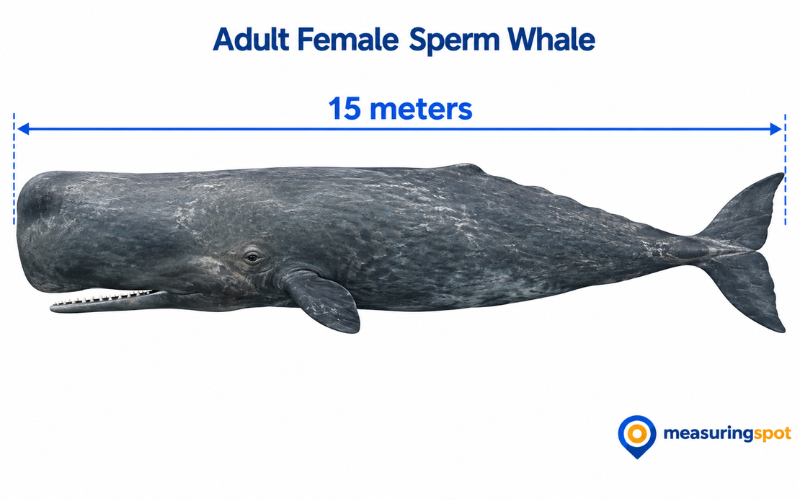
4. An Adult Female Sperm Whale
Nature produces some of the most striking physical benchmarks. While massive bull sperm whales can grow up to 18 meters or 20 meters, adult females and adolescent males consistently reach an average body length of 15 meters from their blunt snouts down to their tail flukes.
Floating horizontally beside a 15-meter marine animal provides a humbling sense of scale. A single mammal of this size can weigh upwards of 35 to 40 metric tons, showing how vast a 15-meter frame feels when filled with biological mass rather than open space.
5. Standard Semi-Truck Trailer (With Hitch Tongue)
On North American and international shipping routes, standard box trailers measure roughly 48 to 53 feet in box storage alone. A typical 48-foot trailer sits right at 14.63 meters. Once you factor in the front kingpin hitch area and the rear bumper crash guards, the complete modular unit spans nearly 15 meters.
Most people drive alongside these trailers every week on major freight highways. When you pass a standard shipping trailer, you are driving past an industrial steel box designed to exploit this precise measurement limit for efficient road transit.

6. The Overall Length of a Badminton Hall Court Zone
A standard competition badminton court has playing boundaries that measure 13.4 meters (44 feet) in length. However, official athletic venue guidelines mandate a minimum run-off clearance zone of at least 1.5 to 2 meters behind each back baseline to keep players from colliding with walls or seating.
When you include the court itself and the required safety zones at both ends, the dedicated floor footprint reaches between 15 and 15.5 meters. Anyone who has played recreationally in a community gym has moved back and forth within this functional zone.

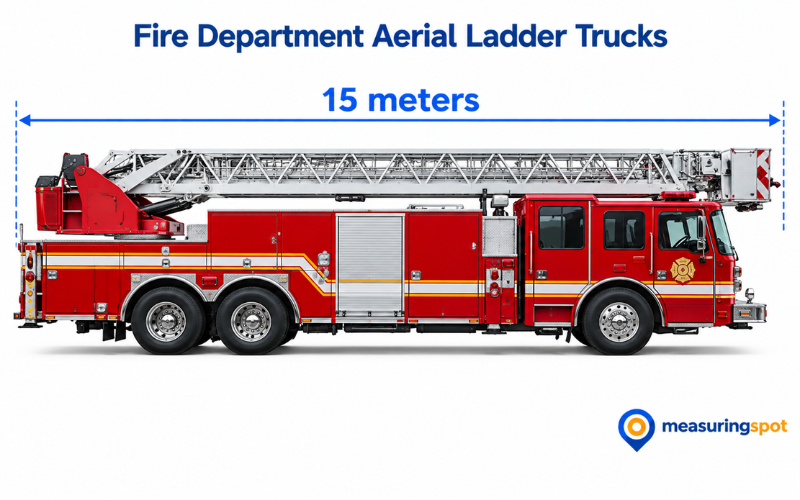
7. Fire Department Aerial Ladder Trucks
Urban fire engines designed with extended hydraulic ladders—often called tillers or straight-frame aerial trucks—are among the largest emergency vehicles on urban roads. The vehicle chassis alone routinely stretches between 14 meters and 15.5 meters from front bumper to rear tailboard.
These vehicles need this substantial structural footprint to counterbalance the hydraulic turntable ladder when it extends vertically to reach high-rise windows. Seeing a fire crew negotiate a tight corner at a downtown intersection demonstrates just how much street space a 15-meter vehicle demands.
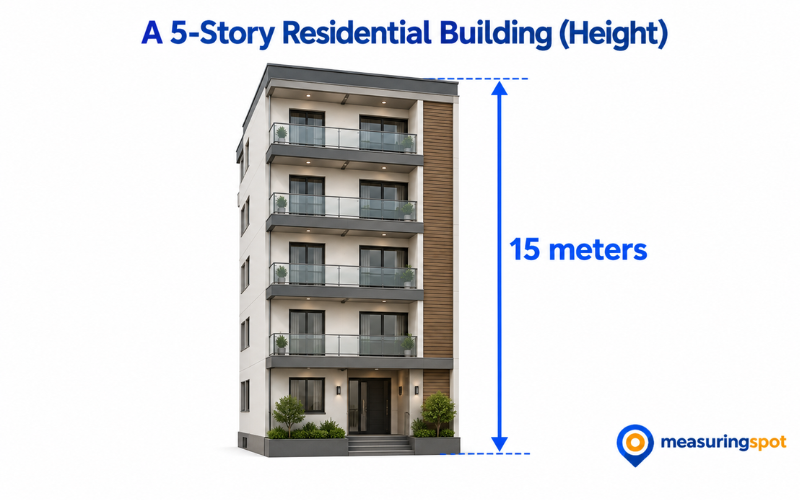
8. A 5-Story Residential Building (Height)
Visualizing 15 meters horizontally is easy when you relate it to vertical urban architecture. In typical residential construction, a single story accounts for roughly 3 meters (about 10 feet) of total clearance, factoring in interior room height, subfloors, concrete slabs, and ductwork.
Therefore, a 5-story building reaches right around 15 meters in vertical height. If you stand on the roof of a standard mid-rise apartment complex and look down to the sidewalk below, the drop you see corresponds to 15 meters.
9. Three and a Half Standard Passenger Cars
The typical modern mid-size sedan—such as a Toyota Camry, Honda Accord, or Volkswagen Passat—measures roughly 4.8 meters from front to rear.
If you park three full-size sedans tightly in a row with minimal bumper clearance, they take up about 14.4 meters. Adding just half the length of another compact hatchback brings the line to 15 meters. Because automobiles are present on every residential street, grouping three or four cars in your imagination serves as one of the most reliable visual estimation tricks.

10. A High-End Residential Lap Pool
While Olympic competition pools stretch an enormous 50 meters, luxury residential backyards and boutique fitness centers commonly install 50-foot training lap pools.
At roughly 15 meters long, these swimming pools provide enough linear distance for an amateur swimmer to perform 8 to 12 strokes per lap before executing a flip turn. It represents the gold standard length for private aquatic exercise where swimming endurance matters more than casual wading space.

Practical Tricks to Measure 15 Meters Without Equipment
You do not always have a 50-foot contractor’s tape measure in your pocket. If you need to map out a boundary line, a landscaping zone, or vehicle clearance on the fly, try these three reliable estimation techniques:
Using the Adult Stride Count
An average adult walking comfortably takes strides that measure approximately 0.75 meters (around 2.5 feet) from heel to heel.
- To measure 15 meters, walk in a straight line at a steady pace and count 20 paces.
- If you take deliberate, exaggerated marching steps (stretching to roughly 1 full meter per step), you can cover the distance in 15 purposeful strides.
Using Standard Concrete Parking Bays
Commercial parking spaces in modern parking lots follow standardized dimensions. In most public zones, a standard angled or perpendicular stall measures between 2.5 and 2.7 meters wide.
- If you walk across the painted stall markers of six side-by-side parking spaces, you cover between 15 and 16 meters.
Using Construction Utility Poles
Along suburban roads, utility poles and timber telephone lines are spaced systematically. While spacing varies depending on local wire tension, modern suburban secondary drops often place telephone poles roughly 30 meters to 35 meters apart.
- Half the distance between two standard utility poles gives you a reliable approximation of 15 meters to 17 meters.
Common Questions About 15-Meter Distances
How long does it take to run 15 meters?
An average healthy adult sprinting at full speed reaches velocities between 6 meters and 8 meters per second. Once acceleration is established, running 15 meters takes approximately 2.0 to 2.5 seconds. Even at a casual jogging pace, you can cover this distance in under 4 seconds.
Is 15 meters the same as 50 feet?
Not quite, though they are close enough for rough estimations. 15 meters equals 49.21 feet. A true 50-foot distance is actually 15.24 meters. The difference between them is roughly 9.5 inches (24 centimeters), which matters in structural engineering but is negligible for casual visual comparisons.
How many people holding hands would it take to span 15 meters?
A person’s wingspan (fingertip to fingertip with arms outstretched) roughly equals their standing height. For an average adult with a wingspan of 1.7 meters, allowing for overlapping hand grips:
- It takes about 9 to 10 adults standing side by side with linked hands to stretch across a 15-meter line.
How wide is a 15-meter road?
A standard highway travel lane is between 3.5 and 3.7 meters wide. A roadway spanning 15 meters across can accommodate a full four-lane avenue (two lanes traveling in each direction) or a two-lane street equipped with generous bike lanes and dedicated curbside parking on both sides.
Related Posts
- 10 Everyday Things That Measure 8 Meters Long/ Tall
- 10 Everyday Things That Measure 7 Meters Long/ Tall
- 10 Everyday Things That Measure 6 Meters Long/ Tall
- 10 Common Things That Are 5 Meters Long/ Tall
Conclusion 🏁
Understanding how long 15 meters is becomes simple once you anchor the measurement to everyday reference points rather than raw numbers. Whether you picture the full sideline-to-sideline width of an international basketball court, three and a half family sedans parked nose-to-tail, or the five-story drop of an apartment complex, this 49.2-foot span appears across sports, transportation, architecture, and the natural world. Keeping these physical benchmarks in mind ensures you can reliably estimate and visualize the distance in seconds, even without a tape measure in hand.
FOR MORE MEASUREMENTS VISIT: MEASURINGSPOT