
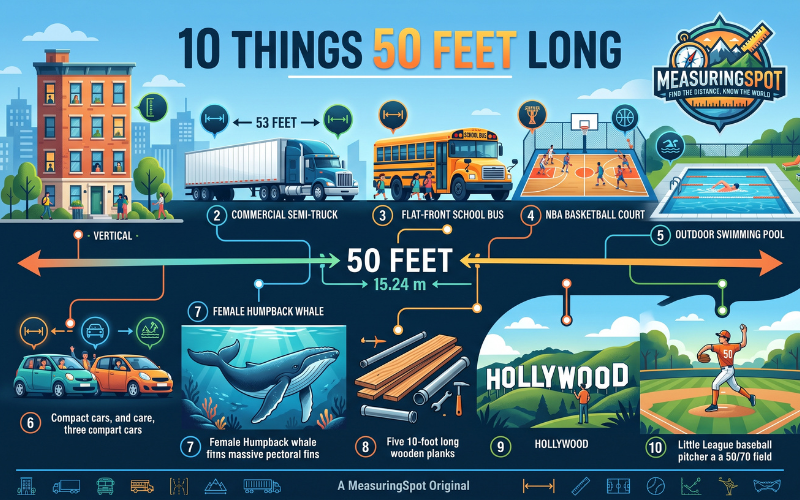
Fifty feet is one of those distances that sounds manageable on paper, yet catches most people completely off guard in the real world. When you hear that a property setback, a swimming pool, or a garden boundary is 50 feet, it is easy to assume it is just a brief stroll. In reality, stepping off 50 feet takes roughly 20 to 25 full adult paces. If you laid down on the pavement, you would need eight to nine average-sized adults lying head-to-toe to span that exact gap.
Whether you are sizing up a construction project, checking zoning laws, planning outdoor landscaping, or simply settling a trivia bet, having tangible real-world comparisons makes measuring distance intuitive. This guide breaks down exactly how long is 50 feet using concrete, familiar objects you encounter in daily life, sports, nature, and urban spaces.
Quick Reference Snapshot: Visualizing 50 Feet in Seconds ⏱️
Before exploring the details, use this quick conversion and reference overview to anchor the measurement in your mind:
- Inches: 600 inches
- Yards: 16.67 yards
- Meters: 15.24 meters
- Centimeters: 1,524 centimeters
- Average Adult Paces: 20 to 25 natural walking steps
- Standard Floor-to-Ceiling Stories: Approximately 5 residential stories tall (at 10 feet per story)
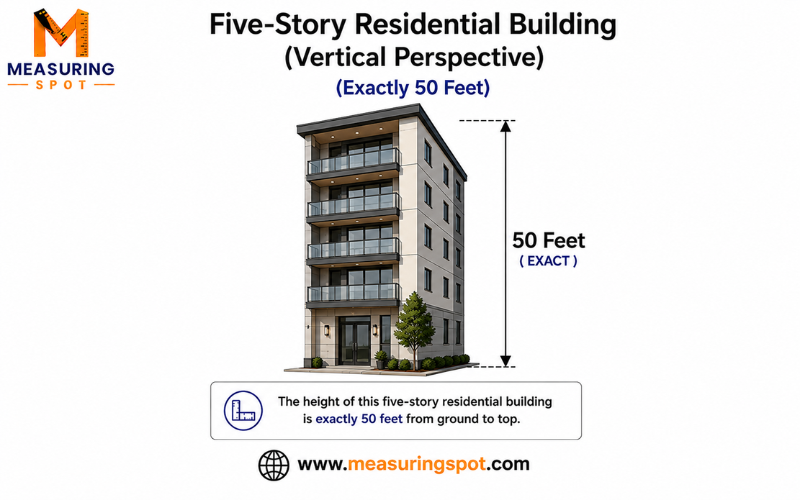
1. Five-Story Residential Building (Vertical Perspective) 🏢
When visualizing distance, human brains naturally judge horizontal lengths much better than vertical heights. Looking up at a five-story apartment complex gives you a direct, neck-straining appreciation of 50 feet.
The Architectural Math
In modern residential construction, standard ceiling heights run between 8 and 9 feet. Once you factor in the thickness of intermediate floor joists, ductwork layers, subflooring, and ceiling drywall—roughly 12 to 18 inches per level—each finished story takes up approximately 10 vertical feet.
Stack five of those residential units on top of each other, and the roofline lands right at 50 feet (15.24 meters) above sidewalk grade.
Why It Matters on the Ground
If you stand directly at the base of the foundation and tilt your head back to track a maintenance worker on the fifth-floor balcony, the distance between your eyes and that railing is the exact length of a 50-foot tape measure fully extended. Seeing that vertical drop makes it clear why city fire codes mandate specialized ladder trucks for buildings reaching five stories and above.
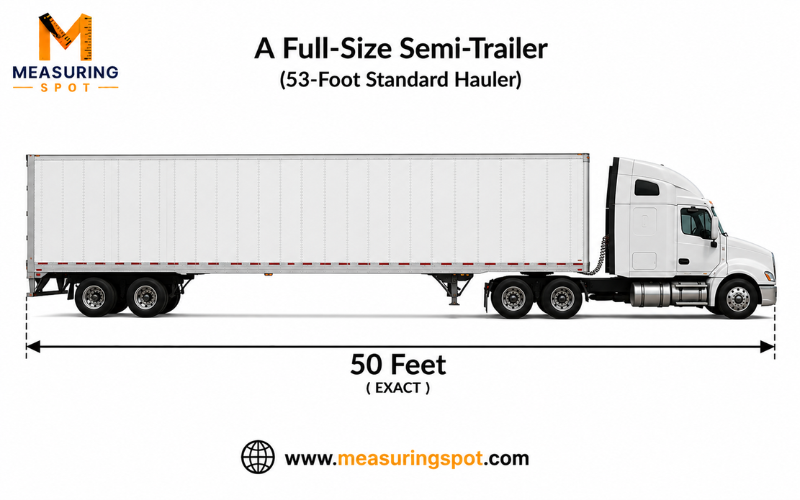
2. A Full-Size Semi-Trailer (53-Foot Standard Hauler) 🚛
Anyone who has driven alongside long-haul freight on the interstate knows the imposing presence of an eighteen-wheeler. While the overall truck-and-cab combination can stretch up to 70 or 80 feet, the box trailing behind the cab is a universal benchmark for 50 feet.
Dimensions of Commercial Hauling
The dominant trailer standard across North American highways is the 53-foot dry van or refrigerated unit. Older fleets and localized city delivery routes still commonly deploy 48-foot trailers.
Split the difference between a legacy 48-footer and a modern 53-footer, and you sit squarely on 50 feet:
- Interior Cargo Length: 47 to 52 feet
- Total Enclosed Volume: Roughly 3,800 to 4,000 cubic feet
- Wheelbase Span: The distance from the kingpin to the center of the rear tandem axles spans near 40 to 45 feet alone
Roadside Context
Next time you pass a tractor-trailer at highway speeds, ignore the cab up front. Focus purely on the long, ribbed metal container rolling behind it. That box alone represents 50 feet of steel, aluminum, and cargo capacity cruising down the asphalt.
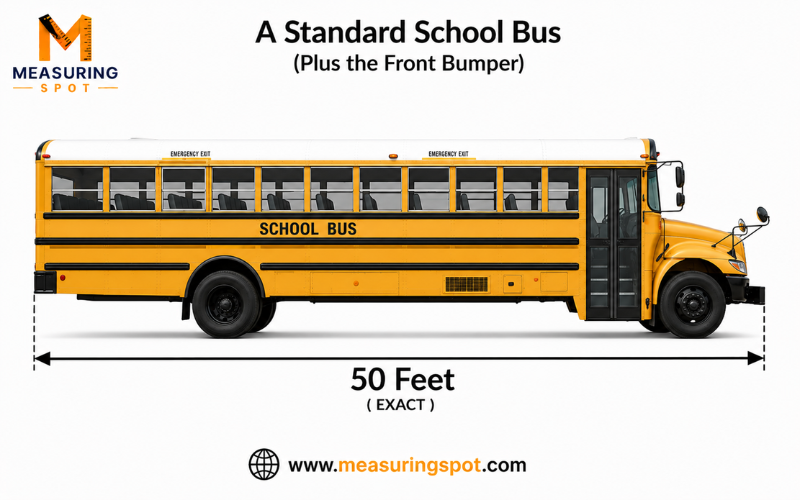
3. A Standard School Bus (Plus the Front Bumper) 🚌
The iconic yellow school bus is an unmistakable fixture of suburban mornings and afternoon school runs. While they look massive when stopped at a crosswalk, how close are they to 50 feet?
Vehicle Length Breakdown
School buses come in several standardized frame sizes, categorized by letters from Type A through Type D:
- Type A (Short Bus): 20 to 25 feet long
- Type C (Conventional Long Hood): 35 to 40 feet long
- Type D (Transit-Style Flat Front): 40 to 45 feet long
The largest Type D school buses—the flat-front models designed to carry up to 84 students—measure roughly 40 to 42 feet bumper-to-bumper.
How to Gauge 50 Feet
Picture one of these giant transit-style school buses parked against a curb, then mentally tack on the length of a small compact city car (like a Mini Cooper or Smart car, which measures 8 to 10 feet) right behind its back bumper. Together, that bus and compact car match 50 feet almost to the exact inch.
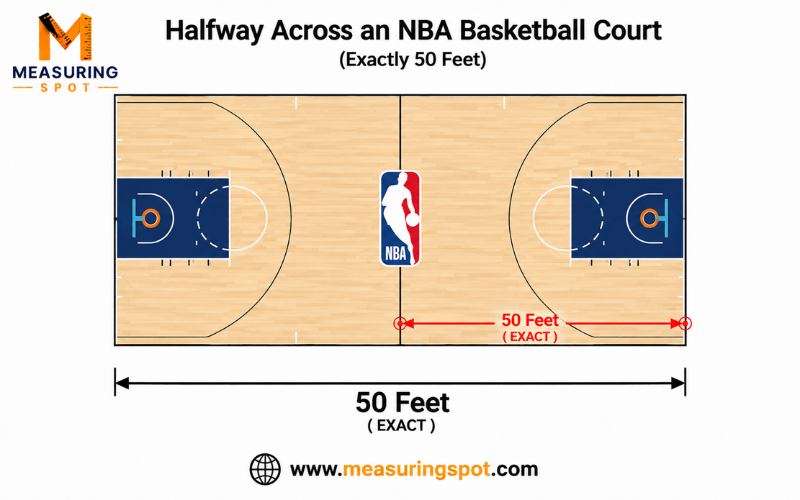
4. Halfway Across an NBA Basketball Court 🏀
Sports facilities are engineered using strict, laser-precise dimensions, making indoor courts and outdoor fields great visual tools for calculating distances without specialized equipment.
The Anatomy of the Hardwood
A regulation National Basketball Association (NBA) and NCAA collegiate basketball court measures 94 feet in total length by 50 feet in width.
This gives you two separate ways to identify 50 feet in a single gym:
- The Sideline-to-Sideline Width: The distance from the out-of-bounds sideline on the bench side across the hardwood to the opposite sideline is precisely 50 feet.
- The Half-Court Line to Baseline: Because the full court runs 94 feet from endline to endline, the journey from half-court to either baseline under the rim is 47 feet. Add the depth of the baseline out-of-bounds safety buffer (typically 3 feet of painted floor behind the backboard), and you get an exact 50-foot run.
Game-Speed Reality
When a point guard pulls up just past the half-court logo to launch a buzzer-beater toward the hoop, the basketball must travel roughly 47 to 50 feet through the air to find the nylon net.
5. An Olympic-Style Semi-Lap (Half of a 50-Meter Competition Pool) 🏊
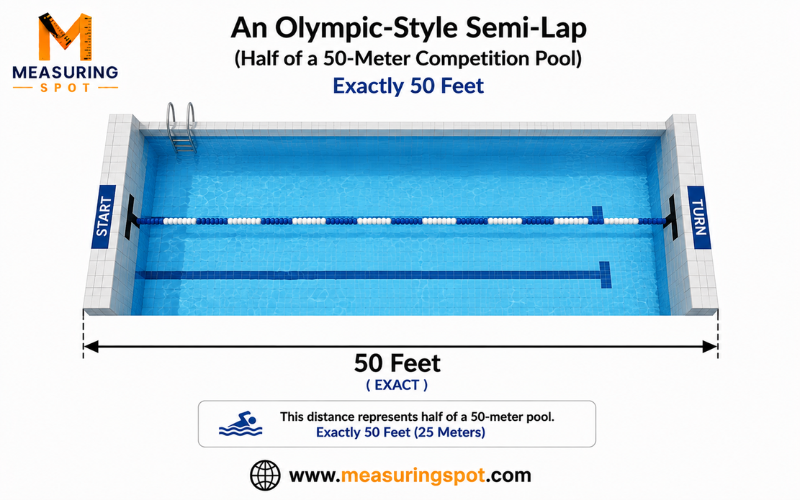
Competitive swimming takes place across two major standardized pool formats: short-course (25 meters or 25 yards) and long-course Olympic dimensions (50 meters).
Aquatic Metric Conversions
An Olympic-size competition pool runs 50 meters in length, which translates to 164 feet. That means one full length of an Olympic venue is well over three times our target mark.
However, residential in-ground swimming pools, hotel leisure pools, and community lap facilities lean heavily on 25-yard configurations or custom builds:
- A luxury residential lap pool is frequently constructed at a 50-foot length (15.24 meters) to give homeowners a balanced workout without eating up an entire backyard lot.
- In a 50-meter Olympic pool, floating lane lines use distinct color transitions—often switching colors 15 meters out from the wall to warn swimmers of approaching flip turns. That 15-meter zone equals 49.2 feet.
If you watch a swimmer kick off the wall, complete their underwater streamline, and pop up past the breakout flags, they have covered almost exactly 50 feet of water.
6. Three Mid-Size Family Sedans Parked Bumper-to-Bumper 🚗
If you do not have a basketball court or highway trailer handy, head out to your driveway or glance out the front window at the street. Passenger cars offer an immediate, grounded frame of reference.
Average Car Lengths
Vehicle lengths fluctuate by class, but modern mid-size family sedans—such as the Toyota Camry, Honda Accord, Hyundai Sonata, or Subaru Legacy—fall within a consistent design window:
| Vehicle Model | Typical Overall Length |
| Honda Civic (Compact) | ~15.3 feet (184 inches) |
| Toyota Camry (Mid-Size) | ~16.1 feet (193 inches) |
| Ford F-150 SuperCrew (Full-Size Truck) | ~19.3 feet (232 inches) |
Lining Them Up
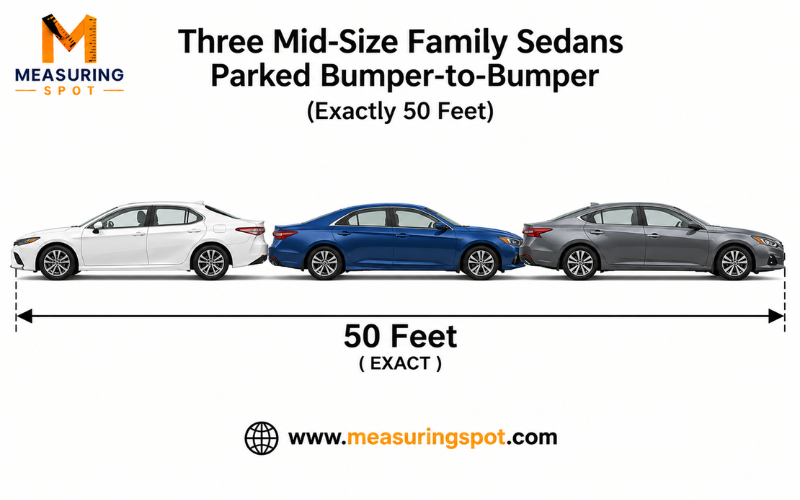
Take three standard mid-size sedans, each measuring roughly 16 to 16.5 feet from front grille to rear exhaust. Park them tightly bumper-to-bumper along the curb:
$$16.5 \text{ ft} \times 3 = 49.5 \text{ ft}$$
Add a few inches of clearance between their license plates, and three everyday family cars form an unbroken 50-foot line of metal and glass.
7. An Adult Female Humpback Whale 🐋
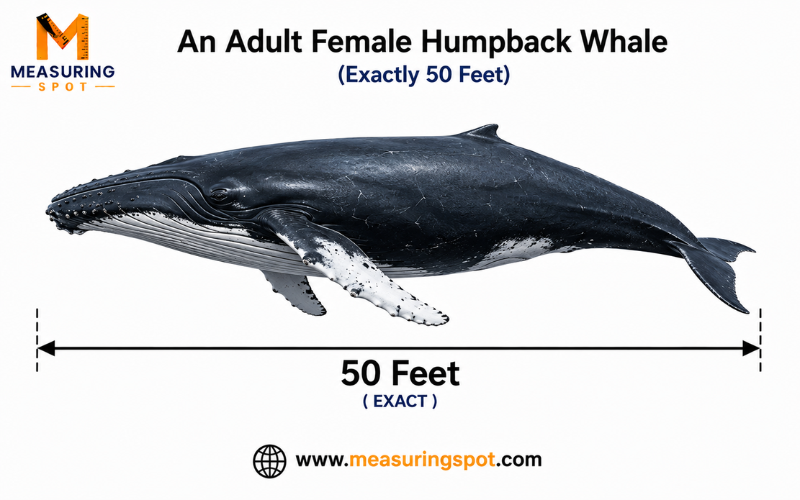
Nature provides massive benchmarks of its own, particularly once you dive into marine biology. While the blue whale takes the crown as the largest animal to ever live (often reaching 90 to 100 feet), the humpback whale sits right at the 50-foot threshold.
Gentle Giants of the Open Sea
Adult humpback whales (Megaptera novaeangliae) display mild sexual dimorphism, meaning females grow slightly larger than males:
- Adult Males: Average 43 to 46 feet in length
- Adult Females: Average 49 to 52 feet in length
- Total Body Mass: Between 30 and 40 metric tons (66,000 to 88,000 pounds)
Pectoral Fin Scale
What makes the humpback an interesting visual reference is not just its overall length from snout to fluke, but its appendages. A humpback’s scientific name translates roughly to “giant wings of New England” because its pectoral fins grow up to one-third of its total body length.
When a 50-foot female raises her pectoral flipper straight out of the ocean swell, that single fin stretches nearly 16 feet into the air—the equivalent of one full car length attached to her shoulder.
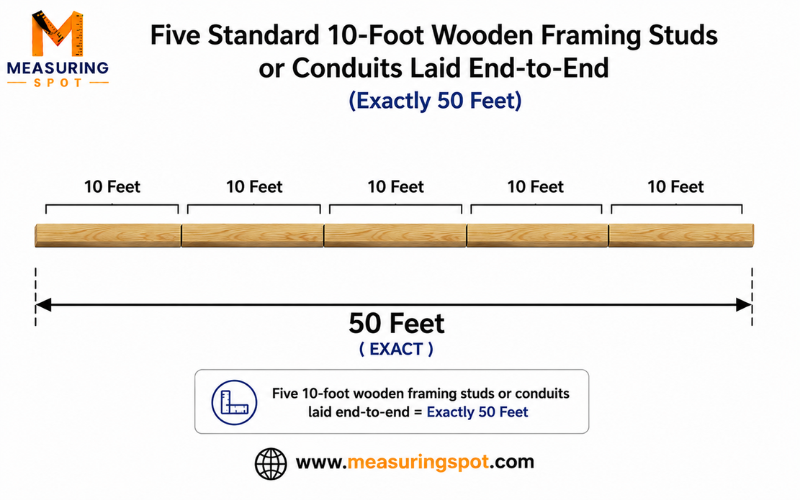
8. Five Standard 10-Foot Wooden Framing Studs or Conduits Laid End-to-End 🪵
Anyone who has tackled a home renovation, built a privacy fence, or walked through the lumber yard at Home Depot or Lowe’s knows building supplies rely on modular dimensions.
Modular Construction Materials
Standard structural lumber and electrical piping are manufactured in predictable lengths for transport and structural consistency:
- Framing Studs: Available readily in 8-foot, 10-foot, and 12-foot cuts
- PVC Drainage Pipes: Sold primarily in 10-foot rigid segments
- EMT Electrical Metallic Tubing: Sold almost exclusively in 10-foot bundles
The 5-Stick Calculation
If you pick up five standard 10-foot lengths of PVC schedule-40 pipe or five 10-foot 2×4 framing studs and place them tip-to-tip across a lawn:
$$10 \text{ ft} + 10 \text{ ft} + 10 \text{ ft} + 10 \text{ ft} + 10 \text{ ft} = 50 \text{ ft}$$
This modular calculation is why professional contractors rarely need a physical tape measure to estimate whether a straight drywall or fence run hits the 50-foot mark. Counting joist spans or board joints gets them there in seconds.
9. The Hollywood Sign Letters (Stacked Vertically) 🎬
Perched atop Mount Lee in the Santa Monica Mountains, the Hollywood Sign is an internationally recognized monument. While tourists look at it from miles away across Los Angeles, standing next to the physical sheet metal reveals its true scale.
Dimensions of the Landmark
Originally erected in 1923 as an outdoor billboard for the “Hollywoodland” real estate development, the letters were rebuilt in 1978 out of structural steel and white enameled corrugated metal sheets:
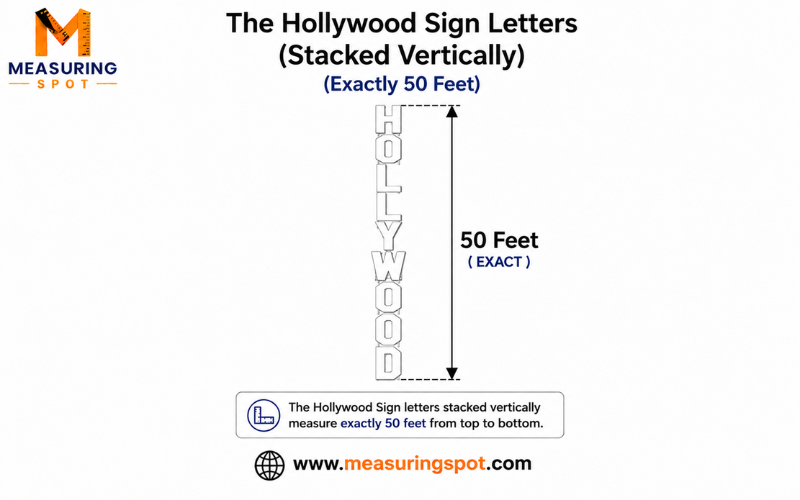
- Letter Height: Each individual capital letter stands 45 feet tall.
- Letter Width: Varies from 31 feet wide (for letters like “E” and “T”) to 39 feet wide (for the letter “W”).
- Total Landmark Span: Stretches roughly 350 feet across the mountain ridge.
Visualizing 50 Feet on Mount Lee
Each white letter stands just five feet shy of 50 feet tall. If you place a standard 5-foot human being on the ground next to the letter “H,” the combined height from the person’s shoes to the top rim of the steel beam hits 50 feet.
10. A Full Pitch Distance in Little League Baseball ⚾
Distance markers in diamond sports are measured to fractional inches, dictated by historical rulebooks and physiological limits of throwing arms.
Youth vs. Professional Diamond Geometry
In Major League Baseball (MLB), the pitching rubber sits exactly 60 feet, 6 inches away from the back tip of home plate. That distance was established in 1893 to balance pitching dominance against batting reaction times.
For youth sports, however, that distance is shortened:
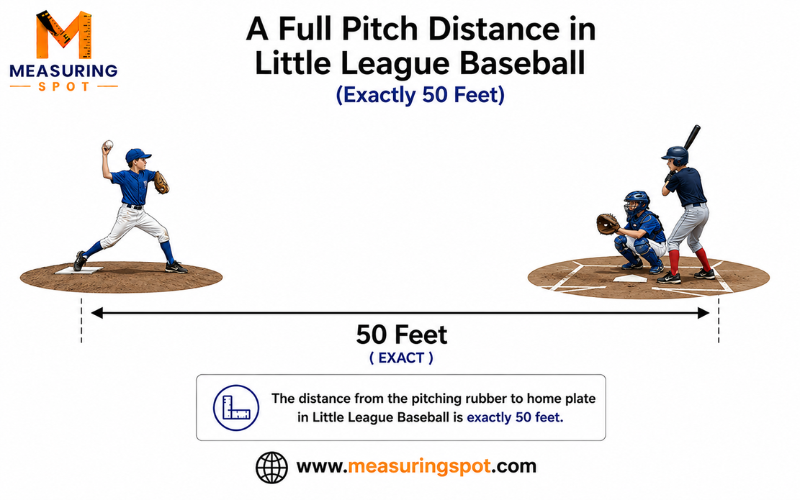
- Little League Majors (Ages 9–12): The pitching mound sits 46 feet from home plate. Adding the depth of the batter’s box and catcher’s stance brings the playable battery zone right to 50 feet.
- Intermediate 50/70 Division: Designed as a transitional bridge for 11- to 13-year-olds moving toward high school baseball fields, this division sets the pitching rubber at precisely 50 feet from the back point of home plate, alongside 70-foot base paths.
When a youth pitcher winds up on a 50/70 intermediate field, their fingertips release the baseball across an exact 50-foot gap straight into the catcher’s leather mitt.
Detailed Measurement Reference & BioWiki Table 📊
To consolidate these figures into a single clear resource, this table outlines standard dimensions, metric translations, and everyday reference points for 50-foot objects:
| Object / Subject | Category | Exact / Approximate Span | Metric Equivalent | Notable Reference Detail |
| 5-Story Apartment Building | Architecture | ~50 Feet | 15.24 m | Assumes standard 10 ft floor-to-floor structural height |
| Commercial Semi-Trailer | Transportation | 48 to 53 Feet | 14.63 to 16.15 m | Standard dry van trailer without the front tractor cab |
| Large Type D School Bus + Car | Automotive | ~50 Feet | 15.24 m | 40 ft transit-style flat-front bus plus a 10 ft compact car |
| NBA Basketball Court Width | Athletics / Sports | 50 Feet Exact | 15.24 m | Official sideline-to-sideline dimension across the hardwood |
| Residential Lap Pool | Recreation / Aquatics | ~50 Feet | 15.24 m | Common private fitness length; matches 15-meter warning flags |
| 3 Mid-Size Sedans Parked | Automotive | 48 to 50 Feet | 14.63 to 15.24 m | Three standard 16.5 ft cars placed tightly bumper-to-bumper |
| Adult Female Humpback Whale | Marine Biology | 49 to 52 Feet | 14.93 to 15.85 m | Massive baleen whale weighing up to 40 metric tons |
| 5 PVC Conduits / 2×4 Studs | Construction Materials | 50 Feet Exact | 15.24 m | Five modular 10 ft building supply boards laid end-to-end |
| Hollywood Sign Letter + Person | Landmarks / Monuments | 50 Feet Exact | 15.24 m | 45 ft tall corrugated steel letter plus a 5 ft human |
| 50/70 Little League Pitch | Athletics / Baseball | 50 Feet Exact | 15.24 m | Distance from the pitching rubber to home plate apex |
Everyday Tips for Estimating 50 Feet Without Tools 🛠️
If you are standing on a plot of bare land, walking through an empty warehouse, or trying to measure a property boundary without a fiberglass reel tape, you can calculate 50 feet using your body:
1. The Walking Pace Technique
The average adult human walking stride (the distance from the heel strike of one foot to the heel strike of the opposite foot) is approximately 2.2 to 2.5 feet long.
- Walk in a natural, straight line without over-striding.
- Count every time your right foot hits the ground (a two-step “pace,” roughly 5 feet total).
- Ten full paces (or 20 to 23 regular steps) will put you remarkably close to 50 feet.
2. The Arm-Span Method (Fathom)
For most people, arm span—the distance from the tip of the middle finger on one hand to the tip of the middle finger on the other with arms outstretched—closely matches total body height.
- An adult standing 5 feet, 8 inches to 6 feet tall possesses an arm span of roughly 5.75 to 6 feet.
- Grabbing a length of rope or string and pulling eight to nine full arm spans across your chest yields an accurate 50-foot section.
Frequently Asked Questions About Measuring 50 Feet 🤔
How long is 50 feet compared to human steps?
For the average adult, walking 50 feet takes between 20 and 25 natural walking steps. If you use a measured pace where one step equals roughly 2.5 feet, exactly 20 paces covers 50 feet.
How many yards are in 50 feet?
There are 16.67 yards in 50 feet. Because one yard equals exactly 3 feet, you divide 50 by 3:
$$50 \div 3 = 16.666… \text{ yards}$$
How many meters is 50 feet?
Fifty feet converts to precisely 15.24 meters. One foot equals 0.3048 meters ($50 \times 0.3048 = 15.24$).
How many cars equal 50 feet?
Approximately three mid-size passenger sedans parked end-to-end equal 50 feet. Most modern family sedans (like the Honda Accord or Toyota Camry) measure right around 16.2 to 16.5 feet long.
What is the easiest way to visualize 50 feet instantly?
Look across an official NBA basketball court from one sideline directly to the other. That sideline-to-sideline boundary is exactly 50 feet wide. If you are outdoors on a street, picture the cargo container of an 18-wheeler semi-truck rolling by without its front engine cab.
Related Posts
- 10 Common Everyday Things That Are 1 Foot Long
- 10 Common Things That Are 2 Feet Long
- 10 Common Things That Are 3 Feet Long
- 10 Common Everyday Things That Are 4 Feet Long
Conclusion 🎯
Grasping how long is 50 feet becomes effortless once you connect the raw numbers to concrete, tangible anchors in the physical world. Instead of trying to calculate 600 inches or 15.24 meters in your head, you can simply picture walking across the width of an NBA basketball court, glancing up at the roofline of a five-story apartment building, or lining up three family sedans along a curb. Whether you are mapping out a backyard renovation, double-checking property boundaries, or gauging vehicle clearances, these familiar reference points give you an accurate, practical sense of 50 feet without ever needing to unroll a tape measure.
FOR MORE MEASUREMENTS VISIT: MEASURINGSPOT