
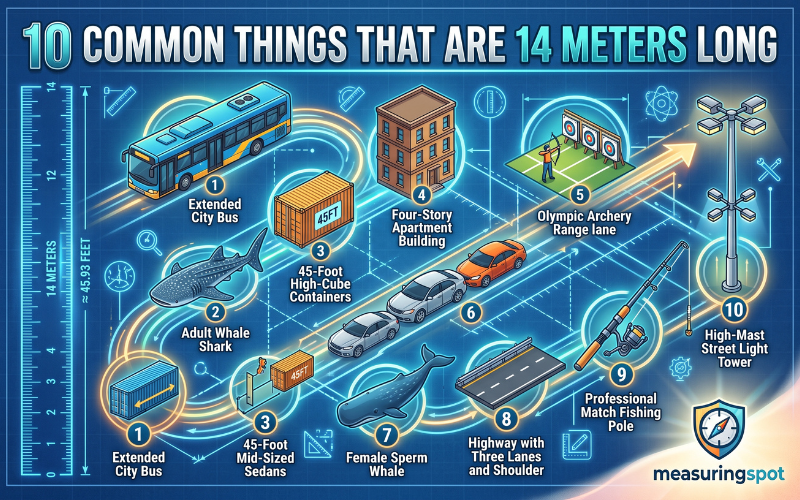
Trying to visualize physical space using pure metrics can make anyone pause. When you see a measurement like 14 meters on paper, understanding what that looks like in the real world is not always intuitive. Converting numbers into everyday objects bridges that gap instantly.
So, how long is 14 meters? In imperial measurements, 14 meters equals roughly 45.93 feet, or approximately 45 feet and 11 inches. That is also 551.2 inches, or just a hair over 15.3 yards. If you line up three average sedans bumper-to-bumper, you are standing alongside 14 meters.
Here is a practical, detailed exploration of real-world objects, animals, and structures that measure right around 14 meters, along with handy reference tables and answers to common measurement questions.
Quick Reference Snapshot
If you need a fast conversion or an immediate visual benchmark, this snapshot breaks down what 14 meters represents across various units and familiar scales:
- In Feet: 45.93 ft (approx. 46 feet)
- In Yards: 15.31 yards
- In Inches: 551.18 inches
- In Centimeters: 1,400 cm
- Visual Shortcut: Roughly the length of an articulated city bus, a four-story building laid flat, or three average sedans parked back to back.
10 Common Things That Are 14 Meters Long
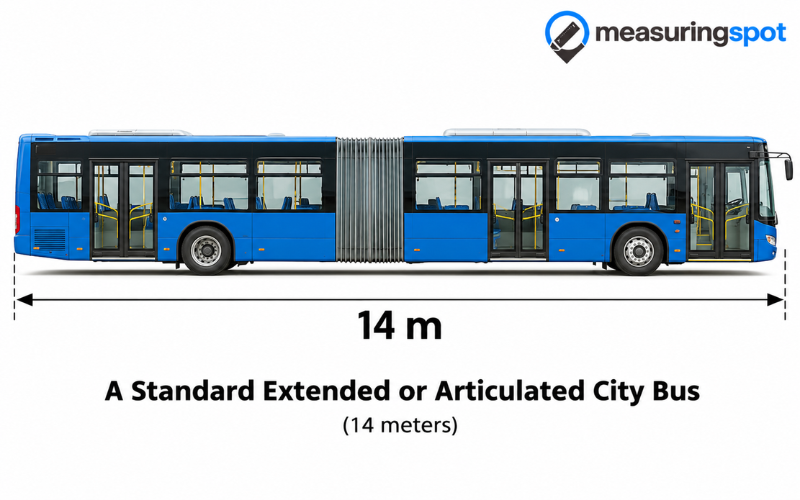
1. A Standard Extended or Articulated City Bus
Public transportation buses are one of the best everyday yardsticks because you see them regularly on urban roads. While standard city transit buses hover around 10 meters to 12 meters, long-wheelbase single-deckers and compact articulated commuter buses typically stretch out between 13.5 and 14.5 meters.
Standing next to one gives an immediate sense of scale. A 14-meter bus provides enough room inside for roughly 40 to 50 passenger seats, wide central aisles, and dual boarding doors. The front windshield all the way back to the exhaust bumper represents almost exactly 14 meters of automotive engineering.
2. A Fully Grown Adult Whale Shark
Whale sharks (Rhincodon typus) hold the title as the largest living fish species in the world. While newly mature specimens measure around 8 meters to 10 meters, mature adults frequently reach an impressive length of 14 meters (about 46 feet).
Despite their massive bulk, which can exceed 20 metric tons at this length, whale sharks are gentle filter feeders. Their mouths alone can span over 1.5 meters wide, sucking in plankton, krill, and small fish as they cruise warm tropical seas. Seeing a 14-meter whale shark glide past an ocean research vessel is equivalent to watching an entire transit bus swim smoothly through the water.

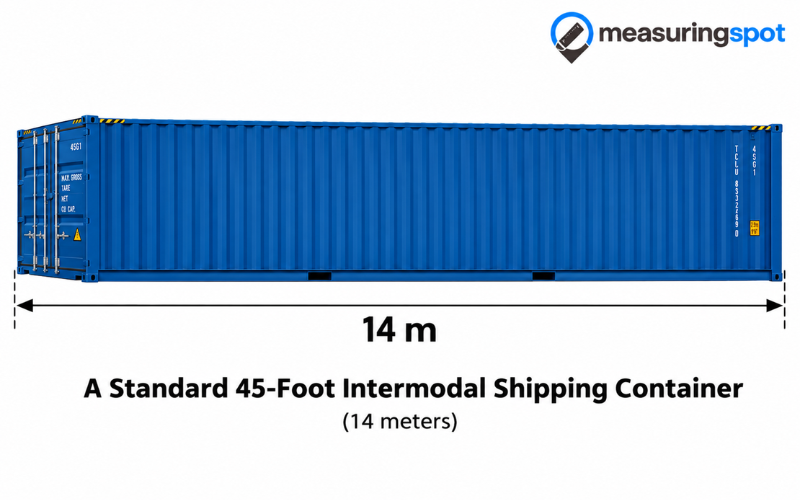
3. A Standard 45-Foot Intermodal Shipping Container
If you have ever driven alongside freight trains, visited a shipping port, or passed a modern modular container home, you have seen standard cargo units. The primary extended container used in international maritime freight is the 45-foot high-cube container.
Forty-five feet converts to 13.72 meters—just a sliver shy of 14 meters. When you include the corner castings, locking bars, and clearance brackets, the entire footprint lines up almost seamlessly with the 14-meter mark. These metal containers are designed to maximize highway haulage limits while fitting cleanly onto container ships and railroad flatcars.
4. The Height of a Four-Story Residential Building
Height and length share the exact same physical distance, just rotated 90 degrees. An average residential story—including the ceiling height, subflooring, and structural joists—measures between 3.0 meters and 3.5 meters (roughly 10 feet to 11.5 feet).
Stack four floors together, add the foundational ground offset and a standard roof parapet, and you reach right around 14 meters. When you look up at a modest apartment block or a commercial office building with four floors, you are looking directly at a 14-meter vertical span.

5. Length of an Olympic-Standard Archery Range Shooting Lane
In competitive target archery governed by World Archery rules, the layout of the range requires designated shooting lanes and safety buffers. The distance between the waiting line and the target zone for short-distance training circuits and regional intermediate ranges frequently measures 14 to 15 meters.
In indoor Olympic recurve rounds, archers stand behind a shooting line set back from the target wall. When factoring in the archer’s stance platform (roughly 1 meter), the competition line, and the rear barrier net, the enclosed shooting corridor operates inside a 14-meter envelope.

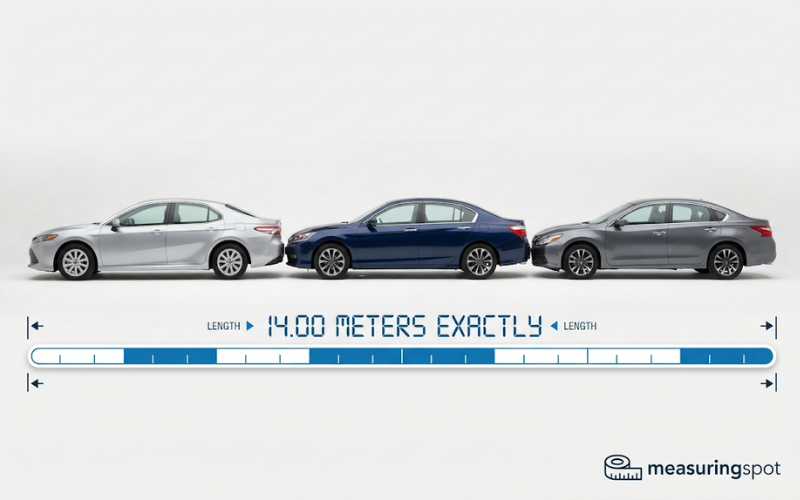
6. Three Mid-Sized Family Sedans Parked Bumper-to-Bumper
Automobiles offer one of the most accessible spatial references. A standard mid-sized four-door sedan—like a Toyota Camry, Honda Accord, or Volkswagen Passat—measures roughly 4.8 meters (15.7 feet) from the front grille to the rear bumper.
If you park three of these sedans in a straight line with tight spacing between their bumpers, the total length spans almost exactly 14.4 meters. Whenever you need to estimate 14 meters in an open parking lot or on a driveway, picture three typical family cars aligned nose-to-tail.
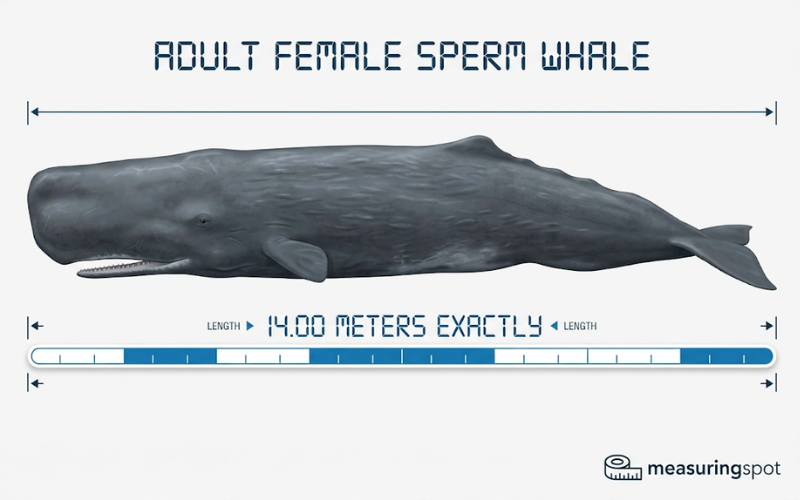
7. The Length of an Adult Female Sperm Whale
Sperm whales (Physeter macrocephalus) exhibit dramatic sexual dimorphism, meaning males and females grow to significantly different sizes. While bull sperm whales can reach up to 16 meters to 18 meters, fully grown adult females level off at an average length of 11 meters to 14 meters.
At 14 meters, a female sperm whale weighs around 15 to 20 metric tons. A huge portion of that length is occupied by their distinctive squared-off head, which houses the spermaceti organ used for echolocation and buoyancy control during deep-sea squid hunts.
8. The Width of Three Standard Highway Traffic Lanes
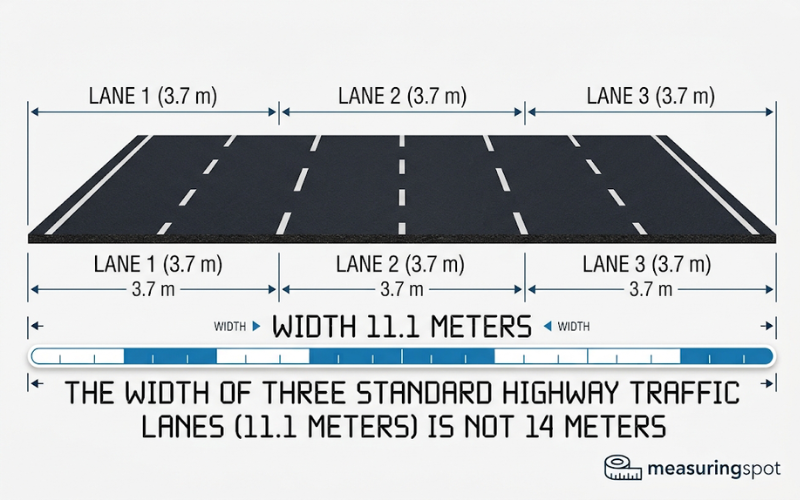
In most parts of North America and Europe, highway engineers design interstate and motorway driving lanes to a standard width of 3.65 meters (12 feet) per lane.
When you add three active travel lanes together:
$$3.65\text{ m} \times 3 = 10.95\text{ m}$$
When you combine those three standard lanes with an inner paved safety shoulder of 2.5 to 3 meters, the total paved asphalt surface across the motorway corridor spans almost exactly 14 meters.
9. A Professional Competition Match Fishing Pole
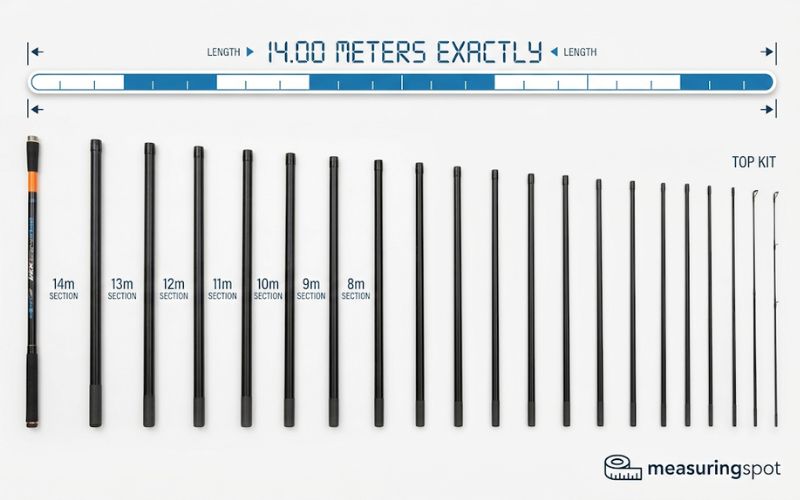
Unlike recreational casting rods that rely on reels and measure 2 meters to 3 meters, specialized freshwater match fishing poles used in European coarse fishing competitions are remarkably long.
Anglers use rigid carbon-fiber sectional poles that slide together to drop bait with pinpoint accuracy into canals and lakes. The official international federation rules (FIPSed) allow match poles up to 13 meters for seniors, while non-regulated sport poles regularly ship in commercial lengths of 14 meters and 16 meters. Holding a featherlight carbon pole that stretches 14 meters out over the water requires balanced counterweights and specialized roller rests.
10. A High-Mast Highway Street Lighting Pole
Standard neighborhood street lamps stand around 6 meters to 8 meters tall, but the high-intensity illumination towers found along major expressway junctions, cloverleaf interchanges, and freight rail yards are far larger.
These heavy-duty steel masts commonly feature standardized mounting heights of 14 meters. This elevation allows the multi-fixture LED luminaires mounted at the top to cast wide, uniform light patterns across multiple lanes without creating harsh glare points for passing drivers.

Biowiki Comparison Table
The table below organizes these 14-meter benchmarks by category, exact measurements, and distinctive physical characteristics:
| Item / Subject | Category | Metric Span | Imperial Span | Key Defining Detail |
| City Transit Bus | Transportation | 13.5 – 14.0 m | 44.3 – 46.0 ft | Extended single-deck layout with dual doors |
| Adult Whale Shark | Marine Biology | 12.0 – 14.0 m | 39.4 – 45.9 ft | Largest known non-mammalian vertebrate |
| 45-Foot Cargo Container | Logistics & Freight | 13.72 m | 45.0 ft | Extended intermodal steel shipping box |
| 4-Story Building | Architecture | 13.0 – 14.0 m | 42.6 – 45.9 ft | Typical residential floor-to-roof elevation |
| Archery Range Corridor | Sports Infrastructure | 14.0 m | 45.9 ft | Target line plus archer safety zone |
| 3 Mid-Sized Sedans | Automotive | 14.2 – 14.4 m | 46.5 – 47.2 ft | 3 standard family cars parked in sequence |
| Female Sperm Whale | Marine Biology | 11.0 – 14.0 m | 36.0 – 45.9 ft | Mature female deep-diving toothed whale |
| 3 Highway Lanes + Shoulder | Civil Engineering | 13.5 – 14.0 m | 44.3 – 45.9 ft | Triple-lane expressway paving footprint |
| Match Fishing Pole | Outdoor Recreation | 14.0 m | 45.9 ft | Sectional carbon-fiber coarse angling pole |
| High-Mast Light Pole | Municipal Utility | 14.0 m | 45.9 ft | Commercial highway illumination tower |
Step-by-Step Conversion: How to Calculate 14 Meters
Converting metric distances to imperial measurements comes down to a few basic conversion ratios. A single meter equals 3.28084 feet or 39.3701 inches.
Converting Meters to Feet
Multiply the number of meters by 3.28084:
$$14 \times 3.28084 = 45.93176\text{ ft}$$
To break 45.93 feet down into feet and inches:
- Take the whole number: 45 feet.
- Take the decimal remainder ($0.93176$) and multiply by 12:
$$0.93176 \times 12 = 11.18\text{ inches}$$ - The final result is 45 feet, 11.18 inches.
Converting Meters to Yards
Because one yard equals 3 feet, divide the total footage by 3:
$$\frac{45.93176}{3} \approx 15.31\text{ yards}$$
Converting Meters to Inches
Multiply the number of meters by 39.3701:
$$14 \times 39.3701 = 551.18\text{ inches}$$
Practical Everyday Tricks to Estimate 14 Meters
When you are out in an open field, working on a job site, or surveying a backyard and do not have a tape measure handy, you can estimate 14 meters using these physical baselines:
- Pacing It Out: An average adult walking at a natural stride covers about 0.75 meters (2.5 feet) per pace. Walking 18 to 19 normal steps in a straight line covers roughly 14 meters.
- The Telephone Pole Test: Standard utility poles beside residential streets are spaced roughly 35 to 45 meters apart. One-third of the distance between two standard utility poles is just under 14 meters.
- School Bus Length: A standard American yellow school bus measures around 11 to 12 meters long. Imagine a full-size school bus plus half the length of a compact car parked right behind it.
- Shipping Palette Line: Standard wooden Euro pallets measure 1.2 meters long. Laying 11 to 12 pallets end-to-end creates a 14-meter walkway.
Frequently Asked Questions
How long is 14 meters compared to a person?
The average adult male height across most countries sits around 1.75 meters (5 feet 9 inches). If you laid eight adults head-to-toe in a straight line, their combined height would equal 14 meters ($8 \times 1.75\text{ m} = 14\text{ m}$).
Is 14 meters roughly 50 feet?
Not quite. Fourteen meters comes out to 45.93 feet. While it is close to 46 feet, reaching a full 50 feet requires approximately 15.24 meters. That leaves a noticeable 4-foot difference.
How many square meters is a 14-meter square space?
If you have a square plot or room where each wall measures 14 meters long, you calculate the area by multiplying length by width:
$$14\text{ m} \times 14\text{ m} = 196\text{ m}^2$$
In imperial units, that equals approximately 2,109.7 square feet—roughly the size of a spacious single-family home.
How long does it take to walk 14 meters?
At a moderate walking pace of 1.4 meters per second (about 5 km/h or 3.1 mph), an average walker covers 14 meters in roughly 10 seconds.
Can you buy a tape measure that reaches 14 meters?
Standard pocket tape measures used for interior carpentry typically cap out at 5 meters, 8 meters, or 25 feet. To measure 14 meters in one go, you will need a 15-meter or 30-meter open-reel surveyor tape, or an electronic laser distance measurer.
Related Posts
- 10 Everyday Things That Measure 8 Meters Long/ Tall
- 10 Everyday Things That Measure 7 Meters Long/ Tall
- 10 Everyday Things That Measure 6 Meters Long/ Tall
- 10 Common Things That Are 5 Meters Long/ Tall
Conclusion
Understanding how long is 14 meters becomes effortless once you connect the raw metric figure—roughly 46 feet—to tangible objects you encounter in daily life. Whether you picture a full-sized city bus, three parked family sedans, an adult whale shark gliding through the sea, or the vertical height of a four-story apartment block, each benchmark provides an immediate spatial anchor. Keeping these visual shortcuts in mind saves you from tedious mental math and ensures you can gauge expansive distances on job sites, in design projects, or out in open spaces with total confidence.
FOR MORE MEASUREMENTS VISIT: MEASURINGSPOT