
Most people struggle to measure tiny distances without a ruler in hand. Whether you work on home improvements, buy jewelry, or fix electronics, small metric measurements often feel abstract. You hear that an item measures 2 millimeters, but you cannot instantly gauge what that looks like in the palm of your hand.
Fortunately, dozens of everyday items around your house match this exact dimension. Connecting a 2mm measurement to tangible household objects helps you quickly check sizes without reaching for calipers or tape measures.
This guide breaks down common items that measure 2 millimeters, explains conversion math in simple terms, and provides practical reference points you can grab whenever you need an accurate estimate.
Quick Answer: How Big is 2mm?
Two millimeters (2mm) equals 0.0787 inches, which is just slightly thicker than 1/16 of an inch (0.0625 inches) and roughly equal to 5/64 of an inch.
If you want an immediate real-world visual:
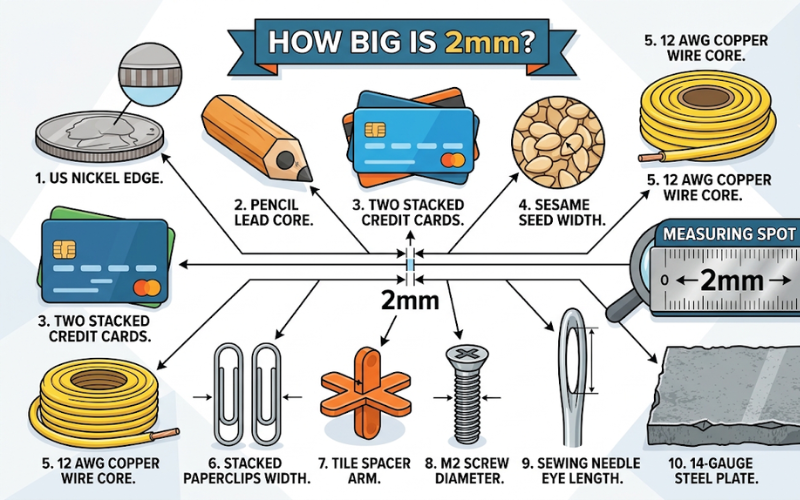
- The edge of a standard US nickel measures 1.95 mm thick.
- Two standard credit cards stacked together measure 1.52 to 2 mm thick.
- The tip of a standard wooden pencil lead measures 2 mm wide.
- A single sesame seed measures roughly 2 mm wide.
Metric Quick Reference: The 2mm BioWiki Profile
The following reference table outlines the technical dimensions, system conversions, and exact mechanical properties of a 2mm measurement across various standards.
| Attribute | Specification Details |
| Measurement | 2 Millimeters (2 mm) |
| Base Unit System | International System of Units (SI Metric) |
| Decimal Inches | 0.0787402 inches |
| Fractional Inch Equivalent | ~5/64 in (closest common fraction) |
| Centimeter Equivalent | 0.2 cm |
| Meter Equivalent | 0.002 m |
| Micrometer / Micron Equivalent | 2,000 µm |
| Point Size (Typography) | ~5.67 points |
| Wire Gauge Equivalent | ~12 AWG (American Wire Gauge, ~2.05 mm) |
| Common Sheet Metal Gauge | ~14 Gauge Steel (~1.98 mm) |
| Fastener Standard | M2 Screw Thread Diameter |
| Primary Real-World Benchmark | Thickness of a US Five-Cent Nickel Coin |
10 Common Things That Are 2mm Big
1. The Thickness of a US Nickel
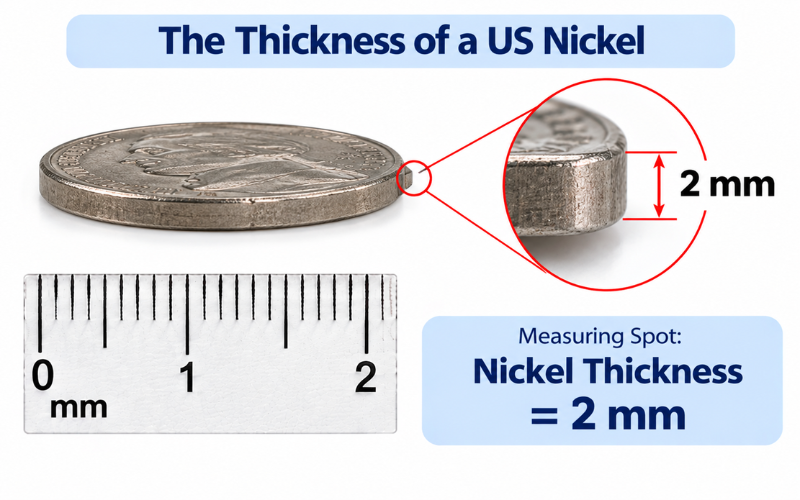
Pick up a modern US nickel from your pocket or desk drawer. Turn the five-cent coin sideways and look directly at its edge. The official specifications from the United States Mint state that a nickel has a diameter of 21.21 mm and a standard thickness of 1.95 mm.
Because 1.95 mm sits just five-hundredths of a millimeter away from 2 mm, the edge of a nickel serves as the most reliable, mass-produced physical benchmark for 2mm in North America. When you need to set a 2mm gap on a workshop project, a nickel slides right into the slot to confirm the spacing.
2. A Standard Wooden Pencil Lead Core
Standard #2 writing pencils contain a graphite core that measures almost exactly 2.0 mm in diameter. While drafting mechanical pencils often feature micro-thin leads like 0.5 mm or 0.7 mm, standard wooden pencils use a thicker graphite cylinder to prevent frequent snapping during heavy hand pressure.
If you sharpen a pencil, slide the wooden casing back, or look at the flat base of an unsharpened pencil, the exposed round graphite circle in the center displays a clean 2mm cross-section.

3. Two Stacked Credit Cards or Plastic Gift Cards
The International Organization for Standardization (ISO/IEC 7810 ID-1) standardizes credit cards, driver’s licenses, and retail gift cards to a uniform thickness of 0.76 mm (around 0.03 inches).
Stack two typical credit cards flat on top of each other. The combined thickness of the two plastic cards equals 1.52 mm. If your cards feature raised, embossed numbers or heavy protective film laminates, two stacked cards reach 1.8 mm to 2.0 mm in total thickness. This stack provides a fast, flat gauge that fits in your wallet.

4. The Width of a Sesame Seed
Pop open your spice rack or examine a seeded hamburger bun. Sesame seeds vary slightly in nature, but agricultural grading sorting puts the average width of a mature sesame seed at 1.8 mm to 2.1 mm (with lengths around 3 to 4 mm).
When you place a sesame seed flat on a table, the distance across its widest belly gives an immediate organic representation of 2 millimeters. If you are comparing jewelry stones or craft beads, thinking of a sesame seed helps you evaluate sizes right away.

5. A 12-Gauge Electrical Wire (Copper Core)
Electricians and DIYers work with 12 AWG (American Wire Gauge) wire every day for common 20-amp household wall circuits. Strip the outer yellow Romex sheath and peel away the inner vinyl insulation. The solid bare copper conductor inside measures 2.052 mm in diameter.
Hold this single bare copper strand up to the light. The circular cross-section gives you a rigid, unyielding 2mm reference cylinder. It matches 2mm far closer than soft materials that crush under hand pressure.

6. A Standard Wire Paperclip (Thickness)
Paperclips come in different sizes, but the wire diameter on a #1 regular steel wire paperclip ranges between 0.8 mm and 1.0 mm. A jumbo paperclip, however, uses steel wire roughly 1.2 mm to 1.4 mm thick.
If you take two standard-sized paperclips and press their straight wire segments side-by-side, the combined width measures right at 2.0 mm. Alternatively, standard heavy-duty electrical binder clips feature handle arms made of bent spring steel that measure approximately 1.8 mm to 2.0 mm thick.

7. A Small Ceramic Tile Spacer
Home renovators use cross-shaped plastic spacers to maintain straight, consistent grout lines while laying ceramic floor and wall tiles. The single most popular spacer size for modern kitchen backsplashes and bathroom walls is the 2mm spacer (often sold alongside 1/16-inch and 1/8-inch options).
The plastic arms of these spacers feature exact, molded factory widths of 2.0 mm. You can grab one from your toolbox to set repeatable gaps across wood, plastic, or masonry surfaces.

8. An M2 Machine Screw Diameter
Engineers, RC hobbyists, and laptop technicians handle metric fasteners constantly. Metric machine screws follow standard naming conventions where the letter “M” indicates the metric thread profile, and the subsequent number designates the outer major thread diameter in millimeters.
An M2 screw has a nominal outer thread shaft diameter of 2.0 mm. You find these tiny screws holding laptop motherboard hinges, securing M.2 solid-state drives, or fastening optical components in eyeglass frames. The full thickness of that threaded metal pin shows what 2mm looks like in mechanical engineering.

9. A Standard Sewing Needle Eye Length
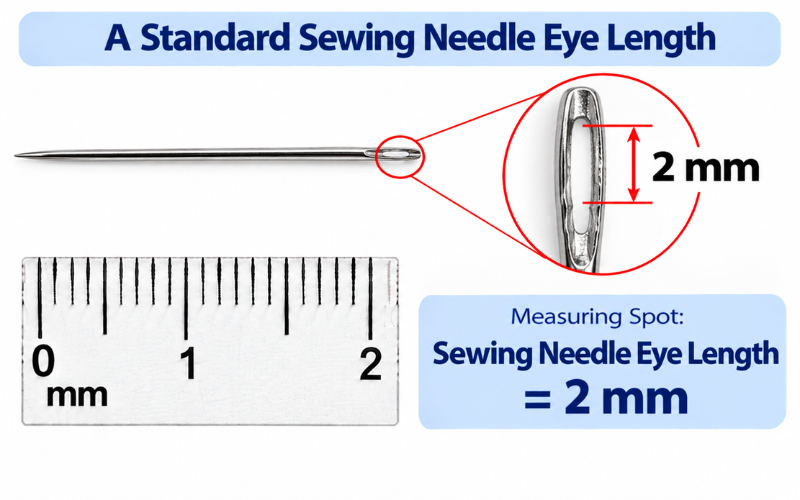
Take a regular size 14/90 universal hand sewing needle or sewing machine needle. The tiny oval hole punched through the metal head—the eye—must allow fine threads to pass through without tearing.
On medium-duty domestic needles, the longitudinal opening (the inside length of the hole) measures approximately 2.0 mm from top to bottom. The wire width of the needle shaft just below the eye usually measures around 0.9 mm to 1.0 mm, making the eye opening twice as long as the needle is wide.
10. The Thickness of a 14-Gauge Steel Sheet
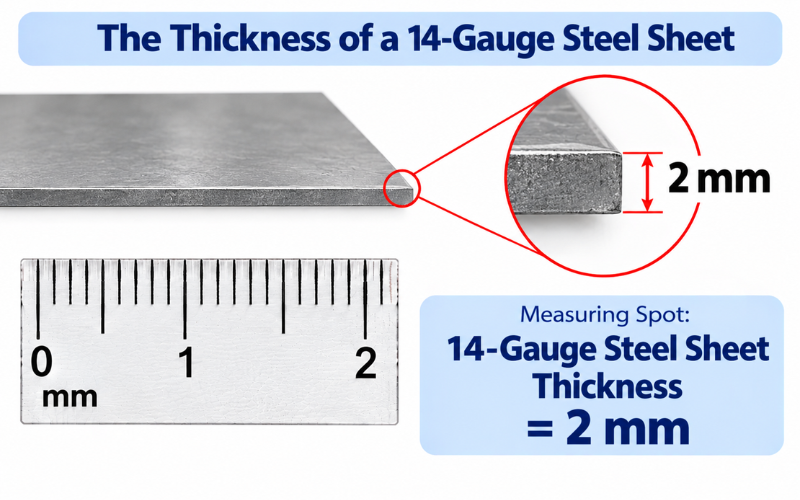
Metal fabrication shops measure sheet metal by gauge, where lower gauge numbers indicate thicker metal sheets. Standard 14-gauge hot-rolled carbon steel sheet has a manufacturer thickness of 1.98 mm (0.0781 inches).
Steel fabricators consider 2mm the sweet spot for heavy-duty consumer products, such as welded vehicle utility brackets, sturdy computer desktop cases, steel toolbox walls, and custom furniture frames. When you touch the rim of a metal equipment enclosure, you frequently feel a solid 2mm lip.
2mm Metric and Imperial Conversions
Converting tiny units between the metric system and the imperial system causes common errors. The table below matches 2 millimeters against fractional inches, decimal inches, metric units, and typographical scales.
| Unit Format | Exact or Common Value | Practical Use Case |
| Inches (Decimal) | 0.07874 in | Machining, 3D printing slicing software, CNC CAD |
| Inches (Fraction) | ~5/64 in (0.0781 in) | Carpentry, woodworking drill bit sets |
| Closest Imperial Mark | Just over 1/16 in (0.0625 in) | Measuring tapes with 1/16-inch line increments |
| Centimeters | 0.2 cm | European school rulers, general fabric drafting |
| Microns (µm) | 2,000 µm | Powder coating thickness, paint films, biology |
| Points (pt) | 5.669 pt | Graphic design stroke weight, line rules |
| Pixels (at 96 DPI) | ~7.56 px | Web interface layout borders, CSS styling |
| Pixels (at 300 DPI) | ~23.62 px | High-resolution print graphic borders |
How to Convert 2mm to Inches Manually
To convert millimeters to decimal inches on any standard calculator, divide the millimeter value by 25.4 (since one international inch equals exactly 25.4 millimeters):
$$2 \div 25.4 = 0.078740157… \text{ inches}$$
To locate this measurement on a traditional woodworking tape measure:
- Find the 1/16-inch mark ($1 \div 16 = 0.0625\text{ in}$).
- Find the 3/32-inch mark ($3 \div 32 = 0.09375\text{ in}$).
- Notice that 2mm (0.0787 in) lands right between these two ticks, matching the 5/64-inch increment ($5 \div 64 = 0.078125\text{ in}$).
Why 2mm Matters in Everyday Life
A measurement of 2 millimeters seems trivial on paper, but across multiple specialized trades, 2 millimeters creates the line between success and failure.
Watchmaking and Fine Jewelry
In jewelry design, a 2mm difference changes a ring completely. A 2mm wide metal band feels delicate, understated, and slim on a finger. A 2mm round diamond equals approximately 0.03 carats, which gemologists commonly set as accent pavé stones along the shoulders of engagement rings. In mechanical watch movements, gear pivots and ruby bearings often measure less than 2mm across; a miscalculation of even 0.05 mm causes the internal gears to bind and halt the movement.
Tile Installation and Flooring
Contractors use 2mm grout joints to create modern, seamless aesthetic finishes. When installing rectified porcelain tiles—which feature sharp, laser-cut 90-degree edges—a 2mm joint accommodates subtle thermal expansion while keeping grout lines crisp. If a tiler skips the 2mm spacer and butts the tiles flush against each other, temperature fluctuations cause the edges to chip, buckle, and crack off the floor slab.
3D Printing and Additive Manufacturing
In consumer FDM (Fused Deposition Modeling) 3D printing, filament diameters measure either 1.75 mm or 2.85 mm. Standard default nozzle orifices measure 0.4 mm. When a print slicer generates a solid outer wall perimeter, it typically prints 5 parallel passes of 0.4 mm lines to create a sturdy 2.0 mm structural outer wall shell. That 2mm plastic perimeter grants structural rigidity and impact resistance to finished parts.
Medical and Dermatology Assessments
Doctors track small skin lesions, freckles, and moles using millimeter scales. Dermatologists look for unusual changes in mole diameters using the ABCDE criteria. A lesion under 2mm usually warrants routine observation. When a pigmented spot expands past 2mm and pushes toward 6mm (the diameter of a pencil eraser), medical practitioners run diagnostic checks to evaluate suspicious cellular activity.
How to Measure 2mm Accurately Without Calipers
When you do not have digital vernier calipers nearby, use these quick household workarounds to mark or check a 2mm gap:
- The Nickel Slide: If you are building cabinets or setting an expansion gap on laminate flooring, slide a clean five-cent nickel between your boards. If the coin passes through with light friction, your gap sits at 2mm.
- The 5/64 Wood Drill Bit: Open a standard drill bit index. Pull out the 5/64-inch high-speed steel bit. The metal shank measures 1.98 mm wide. You can use the smooth shank end of the bit as a solid pin gauge to check interior holes and clearances.
- Stacked Utility Blades: A standard heavy-duty trapezoid utility knife blade measures roughly 0.6 mm thick. Stacking three clean utility knife blades on top of each other produces a combined metal thickness of 1.8 mm to 1.9 mm, approximating a 2mm gap.
Frequently Asked Questions About 2mm
How big is 2mm compared to an inch?
Two millimeters is equal to 0.0787 inches. It measures slightly larger than 1/16 of an inch (0.0625 inches) and slightly smaller than 3/32 of an inch (0.0938 inches). The closest common fractional measurement is 5/64 of an inch (0.0781 inches).
Is 2mm the same as 0.2 cm?
Yes. The metric system operates on base-ten increments. Ten millimeters make up one centimeter. Therefore, dividing 2 millimeters by 10 yields exactly 0.2 centimeters.
What coin is 2mm thick?
A United States nickel coin measures 1.95 mm thick, which falls within five-hundredths of a millimeter of 2mm. A Euro 1-coin measures 2.33 mm thick, while a British 1-pound coin measures 2.8 mm thick. A 20-pence UK coin measures 1.7 mm thick.
How big is a 2mm diamond?
A round brilliant cut diamond measuring 2.0 mm in diameter weighs approximately 0.03 to 0.035 carats. Jewelers classify stones of this size as “melee” diamonds and use them to create glittering halo borders, eternity rings, and side-stone pavé settings.
What drill bit size matches 2mm?
A 5/64-inch drill bit measures 0.0781 inches, which equals 1.984 mm—making it the closest fractional imperial drill bit to 2mm. If you work on metric projects, purchase a dedicated 2.0 mm jobber drill bit for an exact hole clearance.
Can you see 2mm with the naked eye?
Yes. Human visual acuity resolves objects down to approximately 0.1 mm (100 microns) at standard reading distance. A 2mm object sits well above this threshold, appearing bold, distinct, and easy to inspect without magnifying lenses.
A 2mm distance seems tiny when isolated on a blueprint, but tangible items like coin rims, pencil leads, and tile spacers prove how frequently we encounter this exact size. Keeping these common items in mind lets you estimate small dimensions reliably wherever you work.
The next time you need to check a gap, align a craft piece, or evaluate a component, pull a nickel from your pocket or set two credit cards together. You will possess an immediate, accurate 2mm measurement gauge in seconds.
Related Posts
- 10 Common Things That Are 90 Meters Long/ Tall
- 10 Common Things That Are 80 Meters Long/ Tall
- 10 Common Things That Are 70 Meters Long/ Tall
- 10 Common Things That Are 60 Meters Long/ Tall
Conclusion
A 2mm distance seems tiny on paper, but everyday items like coin rims, pencil leads, and tile spacers prove how frequently we encounter this exact dimension. Recognizing these physical benchmarks lets you estimate tight spaces, gaps, and component sizes reliably without needing specialized tools.
The next time you need to confirm a small clearance, align a home improvement project, or gauge material thickness, reach for a nickel or stack two credit cards. Having these practical references on hand makes measuring 2 millimeters quick, accurate, and completely effortless.
FOR MORE MEASUREMENTS VISIT: MEASURINGSPOT