
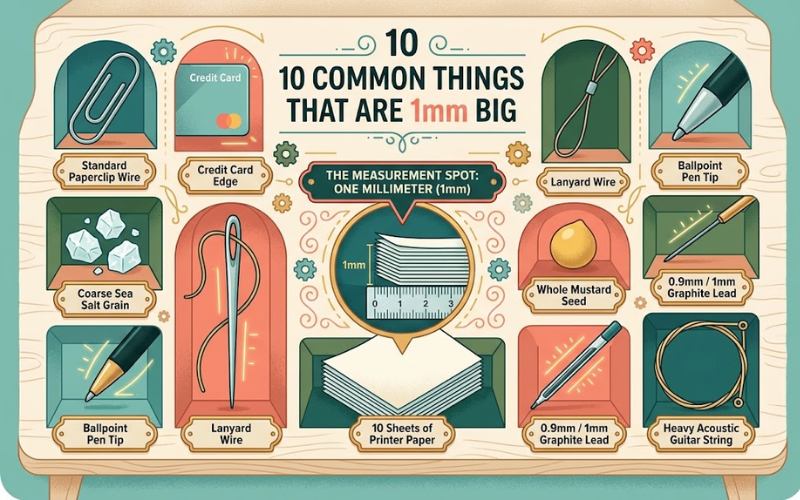
Tiny measurements often baffle the human eye. When someone mentions a millimeter, most people think of a tiny speck or the smallest mark on a plastic school ruler, yet they struggle to anchor that size to everyday life.
Knowing exact micro-dimensions matters far more than you might realize. Whether you buy jewelry, pick watch sizes, replace phone screen protectors, set 3D print layer heights, or manage household DIY fixes, having a solid real-world reference helps you make better decisions without constantly reaching for calipers.
Here is your straightforward guide to gauging this measurement instantly, followed by ten everyday items that represent exactly one millimeter in the real world.
Quick Answer: How Big is 1mm?
One millimeter ($1\text{ mm}$) equals one-thousandth of a meter, one-tenth of a centimeter, or roughly $0.03937$ inches.
To check it without a ruler, pull a standard plastic bank card or driver’s license from your wallet. The thickness of that single card sits right around $0.76\text{ mm}$ to $0.80\text{ mm}$—just a hair under a full millimeter. If you stack a heavy sheet of cardstock next to it, you hit $1\text{ mm}$ exactly.
Quick Reference BioWiki Table: Everyday 1mm Objects
| Object Name | Dimension Measured | Exact Average Size | Where You Find It |
| Standard Paperclip Wire | Wire diameter / gauge | $0.90\text{ mm} – 1.05\text{ mm}$ | Desk drawer, office supplies |
| Credit Card Edge | Edge thickness | $0.76\text{ mm} – 0.85\text{ mm}$ | Wallet, payment cards |
| Coarse Sea Salt / Sand Grain | Crystal diameter | $1.00\text{ mm} – 1.20\text{ mm}$ | Kitchen pantry, ocean beaches |
| Sewing Needle Eye | Internal eye opening | $0.80\text{ mm} – 1.00\text{ mm}$ | Sewing kit, mending basket |
| Ballpoint Pen Tip | Tungsten carbide ball | $1.00\text{ mm}$ | Pens (Medium/Bold point) |
| ID Card Lanyard Wire | Braided cord core / wire | $1.00\text{ mm}$ | Badges, keychains |
| US Dime Edge | Rim edge thickness | $1.35\text{ mm}$ (approx.) | Pocket change |
| Mustard Seed | Whole seed diameter | $1.00\text{ mm} – 1.50\text{ mm}$ | Spice rack |
| Graphite Pencil Lead | Clutch pencil refill core | $0.90\text{ mm} – 1.00\text{ mm}$ | Drafting supplies, school bag |
| Guitar High E String (Heavy) | Metal wire diameter | $0.90\text{ mm} – 1.05\text{ mm}$ | Electric / acoustic guitar packs |
10 Common Things That Are 1mm Big
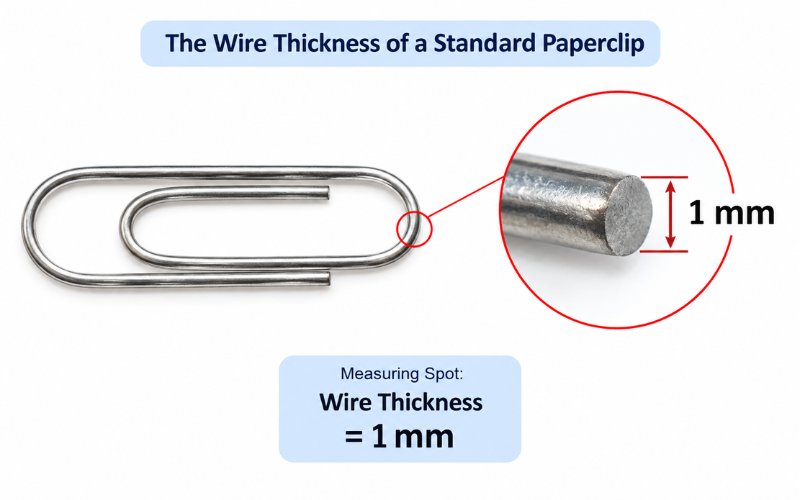
1. The Wire Thickness of a Standard Paperclip
Walk over to any desk drawer and pick up a regular silver paperclip. While jumbo clips use thick $1.5\text{ mm}$ metal rod, standard No. 1 paperclips use steel wire drawn to roughly 19 or 20 gauge. That translates directly to an outer diameter between $0.90\text{ mm}$ and $1.02\text{ mm}$.
Running your fingertips over this steel wire gives you the most reliable tactile feel for one millimeter. Manufacturing plants across the world calibrate their bending equipment to this exact wire gauge so the metal bends easily without snapping under repeated bending.
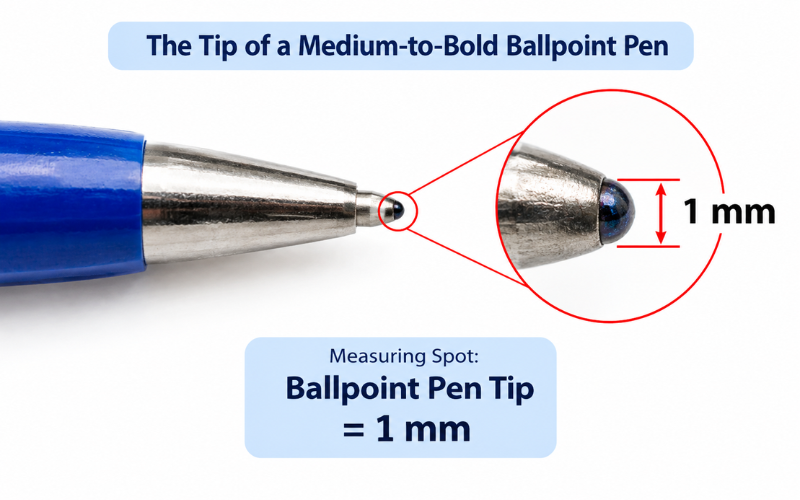
2. The Tip of a Medium-to-Bold Ballpoint Pen
Pens come in distinct tip categories: ultra-fine ($0.38\text{ mm}$), fine ($0.5\text{ mm}$), medium ($0.7\text{ mm}$), and bold ($1.0\text{ mm}$).
A classic bold Bic Cristal or standard promotional ballpoint pen houses a rotating tungsten carbide sphere in its brass socket that measures precisely $1.0\text{ mm}$ across. When you place the pen tip against paper, that tiny rolling orb provides an exact point of reference for a millimeter sphere.
3. A Single Grain of Coarse Sand or Kosher Flake Salt
Fine beach sand runs around $0.1\text{ mm}$ to $0.25\text{ mm}$, but coarse coastal sand and pickling salt crystals sit right at $1\text{ mm}$.
If you spill coarse sea salt on a dark kitchen counter, isolate a single cubic grain. That tiny white speck is virtually identical to a cubic millimeter block. Geologists formally classify sand grains between $1\text{ mm}$ and $2\text{ mm}$ as “very coarse sand,” marking the transition point where sediment changes from fine dust to micro-gravel.

4. Ten Sheets of Printer Paper Stacked Together
Standard multipurpose office printer paper ($20\text{ lb}$ bond or $75\text{–}80\text{ GSM}$) measures approximately $0.10\text{ mm}$ thick per sheet.
Count out exactly ten flat sheets from your printer tray and press them tightly between your thumb and forefinger. That entire stack equals $1.0\text{ mm}$ of total thickness. This ratio offers an intuitive multiplication trick: every ten standard pages equal one millimeter of book spine thickness.

5. The Width of a Whole Mustard Seed
Culinary mustard seeds (whether yellow, brown, or black) grow into nearly uniform spheres. A standard yellow mustard seed measures between $1.0\text{ mm}$ and $1.5\text{ mm}$ in diameter.
If you inspect a spoonful of whole-grain Dijon mustard, each individual popping sphere represents an accurate biological demonstration of a millimeter. Their uniform shape has made them a historical benchmark for micro-weights and measures across multiple ancient cultures.

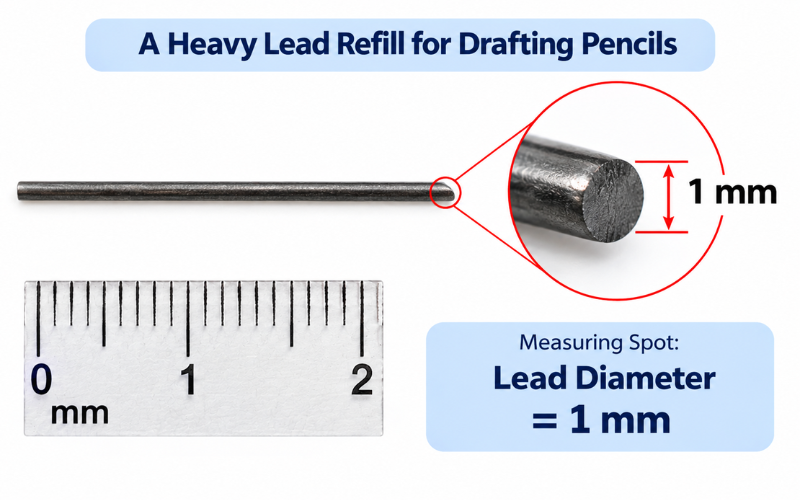
6. A Heavy Lead Refill for Drafting Pencils
Mechanical pencils commonly use thin leads measuring $0.5\text{ mm}$ or $0.7\text{ mm}$, but construction pencils and heavy-duty drafting tools use thick $0.9\text{ mm}$ or $1.0\text{ mm}$ graphite cores.
When you slide one of these dark gray graphite rods out of its plastic cartridge, you are holding a structural cylinder of pure carbon that matches the target width from end to end. Woodworkers prefer this specific thickness because a $1\text{ mm}$ lead creates bold, legible cut lines on rough lumber without snapping under hand pressure.
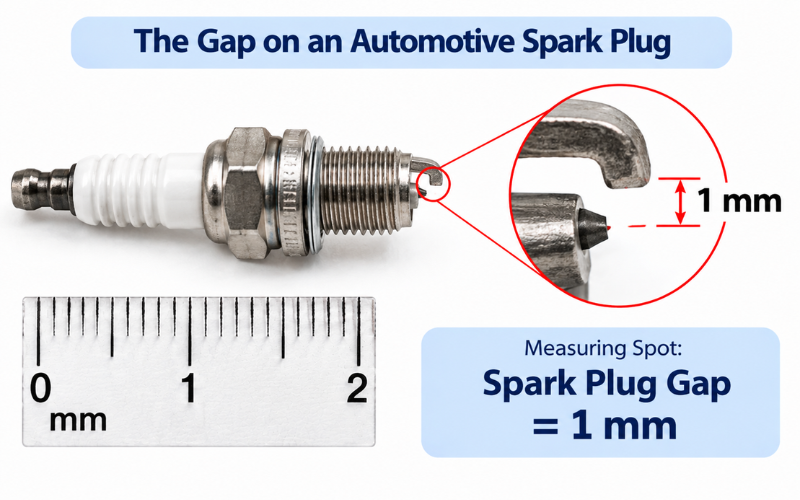
7. The Gap on an Automotive Spark Plug
Internal combustion engines depend on an exact gap between the center electrode and the ground electrode of each spark plug to ignite fuel vapors cleanly.
Automotive mechanics regularly set this ignition gap between $0.8\text{ mm}$ and $1.1\text{ mm}$ using feeler gauges. A spark plug calibrated to $1.0\text{ mm}$ ($0.039\text{ inches}$) maintains just enough clearance for electrical voltage to jump across and create an efficient combustion spark.
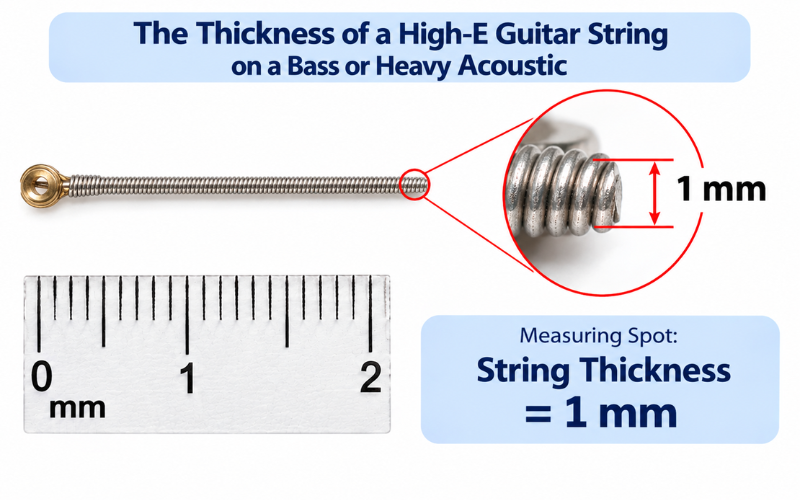
8. The Thickness of a High-E Guitar String on a Bass or Heavy Acoustic
Stringed instruments demand micro-level tolerances to sound in tune. While electric guitars use razor-thin strings starting at $0.22\text{ mm}$ ($0.009\text{ inches}$), acoustic guitar “G” strings or heavy wound nylon classical strings frequently measure around $0.040\text{ inches}$—which converts directly to $1.016\text{ mm}$.
Plucking this specific cord lets you feel and hear the physical vibration of a millimeter-thick metal wire.
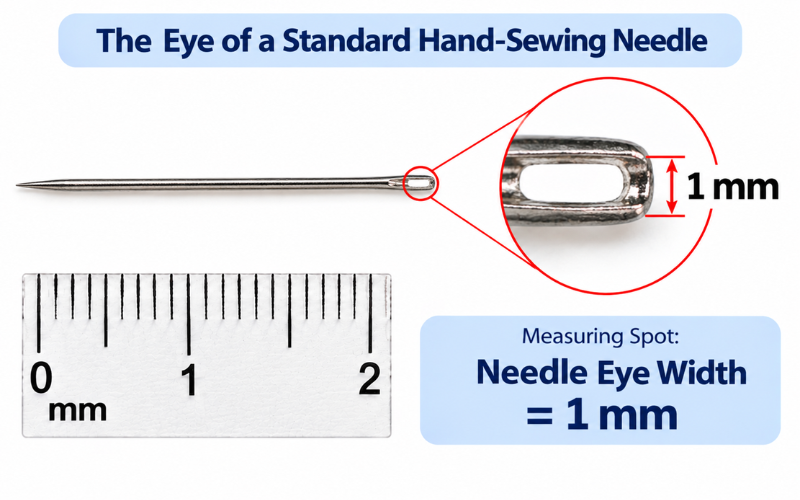
9. The Eye of a Standard Hand-Sewing Needle
Thread your favorite hand-sewing needle, and you will notice how precisely designed that tiny eyelet is.
An average household sharps needle features an internal eye aperture roughly $0.8\text{ mm}$ to $1.0\text{ mm}$ long and roughly $0.3\text{ mm}$ wide. It permits two strands of standard polyester sewing thread (each about $0.2\text{ mm}$ to $0.3\text{ mm}$ thick) to slide through cleanly side-by-side without binding against the polished steel walls.
10. The Rim of a Thinned-Down Coin
A standard United States one-cent penny measures roughly $1.52\text{ mm}$ in edge thickness, while a US ten-cent dime sits at $1.35\text{ mm}$.
While no single coin hits $1\text{ mm}$ cleanly, the edge of a dime comes remarkably close. Shave roughly one-fourth off that edge, and you reach the $1\text{ mm}$ line. In countries using the euro, the $0.01$ Euro coin measures $1.67\text{ mm}$, making a dime the closest Western currency coin for a fast pocket reference.

Why 1mm Matters in Daily Life and Manufacturing
Small distances produce massive consequences across engineering, construction, and consumer products. When manufacturers miss tolerances by a single millimeter, the physical world stops working smoothly.
Consumer Electronics and Smartphones
Smartphones pack camera modules, wireless charging coils, haptic vibration motors, and multi-cell lithium batteries into frames that measure less than $8\text{ mm}$ thick. In modern phone assembly, gaining or losing $1\text{ mm}$ of internal volume determines whether engineers can fit a larger $5,000\text{ mAh}$ battery or need to scale down to a smaller capacity. Screen protectors also use tempered glass ground down to $0.33\text{ mm}$ or $0.5\text{ mm}$—fractions of our target measurement.
Carpentry, Tiling, and Home Improvement
Tile installers use tiny plastic cross-spacers during floor and wall installations. These spacers come in $1\text{ mm}$, $2\text{ mm}$, and $3\text{ mm}$ increments. Setting a tile row off by a solitary millimeter at one corner compounds across ten feet of kitchen floor, creating visible crooked grout lines and uneven gaps along baseboards.
Medical Devices and Surgical Tools
Surgical sutures, hypodermic needles, and dental implants rely heavily on the metric millimeter scale. An 18-gauge medical needle has an outer diameter of approximately $1.27\text{ mm}$, while a 20-gauge needle measures $0.91\text{ mm}$. To a vascular surgeon or a phlebotomist, this minute difference governs liquid flow rates and patient comfort during injections.
Metric vs. Imperial: Converting 1mm Easily
Working across different measurement systems often causes headaches. If you grew up with inches, feet, and fractions, thinking in metric requires quick conversion benchmarks:
- 1 Millimeter = 0.03937 Inches
- 1/32 of an Inch = 0.7938 mm (slightly thinner than 1mm)
- 3/64 of an Inch = 1.1906 mm (slightly thicker than 1mm)
- 1/16 of an Inch = 1.5875 mm (much thicker than 1mm)
- 25.4 Millimeters = Exactly 1 Inch
Because imperial tape measures divide inches into sixteenths or thirty-seconds, carpenters often consider $1\text{ mm}$ roughly equal to the thickness of a utility knife blade or the kerf line left by a fine-toothed hand saw.
Frequently Asked Questions
Can the naked human eye see 1 millimeter?
Yes, easily. The naked human eye with normal 20/20 vision can resolve objects down to approximately $0.1\text{ mm}$ ($100\text{ microns}$) under decent lighting conditions. A $1\text{ mm}$ object is ten times larger than the threshold of human visual acuity, making it sharp and distinct at arm’s length.
How many hairs make up 1 millimeter?
An average human scalp hair measures between $0.06\text{ mm}$ and $0.08\text{ mm}$ in diameter. If you lay straight strands of hair flat side-by-side without overlapping them, it takes roughly 12 to 16 individual strands to cover a span of one millimeter.
Is a fingernail 1mm thick?
No. An average healthy adult fingernail measures between $0.4\text{ mm}$ and $0.6\text{ mm}$ thick. To reach a full millimeter of keratin, you would need to press two fingernails flat against one another. Human fingernails do, however, grow roughly $1\text{ mm}$ every 8 to 10 days.
What tool measures 1 millimeter most accurately?
While standard plastic and wooden rulers display millimeter lines, digital vernier calipers and screw-gauge micrometers measure one millimeter and its sub-fractions with the highest accuracy. Calipers can read dimensions down to $0.01\text{ mm}$, removing any guesswork caused by the thickness of printed tick lines on regular rulers.
A millimeter might seem like an insignificant speck in isolation, but it represents one of the most practical benchmarks in the modern physical world. From paperclips to pen tips and seed grains, objects of this size surround you every day.
Keep these common items in mind whenever you need to check a gap, plan a craft project, or gauge dimensions on the fly. Once you connect the number to a tangible item like a paperclip wire or ten sheets of paper, you will never struggle to estimate small measurements again.
Related Posts
- 10 Common Things That Are 90 Meters Long/ Tall
- 10 Common Things That Are 80 Meters Long/ Tall
- 10 Common Things That Are 70 Meters Long/ Tall
- 10 Common Things That Are 60 Meters Long/ Tall
Conclusion
Mastering small measurements transforms how you navigate everyday tasks, from minor home repairs and 3D printing to choosing the right watch or jewelry. Knowing that a standard paperclip wire or a stack of ten printer pages equals one millimeter gives you an immediate physical baseline, eliminating the guesswork when a ruler is out of reach.
A single millimeter may seem negligible on its own, but it carries enormous weight in manufacturing, electronics, and design. Keeping these ten everyday references in mind allows you to estimate micro-dimensions accurately, spot tight tolerances instantly, and make confident sizing decisions on the fly.
FOR MORE MEASUREMENTS VISIT: MEASURINGSPOT