
Have you ever tried to gauge a distance across an open field, along a city street, or out at sea, only to find yourself second-guessing the numbers? Measurements on paper make sense mathematically, but human brains process size far better through tangible reference points.
Eighty meters sits in an interesting zone. It is longer than a standard residential plot, taller than most neighborhood trees, and substantially larger than everyday objects like cars or city buses. Yet, it appears everywhere once you know what benchmarks to track.
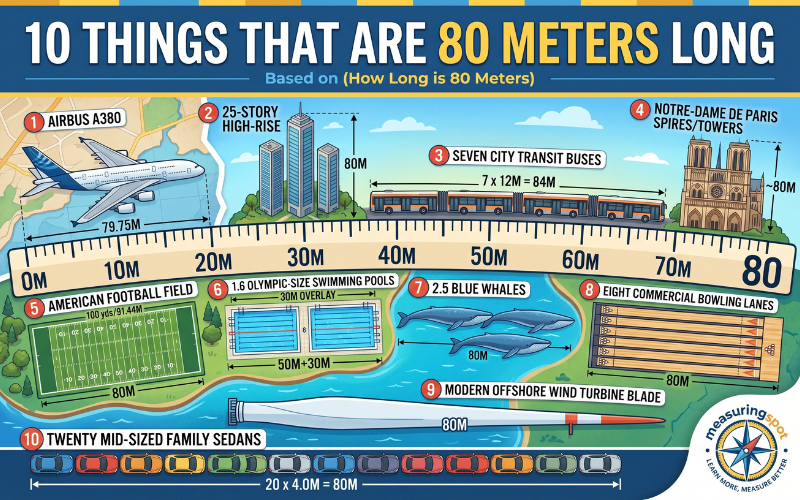
To help you gain an immediate sense of scale, this guide breaks down exactly what 80 meters means in practical, real-world terms. From commercial airliners and historic monuments to sports fields and marine giants, here are ten recognizable things that measure roughly 80 meters long.
Quick Answer: How Long is 80 Meters?
Eighty meters converts to exactly 262.47 feet or 87.49 yards.
In casual conversation:
- It is about 87% the length of an American football field (excluding the end zones).
- It equals nearly two Olympic-size swimming pools placed end to end.
- It matches the length of six standard full-size transit buses parked bumper to bumper.
- An average adult walking at a brisk pace covers 80 meters in roughly 55 to 60 seconds (about 105 to 110 footsteps).
80 Meters Quick Reference & Biowiki Table
| Dimension / Metric | Value / Equivalent |
| Length in Meters | 80 m |
| Length in Feet | 262.47 ft |
| Length in Yards | 87.49 yd |
| Length in Inches | 3,149.61 in |
| Length in Kilometers | 0.08 km |
| Length in Miles | 0.0497 mi |
| Standard Olympic Swimming Pools | 1.6 pools (50 m each) |
| City Transit Buses (Standard 40-ft) | ~6.5 buses lined up |
| Standard American Football Fields | ~0.87 field (field of play: 91.44 m) |
| Average Human Walking Steps | 105 to 115 strides |
| Time to Walk (at 5 km/h / 3.1 mph) | ~58 seconds |
| Average Story Height Equivalent | ~24 to 26 building stories (residential) |
How Long is 80 Meters? Converting the Distance
Before examining physical objects, converting 80 meters into imperial and familiar metric increments helps bridge the mental gap.
Conversion to Feet and Yards
The metric unit meter equals roughly 3.28084 feet. Multiplying 80 by 3.28084 gives 262.47 feet. If you measure distance in yards, 80 meters works out to 87.49 yards, which sits just 12.5 yards shy of a 100-yard milestone.
Height vs. Horizontal Distance
Perspective alters how we perceive 80 meters. Horizontally, you can cross 80 meters on foot in under a minute without breaking a sweat. Vertically, 80 meters transforms into a towering structure. Standard modern architectural guidelines allot approximately 3 meters to 3.3 meters per residential floor. Consequently, an 80-meter vertical rise equals a skyscraper or apartment complex between 24 and 27 stories tall. Looking up at an 80-meter building produces a far more imposing impression than walking across an 80-meter park path.
1. The Wingspan of an Airbus A380-800
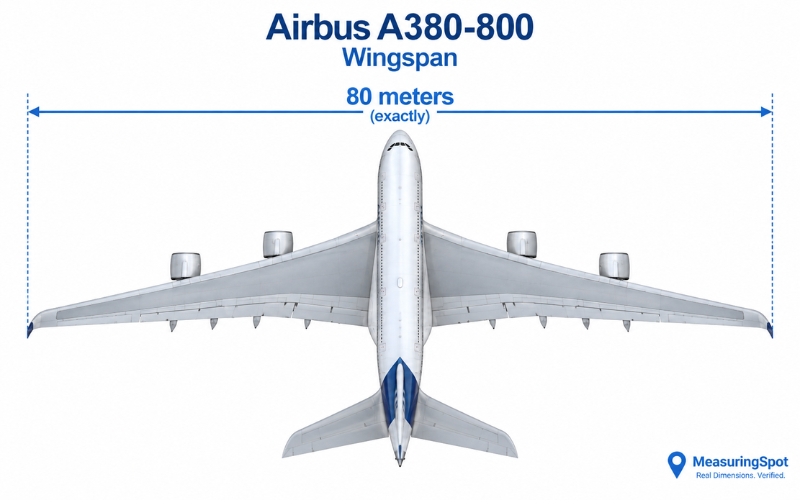
The Airbus A380 stands as the world’s largest commercial passenger airliner. While its fuselage stretches roughly 72.7 meters from nose to tail, its massive wingspan comes remarkably close to the 80-meter mark.
Engineering the 80-Meter Box
Airport planners operate within strict sizing regulations known as the “80-meter box.” International aviation standards dictate that standard airport gates, taxiways, and runways accommodate aircraft with a maximum exterior footprint of 80 by 80 meters. When Airbus engineers designed the double-decker A380, they maximized this envelope. The plane boasts a total wingspan of 79.75 meters (261.6 feet).
Why This Comparison Works
If you have ever stood at an international airport terminal and watched an Airbus A380 taxi past your departure gate, you have witnessed 80 meters in horizontal breadth. The wings stretch so far across that maintenance crews can park multiple mid-sized cars along the surface of each wing structure.
2. A 25-Story Modern High-Rise Building
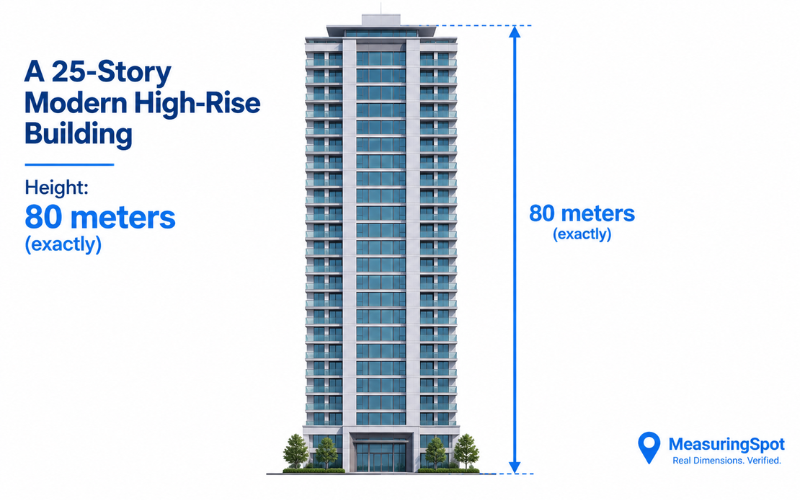
Buildings offer one of the most accessible ways to assess 80 meters in urban environments. Most cities feature high-rise condominiums, hotels, or corporate office towers that reach this exact threshold.
Calculating Floor Heights
Floor-to-floor height varies depending on whether a building serves commercial or residential tenants:
- Residential towers: Modern residential apartments typically maintain ceiling heights of around 2.7 meters, with floor plates and ductwork bringing the total slab-to-slab height to roughly 3.1 to 3.2 meters. A 25-story residential tower reaches approximately 78 to 80 meters.
- Commercial office buildings: Offices demand wider plenums above the ceilings to house complex HVAC systems, cable trays, and electrical infrastructure. These floors often measure 3.8 to 4.0 meters apiece. A 20-story corporate building comfortably hits the 80-meter mark.
Spotting One from the Ground
Whenever you pass a 24- to 26-story downtown apartment tower, trace your eyes from the sidewalk entrance straight up to the parapet roofline. You are surveying an 80-meter vertical plane.
3. Seven City Transit Buses Parked End-to-End
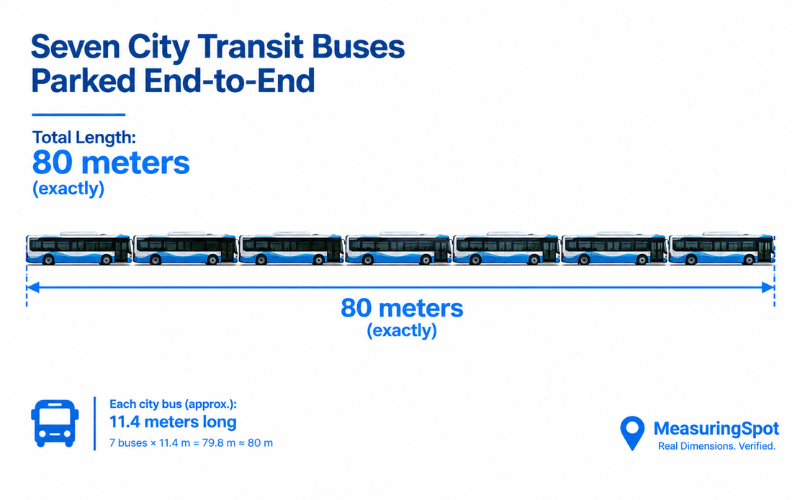
Public transit buses provide a ground-level measurement tool you encounter every day. Standard single-unit city buses follow uniform dimensions across North America, Europe, and Asia.
The Math Behind the Fleet
A standard transit bus (such as a New Flyer, Gillig, or Mercedes-Benz Citaro) measures 12 meters (40 feet) in total length.
- Two buses: 24 meters
- Four buses: 48 meters
- Six buses: 72 meters
- Seven buses: 84 meters
If you park six full-size buses bumper-to-bumper and add a compact passenger vehicle at the front, you create an unbroken convoy that stretches precisely 80 meters.
Articulated “Accordion” Buses
Many metropolitan transit authorities also deploy articulated transit buses featuring accordion-style joints in the middle. These extended models measure 18 meters (60 feet) from front bumper to rear tailpipe. Lined up together, four and a half articulated buses cover the exact 80-meter span.
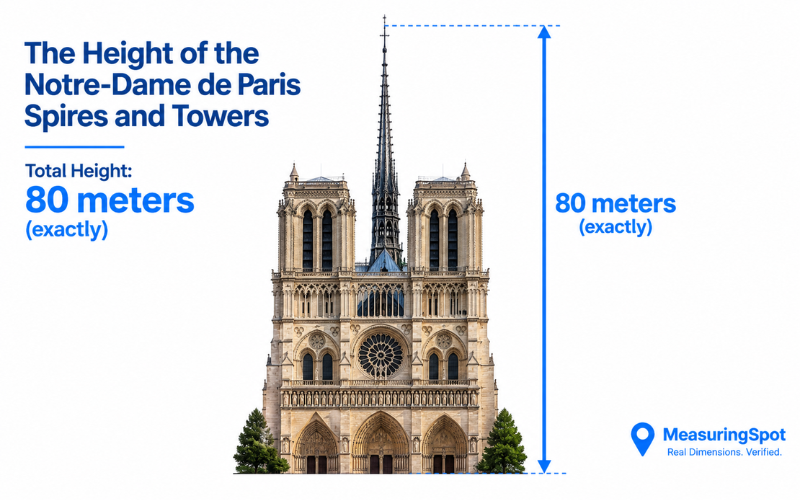
4. The Height of the Notre-Dame de Paris Spires and Towers
Historic architecture frequently illustrates 80-meter vertical proportions. The famous Cathedral of Notre-Dame de Paris in France provides a classic example through both its western towers and central spire.
Monumental Heights
While Notre-Dame’s main western facade towers stand at roughly 69 meters (226 feet) tall, the historic spire designed by Eugène Viollet-le-Duc originally pierced the skyline at 96 meters (315 feet). The cathedral’s primary roof ridge—the long stone spine running down the center of the nave and choir—sits right around 35 meters, while the entire length of the nave itself measures roughly 120 meters.
If you view the cathedral from across the River Seine, the distance from the stone foundation walls up through the clerestory roof and into the lower midsection of the soaring spire spans approximately 80 meters. It represents the height of medieval engineering ambition, using flying buttresses and heavy limestone arches to push stone structures to breathtaking elevations.
5. Nearly One American Football Field (Goal Line to Goal Line)
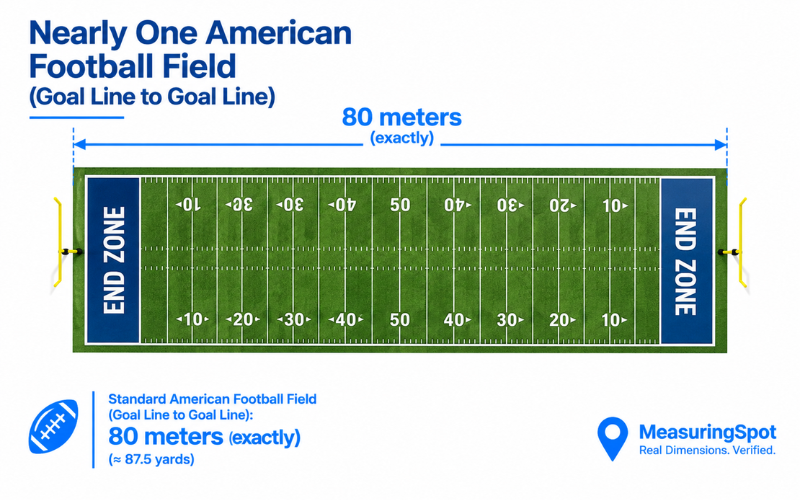
Sports fans often rely on football fields to estimate expansive land parcels. Because gridiron dimensions remain constant across all official stadiums, they offer reliable mental yardsticks.
Field Dimensions Broken Down
An entire official American football field measures 120 yards (360 feet or 109.7 meters) when counting both 10-yard end zones. However, the active field of play—spanning from goal line to opposite goal line—measures 100 yards, which converts to 91.44 meters.
Finding 80 Meters on the Field
To mark out 80 meters on a football field:
- Start at one goal line (the 0-yard marker).
- Walk down the hash marks past the 50-yard line.
- Stop at the opposing team’s 12.5-yard line.
The distance between the goal line you left behind and the 12.5-yard mark represents exactly 80 meters (87.5 yards). It covers almost nine full sets of downs.
6. Approximately 1.6 Olympic-Size Swimming Pools
Anyone who has swum laps in a competitive pool knows how strenuous traversing water can be. Olympic competition pools maintain rigid global regulations overseen by World Aquatics.
Regulation Pool Dimensions
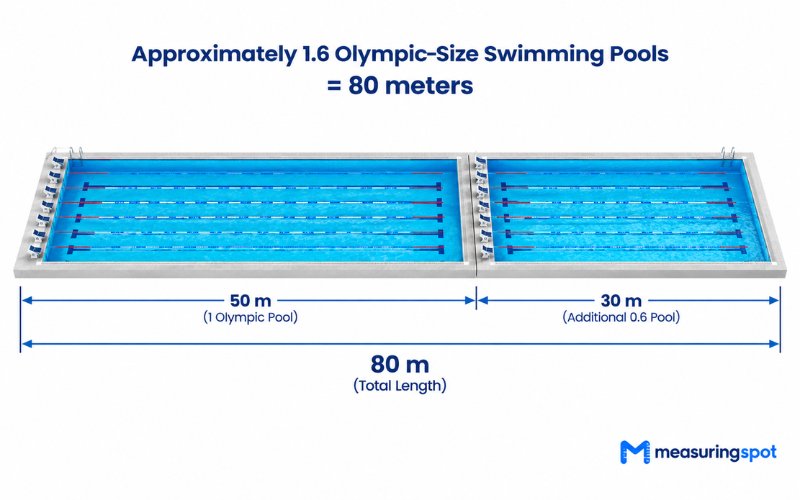
An Olympic-size swimming pool must measure exactly 50 meters (164 feet) in length between the timing touchpads, with a typical width of 25 meters and a minimum depth of 2 meters.
Stacking the Pools
To reach 80 meters, you need:
- One full 50-meter Olympic pool.
- Plus another 30 meters of a second pool (three-fifths of its total length).
Swimmers covering an 80-meter sprint complete one full length of an Olympic pool and turn back around to swim more than halfway toward their starting blocks. For open-water swimmers or triathletes, navigating 80 meters requires roughly 45 to 60 swimming strokes depending on efficiency and stroke style.
7. Two and a Half Blue Whales
The blue whale (Balaenoptera musculus) ranks as the largest animal known to have ever lived on Earth, surpassing even the heaviest titanosaur dinosaurs in sheer bulk.
Marine Giants by the Numbers
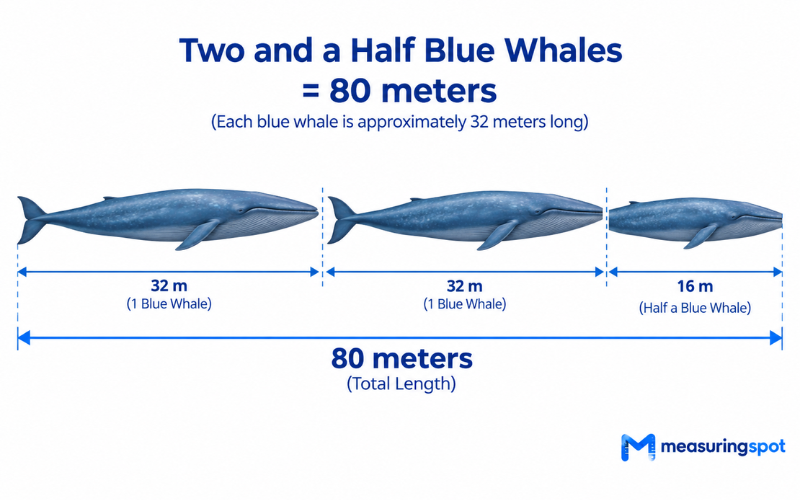
An adult blue whale can reach lengths between 24 and 30 meters (80 feet to 100 feet), with mature females in Antarctic waters frequently topping 29 meters.
- One mature blue whale: ~28 to 30 meters
- Two mature blue whales: ~58 to 60 meters
- Two and a half blue whales: ~80 meters
If three adult blue whales swam in a tight single-file migration line, their bodies from snout to tail flukes would stretch slightly past an 80-meter line. Considering that an adult blue whale’s tongue alone weighs as much as an entire African elephant, seeing two and a half of these colossal creatures end to end shows just how huge 80 meters is in the biological realm.
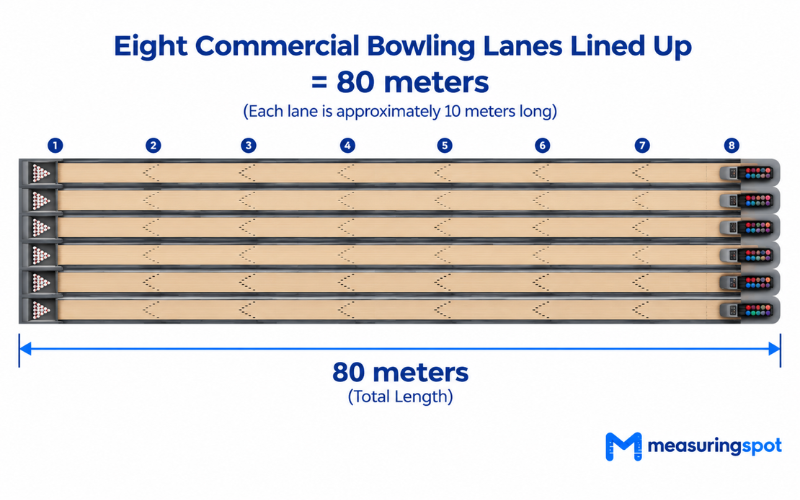
8. Eight Commercial Bowling Lanes Lined Up
Ten-pin bowling alleys feature flat, wooden or synthetic lanes designed to exact physical specifications mandated by the United States Bowling Congress (USBC) and the International Bowling Federation.
Precise Bowling Lane Dimensions
An official regulation bowling lane measures:
- 60 feet (18.29 meters) from the foul line to the center of the headpin (pin number 1).
- When factoring in the approach area behind the foul line (minimum 15 feet or 4.57 meters) and the pin deck behind the headpin, an entire operational bowling lane structure spans approximately 75 feet (22.86 meters).
Calculating the 80-Meter Run
If you take only the playing surface—from the foul line to the headpin (18.29 meters):
- 1 lane: 18.29 m
- 2 lanes: 36.58 m
- 3 lanes: 54.87 m
- 4 lanes: 73.16 m
- 4.37 lanes: 80 m
However, if you take the approach and lane assembly together (~22.8 meters), lining up three and a half complete bowling installation bays end to end spans 80 meters. Alternatively, walking down four and a half consecutive bowling alleys from player stance to the pin pit covers that same distance.
9. Modern Offshore Wind Turbine Blades
Renewable energy infrastructure has grown dramatically over the past two decades. As engineering firms develop more efficient wind generators, turbine blade lengths have scaled up to capture maximum air currents.
Massive Rotor Spans
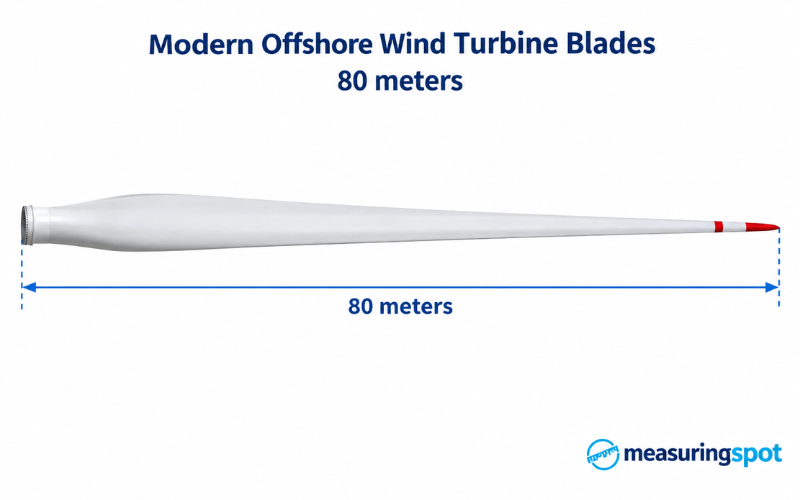
While early land-based wind turbines featured blades measuring 20 meters to 30 meters, modern utility-scale offshore installations dwarf those older designs. Many commercial offshore turbines—such as the 8-megawatt to 10-megawatt models manufactured by Vestas and Siemens Gamesa—employ single rotor blades that measure between 75 and 85 meters long.
A Single Blade on the Highway
A single rotor blade from one of these offshore giants matches 80 meters from root to tip. When transport companies haul these blades overland before installation, they require custom multi-axle steerable trailers and police escorts just to navigate highway curves. A single fiberglass blade lying on the grass covers the same span as an 80-meter field.
10. Twenty Mid-Sized Family Sedans Parked Bumper to Bumper
Automobiles offer another immediate, accessible benchmark for estimating distances along curbs and roadways.
Everyday Vehicle Lengths
Mid-sized family sedans—such as the Toyota Camry, Honda Accord, or Hyundai Sonata—measure approximately 4.88 to 4.92 meters (16 to 16.1 feet) from front grille to rear bumper. Compact crossovers and hatchbacks sit closer to 4.4 meters, while full-size pickup trucks often reach 5.8 meters.
The 20-Car Parking Line
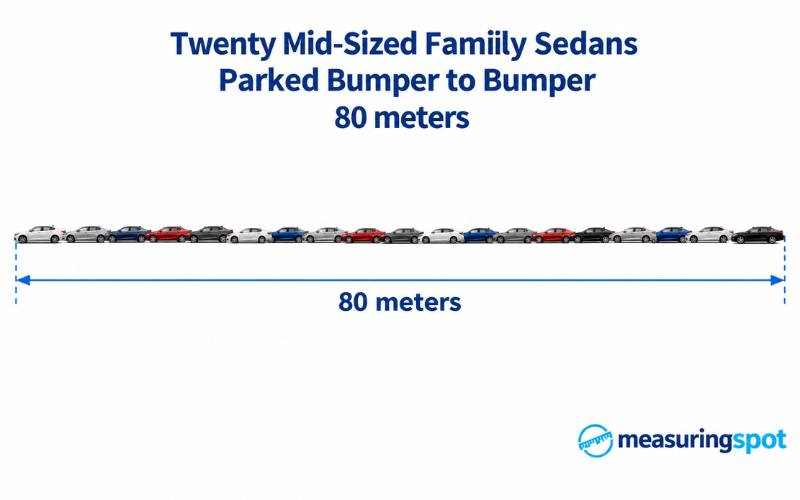
Taking an average car length of roughly 4 meters for compacts, or grouping 16 to 17 mid-sized sedans together without gaps, produces an 80-meter traffic line:
- 16 mid-sized sedans (at 4.9 meters each) = 78.4 meters.
- 20 compact cars (at 4.0 meters each) = 80 meters.
When you sit in heavy rush-hour traffic and count 16 to 20 cars idling bumper-to-bumper ahead of you, your windshield sits approximately 80 meters behind the lead car.
Practical Applications: When Does Knowing 80 Meters Matter?
Understanding this specific distance serves functional purposes beyond mere trivia. Several industries, recreational activities, and safety protocols rely on estimating an 80-meter span quickly.
Land Surveying and Real Estate Development
Rural residential parcels, hobby farms, and commercial outlots frequently list perimeter boundaries measured in tens of meters. A standard square parcel of one hectare (10,000 square meters) measures 100 meters by 100 meters. An 80-meter boundary line defines a substantial property perimeter. Recognizing what 80 meters looks like prevents errors when walking property boundaries or planning perimeter fencing.
Maritime Operations and Anchoring
Mariners calculate safe swinging room at anchor based on boat length, water depth, and rode scope. A vessel anchored in 10 meters of water with a standard 7:1 scope lets out roughly 70 meters to 80 meters of chain or nylon rode. Knowing the radius of that 80-meter swing circle helps skippers prevent collisions with neighboring boats or shallow shoals as the wind shifts.
Athletic Conditioning and Track Training
Track athletes running 100-meter sprints routinely use 80-meter checkpoints during speed endurance workouts. In sprint training, runners often maintain top-end mechanical velocity through 80 meters before deceleration sets in. Understanding this length helps coaches set acceleration markers and camera placements along the straightaway.
Frequently Asked Questions About 80 Meters
How long does it take to walk 80 meters?
A healthy adult walks at an average speed of 4.8 to 5.0 kilometers per hour (roughly 1.35 to 1.4 meters per second). At that normal cruising pace, walking 80 meters takes approximately 55 to 60 seconds. If you pick up your pace to a brisk walk, you can easily cover the distance in 40 to 45 seconds.
How many steps does it take to cover 80 meters?
Step count depends on individual height and natural stride length. The average adult male maintains a walking stride of about 0.76 meters (2.5 feet), while the average female stride measures roughly 0.67 meters (2.2 feet). Consequently, covering 80 meters requires between 105 and 120 steps.
How many yards is 80 meters?
Eighty meters equals 87.489 yards. To calculate this yourself, divide the meter measurement by 0.9144 (the exact number of meters in a standard international yard).
How does 80 meters compare to a soccer pitch?
Official soccer (football) pitches governed by FIFA regulations vary in size, but professional international matches require field lengths between 100 and 110 meters. An 80-meter distance covers roughly 75% to 80% of a professional soccer pitch’s total sideline.
Can you see a person clearly from 80 meters away?
Yes. At 80 meters under clear daylight conditions, a person with 20/20 vision can easily detect someone standing, determine their clothing colors, and recognize their overall gait. Distinguishing fine facial features or reading facial expressions becomes difficult past 30 meters to 40 meters, but body posture and gross hand gestures remain visible across an 80-meter distance.
What is the stopping distance of a car from 80 meters?
Under dry asphalt conditions, a standard passenger vehicle traveling at 100 km/h (62 mph) requires about 40 meters of actual braking distance to come to a complete halt. Factoring in driver reaction time (roughly 1 to 1.5 seconds, which adds another 28 to 42 meters of travel before the brakes engage), the total stopping distance ranges from 68 to 82 meters. Therefore, 80 meters represents the absolute total safety buffer needed to stop a car moving at highway speeds.
Summary of 80-Meter Comparisons
Conceptualizing 80 meters becomes effortless once you link the figure to familiar objects in your environment. Whether looking up at a 25-story building, checking the wingspan of a double-decker passenger jet, or observing six transit buses queued up along a busy downtown street, 80 meters surrounds us in daily life.
Next time you need to estimate an 80-meter gap across an open area, remember the football field rule: walk to the goal line, cast your eyes down toward the opposite 12.5-yard marker, and you have marked your distance with near-perfect accuracy. Keep these ten real-world objects in mind, and you will gauge medium-to-long distances with confidence.
Related Posts
- 10 Common Things That Are 50 Meters Long/ Tall
- 10 Common Things That Are 40 Meters Long/ Tall
- 10 Common Things That Are 30 Meters Long / Tall
- 10 Everyday Things That Are 20 Meters Long/ Tall
Conclusion
Estimating medium-to-long measurements does not require complex tools or guesswork when you have concrete reference points. Eighty meters may feel abstract as a standalone number, but it snaps into focus the moment you link it to a 25-story building, an Airbus A380 wingspan, or six city buses lined up bumper-to-bumper.
Whether you are pacing out a property boundary, gauging stopping distances along the highway, or checking athletic sprint markers on a track, these everyday benchmarks provide reliable perspective. Keeping a few of these physical anchors in mind makes assessing 80 meters simple, quick, and remarkably accurate wherever you go.
FOR MORE MEASUREMENTS VISIT: MEASURINGSPOT