
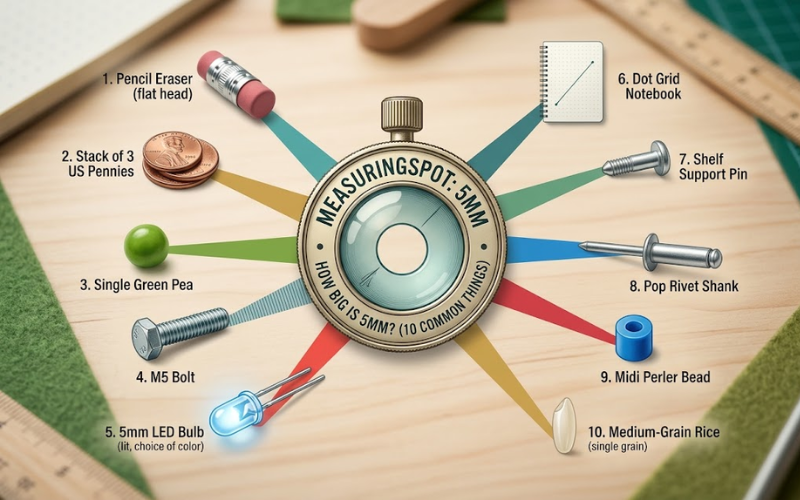
Most people struggle to estimate tiny metric measurements on the spot. When a product description lists a diameter of five millimeters, or a doctor mentions a five-millimeter spot, pulling out a ruler is not always practical.
Having everyday reference points makes small measurements immediately obvious. By anchoring the measurement to items sitting on your desk, in your kitchen drawer, or inside your pocket, you can instantly tell what five millimeters looks like in real life.
Quick Answer: How Big is 5mm?
Five millimeters (5mm) equals exactly 0.5 centimeters or approximately 0.197 inches (just under one-fifth of an inch). If you stack three standard US pennies together, the total thickness is almost exactly 5mm. A standard wooden pencil eraser also measures roughly 5mm across.
5mm at a Glance: Biowiki Reference Chart
This quick reference guide outlines the core physical constants, unit conversions, and everyday anchors associated with a 5mm span.
| Specification | Metric Value | Imperial Equivalent | Everyday Equivalent |
| Exact Length | 5.0 mm | 0.19685 inches | ~1/5 of an inch |
| Centimeter Scale | 0.5 cm | 0.0164 feet | Half of one centimeter |
| Meter Fraction | 0.005 m | 0.0054 yards | 1/200th of a meter |
| Microns (µm) | 5,000 µm | 196.85 mils | 5,000 micrometers |
| Coin Stack | 3.28 US Pennies | 3 Pennies stacked | Total thickness of three pennies |
| Hardware Standard | M5 Bolt thread | 0.1969″ Major Diameter | Common metric furniture bolt |
| Paper Thickness | ~50 sheets | ~0.2 inches of paper | Stack of standard 20lb printer paper |
| Stationery Mark | Dot-grid spacing | 0.1968″ grid pitch | Standard bullet journal dot spacing |
10 Common Things That Are 5mm Big
Finding concrete physical items removes all guesswork from metric dimensions. Here are 10 common household and commercial items that measure right around 5mm.
1. The Eraser on a Standard Wooden Pencil
Standard #2 pencils feature a pink rubber eraser secured by a metal ferrule at the base. The circular surface of this eraser measures between 4.8mm and 5.0mm in diameter across most manufacturing brands like Dixon Ticonderoga.
When dermatologists evaluate skin marks or moles, they frequently ask patients to compare the blemish to a pencil eraser. If you place the flat head of a fresh pencil eraser against any surface, the circle it covers marks out 5mm.

2. A Stack of Three US Pennies
A single United States one-cent coin has an official mint thickness of 1.52 millimeters. When you stack three pennies flat on top of each other, their combined height reaches 4.56mm. Add slight surface wear, grime, or minor rim variations, and the stack sits at roughly 4.8mm to 5.0mm.
Because pennies circulate everywhere across North America, this provides one of the most reliable tactile benchmarks you can test without tools. Pressing the edge of this three-coin stack against an object gives you an accurate 5mm gauge.

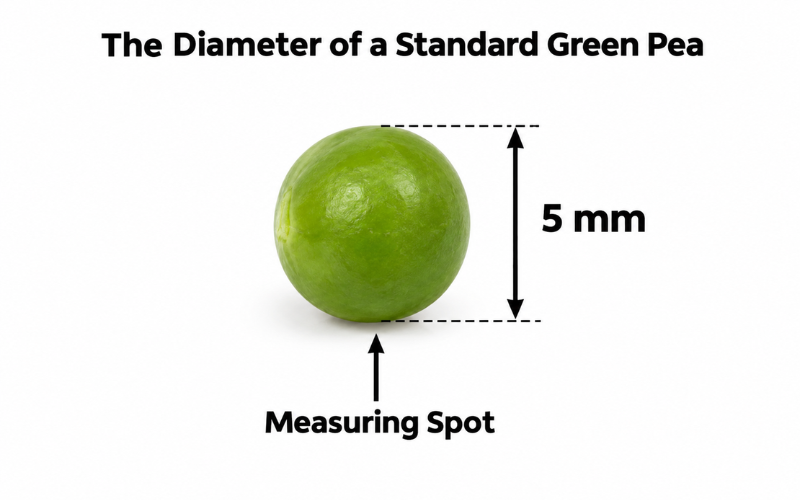
3. The Diameter of a Standard Green Pea
A single medium-sized garden pea (fresh or frozen) regularly measures about 5mm across its center. While natural produce naturally varies in size, commercial grading standards sort standard sweet peas around this diameter.
Petite peas sit closer to 3mm or 4mm, but everyday canned or garden-variety frozen peas fall right into the 5mm category. Rolling a single green pea across a countertop shows you the volumetric space that a 5mm sphere occupies.
4. An M5 Machine Screw or Bolt
In hardware stores, screw packaging relies directly on metric sizing. An M5 screw or metric bolt features an outer thread diameter of exactly 5.0 millimeters.
Builders, cyclists, and DIY hobbyists handle M5 fasteners constantly. Most water bottle cages on bicycles attach to the frame using M5 bolts. If you run your fingers over the threaded shank of an M5 screw, you feel the precise width of a 5mm cylinder.

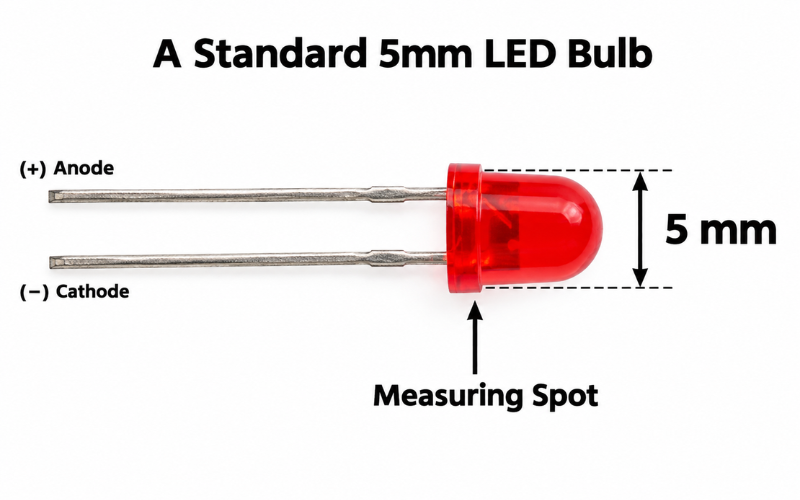
5. A Standard 5mm LED Bulb
Electronic hobby kits, instrument panels, custom PC towers, and consumer electronics rely heavily on through-hole indicator light bulbs. The classic dome-shaped through-hole light-emitting diode (LED) uses a standard casing width of 5mm.
Component makers produce two dominant hobbyist sizes: 3mm and 5mm. The larger, highly recognizable bulb that sits atop small electronic projects measures 5mm along the base of its plastic epoxy lens.
6. Standard Dot Grid Spacing in Notebooks
Stationery enthusiasts, students, and engineers frequently write in dot grid journals. The standard distance between two dots in major brands like Leuchtturm1917, Rhodia, and standard bullet notebooks is exactly 5 millimeters.
Each square within a 5mm dot grid provides a consistent spatial ruler. If you draw a line connecting two adjacent dots either horizontally or vertically, that line measures 5mm long.

7. A Shelf Support Pin (Cabinet Peg)
Most modern flat-pack cabinetry, bookshelves, and kitchen cupboards rely on adjustable shelving systems. The cylindrical metal or plastic pegs that slip into pre-drilled holes along the inner cabinet walls measure 5mm in diameter across most worldwide manufacturers, including IKEA.
Hardware manufacturers sell these pegs under the name “5mm shelf support pins.” If you remove one of these small pegs from your bookcase, its barrel thickness shows you 5mm.

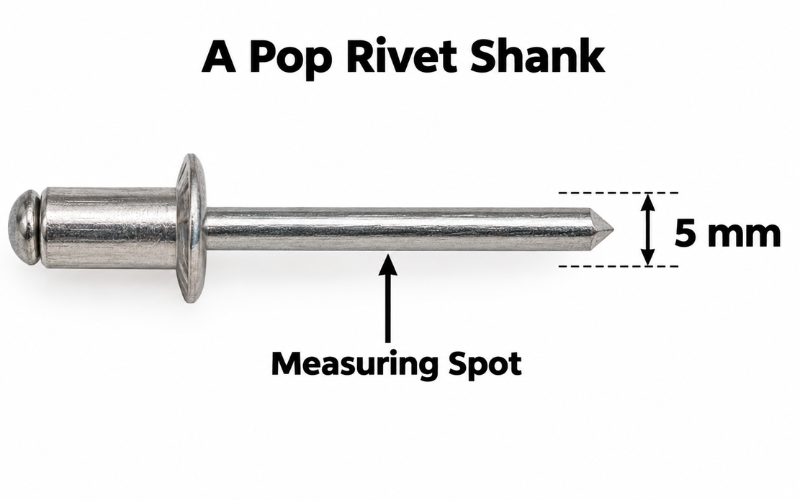
8. A Pop Rivet Shank
Sheet metal workers, auto mechanics, and gutters installers use pop rivets to fasten thin materials permanently. One of the most common standard blind rivet diameters is 3/16 inch, which converts to 4.76mm—commonly rounded up and manufactured as a true 5mm rivet in metric industrial markets.
The metal pin that drops into the pre-drilled sheet metal hole measures 5mm thick. Holding an unused rivet gives you a solid metal reference point for this dimension.
9. A Standard Plastic Bead (Midi Perler or Hama Bead)
Midi-sized fusible craft beads, commonly sold under the Perler, Hama, or Nabbi brand names, measure 5mm in height and 5mm in outer diameter.
Crafters arrange these cylindrical plastic beads on pegged pegboards before melting them together with an iron. Because every bead in the bucket must match identical proportions to fit the pegboard grid, each bead serves as a uniform 5mm cube-like cylinder.

10. A Grain of Medium-Grain Rice (Length)
A single uncooked grain of medium-grain white or brown rice measures between 5.0mm and 5.5mm in total length from tip to tip.
Long-grain varieties like Basmati or Jasmine stretch beyond 6mm or 7mm, but standard medium-grain rice (often used in paella or risotto) sits squarely at the 5mm mark. Placing a single dry grain lengthwise gives you an immediate natural benchmark.

Metric vs. Imperial: Converting 5mm Easily
Converting small measurements between metric and imperial units often creates confusion. The millimeter measures tenths of a centimeter, while the imperial system breaks inches into halves, quarters, eighths, sixteenths, and thirty-seconds.
1 Millimeter = 0.03937 Inches
5 Millimeters = 5 x 0.03937 = 0.19685 Inches
To fit 5mm into an imperial ruler:
- 1/8 inch = 0.125 inches (3.175mm)
- 3/16 inch = 0.1875 inches (4.76mm)
- 5mm = 0.1969 inches
- 1/4 inch = 0.2500 inches (6.35mm)
Five millimeters sits just above 3/16 of an inch and slightly below 1/4 of an inch. When working on home projects without a metric scale, measuring 3/16 inch on a tape measure gives you an accurate rough equivalent.
Where 5mm Appears in Everyday Life
The 5mm mark serves as a critical manufacturing threshold across medical, industrial, culinary, and design fields.
Medical and Dermatology Assessments
Doctors use 5mm as a threshold during skin health evaluations. When screening for melanoma or atypical skin lesions, clinicians use the ABCDE checklist. The “D” stands for diameter.
Lesions larger than 5mm to 6mm across warrant clinical evaluation. The standard benchmark doctors give to patients during self-exams is the width of a pencil eraser, which measures 5mm.
Jewelry and Piercings
Jewelry makers classify small gemstone accents, diamond stud earrings, and body jewelry gauges with millimeters. A 5mm round brilliant-cut diamond weighs roughly 0.45 to 0.50 carats.
For earlobe piercings, 5mm represents a 4-gauge (4G) plug or tunnel. In necklace design, 5mm pearl beads create subtle, classic strands that rest flat against the collarbone without excessive bulk.
Culinary Cuts and Knife Skills
In professional kitchens, culinary knife work requires uniform metric sizing for consistent cooking times. A standard brunoise cut produces cubes measuring 3mm, while a small dice (macédoine) cuts root vegetables and potatoes into precise 5mm cubes.
When a recipe calls for finely minced garlic or small diced shallots, chefs aim for tiny 5mm pieces so the aromatics soften evenly without burning.
Frequently Asked Questions
Is 5mm the same as half an inch?
No. Five millimeters equals roughly one-fifth of an inch (0.197 inches). Half an inch equals 12.7 millimeters, which is more than double the size of 5mm.
How thick is 5mm of glass?
Five-millimeter glass is a heavy-duty single-strength sheet often used for tabletop protectors, picture frames, small display cases, and cabinet doors. It offers structural stiffness while remaining light enough for standard frame channels.
Can you measure 5mm with a standard US ruler?
Yes, if the ruler includes a metric edge. Look for the small tick marks numbered in centimeters; 5mm sits at the halfway mark between 0 and 1 centimeter. If your ruler only shows inches, mark 3/16 of an inch, which lands within a quarter-millimeter of 5mm.
How many sheets of paper make 5mm?
Approximately 50 sheets of standard 20lb office copy paper create a stack that measures 5mm tall. Individual sheets of copy paper measure roughly 0.1mm thick.
Knowing these physical benchmarks removes the frustration of estimating tiny metric sizes. Whenever you encounter a 5mm measurement, you can simply reach for a pencil eraser, a small stack of three pennies, or a single green pea to check the scale instantly.
These everyday items save time and prevent costly measurement mistakes during home repairs, online shopping, craft work, and basic daily tasks. Keep two or three of these reference points in mind so you can assess 5mm anytime without needing a ruler.
Related Posts
- 10 Common Things That Are 4 mm Big
- 10 Common Things That Are 3 mm Big
- 10 Common Things That Are 2 mm Big
- 10 Common Things That Are 1 mm Big
Conclusion
Estimating tiny dimensions becomes effortless once you link metric units to familiar, everyday objects. Whether you check the width of a pencil eraser, stack three pennies together, or glance at the grid dots on notebook paper, these reference points eliminate guesswork and make five millimeters immediately tangible.
Keeping two or three of these practical anchors in mind prevents costly sizing mistakes in DIY repairs, online shopping, craft projects, and everyday tasks. The next time you encounter a 5mm specification, you can assess its true scale in seconds—no measuring tape required.
FOR MORE MEASUREMENTS VISIT: MEASURINGSPOT