

You probably come across small measurements in blueprints, product specifications, camera lens packaging, or online shopping listings every day. When you see a dimension like 50 mm, it can feel abstract without a ruler in your hand.
Connecting millimeter measurements to items you already touch, carry, and use removes all the guesswork. A standard two-inch reference sits right inside your pocket, desk drawer, and kitchen pantry.
Here is a practical breakdown of how large it really is, including ten household objects that hit this exact dimension, a complete reference table, and hands-on measurement tips.
Quick Answer: How Big Is 50 mm?
50 millimeters (50 mm) equals exactly 5 centimeters, or approximately 1.97 inches (just under 2 inches).
If you want an instant mental shortcut, look at these standard everyday benchmarks:
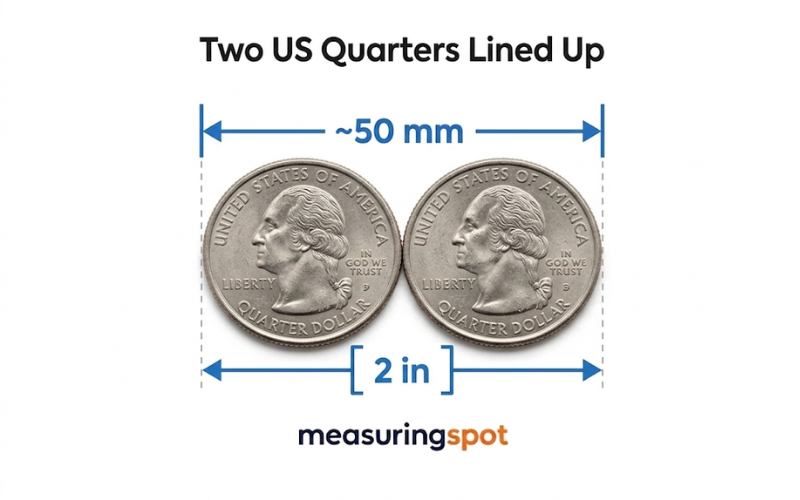
- Two stacked or lined-up US quarter coins measure almost exactly 48.5 to 50 mm.
- A standard large or jumbo metal paperclip spans 50 mm from end to end.
- The short side (width) of a standard plastic credit card or driver’s license measures 53.98 mm, which is just a hair over 50 mm.
- The diameter of an official tournament table tennis (ping pong) ball is 40 mm, so 50 mm is roughly 25% larger than a ping pong ball.
Metric to Imperial: Converting 50 mm at a Glance
Converting between the metric and imperial systems gives you an immediate frame of reference whether you work with woodworking tools, sewing tape, or engineering calipers.
Because one inch contains exactly 25.4 millimeters, you can calculate the inch value by dividing 50 by 25.4:
Inches=5025.41.9685inches
That means 50 mm falls only 0.0315 inches shy of a full 2 inches. For casual home projects, crafting, and online ordering, treating 50 mm as an even 2 inches works seamlessly.
| Unit of Measurement | Equivalent Value | Practical Context |
| Millimeters (mm) | 50 mm | Base metric engineering dimension |
| Centimeters (cm) | 5.0 cm | One-twentieth of a meter stick |
| Inches (in) | 1.9685 in | Roughly 1 and 31/32 inches (~2 inches) |
| Feet (ft) | 0.164 ft | About one-sixth of a standard foot ruler |
| Meters (m) | 0.05 m | Standard scientific notation conversion |
BioWiki Reference Table: Dimensions Overview
| Parameter | Specification | Details & Notes |
| Exact Dimension | 50 mm | Base metric unit |
| Centimeter Equivalent | 5.0 cm | Exactly one-tenth of 50 centimeters |
| Imperial Equivalent | 1.9685 inches | Fractionally equivalent to ~1-31/32 inches |
| Standard Tolerances | ±0.5 mm to ±1.0 mm | Typical consumer manufacturing variance |
| Primary Categories | Hardware, office supplies, optics, sports | Common across consumer items |
| Best Universal Benchmark | Jumbo metal paperclip | Length equals exactly 50 mm |
| Closest Coin Stack | Two US quarter coins | 24.26 mm × 2 = 48.52 mm |
| Optical Benchmark | Standard “Nifty Fifty” camera lens focal length | Standard prime lens field of view |
| Plumbing Standard | 2-inch PVC / DWV inner pipe sizing | Standard drain, waste, and vent pipe size |
10 Common Everyday Things That Are 50 mm Big
1. A Jumbo Paperclip (Length)
Office supply stores sell paperclips in two dominant formats: standard (No. 1) clips and jumbo clips. Standard paperclips measure around 33 mm (1.3 inches). Jumbo paperclips, however, measure almost exactly 50 mm (2 inches) from tip to curve.
Manufacturers produce jumbo clips with thicker steel wire to bind stacks of 20 to 50 pages without bending out of shape. Keep a jumbo paperclip in your wallet or pencil case, and you carry a built-in 50 mm gauge wherever you go.

2. Two US Quarters Lined Up Side by Side
The United States Mint sets strict manufacturing standards for coin minting. A single US quarter coin has a diameter of 24.26 mm (0.955 inches).
Place two quarters flat on a desk so their outer milled edges touch. Together, they span 48.52 mm. Add the slight thickness of a fingernail or a plastic card, and you land right on 50 mm. If you have pocket change handy, this gives you an instant, foolproof estimation tool.
3. A 2-Inch Roll of Heavy-Duty Packing Tape (Core Width)
Clear packing tape, masking tape, and duct tape typically sell in 2-inch band widths. While the roll’s outer diameter shrinks as you use the tape, the width of the tape ribbon stays constant at 48 to 50 mm.
Furthermore, many industrial tape cardboard inner cores feature an inner opening diameter designed specifically to mount on standard hand dispensers. When a cardboard box calls for 50 mm packaging tape, you are looking at the standard shipping roll sitting in your utility closet.

4. A Standard Camera Prime Lens (Focal Length & Front Element)
Photographers revere the 50 mm prime lens, often calling it the “nifty fifty.” A 50 mm focal length on a full-frame sensor produces an angle of view that closely mimics standard human binocular vision without introducing wide-angle distortion or telephoto compression.
Beyond focal length, many compact 50 mm lenses also feature an outer front filter thread size between 49 mm and 52 mm. When you inspect the glass diameter of a standard prime lens, you are observing an authentic 50 mm optical structure.

5. An Oversized Men’s Watch Case Diameter
Traditional wristwatches historically featured case diameters between 36 mm and 40 mm. However, modern pilot watches, dive watches, and rugged outdoor fitness GPS units frequently push case sizes much higher.
Large sports timepieces from brands like Casio G-Shock, Diesel, and Garmin often feature total bezel diameters measuring between 48 mm and 52 mm. When a 50 mm watch case sits on your wrist, it commands substantial real estate, spanning almost the entire width of an average wrist bone.

6. A Standard 2-Inch Golf Tee (Shorter / Iron Variety)
Golf tees come in specific step heights to accommodate different club faces. While drivers require tall tees measuring 3.25 to 4 inches, iron and hybrid shots off the tee box demand much lower profiles.
Standard short golf tees measure exactly 2 inches (50.8 mm) from the spiked bottom point to the shallow top bowl. If you play golf or keep accessories in your sports duffel, one short tee provides an exact 50 mm physical reference.

7. The Diameter of an Olympic Barbell Sleeve
When you walk into a commercial gym or weight room, you encounter two primary barbell classes: standard 1-inch home barbells and Olympic weightlifting barbells.
Olympic barbell sleeves—the revolving outer ends where you load iron or bumper plates—measure 50 mm (1.97 inches) in diameter. The center hole of every regulation Olympic weight plate measures roughly 50.4 mm to slide freely onto that 50 mm steel sleeve without rattling.

8. A Large Matchstick
Standard safety matchsticks found in small cardboard books measure roughly 35 mm to 40 mm long. However, kitchen matchsticks packaged in sturdy slide-out wooden boxes measure 50 mm from the bottom end of the aspen wood splint to the sulfur strike head.
These longer matchsticks allow you to ignite gas stoves, campfires, or fireplace kindling without scorching your fingertips.

9. A Standard 2-Inch PVC Pipe (Outer Diameter Benchmark)
Plumbing, electrical conduit, and drainage projects classify rigid pipes by nominal inside diameter (ID). A nominal 1.5-inch Schedule 40 PVC pipe features an actual outer diameter (OD) of 48.3 mm (1.90 inches), while thin-wall tubes often hit exactly 50 mm.
In European plumbing standards, metric pipe fittings discard nominal inch naming altogether. Plumbers explicitly buy 50 mm waste pipes for bathroom sinks, shower drains, and washing machine outlets.

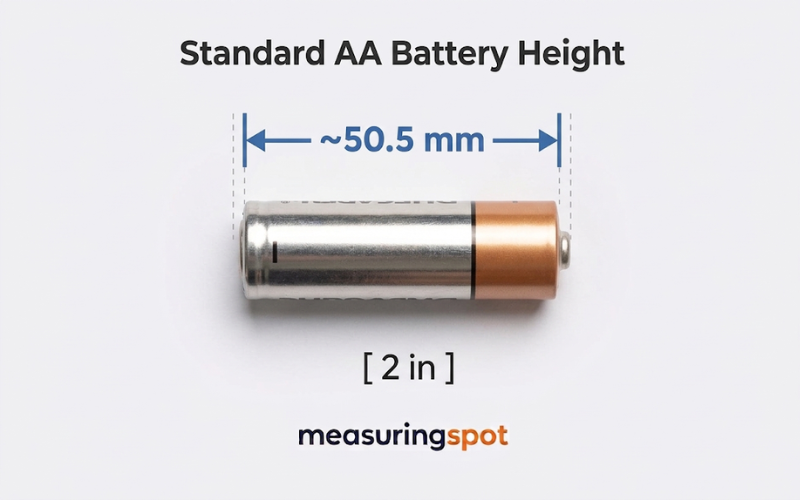
10. A Pair of Standard AA Batteries Stacked End-to-End Across Widths
A single AA battery measures approximately 50.5 mm in total height from the flat negative terminal to the protruding positive button.
This makes a single AA battery one of the easiest household items to use as a 50 mm measuring gauge. Pull a standard AA battery out of a television remote control or wall clock, lay it flat along any surface, and its total length demonstrates an authentic 50 mm span.
Comparing 50 mm to Common Small Measurements
To avoid confusing 50 mm with other frequent metric benchmarks, examine how it stacks up against neighboring dimensions:
50 mm vs. 25 mm (1 Inch)
25 mm matches the diameter of a single US quarter or standard bottle cap. it doubles that exact distance. If you imagine two bottle caps placed edge to edge, you reach 50 mm.
50 mm vs. 75 mm (3 Inches)
75 mm represents the width of a standard square sticky note (Post-it note). it covers two-thirds of that sticky note’s edge.
50 mm vs. 100 mm (4 Inches / 10 cm)
100 mm equals one decimeter or roughly 4 inches—about the length of an average smartphone screen width or a standard index card height. it represents half of that dimension.
Why the Dimension Matters Across Key Industries
Engineers, architects, manufacturers, and designers use 50 mm as a foundational dimension for dozens of structural and ergonomic reasons.
Ergonomics and Hand Grip Design
Human hands naturally wrap around cylindrical grips with diameters ranging between 35 mm and 50 mm. Power tools, pull-up bars, steering wheels, and kitchen utensils frequently rely on outer circumferences based on a 40 mm to 50 mm core thickness. This diameter maximizes gripping leverage while reducing muscle strain across the fingers.
Construction and Metric Grid Layouts
Architects working in metric systems frequently build modular components around intervals of 50 mm and 100 mm. Stud spacing, acoustic ceiling grid brackets, wall cavity depths, and tile layouts rely on 50 mm multiples because the number divides cleanly into meters, half-meters, and centimeters.
Lens Mechanics and Physical Optics
In photography, 50 mm lenses match the diagonal dimension of a 35 mm film frame (which measures roughly 43 mm). Optical engineers found that building lens assemblies around a 50 mm focal length allows for wide apertures like f/1.8 or f/1.4 without requiring gigantic, heavy glass elements. This design offers sharp image quality, natural perspective, and affordable production costs.
Practical Ways to Measure Without a Ruler
When you need to verify whether a space or object measures it and lack a tape measure, use your body or common wallet items:
- Use Your Thumb Joints: For most adults, the distance from the knuckle joint of the thumb to the tip of the fingernail measures roughly 25 mm (1 inch). Stacking two thumb-joint lengths end-to-end yields a reliable 50 mm estimate.
- Use Two Credit Cards Crosswise: While a credit card spans 85.6 mm in length, its width measures 53.98 mm. Subtracting a small sliver from the short edge gives you an immediate approximation of 50 mm.
- Use Three Standard Dice: A standard six-sided die measures 16 mm across each face. Line up three dice in a row:
- 16mm3=48mm
- This arrangement places you within two millimeters of 50 mm.
Frequently Asked Questions About 50 mm
How big is 50 mm compared to an inch?
50 mm measures approximately 1.9685 inches. That falls just 1/32 of an inch short of 2 full inches. For daily practical tasks, rounding 50 mm to 2 inches causes virtually no error.
How many centimeters are in?
There are exactly 5 centimeters in 50 mm. You find this by dividing the millimeter value by 10.
Is it considered large or small?
Context dictates the answer. On a watch face or jewelry pendant, 50 mm is quite large and bold. On a furniture leg, car engine component, or construction framing board, 50 mm is compact.
Can you measure 50 mm with a standard sheet of paper?
A standard US Letter sheet measures 8.5 by 11 inches, while an A4 sheet measures 210 by 297 mm. Folding an A4 sheet into quarters along its short edge produces panels of 52.5 mm, which sits remarkably close to 50 mm.
What sports balls measure around 50 mm?
A regulation squash ball measures roughly 40 mm, while a standard golf ball measures 42.67 mm in diameter. A regulation billiard (pool) ball measures 57.15 mm. A 50 mm sphere sits right between a golf ball and a pool ball.
Connecting abstract numbers to familiar objects makes everyday measurements intuitive. Whenever you encounter a 50 mm measurement on a store shelf, spec sheet, or DIY manual, simply picture a jumbo paperclip, a single AA battery, or two quarters placed side by side.
Keep these simple benchmarks in mind, and you can size up two-inch projects quickly, accurately, and without reaching for a tape measure.
Related Posts
- 10 Common Things That Are 24 mm Big
- 10 Common Things That Are 23 mm Big
- 10 Common Things That Are 22 mm Big
- 10 Common Things That Are 21 mm Big
Conclusion
Connecting abstract dimensions to tangible household items takes the friction out of measuring on the fly. Whether you are browsing product specifications, buying hardware, or evaluating camera gear, it simply represents a standard 2-inch span sitting right before your eyes.
Whenever you need a reliable estimate without reaching for a tape measure, check your surroundings. A standard AA battery, a jumbo paperclip, or two US quarters lined up edge to edge will give you an immediate, accurate benchmark every single time.
FOR MORE MEASUREMENTS VISIT: MEASURINGSPOT