

Ever stare at a measurement on a spec sheet, a tool set, or a watch dial and wonder what that size actually looks like in real life? How big is 24 mm? Finding a ruler or a pair of calipers is not always an option. Knowing how that metric size maps onto everyday household items saves time and eliminates guesswork.
Millimeters can feel abstract when you normally think in inches or fractions. When you need to picture 24mm quickly, the easiest trick is to compare it to objects you touch, spend, or use every single day.
Below is an everyday breakdown of 24mm, exactly what it translates to across common measurement systems, and ten familiar physical references that match this dimension.
Quick Answer: How Big Is 24mm?
A distance of 24 millimeters equals exactly 2.4 centimeters, or 0.945 inches—just under one full inch (roughly 15/16 of an inch).
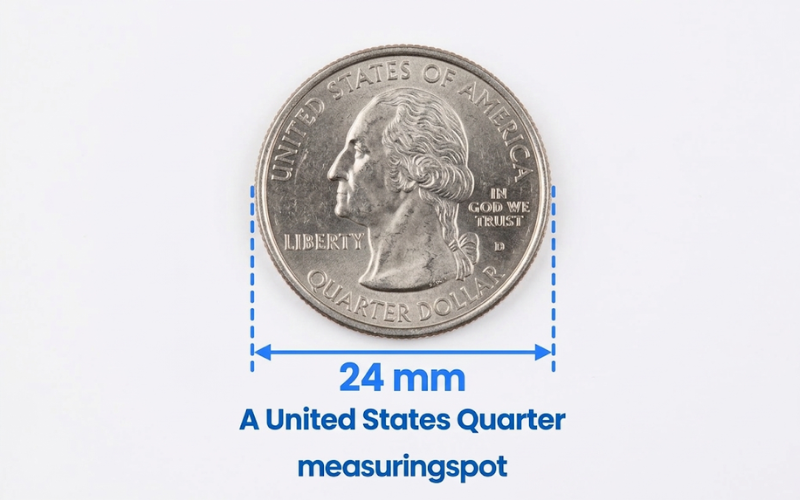
If you want an immediate visual reference, pull a United States quarter out of your pocket. A standard US quarter has an official diameter of 24.26mm. For all practical purposes, holding a quarter gives you an exact physical model of 24mm.
Biowiki & Dimension Profile: The 24mm Metric
| Measurement Property | Exact Value | Practical Context |
| Millimeters (mm) | 24 mm | Base standard metric measurement |
| Centimeters (cm) | 2.4 cm | Metric scale step |
| Meters (m) | 0.024 m | Standard SI unit representation |
| Inches (in) | 0.94488 in | Just shy of 1 full inch |
| Closest Common Fraction | ~15/16 inch | Standard imperial socket/wrench step |
| Exact Imperial Reference | US Quarter Coin | 24.26 mm diameter |
| Common Technical Use | Camera lenses | Classic ultra-wide focal length field of view |
| Common Hardware Use | Metric wrench/socket | M16 bolt head standard across machinery |
| Common Horology Use | Watch lug width | Oversized dive or pilot watch strap spacing |
Converting and Comparing: How Big Is 24mm?
To build an accurate mental model, it helps to see how 24mm interacts with both imperial dimensions and standard metric scales.
One inch contains precisely 25.4 millimeters. Because 24mm falls barely 1.4mm short of that standard, you can treat 24mm as roughly a “hair under an inch.” In practical terms, that tiny difference equals the thickness of about 14 sheets of standard copy paper.
If you work with fractional imperial tape measures, 24mm lands right between 59/64 inch and 15/16 inch. Most craft workers and mechanics round this to 15/16 inch (0.9375 in) because standard imperial toolsets feature a 15/16-inch wrench socket that sits right on top of a 24mm metric socket.
On a metric ruler, count two full centimeter bars, then add four individual millimeter marks. It spans roughly the width of an adult thumbnail across its widest point or the thickness of three stacked smartphones without cases.
10 Common Things That Measure 24mm
1. A United States Quarter
The United States Mint manufactures quarters with a precise diameter of 24.26mm (0.955 inches) and a thickness of 1.75mm. Because the extra quarter-millimeter is imperceptible without precision digital calipers, the quarter serves as the gold standard real-world substitute for 24mm.
If you hold a quarter between your thumb and index finger, the distance between your fingertips matches 24mm. Whether you need to estimate the width of a bolt flange, a plumbing pipe clearance, or an opening in a piece of furniture, laying a quarter flat against the surface gives you an immediate verification.
2. Standard Plastic Soda and Water Bottle Caps
Look closely at the standard plastic screw caps on beverage bottles made by major global brands. The exterior cap style known across packaging industries as the PCO 1881 standard measures roughly 30mm across its widest ribbed exterior, but the threaded inner neck finish and standard single-serve beverage openings feature an interior plug bore of approximately 21.74mm to 24mm.
Specifically, smaller dairy caps and standard medicine bottle caps frequently sit at an overall outer diameter of exactly 24mm (designated commercially as a 24-400 or 24-410 closure size). When you pop the cap off a travel-sized shampoo bottle or an essential oil dropper, the diameter across the threaded plastic opening measures 24mm.

3. A 24mm Mechanic Wrench or Socket Head
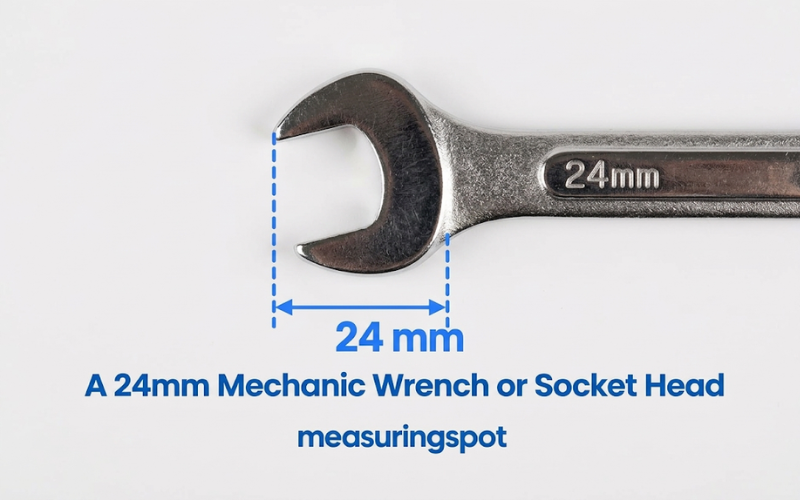
Anyone who works on European automobiles, heavy motorcycles, or industrial machinery knows the 24mm socket intimately. The jaw opening of a 24mm combination open-end wrench measures exactly 24mm across to fit the corresponding hexagonal head of an ISO standard M16 bolt.
In the automotive world, manufacturers frequently select 24mm bolt heads for high-torque applications. Suspension control arms, axle nut retainers, oil filter canisters, and crank pulleys often require a 24mm socket. If you open a mechanic’s chest, the 24mm socket stands out as a substantial, heavy chunk of steel whose internal hexagonal flats measure exactly 2.4cm from parallel edge to parallel edge.
4. Oversized Watch Strap Lug Width
In watchmaking (horology), manufacturers measure the space between the case lugs—where the spring bar holds the strap—in whole millimeters. Standard dress watches usually feature 18mm or 20mm lug widths, while sports watches average 22mm.
Rugged dive watches, tactical timepieces, and large pilot chronographs (such as Panerai Luminor models or large Casio G-Shock cases) often feature a wide 24mm lug spacing. If you own a rugged sports watch, the strap itself measures 24mm broad at the attachment pins. That wide band distributes weight across the wrist and keeps heavy watch cases stable during intense physical movement.

5. A 1-Euro Coin
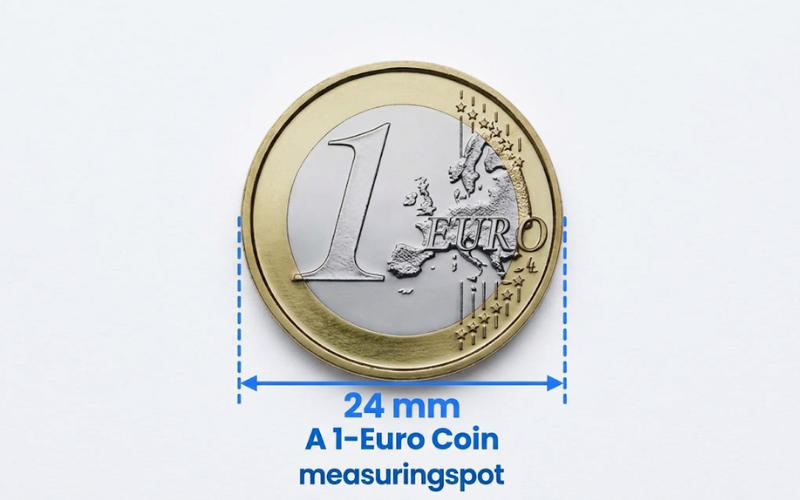
For anyone living in or visiting the European Union, the 1-Euro coin replaces the US quarter as the most ubiquitous handheld pocket reference. The European Central Bank sets the official diameter of the bimetallic 1-Euro coin at exactly 23.25mm.
While it sits three-quarters of a millimeter shy of true 24mm, the 1-Euro coin provides an exceptionally close estimate. Laying a 1-Euro coin beside a 24mm drill hole leaves only a sliver of space—less than the edge of a fingernail—making it an ideal field tool for quick spatial judgments.
6. Standard Arcade Cabinet Pushbuttons
Retro arcade enthusiasts and home arcade builders encounter 24mm buttons constantly. Japanese arcade parts manufacturers produce two core button sizes for fighting game control panels: 30mm and 24mm.
While the primary action buttons on a standard joystick panel use 30mm drill holes, the auxiliary buttons—such as Start, Select, Coin, and Options—almost universally snap into 24mm circular cutouts. Furthermore, compact fightsticks and custom all-button controllers (like Hitbox layouts) replace 30mm buttons with 24mm directional buttons to pack controls closer together for faster fingertip actuation.

7. Classic 24mm Photography Lens Barrel Front Opening
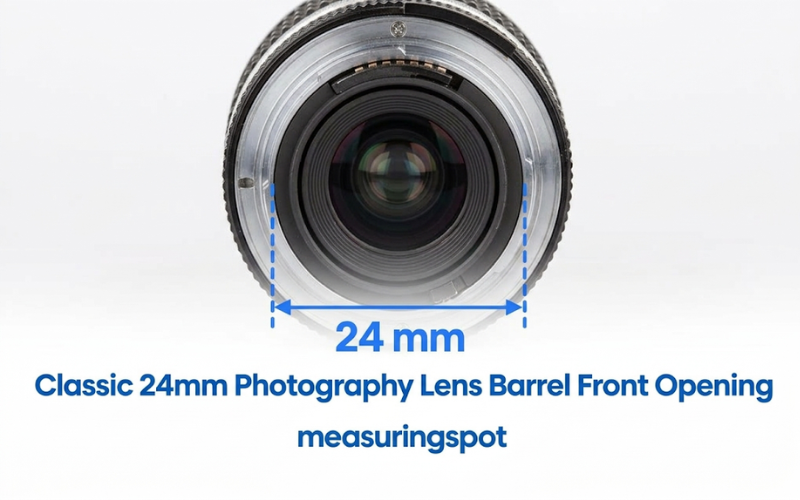
In optical engineering, 24mm represents one of the most celebrated focal lengths in history. A 24mm lens on a full-frame sensor delivers an ultra-wide 84-degree diagonal field of view without introducing the bulbous distortion of a fisheye lens. Landscape photographers, architectural documentarians, and street shooters keep a 24mm prime lens in their camera bags as a baseline tool.
Beyond the focal length specification, the physical glass elements of compact pancake prime lenses frequently measure roughly 24mm across the clear aperture of the front optical glass. Holding up that compact front element puts pure optical craftsmanship right at the 2.4-centimeter mark.
8. A Large Sewing Button (Size 38 to 40 Ligne)
Garment makers and tailors measure buttons using an old French unit called the ligne (abbreviated as L), where 1 ligne equals roughly 0.635mm. Standard dress shirts use small 16L or 18L buttons (around 10mm to 11mm).
Heavy winter overcoats, military peacoats, wool blazers, and trench coats require broad, chunky buttons capable of securing thick fabrics against cold wind. These coat closures typically use 38L or 40L buttons. A 38L button measures 24.13mm, and a 40L button measures 25.4mm. If you pick up a double-breasted winter trench coat and grab one of the main front buttons, you are gripping a smooth disc that matches the 24mm dimension.

9. Three Standard 8mm Wooden Dowels or Pencils Bundled Flat
Woodworkers and furniture assemblers routinely use 8mm fluted wooden dowel pins to align shelving panels and strengthen flat joints. Standard round wooden pencils also feature an exterior diameter of roughly 7.5mm to 8mm across their flat sides.
If you place three 8mm wooden dowels side by side along a flat tabletop, their combined width spans exactly 24mm (8mm x 3 = 24mm). This simple additive trick gives carpenters and craft hobbyists a fast way to verify larger gaps without searching for a specialized gauge.

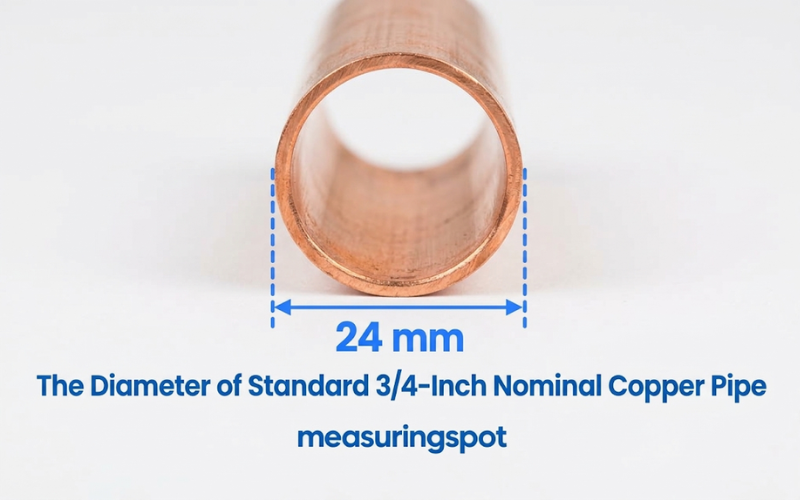
10. The Diameter of Standard 3/4-Inch Nominal Copper Pipe
Plumbing pipes create massive confusion because the industry names pipes by their internal flow capacity rather than their outside dimensions. A standard copper pipe sold in hardware stores labeled as “3/4-inch Type M or Type L” does not measure 3/4 inch on the outside.
Plumbers know that 3/4-inch nominal copper tubing carries an actual outside diameter (OD) of exactly 7/8 of an inch, which converts to 22.22mm. However, when you slip a standard 3/4-inch straight coupling or solder sleeve over that pipe, the exterior metal collar measures right around 24mm across. Whenever you spot exposed modern copper lines running along basement joists or into water heaters, those joint sleeves stand as solid 24mm cylindrical shapes.
Practical Everyday Comparison Table
| Item | What Measures 24mm? | Exact Size | Everyday Availability |
| US Quarter | Outer rim diameter | 24.26 mm | Pocket change (USA) |
| Bottle Neck Opening | Thread bore on 24-410 closures | 24.00 mm | Cosmetics, travel bottles |
| Combination Wrench | Distance between inside jaw flats | 24.00 mm | Metric toolbox |
| Heavy Watch Lug | Distance between strap pins | 24.00 mm | Dive / pilot watches |
| 1-Euro Coin | Outer edge diameter | 23.25 mm | Pocket change (Europe) |
| Arcade Menu Button | Mounting hole cutout diameter | 24.00 mm | Gaming control panels |
| Winter Coat Button | 38-Ligne outer button diameter | 24.13 mm | Heavy wool overcoats |
| Three 8mm Dowels | Combined parallel flat width | 24.00 mm | Woodworking joinery |
Why the 24mm Dimension Matters Across Industries
Specific measurements show up repeatedly across different manufacturing sectors for functional, ergonomic, and structural reasons. The 24mm measurement is not a random number; it occupies a sweet spot across several disciplines.
Mechanical Engineering and Fasteners
In the metric fastener world governed by the International Organization for Standardization (ISO), bolt sizes follow strict mathematical ratios. The standard hex head width across flats (abbreviated as s) for an M16 coarse-thread bolt is 24mm.
Engineers design an M16 bolt to secure high-stress mechanical connections in bridges, automotive engine mounts, structural steel frames, and heavy machinery. A bolt head measuring 24mm wide provides enough bearing surface area to withstand massive tightening torque without crushing the underlying metal plate or stripping the edges under a heavy socket wrench.
Ergonomics and Human Hand Dimensions
Product designers frequently turn to 24mm when creating hand-operated controls, switches, and tactile pushpieces. The human adult index fingertip pad averages between 16mm and 20mm wide.
A button or rotary dial measuring 24mm across gives the finger enough clearance to press firmly without triggering adjacent controls, while remaining compact enough to save panel space. That explains why industrial control panels, guitar effect stomp boxes, and arcade machines rely on 24mm cutouts for their secondary interface components.
Watchmaking and Strap Balance
Horology relies on proportions. When watch designers produce a case spanning 44mm to 47mm across, pairing it with a standard 20mm strap makes the assembly look awkward and top-heavy.
A 24mm lug width matches large cases, ensuring the leather, rubber, or stainless steel bracelet counterbalances the weight of the steel housing. It distributes the pressure evenly over the wrist bones, preventing the watch head from sliding around during rigorous activity.
Practical Tips to Measure 24mm Without a Ruler
When you need to verify whether a space or an object matches 24mm and do not have access to a metric ruler, use these straightforward methods:
- Use the Quarter Test: Lay a US quarter flat against your target item. If your item hides completely behind the quarter with no rim showing, it measures under 24mm. If the edges align seamlessly, your object measures 24mm.
- The Thumbnail Estimate: For many adults, the distance across the widest part of the thumb nail bed sits between 20mm and 24mm. Check your own thumb against a standard coin once; after you know your personal finger width, you have a permanent built-in gauge.
- Stack Three 5-Cent Nickels (US): A standard US nickel is 1.95mm thick. If you stack 12 nickels on a table, the pile reaches 23.4mm tall—very close to the 24mm mark.
- Fold an A4 or Letter Sheet: Standard 20lb printer paper has an average thickness of 0.1mm. While folding paper 240 times is impossible, folding a standard sheet along its long edge produces reliable references: a standard US letter sheet is 8.5 inches wide, which equals 215.9mm. Marking fractional increments across paper edges can quickly recreate missing shop rulers.
Frequently Asked Questions
Is 24mm the same as 1 inch?
No. Exactly 1 inch equals 25.4 millimeters. That means 24mm is slightly smaller than 1 inch—specifically 1.4 millimeters smaller. In fractional measurements, 24mm equals approximately 15/16 of an inch.
What socket size replaces a 24mm socket if you only have imperial tools?
A 15/16-inch imperial socket comes closest to a 24mm socket. A 15/16-inch socket measures 23.81mm across its flats. While it sits 0.19mm tighter than a 24mm socket, it will often slip onto a clean 24mm hex bolt head without damaging the corners. Never use a 1-inch socket on a 24mm bolt, as the loose fit will strip the bolt head under high torque.
How big is 24mm on a camera lens?
On a camera lens, “24mm” refers to focal length rather than the physical diameter of the lens barrel. A 24mm focal length lens on a full-frame camera provides a wide field of view (84 degrees), capturing wide landscapes, interior rooms, and street scenes without extreme fisheye curve.
What coin is exactly 24mm wide?
The United States quarter coin is 24.26mm in diameter, making it the closest widely recognized everyday coin to 24mm. The Canadian quarter shares roughly the same footprint at 23.88mm, and the 1-Euro coin measures 23.25mm across.
Can you use 24mm for watch straps interchangeably with other sizes?
No. Watch lug widths require exact matches. A 24mm watch strap will not fit into a 22mm lug space without cutting or damaging the material. Conversely, putting a 22mm strap onto a 24mm watch leaves an unsightly 2mm gap, exposing the spring bar and risking accidental detachment.
Understanding spatial sizes should never require hunting down a specialized shop tool or deciphering complex conversion charts. By anchoring metric measurements to tangible items like pocket coins, hardware tools, and common clothing closures, estimating dimensions becomes second nature.
Whenever you encounter a 24mm specification on a project, think of a US quarter. That simple coin gives you an accurate, reliable reference point that fits right in the palm of your hand.
Related Posts
- 10 Common Things That Are 20 mm Big
- 10 Common Things That Are 19 mm Big
- 10 Common Things That Are 18 mm Big
- 10 Common Things That Are 17 mm Big
Conclusion
Grasping metric dimensions becomes effortless once you connect numbers to physical objects in your immediate environment. A measurement like 24mm no longer feels abstract when you picture a common pocket quarter, the stout head of a mechanic’s wrench, or the broad strap of a rugged wristwatch.
Keeping these physical benchmarks in mind saves time during DIY repairs, hardware shopping trips, and craft projects. Whenever you see a 24mm specification on a technical sheet or parts catalog, reaching into your pocket for a coin gives you an instant, dependable reference point without a ruler in sight.
FOR MORE MEASUREMENTS VISIT: MEASURINGSPOT