
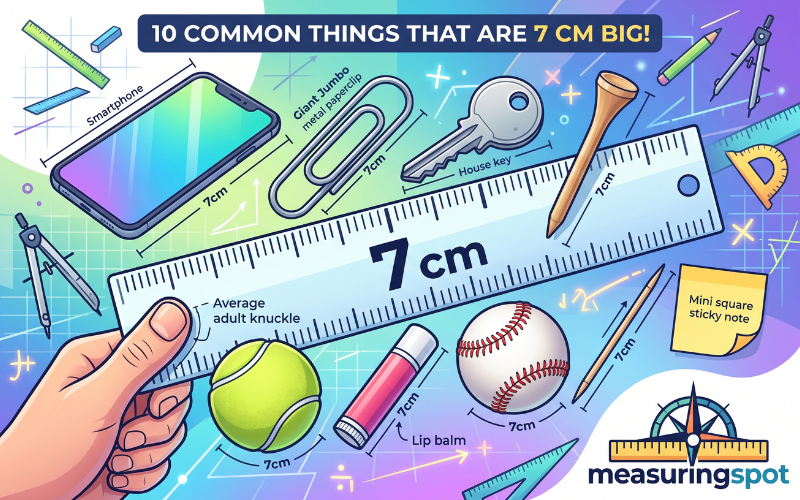
Have you ever found yourself reading a product description online, looking at the dimensions, and wondering exactly how big is 7cm? Unless you walk around with a ruler in your pocket at all times, visualizing metric measurements on the spot can be surprisingly difficult. It is a very common size in manufacturing and nature, yet our brains often struggle to map those numbers to physical reality.
Understanding this specific measurement can save you a lot of guesswork when shopping for jewelry, organizing your desk, evaluating medical information, or starting a DIY crafting project. It turns out that 7 centimeters is right in the “sweet spot” for things we hold, carry, and use every single day.
Before we look at the everyday items that perfectly match this length, let’s break down the basic conversions and facts in a handy BioWiki table to get your bearings.
BioWiki: 7cm Quick Facts 📊
| Attribute | Measurement / Detail |
| Exact Length in Inches | 2.7559 inches |
| Common Fraction (Inches) | 2 ¾ inches |
| Length in Millimeters | 70 mm |
| Length in Meters | 0.07 m |
| Visual Reference Category | Small hand-held objects, pocket-sized items |
| Usual Manufacturing Tolerance | +/- 0.1 to 0.5 cm depending on the item |
Quick Section: Converting 7cm to Other Units ⚡
If you are used to the imperial system, 7 centimeters might just sound like an arbitrary number. To give you an immediate mathematical context:
- Inches: 7 cm is exactly 2.7559 inches. For all practical, everyday purposes, you can round this to 2.75 inches or two and three-quarter inches.
- Millimeters: Multiply by 10, and you get 70 millimeters (mm). This is the unit you will most often see on highly precise technical drawings or jewelry specifications.
- Meters: Divide by 100, and you get 0.07 meters (m).
Now that we have the math out of the way, let’s look at the real world. Numbers on a page are fine, but physical objects are what actually help our brains process size. Here are ten incredibly common items that answer the question of how big is 7cm.
How Big is 7cm in Everyday Life? 10 Common Objects
You likely have at least half of these items sitting within arm’s reach right now. By associating a numeric measurement with these familiar objects, you will never have to guess what 7 centimeters looks like again.
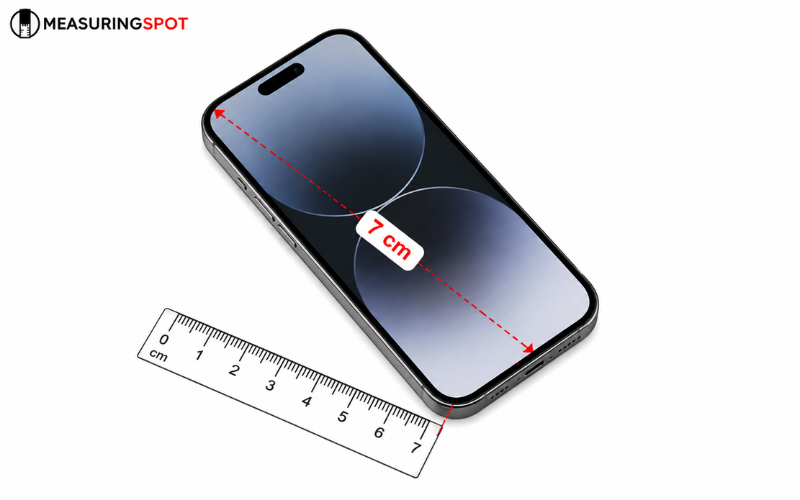
1. The Width of a Standard Smartphone 📱
If you are reading this article on a mobile device, there is a very high probability that you are holding a 7cm reference tool in your hands right now. While smartphone screens have grown taller over the past decade, their width has largely stabilized.
Why? Because human hands have not gotten any bigger. Tech manufacturers discovered that if a phone gets much wider than 7 to 7.5 centimeters, the average person can no longer comfortably grip it with one hand or reach across the screen with their thumb. For instance, the standard base models of the iPhone (like the iPhone 12, 13, and 14) have a width of exactly 7.15 cm. Many popular Android devices follow a similar footprint. So, the next time you need to estimate how big is 7cm, just look at the width of the phone in your pocket.
2. A Jumbo Metal Paperclip 📎
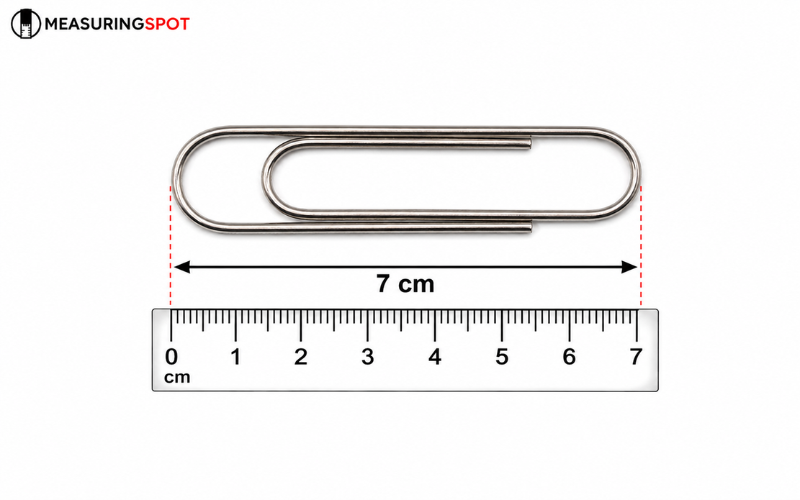
Office supplies are heavily standardized, making them excellent reference points for measurements. While standard paperclips are quite small (usually around 3.3 cm or 1.3 inches), the “jumbo” paperclips are a different story.
If you grab a standard jumbo paperclip from your desk drawer and lay it flat on a ruler, you will find that it measures exactly 2.75 inches, which converts perfectly to 7 cm.
These larger clips are designed to hold thicker stacks of paper—usually up to 20 or 30 sheets—without bending permanently out of shape. Their length is carefully calibrated to provide enough torsion to grip the paper tightly while still fitting easily into small organizer trays. Keeping one of these in your drawer gives you a permanent, highly accurate 7cm measuring stick.
3. A Standard House Key 🔑
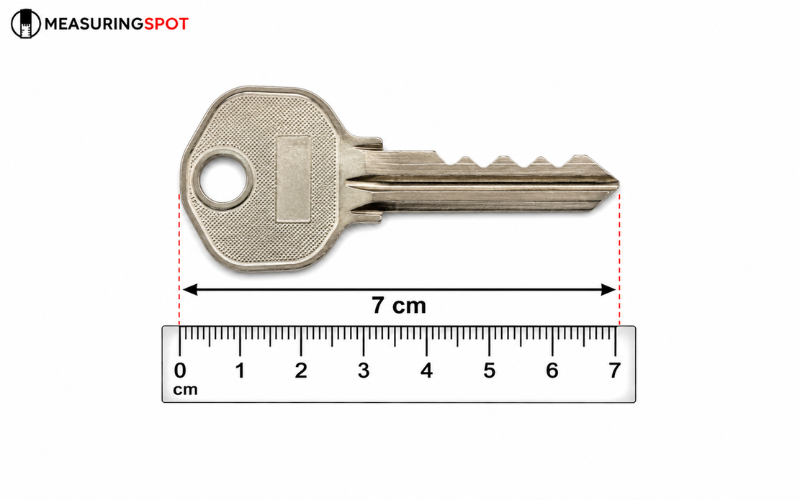
Take your keychain out of your pocket or purse. Look at the standard key you use to unlock your front door. The most common residential door keys—specifically the blanks manufactured by major hardware companies like Kwikset and Schlage—are remarkably consistent in their sizing.
From the tip of the key’s blade to the top of the bow (the rounded part you hold), a standard house key is typically right around 7 cm long. The blade itself is usually about 3.5 cm, and the bow makes up the rest of the length. This size is intentional; it is large enough to provide the leverage needed to turn a stubborn deadbolt, but small enough to rest comfortably in a pocket without stabbing the wearer or taking up too much room.
4. A Wooden Golf Tee ⛳
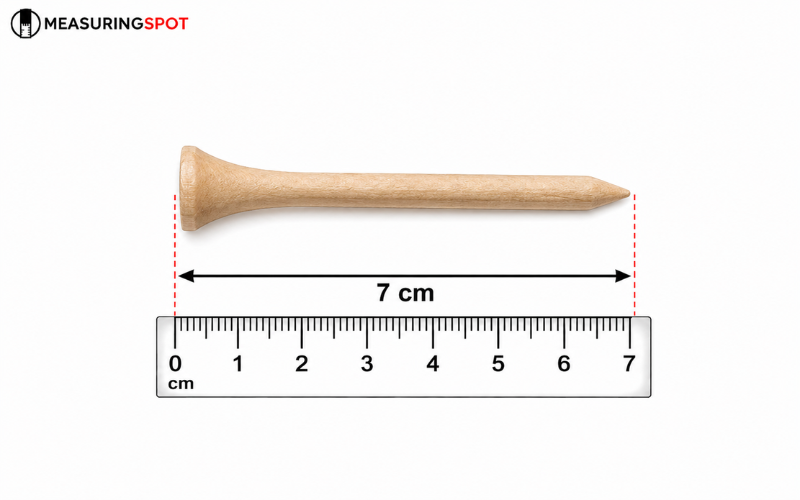
If you are a golfer, or if you just happen to live with one, you have a perfect 7cm reference sitting in your golf bag. Golf tees come in a variety of lengths depending on the club being used, but the most popular and standard tee used for drivers is the 2 ¾ inch tee.
As we established in our quick section, 2.75 inches is exactly 7 centimeters. These wooden or plastic pegs are engineered to lift the ball precisely high enough off the grass to accommodate the large, modern clubheads of today’s drivers. The next time you are trying to visualize a 7cm length, think of a standard golf tee waiting on the tee box.
5. The Length of an Average Adult Thumb 👍
Using your own body to estimate measurements is a trick that dates back thousands of years. Long before standard rulers existed, people used hands, feet, and arms to gauge the size of the world around them.
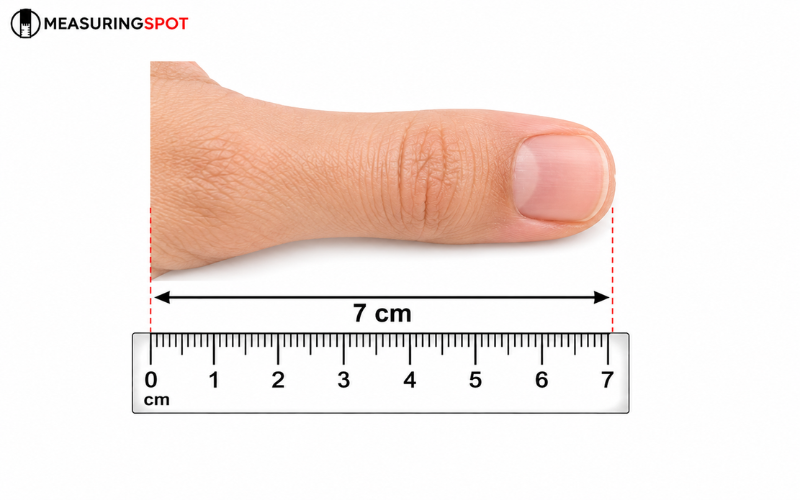
While human bodies naturally vary wildly in size and shape, biometrics show that the average adult human thumb—measured from the tip to the main knuckle joint that connects to the hand—is approximately 7 cm long. If you happen to have average-sized hands, your thumb is an incredibly convenient, built-in ruler. You can test this by placing your thumb against a measuring tape. If it lines up perfectly with the 7cm mark, you will always carry a handy reference tool with you wherever you go.
6. The Diameter of a Standard Tennis Ball 🎾
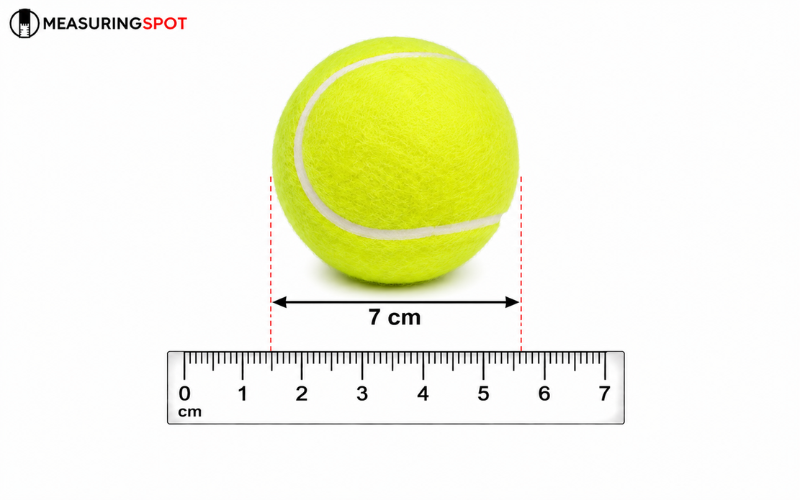
When we talk about how big is 7cm, we usually think in straight lines. But 7cm is also a very common measurement for the diameter (the distance straight across the center) of certain spheres. The most famous example is a tennis ball.
According to the official rules of the International Tennis Federation (ITF), a regulation tennis ball must have a diameter of no less than 6.54 cm and no more than 6.86 cm. With the fuzzy felt exterior taken into account, a standard tennis ball sits right at the 7 cm mark. This specific size was chosen because it provides the ideal aerodynamic properties for the sport, allowing the ball to be hit at high speeds while remaining visible and controllable for the players.
7. A Standard Lip Balm Tube 💄
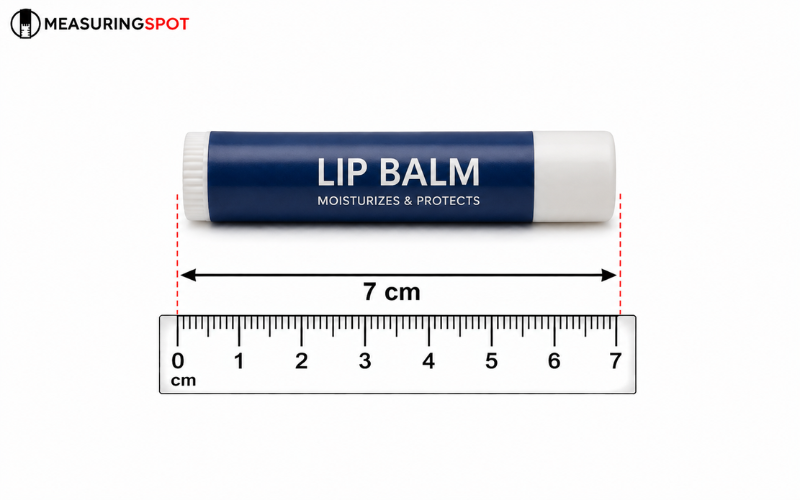
Another item that lives in millions of pockets and purses worldwide is the standard cylinder of lip balm. Brands like ChapStick, Burt’s Bees, and Carmex have all settled on a nearly identical packaging size for their twist-up stick products.
A standard tube of lip balm is roughly 6.7 to 7 cm tall with the cap securely on. This size is dictated by convenience. It contains enough product to last the user for several months of regular application, but the tube is short enough to drop into a tight jeans pocket or a small handbag without being cumbersome. If you need to visualize 7 centimeters, visualizing the height of a fresh tube of lip balm is a great mental shortcut.
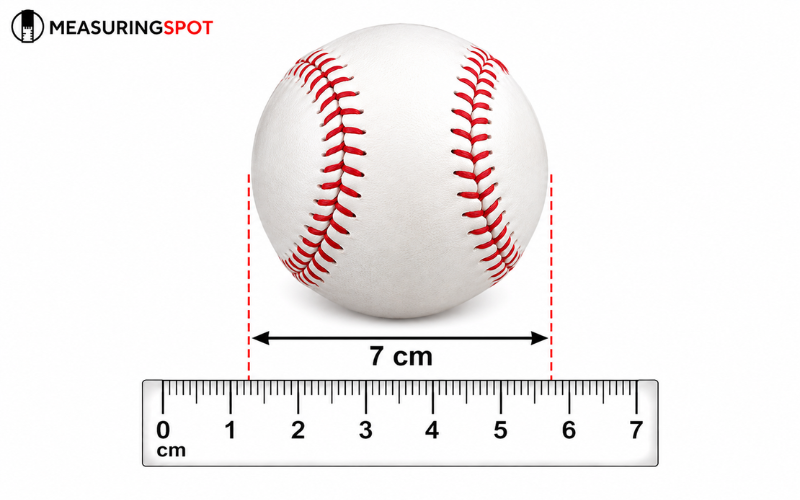
8. The Diameter of a Baseball ⚾
Much like the tennis ball, the baseball offers another fantastic spherical reference for 7 centimeters. While a baseball is slightly heavier and much harder than a tennis ball, their visual footprints are surprisingly similar.
Major League Baseball specifies that a regulation baseball must be between 9 and 9.25 inches in circumference. If you do the math and divide that circumference by Pi (3.14159) to find the diameter, you end up with a measurement of roughly 2.86 to 2.94 inches. This translates to about 7.3 to 7.4 centimeters. While it is just a tiny fraction over exactly 7cm, holding a baseball in your hand gives you a near-perfect tactile understanding of how large a 7cm gap really is.
9. A Standard Wooden Toothpick 🥢
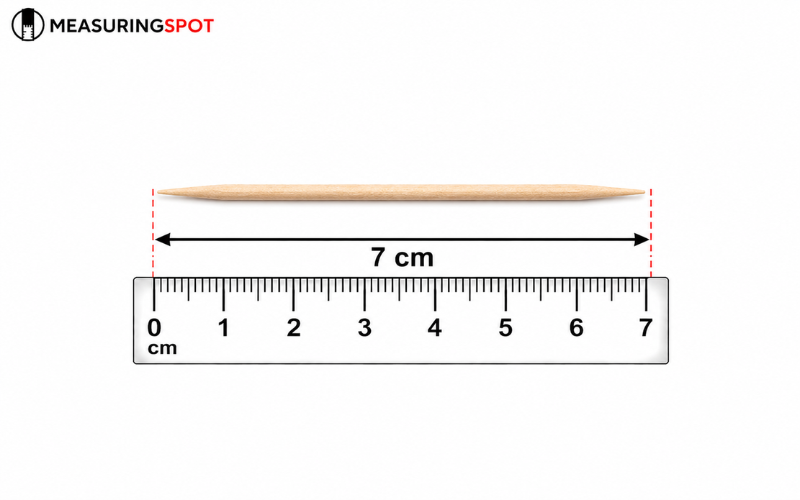
It might surprise you to learn that even the humble wooden toothpick has a standard industry size. While you can find mini toothpicks and extra-long cocktail skewers, the standard wooden toothpick found in most restaurant dispensers and home pantries measures right around 2.5 to 2.75 inches long.
This means that a standard toothpick is approximately 6.5 to 7 cm in length. This specific length is manufactured because it provides enough wood to comfortably hold onto with your thumb and index finger, while leaving enough of the pointed end exposed to efficiently clean between teeth or spear a small appetizer.
10. Mini Sticky Notes 📝
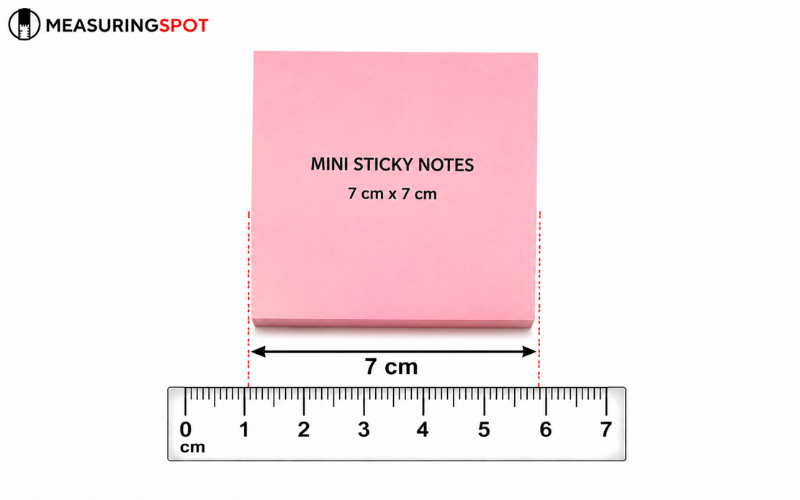
We are all familiar with the standard 3×3 inch yellow sticky notes that clutter office desks worldwide. However, there is a slightly smaller variant that is incredibly popular for quick annotations and bookmarking: the mini square sticky note.
Many brands manufacture mini sticky notes that measure exactly 7×7 cm (or sometimes 7.6 cm to match the 3-inch imperial standard closely). These small squares of paper are used for brief reminders, color-coding files, or leaving tiny notes on computer monitors. If you have a stack of the slightly-smaller-than-standard square sticky notes, you are likely looking at a perfect 7cm square.
Why Estimating Size Actually Matters in Daily Life 🤔
You might be asking yourself why knowing how big is 7cm is useful outside of winning a trivia night. The truth is, spatial awareness and the ability to accurately estimate small sizes is an incredibly practical life skill.
When shopping online, photographs can be incredibly deceiving. Retailers often use macro photography and stark white backgrounds to make products look more impressive. A pair of earrings, a small specialized tool, or a decorative figurine might look massive on your computer screen. If the product description lists the item as “7cm tall,” and you don’t have a mental reference for that size, you might end up sorely disappointed when a tiny package arrives in the mail. By knowing that 7cm is the height of a lip balm tube or the length of a house key, you instantly ground the product description in reality.
Similarly, in medical contexts, doctors often describe things like the size of a skin blemish, a cyst, or a minor laceration in centimeters. Knowing how to visualize these measurements helps reduce anxiety and improves communication between you and your healthcare provider.
Tips for Measuring 7cm Without a Ruler 📐
If you find yourself needing to measure something that is exactly 7cm and you don’t have a ruler, your smartphone, or a jumbo paperclip around, you can use a few physical hacks to get the job done.
First, consider the “finger width” method. For the average adult, the width of the index, middle, ring, and pinky fingers held tightly together is roughly 7 to 8 centimeters across the knuckles. By simply resting your four fingers flat against an object, you can quickly determine if it is in the 7cm ballpark.
Second, if you carry a standard credit card or ID card in your wallet, you have a solid estimation tool. The short edge of a standard credit card is 5.4 cm. While this isn’t 7cm, knowing that 7cm is just about a centimeter and a half wider than the short edge of your credit card gives you a very reliable baseline to work from.
Finally, paper currency can help. A standard US Dollar bill is 2.61 inches wide, which is roughly 6.6 centimeters. If you lay a dollar bill horizontally, the height of that bill is just a hair shy of 7cm. This is an incredibly quick and accessible way to measure small items when you are on the go.
Frequently Asked Questions (FAQs) ❓
Is 7 cm the same as 3 inches?
No, 7 cm is not the same as 3 inches. 7 centimeters is exactly 2.7559 inches. While it is close to 3 inches (which would be 7.62 cm), that quarter-inch difference is significant in fields like construction, sewing, and manufacturing.
How can I visualize 7 cm quickly?
The fastest way to visualize 7 cm is to think of the width of a standard modern smartphone (like an iPhone 13 or 14), the length of a common house key, or the height of a standard lip balm tube. All of these items sit comfortably in your hand and hover right around the 7 centimeter mark.
How big is 7cm in millimeters?
7 centimeters is exactly 70 millimeters. You can easily convert centimeters to millimeters by multiplying the centimeter value by 10. Millimeters are simply a smaller, more precise unit of measurement within the metric system.
Related Posts
- 10 Common Things That Are 4 cm Big
- 10 Common Things That Are 3 cm Big
- 10 Common Things That Are Exactly 2 cm Long
- 10 Common Things That Are Exactly 1 Centimeter Long
Conclusion
Understanding how big is 7cm is no longer a mathematical mystery once you tie the number to the objects you interact with daily. Whether you are using the width of your smartphone, holding a tennis ball, or glancing at a house key, these tangible items bridge the gap between abstract numbers and physical reality. The next time you encounter a 7cm measurement on a blueprint, a crafting tutorial, or an online shopping cart, you can confidently visualize the size without having to dig through your junk drawer in search of a measuring tape.
FOR MORE MEASUREMENTS VISIT: MEASURINGSPOT