

You run into 48 inches all the time, even if you do not carry a tape measure in your back pocket. Whether you want to rearrange your living room, pack luggage into a car trunk, build a backyard garden box, or install kitchen fixtures, knowing how this specific span looks in the real world saves time and headaches.
When you do not have measuring tools nearby, familiar household items act as reliable mental benchmarks. Spotting how everyday objects align with this distance gives you an immediate spatial sense, turning raw numbers into practical, tangible perspective.
Quick Answer: How Long is 48 Inches?
48 inches equals exactly 4 feet, 1.33 yards, 121.92 centimeters, or roughly 1.22 meters.
To gauge it on the fly:
- It reaches the exact height of an average 6- or 7-year-old child.
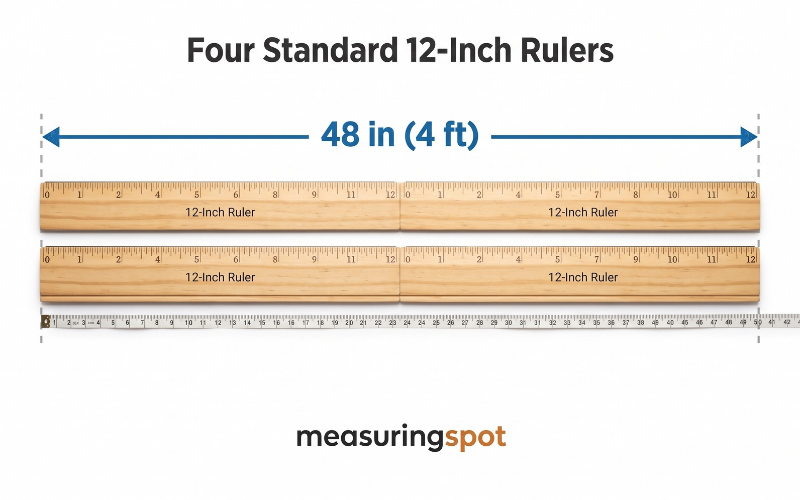
- It equals four standard 12-inch rulers laid end to end.
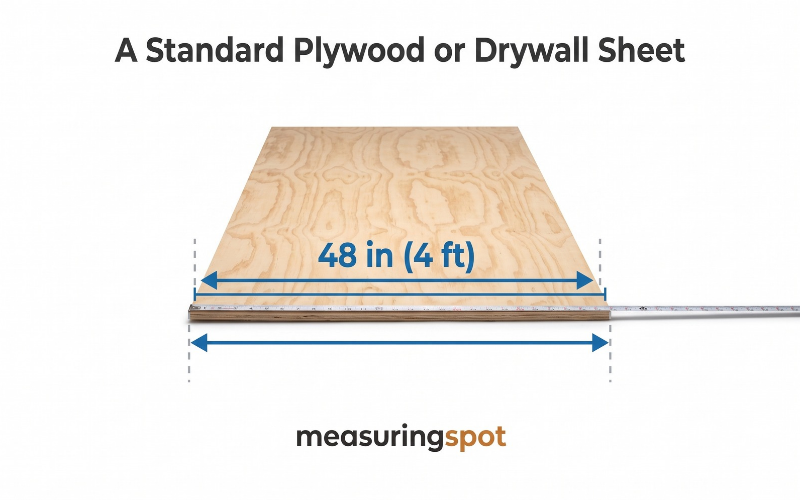
- It spans the precise width of a standard 4×8 sheet of plywood or drywall.
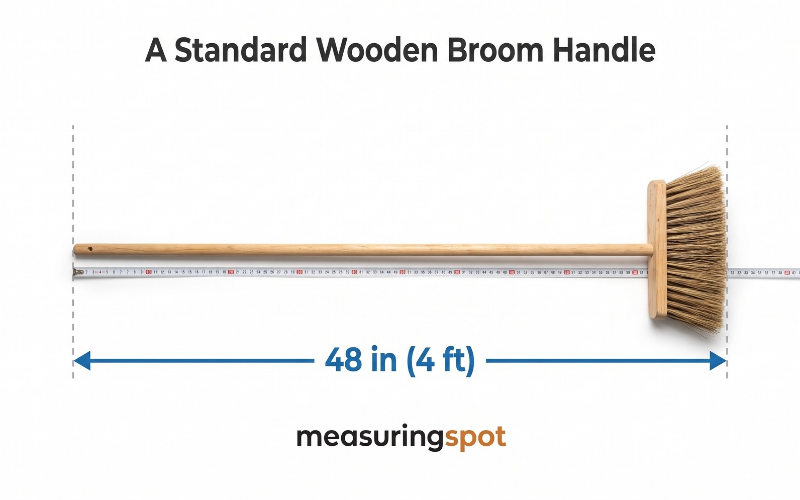
- It matches the total length of a typical wooden kitchen broom standing on its head.
Quick Reference: 48 Inches BioWiki Data
| Specification / Attribute | Measurement Value |
| Inches (in) | 48 in |
| Feet (ft) | 4 ft |
| Yards (yd) | 1.333 yd (4/3 yd) |
| Centimeters (cm) | 121.92 cm |
| Meters (m) | 1.2192 m |
| Millimeters (mm) | 1,219.2 mm |
| Equivalent in Handspans | ~5.5 to 6 adult handspans (spread thumb to pinky) |
| Common Construction Standard | Width of standard drywall and plywood panels |
| Human Body Proportions | Average hip-to-shoulder height of an adult, or total height of a 7-year-old |
| Standard Step Count | Approximately two comfortable adult walking strides |
10 Common Things That Are 48 Inches Long
1. The Width of a Standard Plywood or Drywall Sheet
Step onto any residential construction site or walk down the lumber aisle at your local hardware store, and 48 inches surrounds you. Building material manufacturers manufacture sheet goods—including plywood, oriented strand board (OSB), and gypsum drywall—in standard dimensions of 48 inches wide by 96 inches long (4 feet by 8 feet).
Architects and framers plan wall studs and floor joists on 16-inch or 24-inch centers specifically because 48 divides evenly by both numbers (16 × 3 = 48, and 24 × 2 = 48). When a contractor lifts a sheet of sheetrock sideways, the short side establishes a direct 48-inch span.
2. A Standard Wooden Broom Handle
Grab an everyday upright broom from your pantry. The standard wooden or metal broom handle sold in North America measures between 46 and 48 inches on its own. When you add the broom head and bristles, the entire tool regularly hits 48 to 54 inches.
Janitorial mop handles follow this exact standard specification, offering enough leverage so people of varied heights sweep without straining their lower backs. If you stand a classic yellow broom upright against your leg, it serves as a steady four-foot ruler.
3. Four Standard 12-Inch School Rulers
Most people remember the standard 12-inch wooden or plastic school ruler with the metal edge along one side. Aligning four of these rulers end to end equals exactly 48 inches:
TotalLength=412inches=48inches=4feet
This classic mental model remains one of the fastest calibration tricks because everyone has held a foot-long ruler. Lining four rulers together across a table surface marks an exact 4-foot distance.
4. A 4-Foot Carpenter’s Box Level
Carpenters, masons, and cabinet installers regularly reach for a heavy-duty aluminum or wooden spirit level. While smaller 9-inch torpedo levels and 24-inch levels fit into tight spaces, the 48-inch spirit level serves as the true industry workhorse.
Framers set doors, windows, and kitchen islands plumb and level with this 48-inch tool. Its length spans across multiple framing members to catch dips, crowns, and twists in the lumber. If you see a long yellow or silver metal bar with green bubble vials leaning in a tradesperson’s van, you are looking straight at a 48-inch standard.

5. A 55-Inch Flat-Screen Television (Horizontal Width)
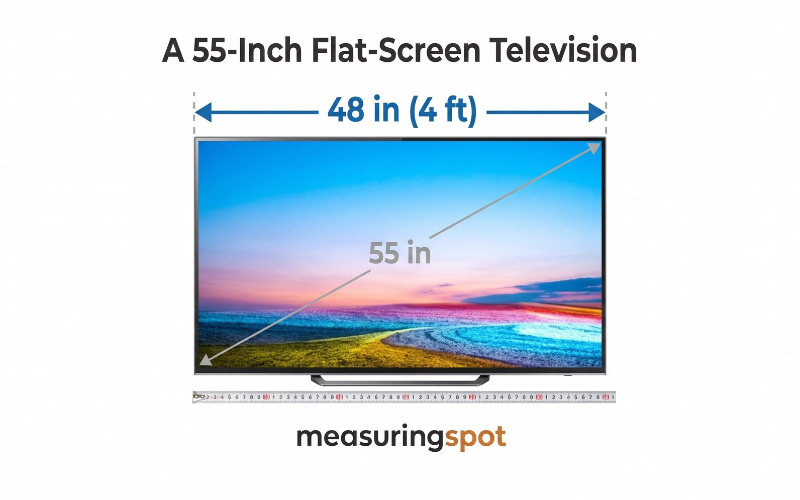
Television manufacturers market screen sizes diagonally, which causes confusion when people try to find an entertainment center or open wall space. A television advertised as a 55-inch screen measures 55 inches from top-left corner to bottom-right corner.
Because modern displays use a standard 16:9 widescreen aspect ratio, the Pythagorean theorem defines their frame dimensions:
Diagonal2=Width2+Height2
For a 55-inch display:
- Diagonal: 55 inches
- Horizontal Width: ~47.9 to 48 inches (depending on bezel thickness)
- Vertical Height: ~27 inches
When you shop for consoles or media credenzas, budget 48 inches of horizontal surface area to support a 55-inch television.
6. Maximum Legal Length of a Golf Driver
Under the Rules of Golf established jointly by the USGA (United States Golf Association) and The R&A, golf equipment must comply with precise physical limits. Rule 4 restricts the maximum overall length of any golf club (except putters) to 48 inches.
While typical tour players use drivers measuring between 44.5 and 45.75 inches for better control, long-drive competitors build custom clubs that extend right up to the 48-inch legal ceiling to maximize swing arc and clubhead speed. Officials measure this distance by laying the club flat against a 60-degree angle gauge from the sole to the end of the grip.

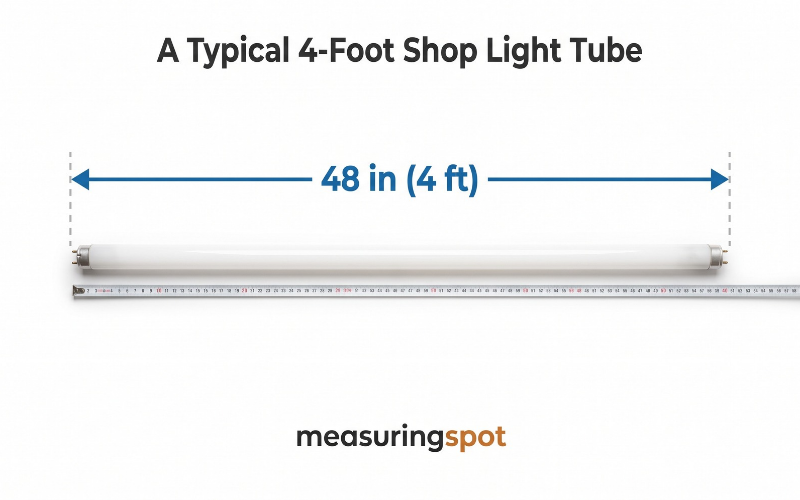
7. A Typical 4-Foot Fluorescent or LED Shop Light Tube
Basements, garages, auto repair bays, and commercial drop ceilings rely on long, thin overhead light tubes. The standard T8, T5, and vintage T12 bulbs that populate these spaces measure exactly 48 inches from pin to pin.
Even as industrial spaces transition from old fluorescent gas ballasts to modern energy-efficient LED retrofit strips, lighting manufacturers preserve the exact 48-inch form factor so property owners update fixtures without tearing out existing ceiling troffers.
8. A Hard Shell Acoustic Guitar Case
A full-size dreadnought acoustic guitar usually measures about 40 to 41 inches from headstock to endpin. However, a protective, molded flight case or heavy wooden hard-shell case adds thick padding, neck cradles, accessory boxes, and exterior bumper rims.
When you latch the exterior locks and measure from bumper to bumper, a standard travel-ready acoustic guitar case measures right around 47.5 to 48.5 inches in total length. If you plan a road trip, measuring your vehicle trunk for 48 inches ensures your instrument case sits flat on the floorboard rather than wedged at an awkward angle.

9. A Standard 4-Seat Dining or Conference Table Width
Interior decorators and furniture makers follow strict ergonomics to ensure people eat, type, and socialize comfortably. Small square kitchen tables and collaborative break-room tables frequently feature tops measuring 48 inches by 48 inches.
This 48-inch footprint provides ample room for two adults on each side without knocking knees or jostling elbows. Furthermore, round bistro and poker tables regularly come in a 48-inch diameter, which seats four adults comfortably with plates, cutlery, and drinks.

10. The Height of an Average 7-Year-Old Child
If you look at the growth charts published by the World Health Organization (WHO) and the Centers for Disease Control and Prevention (CDC), the 50th percentile height for boys and girls between 6.5 and 7.5 years old lands at 48 inches (4 feet tall).
Theme parks use this exact height mark as an operational safety cutoff. When ride operators place a measuring board near the entrance of roller coasters, the 48-inch line usually separates mild family rides from intense loops, inversions, and high-g acceleration coasters.

Practical Ways to Measure 48 Inches Without a Ruler
When you are out thrift shopping, buying lumber, or planning an apartment layout, you rarely carry a metal tape measure. You can turn your own body into an accurate measuring tool with a few simple benchmarks:
Use Your Wingspan or Arm Span
For the average adult, a full fingertip-to-fingertip wingspan closely matches total standing height. If you stand around 5 feet 8 inches to 6 feet tall:
- Measure from the fingertips of one outstretched hand straight across to your opposite armpit or breastbone.
- This distance covers roughly 46 to 48 inches on most adults.
Rely on Pace Count
A normal adult walking stride—measured from the heel of one foot to the heel of the opposite foot—ranges between 28 and 30 inches.
- Two short, deliberate walking steps cover roughly 48 to 50 inches.
- If you take one exaggerated, heel-to-toe stride with a slight extension, you land right around the 4-foot mark.
The Handspan Technique
A standard adult handspan measures the distance from the tip of the thumb to the tip of the pinky finger when you spread your hand wide:
- An average adult male handspan equals roughly 8.5 to 9 inches.
- An average adult female handspan equals roughly 7.5 to 8 inches.
- Walk your outstretched hands end over end: six female handspans or five and a half male handspans reliably trace out a 48-inch distance across fabric, furniture, or walls.
Why 48 Inches Dominates Architecture and Home Design
The number 48 appears constantly across construction documents, blueprints, and municipal building codes for practical reasons:
Mathematical Divisibility
The number 48 represents a highly composite number. You can divide 48 evenly by ten different whole integers:
Divisorsof48={1,2,3,4,6,8,12,16,24,48}
Because it divides cleanly by halves, thirds, quarters, and eighths, designers slice materials on site with minimal waste.
Stud and Joist Spacing
Modern timber framing spaces vertical 2×4 or 2×6 wall studs either 16 inches or 24 inches on-center:
- At 16-inch spacing, a 48-inch sheet of drywall spans exactly three stud bays, ending flush on the middle of a stud.
- At 24-inch spacing, a 48-inch panel spans exactly two stud bays, again landing squarely on a wooden structural member.
This alignment eliminates the need to custom-cut every single piece of drywall or exterior sheathing, accelerating construction timelines and saving thousands of dollars per build.
Kitchen and Hallway Ergonomics
Building codes establish minimum walkway widths to guarantee safe residential egress and wheelchair accessibility. Residential hallways commonly feature finished widths between 42 and 48 inches.
In kitchen design, the primary aisle space between a perimeter countertop and a center island demands a 42- to 48-inch clearance:
- A 42-inch clearance accommodates a single cook opening an oven or dishwasher door.
- A 48-inch clearance allows two adults to pass each other back-to-back without colliding, open opposite drawers simultaneously, and maneuver laundry baskets or grocery boxes smoothly through high-traffic pathways.
Unit Conversions for 48 Inches
When you deal with international vendors, buy imported furniture, or calculate project volumes, you must convert imperial lengths into metric values. Here is how 48 inches translates into common measurement standards:
Metric Conversions
- Millimeters: 1,219.2 mm
- Centimeters: 121.92 cm
- Meters: 1.2192 m
To convert inches to centimeters manually, multiply your inch value by the exact conversion factor 2.54:
Centimeters=48in2.54=121.92cm
Imperial Conversions
- Feet: 4.0 ft (since 4812=4)
- Yards: 1.333 yd (since 43=1.33)
- Mils: 48,000 mil (used for sheet plastic thickness and machining tolerances)
Frequently Asked Questions
Is 48 inches equal to 4 feet?
Yes. There are 12 inches in a foot, so 48 inches divided by 12 equals exactly 4 feet.
Can a 48-inch object fit in an SUV or car trunk?
Yes, most midsize SUVs, crossovers, and wagons offer between 40 and 46 inches of clear floor width between the rear wheel wells, with total cargo depth stretching beyond 60 inches when you fold the second-row seats flat. A 48-inch long item slides directly into almost any SUV or hatchback diagonally or flat down the center. In a standard sedan trunk, 48 inches usually fits across the rear trunk opening or through the fold-down back-seat pass-through.
How wide is a 48-inch bathroom vanity?
A 48-inch bathroom vanity measures exactly 4 feet across the countertop from edge to edge. This represents one of the most popular master and guest bath vanity sizes because it supports either a generous single-sink setup with wide flanking counter space or a compact double-basin installation.
What size bed matches 48 inches?
No standard modern mattress measures 48 inches wide in standard collections, but an antique “three-quarter” bed measures 48 inches wide by 75 inches long. For comparison, a standard Twin bed measures 38 inches wide, a Twin XL measures 38 inches wide, and a standard Full (Double) bed measures 54 inches wide.
Why do roller coasters use 48 inches as a minimum height limit?
Amusement parks and ride manufacturers use 48 inches as a key safety threshold because the vehicle’s secondary lap bars, shoulder harnesses, and molded fiberglass seats are engineered around the torso and leg proportions of a person at least 4 feet tall. Passengers shorter than 48 inches risk sliding beneath standard lap bars during sharp dips or sustained inversions.
Understanding 48 inches comes down to spotting the patterns in your everyday surroundings. Whether you consider the width of a plywood panel, four school rulers end to end, the sweep of a kitchen broom, or the height of a growing child, 4 feet remains one of the most common measurements in modern life.
Keep these everyday items in mind, and you will gauge distances, measure furniture, and plan room projects with total confidence—no tape measure required.
Related Posts
- How Long Is 46 Inches? 10 Everyday Things for Easy Reference
- How Long Is 45 Inches? 10 Everyday Things for Easy Reference
- 10 Common Things That Are 44 Inches Long
- 10 Common Things That Are 43 Inches Long
Conclusion
Understanding 48 inches comes down to recognizing the common objects that shape our daily routines. When you link this measurement to familiar items like a standard plywood sheet, an upright kitchen broom, or a 55-inch television screen, abstract numbers turn into practical spatial awareness.
Holding these real-world benchmarks in your mind saves time and effort during weekend home improvement projects, furniture shopping trips, and quick room makeovers. You no longer need to search for a metal tape measure every time you evaluate floor clearance or wall space.
Keep these ten physical reference points in your pocket for your next DIY build or vehicle packing challenge. With these everyday objects as your guide, you can estimate 4-foot distances on the spot with complete confidence.
FOR MORE MEASUREMENTS VISIT: MEASURINGSPOT