
When you pull out a blueprint, an online furniture spec sheet, or a camera lens manual, measurements often pop up in millimeters. If you grew up measuring everything in inches or feet, seeing a clean round number like 100 mm can leave you scratching your head.
You do not need to hunt down a ruler every time you want to estimate a measurement. Knowing a handful of familiar, everyday objects that measure exactly or roughly 100 millimeters gives you an instant, practical frame of reference wherever you happen to be.
Quick Answer: How Big Is 100 mm?
100 millimeters equals exactly 10 centimeters, or roughly 3.94 inches.
If you want a fast mental shortcut, think of 100mm as just shy of a standard 4-inch mark.
- In centimeters: 10 cm
- In meters: 0.1 m
- In inches: 3.937 inches (about 3 15/16 inches)
- In feet: 0.328 feet
For an immediate real-world check, lay four standard adult fingers flat across a table, or look at the short side of a common postcard. Both give you an instant grasp of how big 100mm looks in plain daylight.
Technical Specifications: The 100mm Metric Profile
To give you an exact breakdown of how this measurement translates across different standard units of length, review the conversion table below.
| Measurement Unit | Equivalent Value | Practical Rounding |
| Millimeters (mm) | 100 mm | Baseline |
| Centimeters (cm) | 10 cm | Exact |
| Decimeters (dm) | 1.0 dm | Exact |
| Meters (m) | 0.1 m | Exact |
| Inches (in) | 3.93701 in | ~3.94 in (approx. 4 in) |
| Feet (ft) | 0.328084 ft | ~1/3 foot |
| Mils (thou) | 3937.01 mil | Machining benchmark |
| Points (pt) | ~283.46 pt | Print standard |
| Picas (pc) | ~23.62 pc | Editorial layout |
10 Common Things That Are 100mm Big
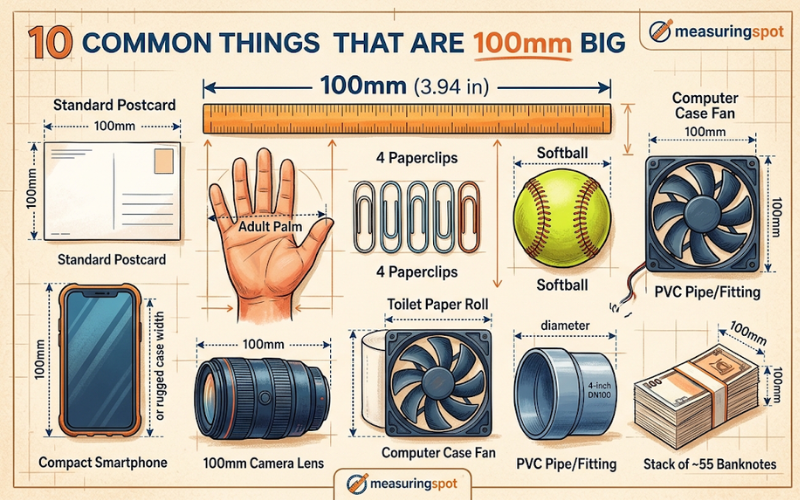
Finding standard objects that hit the 100mm mark is surprisingly easy once you look around your desk, kitchen, toolbox, or bathroom cabinet. Here are ten widely recognized physical items that measure roughly or exactly 100 millimeters.
1. The Width of a Standard Postcard or Note Card
Postal services around the globe rely on standardized dimensions to keep high-speed sorting machines running smoothly. The Universal Postal Union coordinates these specifications across borders, making mail formats remarkably uniform worldwide.
A standard classic postal card or memo index card measures 100mm by 148mm (commonly referenced as the A6 card dimension). When you hold that postcard upright, its narrow edge spans exactly 100 millimeters.
Because virtually everyone has handled a postcard or index card at an office desk, this item serves as one of the most reliable static reference points for 100mm. Place your hand against the short side, and you instantly establish the boundary.

2. The Width of an Adult Palm
Human bodies vary, but statistical averages across adult populations remain consistent when you look at hand measurements. Anthropometric data gathered by industrial designers and safety engineers highlights steady benchmarks across adult demographics.
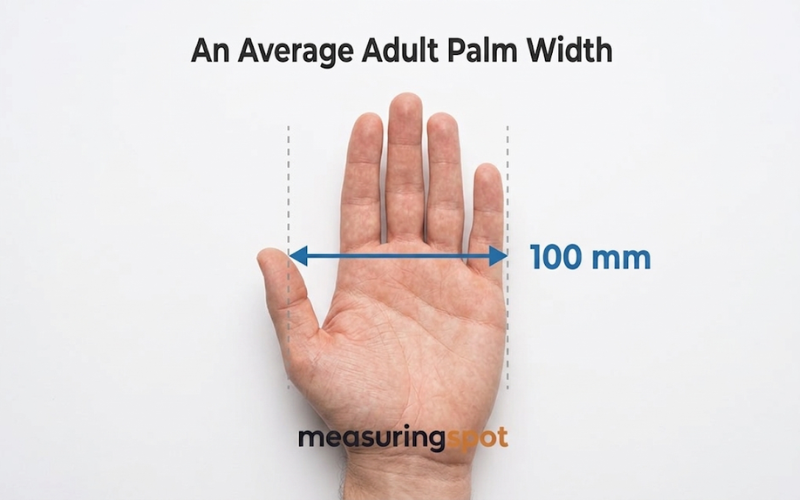
For an average adult male, the width of the palm—measured straight across the knuckles of the four fingers without the thumb—ranges between 95mm and 105mm. For many men and taller women, that knuckle span lands right on 100mm.
This built-in metric provides the most convenient measuring tool you will ever own. Once you measure your own knuckles with a dedicated ruler once or twice, you can gauge raw lumber, desk components, or pipe fittings simply by resting your palm flat against them.
3. Four Standard Large Paperclips End to End
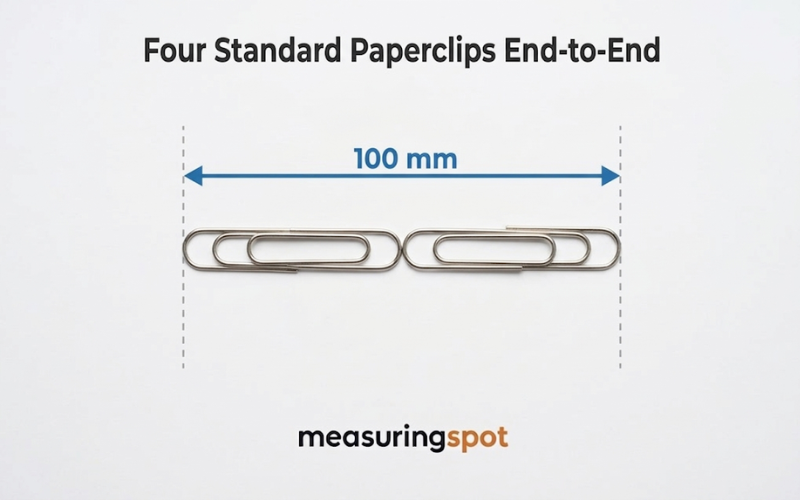
Office stationery follows strict industrial manufacturing dies. While jumbo clips exist in bulkier sizes, the standard #1 paperclip maintains an exact length of roughly 25 millimeters (1 inch) from loop to loop.
Line up four standard paperclips end to end on a smooth surface:
25mm4=100mm
Because paperclips sit in almost every desk drawer or home organizer, they offer a great physical counting system. If you need to estimate roughly 4 inches or 100 millimeters in an office setting, four linked or aligned paperclips mark the spot cleanly.
4. The Diameter of an Athletic Softball
Sports governing bodies enforce tight equipment manufacturing criteria to preserve fair competition. While a baseball measures around 73mm to 76mm in diameter, a standard 12-inch recreational or fastpitch softball sits much larger.
The “12-inch” designation refers to the ball’s circumference (C12inches304.8mm). When you calculate diameter using the basic geometric formula:
D=C=304.83.1415997to100mm
A regulation competition softball measures right around 97mm to 100mm straight through its center core. If you grip a standard softball in your hand, you are holding a sphere roughly 100 millimeters wide.

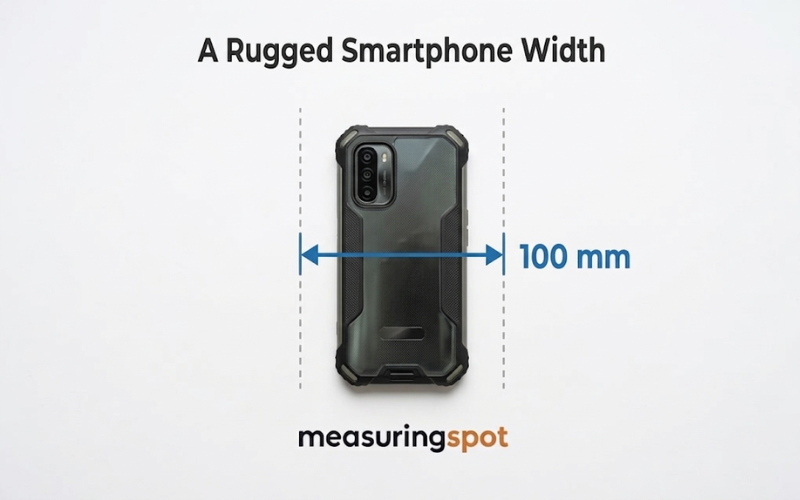
5. A 4-Inch Modern Smartphone Width (Across Screen and Bezel)
While smartphone screen diagonals have expanded upward over the years, the horizontal footprint of pocket-friendly mobile devices stays constrained by human ergonomics. Phone manufacturers design handsets to fit comfortably inside a single hand’s grasp.
Many mid-sized smartphones measure between 70mm and 75mm wide, but ruggedized outdoor smartphones, phones wearing heavy-duty shockproof protective cases, or compact foldable screens unfolded in portrait mode span right at 100mm wide.
Furthermore, if you measure diagonally across a smaller utility screen—such as an electronic shelf label, smart thermostat screen, or mini pocket monitor—you will regularly encounter screens engineered at exactly 100mm along their diagonal or vertical plane.
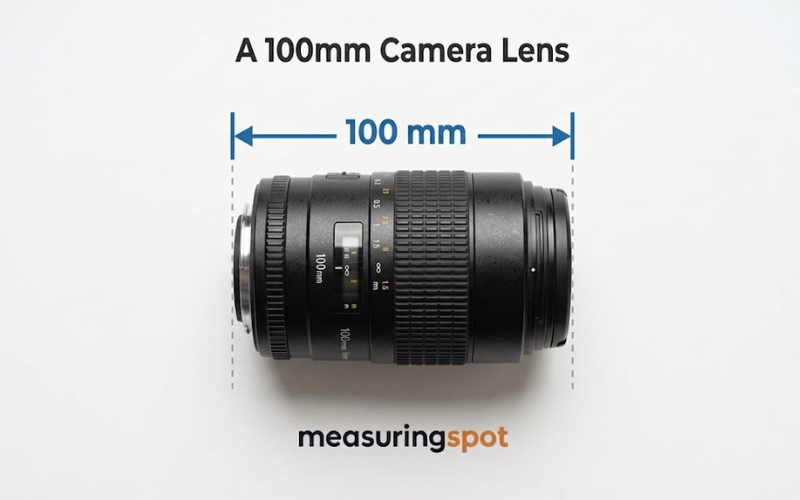
6. A Standard 100mm Macro Camera Lens
Photographers know the 100mm mark intimately. Among camera optics, the 100mm focal length represents the classic golden standard for macro and portrait photography.
Brands like Canon, Sony, Tokina, and Pentax build dedicated 100mm focal length prime lenses. In addition to the optical focal length designation, the physical physical barrel length of many compact prime lenses also hovers right near 100mm from mount flange to front filter ring.
This dimension offers a natural field of view that prevents facial distortion in portraits while providing enough working distance to photograph insects, jewelry, or flowers without casting a shadow on the subject.
7. The Height of a Standard Toilet Paper Roll
Consumer paper product manufacturers standardize roll dimensions to fit wall-mounted brackets, freestanding spindles, and recessed bathroom dispensers.
The cardboard inner tube and outer sheet roll of standard household bath tissue typically measures between 98mm and 102mm in height (approximately 3.9 to 4 inches tall).
Stand a fresh roll of toilet paper on a level counter: the vertical distance from the bottom rim to the top edge gives you an everyday 100mm visual benchmark sitting right in your home.

8. A 100 mm Computer Case Exhaust Fan
Inside desktop desktop computers, server chassis, and electronic cooling enclosures, axial cooling fans regulate internal temperatures. While 120mm and 140mm fans dominate enthusiast gaming towers, 100mm (or 92mm–100mm class) axial fans remain common across compact form factor builds, small workstations, and home theater PCs.
These square-frame fans measure exactly 100mm along each outer edge. Industrial builders specify this size because it fits precisely into rackmount hardware while moving adequate airflow across heat sinks and processors.
If you service personal computers, 3D printers, or server racks, you likely touch a 100mm square fan frame on a regular basis.

9. A Standard 4-Inch PVC Pipe Coupling or Drainage Collar
Plumbers and construction crews deal with the metric-to-imperial crossover every day. Building codes across residential and commercial sewer lines often mandate 4-inch nominal pipe dimensions for waste disposal lines, downspouts, and perimeter French drains.
In metric territories, these pipes and fittings match the standard 100mm internal or outer diameter class (often marked as DN100 in civil engineering plans).
The circular opening of a DN100 soil pipe or standard 4-inch junction sleeve measures right at 100 millimeters across. Tradespeople recognize this round portal instantly on construction sites and basement rough-ins.

10. A Stack of 55 to 60 Standard US One-Dollar Bills or Banknotes
Paper currency feels whisper-thin as an individual sheet, but bulk paper production holds tight, predictable tolerances. A single uncirculated banknote measures approximately 0.11 millimeters in thickness.
When you stack fresh, uncirculated currency:
0.11mm900100mm
However, if you take worn, circulating bank notes with typical handling creases, oil absorption, and air pockets, paper thickness swells substantially. In everyday conditions, a loose stack of roughly 55 to 60 mixed banknotes laying without heavy compression creates a vertical stack right around 100mm tall.
For cashiers, bank tellers, and retail managers, this provides a handy spatial guide when organizing cash drawers or drop safes.

Why the 100 mm Measurement Dominates Global Manufacturing
The popularity of 100 millimeters across industrial sectors does not happen by accident. In the International System of Units (SI), 100mm represents 10 centimeters, or one-tenth of a meter (one decimeter). Human beings naturally prefer base-10 mathematics because our numbering systems rely on decimals.
The Decimal Advantage in Industrial Tooling
Engineers, architects, and product designers routinely dimension plans in millimeters rather than fractional inches. When you build an engine part, a medical syringe, or a window frame, working in whole millimeters eliminates the headache of converting sixteenths or thirty-seconds of an inch. A round 100mm measurement provides structural strength while fitting neatly into standard modular design grids.
The Imperial Overlap
The number 100 sits close to 101.6mm—which equals exactly 4 inches (425.4mm). Because North American industries long relied on 4-inch standard molds, dies, lumber cuts, and pipe sizes, metric factories producing goods for international trade found that 100mm serves as a practical, harmonious metric equivalent. This close conversion eases global supply chain friction across automotive, construction, and consumer electronics categories.
How to Measure 100 mm Without a Ruler
When you find yourself in a workshop, hardware aisle, or field site without a tape measure, you can rely on quick practical methods to gauge a 100mm span:
The Credit Card Diagonal Method
A standard plastic credit card, debit card, or driver’s license conforms to the ISO/IEC 7810 ID-1 standard:
- Width: 85.60 mm
- Height: 53.98 mm
Calculate the diagonal measurement of a credit card using the Pythagorean theorem:
Diagonal=(85.60)2+(53.98)2=7327.36+2913.84=10241.2101.2mm
The corner-to-corner diagonal distance across any standard bank card measures almost exactly 100mm (differing by barely a single millimeter). Hold your payment card corner-to-corner against any object, and you possess an instant 100mm precision gauge.
The Folded Dollar Bill Technique
A United States Federal Reserve note measures 156mm long by 66.3mm tall.
- Fold an ordinary dollar bill in half lengthwise: you create an edge of 78mm.
- If you take the full 156mm length and visually fold or mark roughly two-thirds of the bill, you arrive cleanly at 104mm.
- Alternatively, combining the short height of the bill (66mm) with the width of two adult fingers (roughly 35mm) brings you right to the 100mm threshold.
Standard AA Batteries in Sequence
A typical AA household alkaline battery measures 50.5 millimeters from its flat negative base to the tip of its positive terminal nub.
- Take two standard AA batteries from a remote control or flashlight.
- Place them end-to-end, terminal to base:
50.5mm+50.5mm=101mm
Two AA batteries aligned in a straight line match the 100mm target within a one-percent margin of error.
Frequently Asked Questions About 100mm
How many inches is 100 mm?
100 millimeters equals roughly 3.937 inches. For most fast workshop projects and rough estimates, rounding 100mm to 4 inches works well, as the difference is less than 1.6 millimeters (about 1/16 of an inch).
Is 100mm the same as 10cm?
Yes. There are 10 millimeters in every centimeter. Dividing 100 by 10 yields exactly 10 centimeters.
How big is a 100 mm lens on a camera?
In photography, a 100mm lens has a focal length that provides moderate telephoto reach on a full-frame camera sensor. It narrows your angle of view to roughly 24 degrees, bringing distant subjects closer while isolating them against a softly blurred background.
Can you use your hand to measure 100 mm?
Yes. For most adults, the width across the four main knuckles (index, middle, ring, and pinky fingers) measures right around 95mm to 105mm. Measuring your own knuckles with a ruler once allows you to use your hand as an accurate 100mm reference tool anywhere.
What socket size or wrench is 100 mm?
Hand tools rarely reach 100mm in standard mechanics’ sets. A 100mm wrench or socket belongs to specialized heavy industry, marine engineering, and heavy plant equipment maintenance. A standard mechanics’ set usually tops out around 32mm to 36mm.
How much does 100 mm weigh in water?
Length itself carries no weight, but a 100mm cube (100mm 100mm 100mm) has a volume of 1,000,000 cubic millimeters, which equals exactly 1 liter. One liter of pure water at room temperature weighs exactly 1 kilogram (2.205 pounds).
Getting comfortable with everyday measurements does not require constant conversion apps. By linking 100 millimeters to regular objects like a credit card diagonal, a couple of AA batteries, or the width of your knuckles, you build a sharp spatial intuition that serves you in workshops, stores, and construction projects alike.
Whenever you encounter a 100mm specification on paper or on a screen, simply recall that it sits just a hair under 4 inches. Keep these common references in your pocket, and metric sizing will always make clear, practical sense.
Related Posts
- 10 Common Things That Are 24 mm Big
- 10 Common Things That Are 23 mm Big
- 10 Common Things That Are 22 mm Big
- 10 Common Things That Are 21 mm Big
Conclusion
Mastering metric measurements does not require keeping a conversion calculator in your back pocket. Once you tether 100 millimeters to familiar reference points—like the corner-to-corner diagonal of your credit card, a couple of AA batteries end-to-end, or the span across your knuckles—estimating size becomes second nature.
Whenever you see a 100mm spec sheet or project dimension, simply round it mentally to just shy of 4 inches. These everyday physical shortcuts bridge the gap between abstract numbers and the real world, saving you time and guesswork on every project.
FOR MORE MEASUREMENTS VISIT: MEASURINGSPOT