

Two hundred meters sits right at the edge of human perception. It is too far to measure with a tape measure, yet short enough that you can spot a friend standing at the far end on a clear afternoon. Because the metric system can feel abstract when you are trying to estimate distance on the street, people often wonder: just how long is 200 meters in real life?
In standard measurements, 200 meters equals roughly 656.17 feet, or a little over one-eighth of a mile. An Olympic sprinter blazes past this distance in under twenty seconds, while a leisurely stroll takes about two and a half minutes.
To bridge the gap between plain numbers and physical reality, the easiest method uses familiar landmarks. When you align 200 meters against famous architectural monuments, athletic tracks, and standard transit vehicles, the measurement transforms into something clear, relatable, and easy to identify.
Quick Answer: How Long is 200 Meters at a Glance?
If you need a rapid mental baseline, 200 meters is roughly equivalent to:
- Half a standard outdoor running track lap (the bend plus the home straight).
- Two standard American football fields placed end to end, including end zones.
- 4 Olympic swimming pools placed end to end.
- 14 standard city transit buses parked bumper to bumper.
- About 2 minutes and 20 seconds of brisk walking for an average adult.
- Roughly 260 to 280 adult walking paces.
Quick Reference: 200 Meters Metric & Imperial Conversion
| Unit System | Equivalent Measurement |
| Meters | 200 m |
| Feet | 656.17 ft |
| Yards | 218.72 yd |
| Inches | 7,874.02 in |
| Kilometers | 0.2 km |
| Miles | 0.124 miles (~1/8 mile) |
| Average Human Steps | ~260–280 steps |
| Average Walking Time | ~2 minutes, 20 seconds |
10 Common Things That Are Roughly 200 Meters Long
1. Two American Football Fields (End Zones Included)
When Americans try to grasp long distances, football fields serve as the universal yardstick. A standard American football field measures 360 feet from the back of one end zone to the back of the other.
Two complete football fields stretched end to end total 720 feet, or approximately 219.4 meters. If you shave off half an end zone from each side—leaving you with two regulation 100-yard playing fields plus one end zone—you hit almost exactly 200 meters (656 feet). If you ever stand at the goal line of a stadium, point your gaze through the opposite uprights, and project that exact stretch one more time, you are looking straight across a 200-meter span.

2. Half of an Olympic Running Track
If you have ever laced up running shoes at a local high school or sports facility, you have conquered 200 meters on foot. A regulation outdoor running track lane measures exactly 400 meters around the inner perimeter.
Running the 200-meter sprint requires an athlete to sprint around the curve and power down the entire straightaway into the finish line. Because track surfaces feature fixed lines, they offer the single most accurate everyday physical reference for 200 meters. When you stand at the 200-meter start line on the curve, the distance between your cleats and the final timing mat across the infield represents this exact measurement.

3. Four Olympic Swimming Pools End to End
An Olympic-size competition pool measures exactly 50 meters (164 feet) from touch-pad to touch-pad. While 50 meters feels immense when you are swimming laps against the clock, lining up four of these aquatic facilities lengthwise lands you right at 200 meters.
Competitive swimmers who swim the 200-meter freestyle or individual medley cover this length across four lengths in a long-course pool. Watching a swimmer complete this distance gives you an immediate appreciation for how much open water 200 meters covers, especially when water resistance fights every stroke.

4. Fourteen Standard City Transit Buses
Public transit commuters see 40-foot city transit buses every single day. A standard transit bus—like the workhorse models built by Gillig or New Flyer used throughout North America and Europe—measures roughly 40 feet (12.2 meters) from front bumper to rear tailpipe.
If you park 14 of these buses bumper to bumper in a continuous line during morning rush hour, the entire convoy stretches approximately 170 to 175 meters. Add the typical safety cushion between parked vehicles, or swap in three articulated “accordion” buses (which run about 60 feet each), and the entire vehicle line reaches 200 meters.

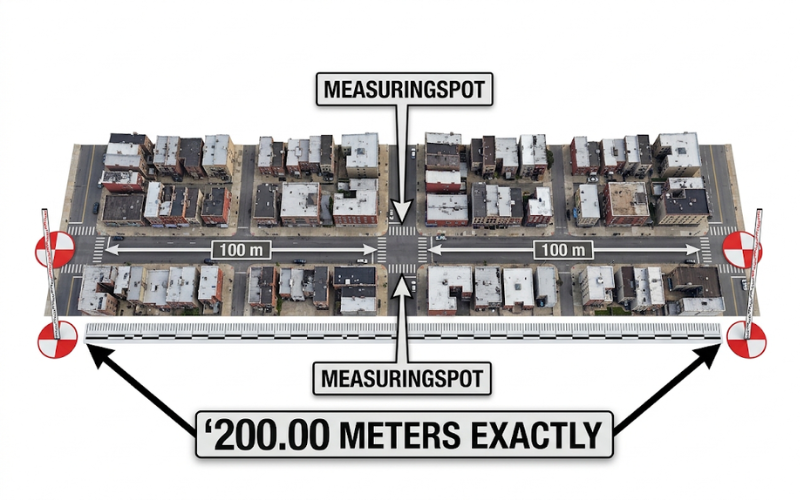
5. Two Average City Blocks
City planners design urban grids using standardized street layouts, though dimensions fluctuate between regions. In Manhattan, for example, the standard north-south blocks along avenues average about 264 feet (80 meters) from the center of one street to the center of the next.
Walking two full north-south blocks plus crossing two intersections brings you to roughly 190 to 200 meters. If you step out of a subway entrance, walk past two cross streets, and stop at the third corner, you have just traversed 200 meters on concrete.
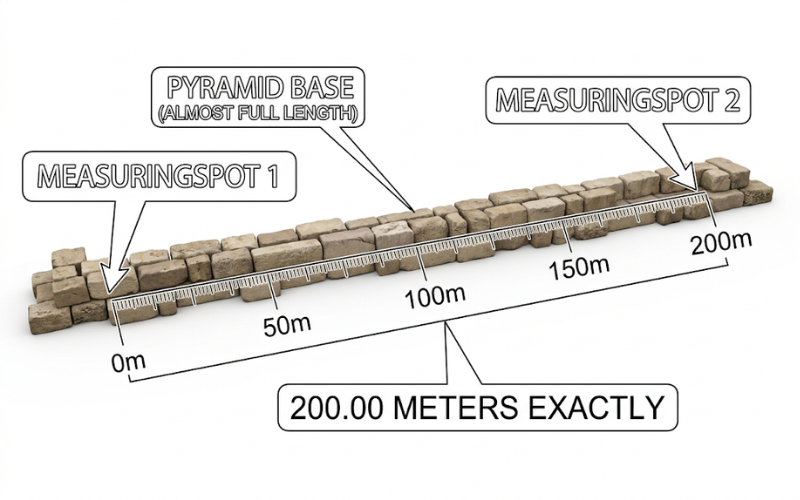
6. The Base of the Great Pyramid of Giza (Almost)
Ancient architecture provides massive physical anchors for measuring space. The Great Pyramid of Giza originally stood with a base length of roughly 230 meters (755 feet) on each side. Due to centuries of erosion and casing stone loss, modern measurements place the base at around 215 to 220 meters per side.
Walking along a single face of this monumental pyramid puts you within a stone’s throw of the 200-meter mark. The sheer mass of the limestone blocks makes the distance feel immense, showing how ancient builders moved materials over spaces that rival modern civil infrastructure.
7. Fifty Mid-Size Family Sedans Bumper to Bumper
Look out across a crowded highway or an airport parking lot, and you will see mid-size passenger cars everywhere. A typical family sedan, such as a Toyota Camry or Honda Accord, measures approximately 16 feet (4.9 meters) in total length.
If a parking attendant arranges 40 to 41 modern sedans tightly bumper to bumper, the total length hits 200 meters. If you include normal driving gaps in bumper-to-bumper traffic, around 25 to 30 cars easily occupy a 200-meter strip of highway pavement.

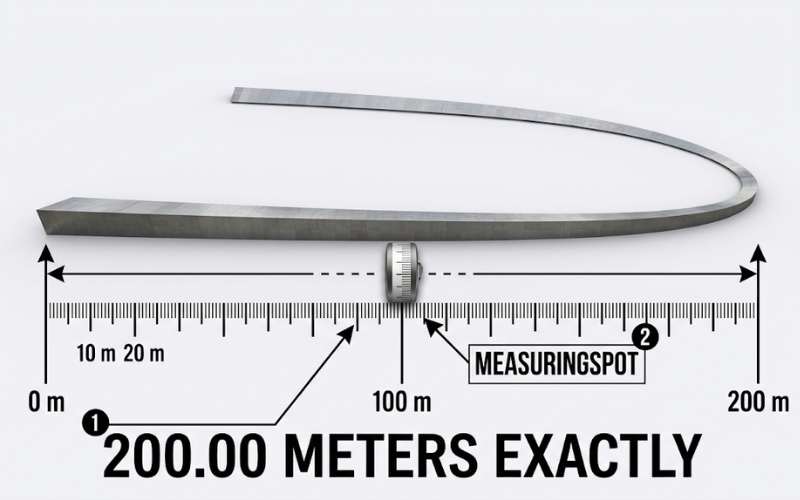
8. The Gateway Arch Laid Flat
The Gateway Arch in St. Louis, Missouri, stands as the tallest monument in the United States. Its catenary design measures 630 feet (192 meters) high and spans 630 feet wide at its base.
If a construction team miraculously lowered the stainless steel monument onto its side along the banks of the Mississippi River, the apex would fall just 8 meters short of a 200-meter finish line. Standing near the base and looking directly up toward the top observation deck gives you a clear sense of what 200 meters looks like rotated vertically into the sky.
9. Ten Modern Bowling Lanes End to End
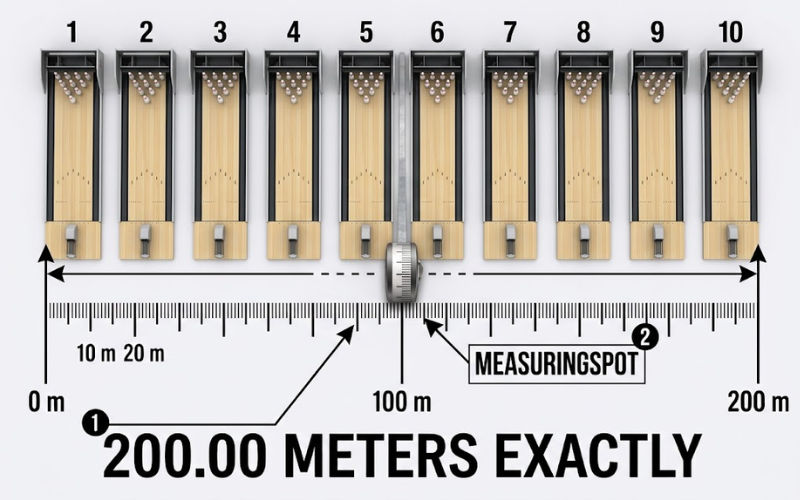
A standard regulation tenpin bowling lane measures 60 feet (18.28 meters) from the foul line to the headpin. When you factor in the approach area behind the foul line and the pinsetter machinery pit at the back, a complete bowling lane installation occupies roughly 65 to 70 feet.
If you took 10 full regulation bowling lanes and laid them out in one continuous straight line, the total span matches 200 meters. The distance that a bowling ball travels across 10 consecutive strikes mirrors what an athlete covers in half a track lap.
10. A 60-Story Skyscraper’s Shadow or Mid-Rise Height
While skyscraper heights vary based on ceiling heights and mechanical floors, commercial office buildings average 3.5 to 4 meters per floor, while residential towers sit closer to 3 meters to 3.2 meters per floor.
A modern 50-to-60-story high-rise office building stands roughly 180 to 210 meters tall. Notable global structures, such as 200 West Street in New York or iconic downtown office cores in major capitals, hover right at this 200-meter elevation mark. Looking straight up at a skyscraper within this tier demonstrates how imposing 200 meters looks against the sky.

What Does Walking 200 Meters Feel Like?
Walking 200 meters requires very little effort for the average person, yet paying attention to your stride reveals consistent biological patterns.
An adult walking at a standard pace of 3 miles per hour (4.8 km/h) covers roughly 1.34 meters per second. At that rate, you will cross 200 meters in approximately 149 seconds—just shy of two and a half minutes.
200 meters ÷ 1.34 meters/second = 149.25 seconds (~2 minutes, 29 seconds)
In terms of physical exertion, human cadence usually sits between 100 and 115 steps per minute, with an average stride length of roughly 0.75 meters (2.5 feet). You can expect to take between 260 and 280 steps to cover this distance on level ground. If you use a pedometer or fitness tracker, completing 200 meters chips away about 3% of a typical 10,000-step daily goal.
Biowiki Reference: 200 Meters Distance Profile
| Dimension Field | Specification & Context |
| Primary Value | 200 Meters (SI Base Unit) |
| Imperial Equivalent | 656.168 Feet / 218.722 Yards |
| Nautical Equivalent | 0.108 Nautical Miles |
| Acoustic Travel Time | ~0.58 seconds (Speed of sound at sea level, 20°C) |
| Light Travel Time | ~0.667 microseconds (Speed of light in vacuum) |
| Sprint Record (Men) | 19.19 seconds (Usain Bolt, 2009) |
| Sprint Record (Women) | 21.34 seconds (Florence Griffith-Joyner, 1988) |
| Free-Fall Duration | ~6.38 seconds (ignoring air resistance from rest) |
| Average Human Energy Burn | ~12–16 calories (walking at standard pace) |
Why 200 Meters Matters Across Industries
Distance estimation plays a crucial operational role in various professional fields. The 200-meter threshold appears frequently in civil design, marine safety, military tactics, and construction planning.
Urban Planning and Walkability
City planners frequently treat 200 meters as the primary radius for public transit access. Studies show that commuters comfortably walk up to 400 meters to reach a train station or major bus hub without reconsidering their route. Planners space local neighborhood bus stops 200 to 250 meters apart so that residents never walk more than a couple of minutes to access transit service.
Maritime Operations and Docking
At sea, vessel lengths scale rapidly. Many medium-sized cargo ships, roll-on/roll-off vehicle carriers, and large chemical tankers measure right around 200 meters in length. When harbor pilots guide a 200-meter vessel into a berth, they manage massive momentum; stopping a vessel of this size requires extensive tug support and hundreds of meters of advance braking distance.
Commercial Aviation Safety
Airport planners follow strict runway clearance and safety area guidelines. While commercial jetliner runways range from 2,000 to 4,000 meters in length, runway safety overruns (the clear tarmac past the runway threshold) often measure 150 to 240 meters. This safety zone gives pilots room to decelerate safely if an aircraft aborts takeoff at high speed.
Frequently Asked Questions
How long does it take to walk 200 meters?
A healthy adult walking at an average pace of 3 miles per hour (4.8 km/h) covers 200 meters in roughly 2 minutes and 20 seconds to 2 minutes and 30 seconds.
How many steps are in 200 meters?
For a person of average height (5’7″ to 5’10”), an average stride measures around 2.5 feet (0.76 meters). This translates to approximately 260 to 280 steps to cover 200 meters on flat terrain.
How many football fields make up 200 meters?
Two American football fields—including both end zones—measure 720 feet (219.4 meters). Therefore, 200 meters is just slightly shorter than two complete football fields, aligning closely with two 100-yard playing fields plus one end zone.
What is the world record for running 200 meters?
Usain Bolt holds the men’s world record at 19.19 seconds, set at the 2009 World Athletics Championships in Berlin. Florence Griffith-Joyner holds the women’s world record at 21.34 seconds, set at the 1988 Seoul Olympics.
How long is 200 meters in miles?
Two hundred meters equals approximately 0.124 miles, which is almost exactly one-eighth of a standard statute mile.
Grasping the true scale of 200 meters comes down to tying abstract units to objects you see every week. Whether you visualize half an outdoor running track, two football gridirons placed head-to-head, or a 14-bus traffic lineup, these concrete reference points anchor the measurement in reality.
Next time you need to estimate a 200-meter span outdoors, look for two city blocks or track your footsteps for about two and a half minutes. Using these real-world anchors turns metric estimations into second nature.
Related Posts
- 10 Common Things That Are 90 Meters Long/ Tall
- 10 Common Things That Are 80 Meters Long/ Tall
- 10 Common Things That Are 70 Meters Long/ Tall
- 10 Common Things That Are 60 Meters Long/ Tall
Conclusion
Grasping the true scale of 200 meters comes down to tying abstract metric numbers to everyday objects. Whether you picture half of a standard running track, two football gridirons placed head to head, or a lineup of fourteen city transit buses, concrete reference points transform a distant figure into an intuitive span.
Understanding this measurement sharpens your real-world awareness, whether you are planning an urban commute, evaluating sports performance, or surveying building heights. Walking this distance takes less than two and a half minutes, proving that while 200 meters sounds substantial on paper, you can cross it in just a few hundred strides.
Next time you need to estimate how long 200 meters is, rely on these practical landmarks instead of guessing. With these ten everyday comparisons in mind, judging distance outdoors becomes second nature.
FOR MORE MEASUREMENTS VISIT: MEASURINGSPOT