

Measurements on blueprints, road signs, or specification sheets often look straightforward on paper. In everyday environments, however, understanding metric spans without a physical tape measure can be challenging. When asking how long is 11 meters, having clear real-world benchmarks helps ground the measurement in daily experience.
Converted into standard imperial units, 11 meters equals roughly 36.089 feet, or approximately 12.03 yards and 433 inches. It covers substantial ground—longer than most parking spots, taller than the majority of two-story suburban homes, and extensive enough that walking it at a leisurely pace takes about 14 normal paces.
Quick Conversion Cheat Sheet
Here is a fast glance at how 11 meters translates across different measurement systems and quick visual units:
| Unit of Measurement | Equivalent to 11 Meters |
| Feet (ft) | 36.089 ft (approx. 36 ft, 1 in) |
| Inches (in) | 433.07 inches |
| Yards (yd) | 12.03 yards |
| Centimeters (cm) | 1,100 cm |
| Millimeters (mm) | 11,000 mm |
| Kilometers (km) | 0.011 km |
| Average Human Footsteps | ~14 to 15 standard adult walking steps |
| Standard Sedans (Parked End-to-End) | ~2.4 midsize passenger cars |
Biowiki & Quick Reference Table
| Spec / Dimension Property | Measurement Data 📐 |
| Standard Metric Value | 11.00 m |
| Exact Value in Feet | 36.08924 ft |
| Exact Value in Inches | 433.0709 in |
| Exact Value in Millimeters | 11,000 mm |
| Scientific Notation | $1.1 \times 10^1$ m |
| Light Travel Time (Vacuum) | ~36.69 nanoseconds |
| Sound Travel Time (Air at 20°C) | ~0.032 seconds |
| Common Architectural Equivalent | ~3.5 residential ceiling stories (exterior height) |
| Primary Utility Comparison | Standard urban utility pole overall length |
| Maritime Classification | Typical 36-foot weekend cruiser monohull yacht |
10 Common Things That Are 11 Meters Long
1. Standard Single-Decker Transit Bus
Transit buses running through municipal city streets commonly measure between 10.5 and 11.5 meters from bumper to bumper. While commuter coaches can extend up to 12 meters or 15 meters, the agile two-axle single-decker transit buses used in tighter urban neighborhoods sit right at the 11-meter mark.
Standing on the curb and watching a standard city bus pull alongside gives an immediate sense of this distance. From the driver’s front windscreen back to the rear exhaust grille, you are observing an 11-meter span.

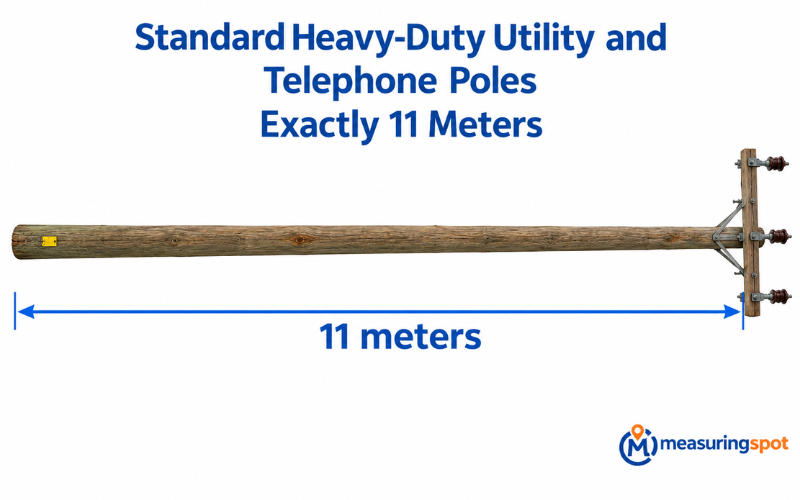
2. Standard Heavy-Duty Utility and Telephone Poles
Wooden and concrete utility poles line suburban roadways, alleys, and country paths. While they seem relatively modest sticking out of the ground, pole specifications include the portion embedded deep underground.
A standard class utility pole often measures 35 to 40 feet in total timber length—roughly 11 meters. Around 1.5 to 2 meters remains anchored below ground level for structural stability, while roughly 9 meters to 9.5 meters stays exposed to support power lines, transformers, and fiber-optic cables.
3. A 36-Foot Cabin Cruiser or Midsize Sailing Yacht
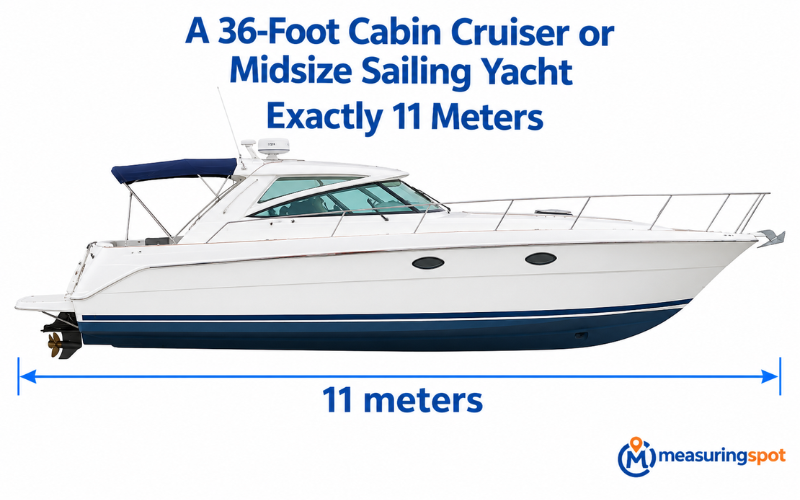
Boats are traditionally cataloged by their hull length in feet, and the 36-foot class is one of the most common midsize monohull designs in recreational boating. That 36-foot length translates almost exactly to 11 meters (36.089 feet).
An 11-meter yacht offers enough room for an enclosed saloon, a galley, a separate head, and two private sleeping berths. Standing at the bow pulpit and looking back across the teak deck to the stern swim platform illustrates the exact scale of an 11-meter boundary on open water.
4. Two and a Half Midsize Family Sedans
If you have ever parallel-parked or waited in a drive-thru, you are already familiar with the profile of modern sedans. A typical midsize passenger vehicle (such as a Toyota Camry, Honda Accord, or Volkswagen Passat) measures between 4.8 and 4.9 meters long.
When you place two of these full-size sedans bumper-to-bumper, they account for roughly 9.7 meters. Add half the length of another car—or account for standard suburban parking spacing between vehicles—and you reach 11 meters.

5. Wingspan of the Giant Quetzalcoatlus
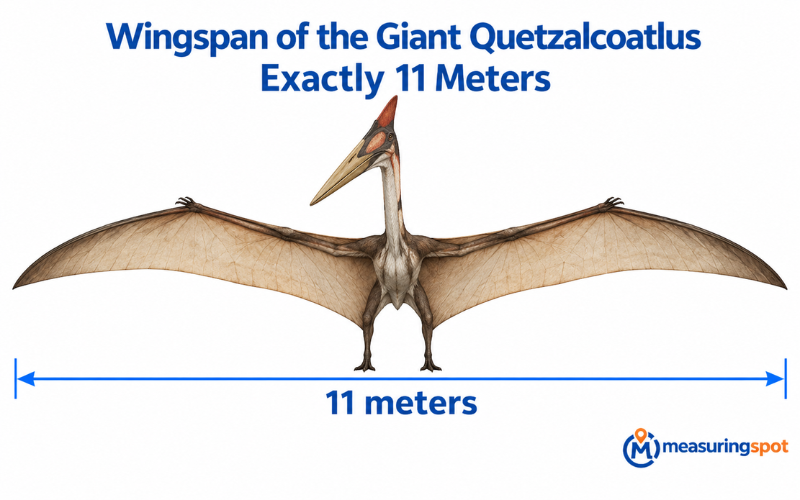
During the Late Cretaceous period, the skies were dominated by azhdarchid pterosaurs, the largest of which was Quetzalcoatlus northropi. Paleontologists and fossil biomechanic studies estimate that this enormous flying creature possessed an adult wingspan of roughly 10 meters to 11 meters.
Spanning wingtip to wingtip, Quetzalcoatlus covered a distance comparable to an entire 11-meter city bus. Standing on the ground, its head and neck reached nearly the height of a modern giraffe, showing that nature has occasionally pushed airborne anatomy to the limits of this measurement.
6. Giant Selenite Crystals in the Naica Mine Cave
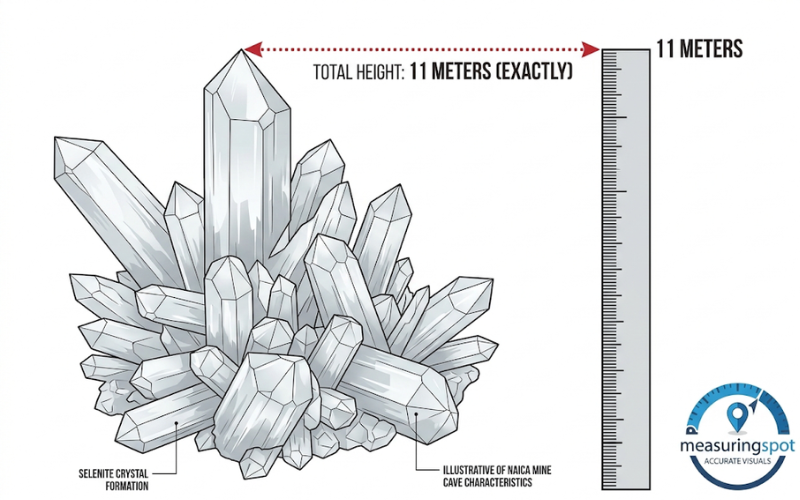
Deep beneath Naica, Chihuahua, Mexico, lies the famous Cave of the Crystals (Cueva de los Cristales). This subterranean cavern contains some of the largest natural mineral formations ever discovered.
The largest selenite (gypsum) pillars jutting from the humid limestone floor measure up to 11 meters in length and over 1 meter in thickness. These colossal, translucent white columns grew slowly over hundreds of thousands of years under extreme hydrothermal conditions, providing a rare geological example of this length.
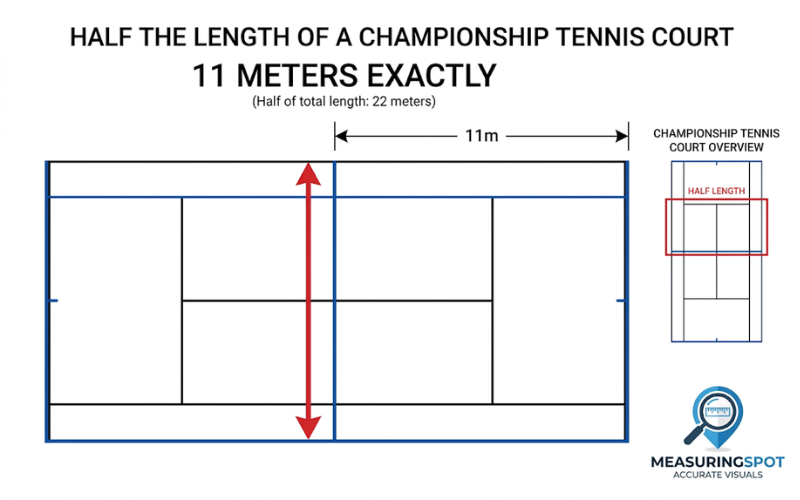
7. Half the Length of a Championship Tennis Court 🎾
Regulation tennis courts are designed according to strict International Tennis Federation (ITF) parameters. The full baseline-to-baseline length of a regulation tennis court measures 23.77 meters (78 feet).
If you cut the court in half—running from the center net to the outer edge of either baseline—it measures 11.88 meters. If you stand right at the service line, take one step backward, and trace your view to the net strap, you are looking at almost exactly 11 meters of court turf or hardcourt surface.
8. An Adult Female Sperm Whale’s Total Body Length
While massive bull sperm whales can grow to 16 meters or 18 meters, adult females and adolescent males generally plateau between 10.5 and 11.5 meters in total length.
An 11-meter female sperm whale can weigh upwards of 15 to 20 metric tons. Her broad, squared head—which houses the spermaceti organ used for echolocation—makes up roughly one-third of that entire 11-meter span, while her muscular tail stock and flukes span the rest.

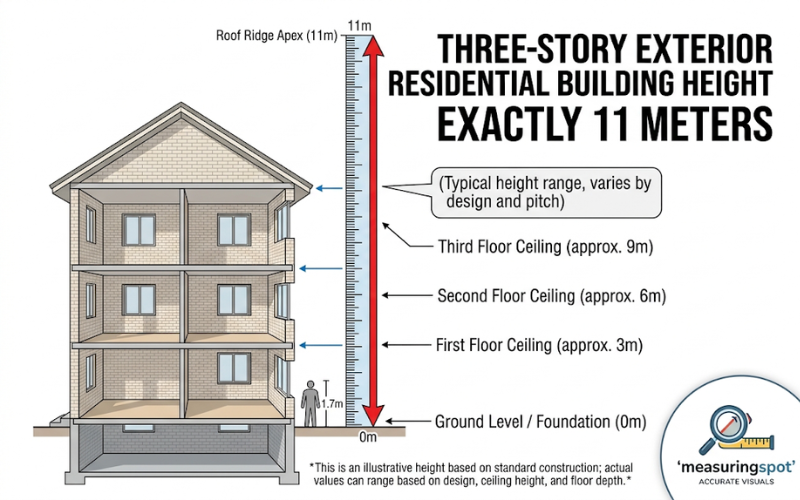
9. Three-Story Exterior Residential Building Height
When looking upward rather than horizontally, 11 meters translates to the exterior vertical height of a compact three-story townhouse or small apartment walk-up.
Standard residential interior ceilings are framed at 2.4 to 2.7 meters (8 feet to 9 feet). Once you add the joists, subflooring, ductwork cavities between levels, a raised ground-floor foundation slab, and a moderate roof pitch, each story adds approximately 3.3 to 3.6 meters of vertical rise. Stack three of those floors together, and the distance from the sidewalk to the gutter line comes out to roughly 11 meters.
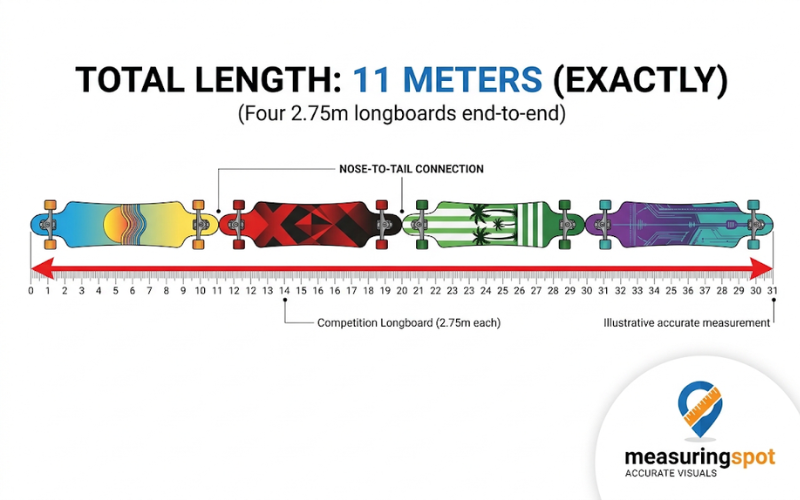
10. Four Competition Longboards Placed Nose-to-Tail
Surfing longboards built for traditional nose-riding and competition logging usually measure 9 feet in length (approximately 2.74 meters).
If you take four of these classic boards and line them up nose-to-tail down a sandy beach or grass field, their combined length equals 10.96 meters. This makes four surfboards laid end-to-end one of the most accessible outdoor references for visualizing an 11-meter boundary.
Everyday Ways to Gauge 11 Meters Without Tools
When you do not have a tape measure, laser distance finder, or architectural ruler available, you can use these bodily and environmental markers:
- Adult Walking Paces: A relaxed step for an average adult male covers roughly 0.75 to 0.8 meters from heel to heel. Walking 14 to 15 continuous forward strides will cover very close to 11 meters.
- Standard Interior Doors: Most interior residential doorways measure roughly 2 meters (6 feet, 8 inches) tall. Imagining 5.5 standard door frames stacked on top of each other yields 11 meters.
- Standard Shipping Containers: Standard international intermodal dry containers come in two primary configurations: 20-foot and 40-foot. An 11-meter object is just about one meter shy of a massive 40-foot shipping container (which measures 12.19 meters).
Frequently Asked Questions (FAQ)
How many feet is 11 meters?
Eleven meters converts to 36.0892 feet (or 36 feet and roughly 1 inch). To quickly estimate this conversion in your head, multiply the meter figure by 3.28.
Is 11 meters longer than a school bus?
Most full-size yellow American school buses (Type D) measure around 35 to 40 feet long (10.6 to 12.2 meters). That means an 11-meter object is roughly the same length as a typical full-size school bus, or slightly longer than midsize transit models.
How many seconds does it take to run 11 meters?
A reasonably fit adult jogging at a casual pace of 10 km/h (6.2 mph) covers 11 meters in roughly 4 seconds. An Olympic-level sprinter running at full sprint speed can clear that distance in under 1.1 seconds.
How many yards is 11 meters?
Eleven meters equals 12.0298 yards. A yard is 3 feet (0.9144 meters), making a meter slightly longer than a yard (approximately 1.09 yards per meter).
Can 11 meters fit inside a standard residential garage?
A standard residential single- or double-car garage typically measures 6 to 7.3 meters (20 to 24 feet) deep. An 11-meter item is far too long to fit into a normal garage and would require a commercial bay, a specialized RV garage, or a deep industrial workshop.
Related Posts
- 10 Everyday Things That Measure 8 Meters Long/ Tall
- 10 Everyday Things That Measure 7 Meters Long/ Tall
- 10 Everyday Things That Measure 6 Meters Long/ Tall
- 10 Common Things That Are 5 Meters Long/ Tall
Conclusion
Understanding how long is 11 meters becomes much simpler when tied to familiar, physical objects rather than raw metric figures alone. Whether looking up at the gutter of a three-story townhouse, eyeing a typical city transit bus curbside, or noting the length of an anchored utility pole, this 36-foot span represents a substantial structural distance in our daily environment. By keeping these everyday benchmarks and quick pacing tricks in mind, you can reliably estimate 11 meters on the spot without ever needing to unroll a physical tape measure.
FOR MORE MEASUREMENTS VISIT: MEASURINGSPOT