

Have you ever looked at a construction blueprint, a property boundary line, or an oversized vehicle spec sheet and found yourself wondering: How Long is 9 Meters in real life?
Numbers on paper often fail to give an intuitive sense of scale. A meter might be simple enough to estimate by taking an exaggerated stride, but multiplying that out to nine paces stretches ordinary spatial memory. When someone mentions 9 meters, they are talking about an intermediate dimension: far longer than any interior living room wall, yet shorter than a standard commercial semi-trailer.
To anchor this measurement in everyday terms, nine meters equals exactly:
- 29.53 feet (roughly 29 feet and 6.3 inches)
- 354.33 inches
- 900 centimeters
- 9.84 yards
Having clear physical benchmarks makes estimating distance effortless. Here is an exploration of common items, vehicles, structures, and living creatures that measure right around 9 meters long.
Quick Reference Summary
If you need an immediate mental yardstick, check out this rapid snapshot before moving into the detailed breakdowns.
| Everyday Object / Subject | Category | Approximate Length | Primary Visual Landmark |
| Traditional London Double-Decker (Routemaster) 🚌 | Transport | ~8.4 to 9.1 m | Classic red city transit icon |
| Two Mid-Size Family Sedans Bumper-to-Bumper 🚗 | Automotive | ~9.0 m | Typical curbside parking footprint |
| Adult Male Orca (Killer Whale) 🐋 | Marine Wildlife | ~8.0 to 9.5 m | Apex predator of the oceans |
| Standard Telephone / Utility Pole 🪵 | Infrastructure | ~9.0 to 10.5 m | Neighborhood wooden electric poles |
| Standard Volleyball Court Width 🏐 | Sports & Athletics | Exactly 9.0 m | Baseline running under the net |
| Full-Size School Bus (Class D Transit Type) 🚍 | School Transit | ~9.0 to 10.5 m | Shorter commercial school transit rig |
| Three-Story Residential Building Height 🏢 | Architecture | ~9.0 m | Ground level to the top gutter line |
| Adult Stegosaurus Fossil Skeleton 🦕 | Paleontology | ~8.5 to 9.0 m | Snout to end of thagomizer tail |
| Large Camper / Class A Motorhome 🚐 | Recreation | ~8.8 to 9.2 m | 30-foot RV touring vehicle |
| Full Badminton Court Diagonal Boundary 🏸 | Sports & Athletics | ~9.0 to 9.5 m | Opposite court corner-to-corner span |
1. The Classic London Routemaster Bus (Double-Decker)
Public transport gives some of the most reliable visual references available because thousands of people see them every day. The classic AEC Routemaster—the universally recognized red double-decker bus that dominated London streets for decades—measures roughly 8.4 to 9.1 meters long, depending on whether you look at the standard RM model (8.38 meters) or the slightly extended RML variants introduced later (9.14 meters / 30 feet).
When looking at a classic Routemaster parked along a curb, you are looking directly at a 9-meter physical boundary. It accommodates two interior decks, an open rear boarding platform, and a front engine bay, all packed tightly within that 30-foot footprint.

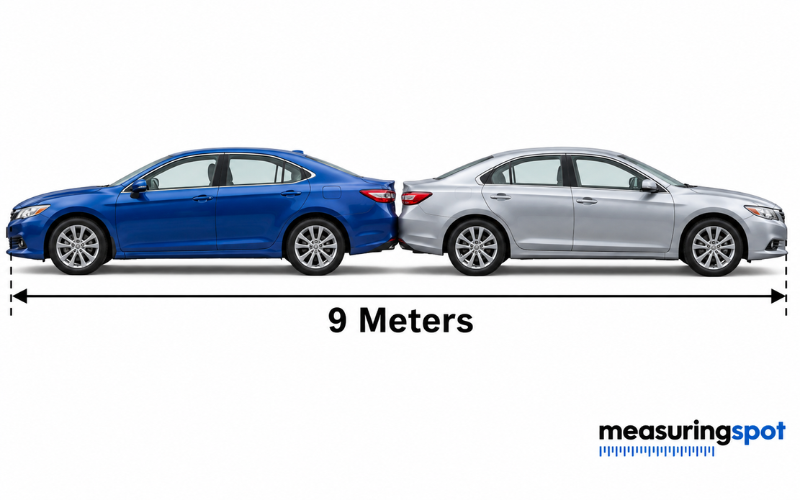
2. Two Mid-Size Family Sedans Parked Bumper-to-Bumper
Parking spaces offer an immediate way to visualize ground measurements without specialized tools. A standard mid-size sedan—such as a Toyota Camry, Honda Accord, or Volkswagen Passat—measures almost universally between 4.5 and 4.6 meters (around 14.8 to 15.1 feet) from its front bumper to its rear exhaust tip.
If you park two of these cars bumper-to-bumper with zero clearance between them:
- First Car: ~4.5 meters
- Second Car: ~4.5 meters
- Combined footprint: 9.0 meters on the dot
Next time you walk down a residential street, glance at two compact-to-midsize cars parked tightly along the curb. That total stretch represents 9 meters of asphalt.
3. A Fully Grown Bull Orca (Killer Whale)
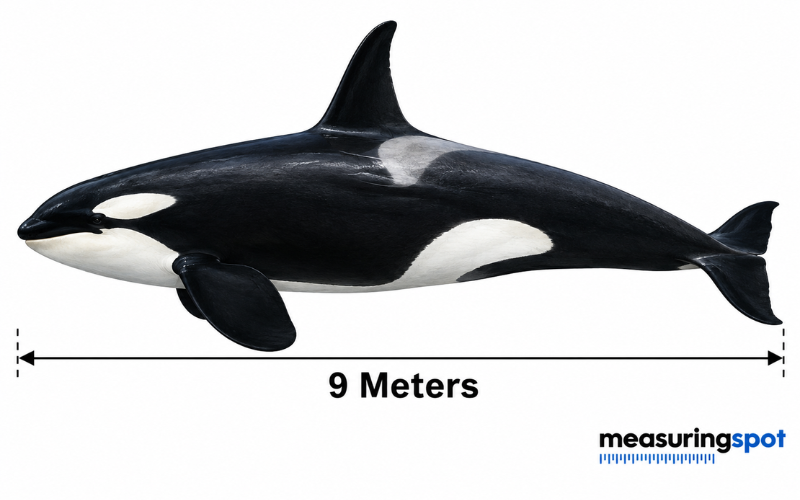
In the natural world, large marine mammals demonstrate scale in spectacular fashion. While female killer whales generally reach between 5 meters and 7 meters, fully mature male orcas (Orcinus orca) frequently attain lengths between 8 meters and 9.5 meters, with outstanding specimens measuring upwards of 30 feet.
A 9-meter bull orca weighs roughly six to eight metric tons. Its dorsal fin alone can stand nearly 1.8 meters (6 feet) tall, which is as tall as an average adult human standing straight up on its back. Visualizing an orca cruising alongside a small commercial fishing vessel is one of the clearest ways to appreciate the sheer mass that a 9-meter creature occupies.
4. A Standard Wooden Utility / Telephone Pole
Most people walk past utility poles daily without paying much attention to their height. In residential neighborhoods throughout North America and Europe, the most common standard class for local power distribution and communication wires is the 30-foot utility pole, which converts to 9.14 meters.
Keep in mind that when installed, utility companies bury roughly 1.5 to 1.8 meters (5 feet to 6 feet) into the earth to anchor the structure securely against wind shear. If you were to see that same pole lying flat on the grass before being dropped into its augered hole, you would see an unbroken 9-meter timber trunk.

5. The Width of an Official Volleyball Court
Regulation sports surfaces provide exact, millimetrically verified dimensions established by international regulatory bodies. According to the International Volleyball Federation (FIVB), an indoor volleyball court is a rectangle measuring 18 meters long by 9 meters wide.
The court is divided across the middle by a net, creating two equal playing halves measuring 9 meters by 9 meters each.
Key Dimensions on the Volleyball Floor:
- Total width (sideline to sideline): Exactly 9.0 meters (29.53 feet).
- Attack line distance: Drawn 3 meters back from the center line axis.
- Serving zone: Spans the entire 9-meter breadth behind each end boundary line.
If you have ever stood along the baseline ready to receive a jump serve, you were covering a boundary that spans exactly nine meters from left to right.

6. A Mid-Size School Bus (Transit Style / Class D)
School buses come in varied sizes, ranging from short “Type A” shuttle vans to massive 40-foot flat-nosed models designed for highway transit. Right in the middle of these fleets sits the standard 54-passenger, 30-foot bus, which measures roughly 9.0 to 9.2 meters.
These buses are engineered with shorter wheelbases than highway coaches to navigate sharp suburban cul-de-sacs and rural turns. When parked in a school loading zone, five rows of double bench seating on each side of a central aisle occupy almost the entirety of that 9-meter interior cabin.

7. The Height of a Typical Three-Story Home
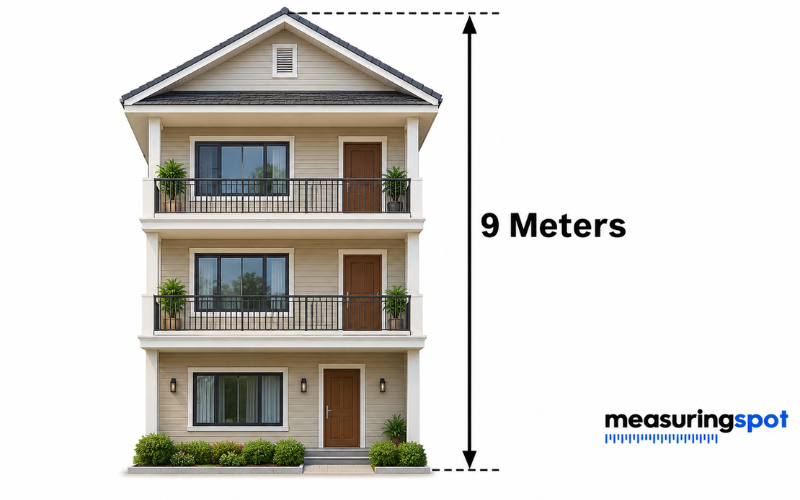
Height can be more difficult to estimate than horizontal distance because human perspective diminishes rapidly looking upward. In conventional timber and masonry home construction:
- One residential story equals roughly 2.6 to 2.8 meters (8.5 to 9.2 feet) of clear interior ceiling space.
- Add 0.3 meters for the joists, subflooring, and insulation between each level.
Stack three floors together—ground floor, first floor, and second floor—and the top fascia board or roof gutter sits between 8.8 and 9.2 meters above the foundation slab. When looking at a brownstone, townhouse, or modern suburban three-deck house, the distance from the sidewalk to the bottom of the attic window is approximately 9 meters.
8. An Adult Stegosaurus Skeleton
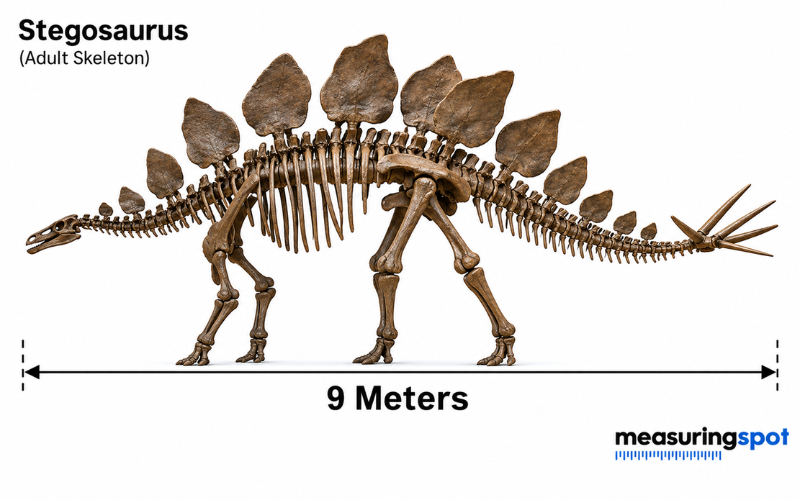
Paleontology gives us striking examples of prehistoric land giants that fit neatly into this dimensional window. The iconic herbivore Stegosaurus stenops, which roamed western North America during the Late Jurassic period, averaged roughly 8.5 to 9.0 meters in total body length.
Anatomical Proportion Breakdown:
- Small skull and neck: ~1.5 meters
- Deep arched torso: ~3.0 meters
- Muscular tail with spikes: ~4.0 meters to 4.5 meters
From its diminutive beak to the tips of the four defensive tail spikes (known as the thagomizer), a full-grown Stegosaurus would stretch across the full length of two parked family cars.
9. A 30-Foot Class A or Class C Motorhome (RV)
Recreational vehicles are manufactured to distinct standard floor plans, with the 30-foot model being among the most popular choices for families traveling across national parks. Translating 30 feet into the metric system yields 9.14 meters.
A motorhome of this size features:
- A cabover sleeping or driving cockpit area
- A centralized galley kitchen and dinette slide-out
- A split bathroom and rear private queen bedroom
Standing inside a 9-meter RV gives you an immediate physical boundary of how much living space can fit along a 30-foot chassis while still remaining maneuverable on regular highways.

10. The Diagonal of Half a Badminton Court
Badminton court boundaries follow rigid guidelines set by the Badminton World Federation (BWF). A standard court is 13.4 meters long and 6.1 meters wide for doubles play.
When you divide the court across the net, each half forms a rectangle measuring 6.7 meters deep by 6.1 meters wide. Calculating the diagonal across one player’s court side using the Pythagorean theorem:
$$\sqrt{6.7^2 + 6.1^2} = \sqrt{44.89 + 37.21} = \sqrt{82.1} \approx 9.06\text{ meters}$$
A player lunging from the back-right corner of their baseline all the way forward to the front-left corner at the tape of the net is traversing a diagonal path of practically nine meters.

Biowiki Reference Table: Comparative Technical Data
To consolidate how each of these subjects compares across standard dimensions, weights, and typical domains, this reference table organizes their engineering and biological specs:
| Subject Name | Domain / Type | Metric Length (m) | Imperial Length (ft) | Typical Weight / Mass | Key Identifying Feature |
| AEC Routemaster Bus | Transportation / Vehicle | 8.38 – 9.14 m | 27.5 – 30.0 ft | ~7,500 kg (unladen) | Open rear boarding platform, double-deck design |
| 2x Mid-Size Sedans | Automotive Assembly | ~9.00 m | ~29.5 ft | ~3,100 kg (combined) | Typical front bumper to rear bumper lineup |
| Bull Orca | Marine Biology / Cetacea | 8.00 – 9.50 m | 26.2 – 31.2 ft | 6,000 – 8,000 kg | Prominent 1.8m triangular dorsal fin |
| Class 4 Utility Pole | Public Infrastructure | 9.14 m | 30.0 ft | 450 – 600 kg | Southern yellow pine or Douglas fir timber |
| Volleyball Baseline | Sports Court Boundary | 9.00 m | 29.53 ft | N/A (Fixed line) | Delimits boundary under FIVB regulations |
| Class D School Bus | Student Transportation | 8.80 – 9.20 m | 28.8 – 30.2 ft | 9,000 – 11,000 kg | High visibility yellow body, flat transit front |
| 3-Story House Façade | Civil Architecture | ~9.00 m | ~29.5 ft | Variable structural | Ground grade to eave line across three levels |
| Stegosaurus Skeleton | Paleontology / Dinosauria | 8.50 – 9.00 m | 27.9 – 29.5 ft | ~4,500 kg (alive) | Double row of alternating kite-shaped back plates |
| 30-Foot Class A RV | Automotive / Leisure | 9.14 m | 30.0 ft | 6,500 – 8,500 kg | Full residential motor coach layout |
| Badminton Half-Court | Athletic Court Geometry | 9.06 m | 29.72 ft | N/A (Diagonal line) | Baseline corner to opposite net corner angle |
Practical Methods to Measure 9 Meters Without a Tape Measure
When you are out in the field, on a job site, or staging furniture in a yard, you will rarely have a 10-meter surveyor’s tape readily available. You can rely on reliable everyday physical proxies to estimate this length quickly.
1. The Normal Walking Stride Method
For an average adult between 5’8″ and 6’0″ (173 to 183 cm) tall, a typical walking pace covers approximately 0.75 meters (2.5 feet).
- 12 natural walking steps will cover roughly 9 meters.
- If you intentionally stretch your legs into exaggerated, heel-to-toe marching strides that approximate one full meter each, 9 full paces will land you within inches of the mark.
2. Standard Parking Space Widths
In most municipal commercial parking lots, building codes mandate parking stalls to be between 2.4 and 2.7 meters wide (8 feet to 9 feet).
- Walking across 3.5 standard parking bay widths gives you approximately 9 meters of distance.
3. Interior Ceiling Drywall Panels 🪵
Standard building supply drywall sheets sold at home improvement centers generally measure 4 feet by 8 feet (1.22 meters by 2.44 meters).
- Laying seven and a half drywall sheets side-by-side on their short 1.2-meter edge equals 9 meters.
- If looking at 3-meter (10-foot) commercial drywall sheets placed end-to-end, exactly three sheets equal 9 meters.
Frequently Asked Questions (FAQs) ❓
Exactly how long is 9 meters in feet and inches?
Nine meters is equal to 29 feet and 6.33 inches (or 29.5276 feet). In rounded carpentry terms, it is generally treated as 29 and a half feet.
How many seconds does it take to run 9 meters?
An average healthy adult sprints at roughly 20 to 24 km/h (5.5 to 6.6 meters per second). At that pace, sprinting 9 meters takes between 1.3 and 1.6 seconds. An elite Olympic sprinter covering the first drive phase of a 100-meter dash clears 9 meters in barely over 1.1 seconds.
Is 9 meters longer than a semi-truck trailer?
No. A standard full-size highway semi-trailer (commonly referred to as a 53-foot trailer in North America) measures 16.15 meters long, making it substantially longer than 9 meters. However, shorter city delivery trailers (such as 28-foot “pup” trailers) measure roughly 8.5 meters, which is close to the 9-meter mark.
How many square meters are in a 9-meter by 9-meter space?
A square space measuring 9 meters on each side contains 81 square meters (or approximately 871.88 square feet). This area matches the size of a comfortable two-bedroom apartment or a spacious three-car garage.
How long does it take sound to travel 9 meters?
Sound travels through dry air at 20°C (68°F) at roughly 343 meters per second. Sound covers 9 meters in 0.026 seconds (26 milliseconds), an interval imperceptible to human hearing.
Related Posts
- 10 Everyday Things That Measure 8 Meters Long/ Tall
- 10 Everyday Things That Measure 7 Meters Long/ Tall
- 10 Everyday Things That Measure 6 Meters Long/ Tall
- 10 Common Things That Are 5 Meters Long/ Tall
Conclusion
Understanding How Long is 9 Meters transforms an abstract metric figure into an intuitive sense of physical scale. By anchoring 29.53 feet against familiar reference points—whether that means glancing at two family sedans parked bumper-to-bumper along a curb, walking the baseline of an official volleyball court, or imagining an adult bull orca gliding through the ocean—you can reliably gauge this dimension without needing a tape measure. Whether you are mapping out a backyard renovation, planning an interior floor layout, or simply trying to visualize large vehicles and wildlife, these ten real-world benchmarks provide a fast, practical framework for sizing up 9 meters anywhere you encounter it.
FOR MORE MEASUREMENTS VISIT: MEASURINGSPOT