

Ten meters equals exactly 32.8 feet, or roughly 393.7 inches. If you want a quick real-world mental shortcut for How Long is 10 Meters, think of two and a half parked mid-size sedans lined up bumper to bumper, or the vertical drop from an Olympic high-dive platform into the pool below.
Quick Reference: How Long is 10 Meters at a Glance?
When you do not have a long measuring tape handy, everyday benchmarks bridge the gap between numbers on paper and physical space.
- Metric conversion: 10 meters = 1,000 centimeters = 10,000 millimeters
- Imperial conversion: 32.808 feet = 10.936 yards = 393.7 inches
- Walking distance: Approximately 13 to 14 normal adult walking paces
- Vehicles: About 2.2 Toyota Camrys parked end to end
- Height equivalence: A standard three-story residential building rooftop
10 Common Things That Measure Around 10 Meters Long
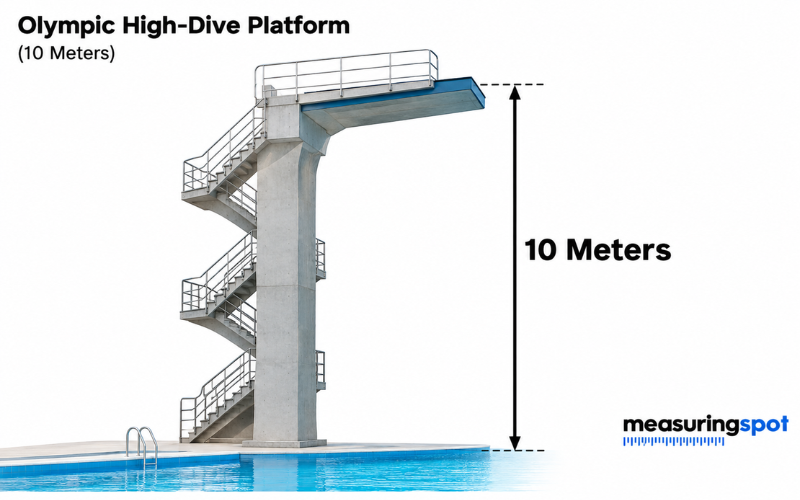
1. The Olympic High-Dive Platform
The 10-meter platform in competitive diving represents one of the most strictly regulated heights in international sports. Governed by World Aquatics, the concrete or composite tower stands precisely 10 meters above the water surface.
Looking down from this perch, you are staring at a three-story sheer drop. Divers hit the water at speeds approaching 55 to 60 km/h (around 34 to 37 mph) in less than 1.5 seconds. When you watch Olympic athletes execute twist routines before knifing into the pool, that vertical flight path gives you an exact physical measure of 10 meters.
2. A Standard City Transit Bus
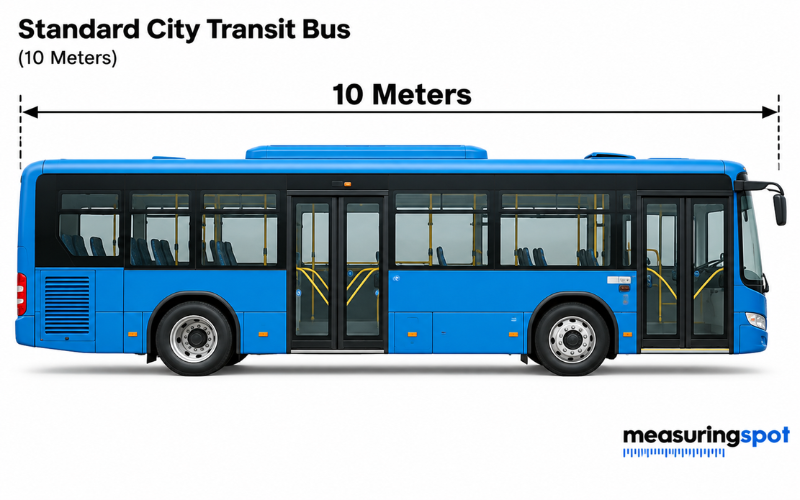
While modern articulated “bendy” buses run up to 18 meters, standard single-deck municipal buses in many European, Asian, and Latin American transit systems operate at 10 to 10.5 meters in total length.
In North America, standard transit coaches usually span 35 to 40 feet (roughly 10.6 to 12.2 meters), making the 30- foot to 35-foot short-wheelbase urban commuter bus practically identical to it. Standing beside one at a crosswalk gives you an immediate ground-level sense of this distance.
3. A Standard Residential Telephone or Utility Pole
Look out of your front window down a suburban street. Most neighborhood timber distribution poles carrying low-voltage electrical lines, cable connections, and telephone wires are ordered as Class 4 or Class 5 poles measuring 35 feet from end to end—roughly 10.6 meters total.
Crews bury about 5 feet to 6 feet of the pole underground for anchoring stability, leaving approximately 30 feet (9.1 meters) exposed above the turf. When laid flat on the grass prior to installation, one of these distribution poles stretches almost perfectly across 10 meters.

4. A Standard Tennis Court Baseline to Baseline Width (Doubles)
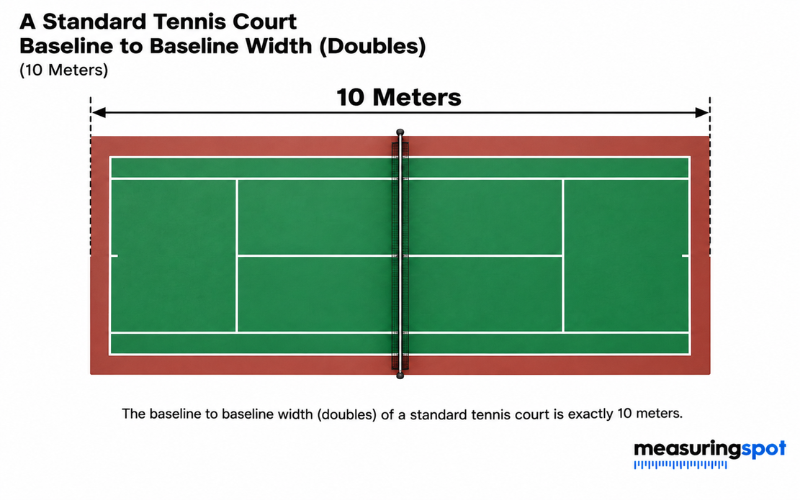
The playing boundary of an official International Tennis Federation doubles court measures 36 feet (10.97 meters) across its baseline. If you look at the width of the service boxes combined with the singles sidelines, or walk the service line across the court from one doubles sideline to the other, you are covering a span right around the 10-meter mark.
Next time you watch a tennis match, notice the player scrambling horizontally along the baseline to retrieve a wide shot; they are covering roughly 10 meters of real estate across the court.
5. Two Mid-Size Cars Parked Bumper to Bumper
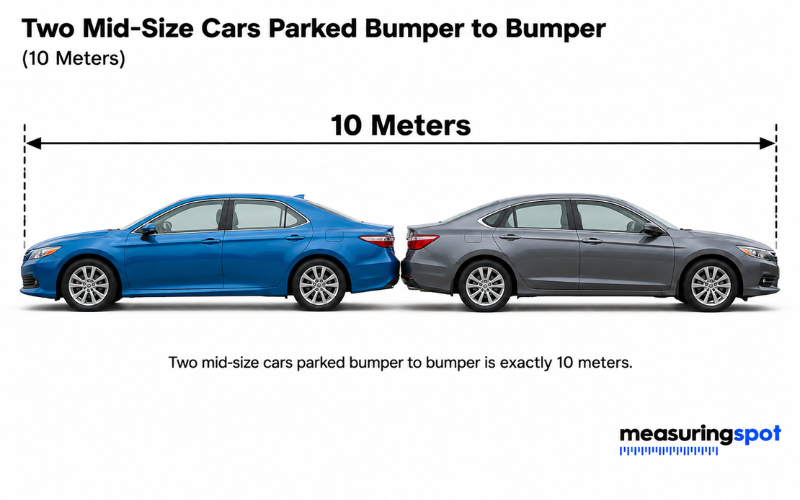
A reliable way to estimate distance in everyday life is using passenger automobiles. A family sedan like a Honda Accord, Toyota Camry, or Tesla Model 3 measures between 4.6 and 4.9 meters in length:
| Vehicle Model | Length in Meters | Length in Feet | Two Cars + Gap |
| Toyota Camry | 4.88 m | 16.0 ft | ~10.0 m (with 24 cm gap) |
| Honda Civic | 4.67 m | 15.3 ft | ~9.9 m (with 56 cm gap) |
| Tesla Model 3 | 4.69 m | 15.4 ft | ~10.0 m (with 62 cm gap) |
| Ford F-150 (Regular Cab) | 5.31 m | 17.4 ft | ~10.6 m (two trucks touching) |
Park two typical family sedans in a straight line with a tight gap between them, and the combined length from front bumper to rear bumper matches 10 meters almost to the millimeter.
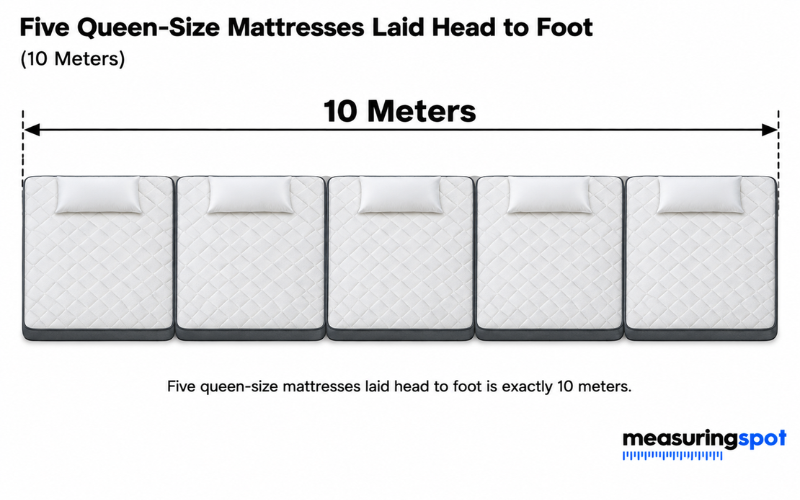
6. Five Queen-Size Mattresses Laid Head to Foot
A standard queen mattress measures 80 inches long (2.03 meters) by 60 inches wide (1.52 meters).
If you were to take five queen mattresses out of the bedroom and line them up head-to-toe along a hallway or patio:
$$\text{Total Length} = 5 \times 2.03\text{ m} = 10.15\text{ meters}$$
This hits within inches of the 10-meter mark. It provides an intuitive mental anchor for homeowners and interior decorators trying to plan long open-plan floor plates.
7. The Length of an Adult Female Sperm Whale Skull and Upper Body / Neonatal Blue Whale
Marine biology offers striking 10-meter benchmarks. A newborn blue whale calf (Balaenoptera musculus) measures roughly 7 meters to 8 meters at birth and hits 10 meters in overall length within its first six months of nursing on nutrient-rich milk.
Mature killer whales (orcas) can approach 8 to 9 meters in rare male specimens, while medium-sized baleen species like adult minke whales average 8 to 10 meters in total body length. Watching a 10-meter whale glide beside an expedition boat puts this measurement into perspective against the ocean surface.

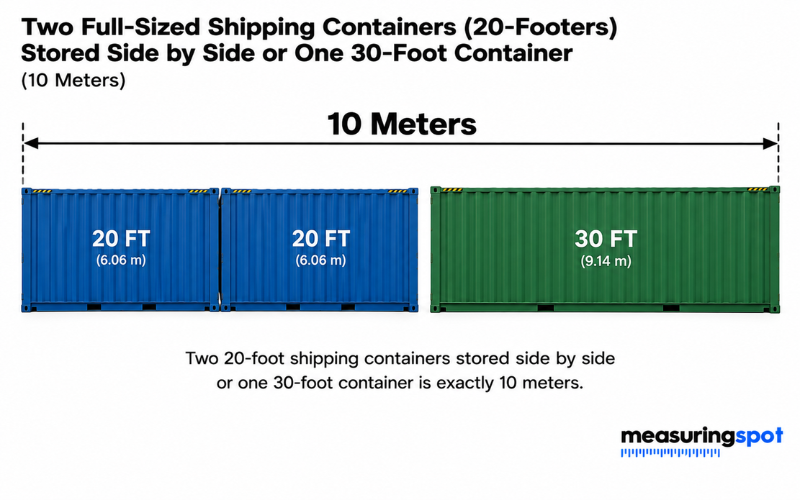
8. Two Full-Sized Shipping Containers (20-Footers) Stored Side by Side or One 30-Foot Container
Standard intermodal ISO shipping containers dominate global freight logistics. While the two main workhorses are the 20-foot (6.06 m) and 40-foot (12.19 m) containers, custom and specialized intermodal containers are frequently fabricated at 30-foot lengths (9.14 meters).
Alternatively, if you measure along the diagonal of a standard 20-foot steel container or measure two standard 16-foot storage pods placed in sequence, you sit squarely in the 9.8 to 10-meter bracket.
9. Three Stories of an Ordinary Residential Apartment
Architectural floor-to-floor heights in standard residential building construction typically measure between 3.0 meters and 3.3 meters (roughly 10 feet per level, factoring in floor trusses, subflooring, wall studs, drywall, and drop ceilings).
When you stand on the sidewalk and look up toward the ceiling line of the third floor (or the floor of the fourth level), you are looking up at a vertical span of 10 meters.

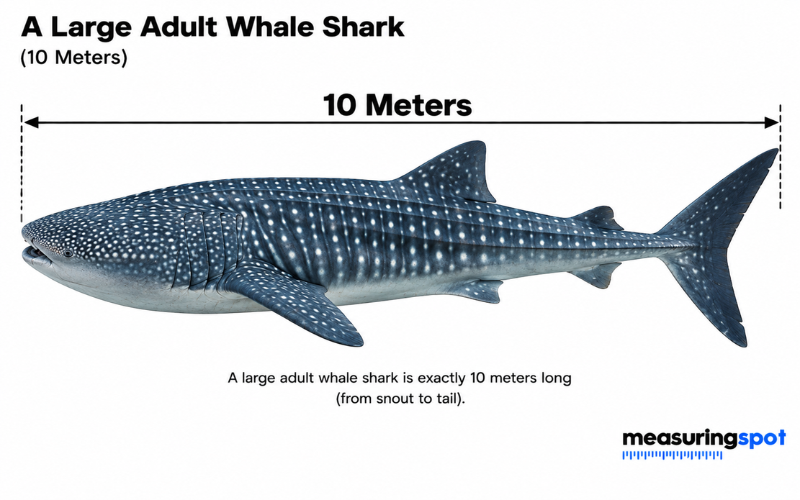
10. A Large Adult Whale Shark
The whale shark (Rhincodon typus) holds the title of the largest living non-mammalian vertebrate on Earth. While extreme specimens have been documented stretching past 14 meters, the average mature adult whale shark encountered in places like Ningaloo Reef, Australia, or Isla Mujeres, Mexico, measures between 9.5 and 10.5 meters from snout to caudal fin tip.
Swimming alongside an animal of this size feels like drifting past a motorized tour bus underwater.
Biowiki Reference Sheet: The 10-Meter Scale
| Attribute | Specification Details |
| Core Measurement | 10.00 Meters (m) |
| System of Units | International System of Units (SI Base unit: meter) |
| Imperial Equivalent | 32 Feet, 9.7 inches (32.8084 ft) |
| Yard Equivalent | 10.9361 Yards |
| Inches Equivalent | 393.701 Inches |
| Human Walking Time | ~7.5 seconds at an average walking pace of 1.34 m/s (3 mph) |
| Sound Travel Time | ~0.029 seconds in dry air at 20°C (speed of sound: 343 m/s) |
| Light Travel Time | ~33.36 nanoseconds in a vacuum |
| Common Architectural Scale | Typical residential plot frontage in medium-density urban zoning |
| Sports Field Relevance | Exact height of Olympic diving platform; width of tennis doubles court baseline (~10.97 m) |
Why Understanding 10 Meters Matters in Daily Life
Having a working grasp of 10 meters helps solve practical problems without pulling out specialized gear:
Property Lines and Garden Planning
Many suburban residential building lots feature street frontages between 10 and 12 meters wide. When you landscape, install boundary fences, or order rolls of turf, knowing what 10 meters feels like prevents severe over-ordering or costly material shortages.
DIY Cord and Hose Management
Standard garden hoses and heavy-duty extension cords are widely sold in 10-meter (33-foot), 15-meter (50-foot), and 30-meter (100-foot) spools. If you know that your back patio to the vegetable patch is about two car lengths, a single 10-meter hose will reach without daisy-chaining extra lines.
Safe Braking Distances
Driver education manuals highlight follow distances and braking cushions in meters. At 50 km/h (31 mph), a passenger car covers roughly 14 meters every single second during driver reaction time alone. Visualizing 10 meters on asphalt shows why tailgating at highway speeds leaves zero margin for error.
Frequently Asked Questions ❓
How many steps does it take to walk 10 meters?
For an average adult with a stride length of roughly 0.75 meters (2.5 feet), it takes between 13 and 14 steps to cover 10 meters. Taller individuals with longer gaits may cover the distance in 11 to 12 steps.
Is 10 meters equal to 30 feet?
No. 10 meters is actually 32.81 feet (nearly 33 feet). Confusing 10 meters with 30 feet introduces an error of nearly three full feet (almost an entire meter), which creates substantial issues in construction, engineering, and sports layout.
How high is a 10-meter building?
A 10-meter building typically corresponds to a three-story residential structure or a two-story commercial building with generous ceiling heights and retail parapets.
What is the easiest way to measure 10 meters without a tape measure?
Pacing is the most reliable zero-tool method. Measure your normal walking stride once at home. If your natural stride is 2.5 feet, take 13 consecutive strides in a straight line to hit roughly 10 meters. Alternatively, count two standard car lengths along the curb.
Related Posts
- 10 Everyday Things That Measure 8 Meters Long/ Tall
- 10 Everyday Things That Measure 7 Meters Long/ Tall
- 10 Everyday Things That Measure 6 Meters Long/ Tall
- 10 Common Things That Are 5 Meters Long/ Tall
Conclusion
Grasping How Long is 10 Meters becomes simple once you link the raw math of 32.8 feet to familiar objects in your daily surroundings. Whether you imagine two family cars parked end to end, the sheer height of an Olympic high-dive platform, a neighborhood utility pole, or about 14 normal walking paces, these real-world anchors make estimating distances quick and intuitive. Keeping these benchmarks in mind takes the guesswork out of DIY home projects, backyard landscaping, and road safety, giving you a reliable sense of spatial measurement whenever you leave your tape measure behind.
FOR MORE MEASUREMENTS VISIT: MEASURINGSPOT