
Understanding physical dimensions can be difficult when you are just looking at numbers on a screen or paper. When you need to visualize a specific length, the best method is to compare it toeveryday objects you already know.
If you are trying to figure out exactly how long 20 inches is, you are in the right place. Twenty inches is equal to 50.8 centimeters, or 1 foot and 8 inches. It is a highly common dimension in manufacturing, retail, and everyday life. By anchoring this measurement to familiar items found in your home, garage, or office, you can easily estimate distances and sizes without needing to search for a tape measure.
Quick Summary: 20 Inches at a Glance ⚡
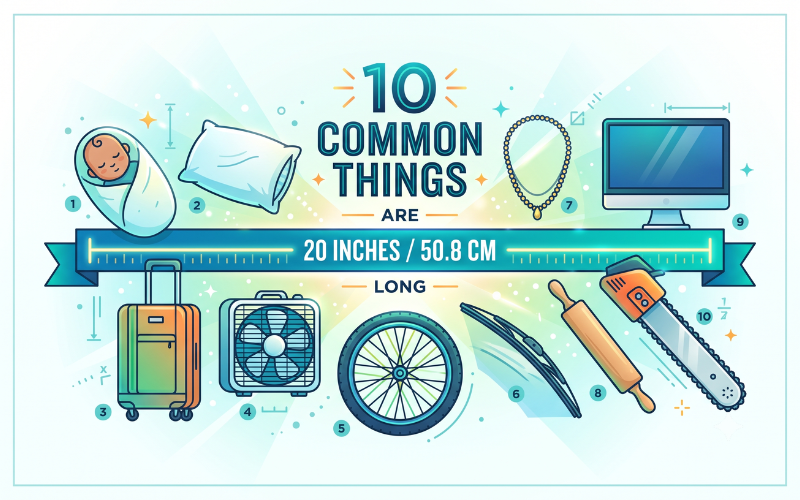
If you are in a rush and just need a fast reference, here are the most recognizable items that measure exactly or approximately 20 inches in length:
- Household Items: The short side of a standard bed pillow, a classic square box fan.
- Travel & Transport: An international carry-on suitcase, a BMX bicycle wheel.
- Human Body: The average length of a newborn baby.
- Tools & Auto: A heavy-duty chainsaw bar, a standard windshield wiper blade.
- Fashion & Accessories: A matinee-length necklace.
- Kitchen & Tech: A professional French rolling pin, a standard desktop computer monitor.
Why Visualizing 20 Inches Matters 📏
Spatial awareness is a practical skill. Whether you are buying furniture online, measuring a space for a new appliance, packing for a flight, or doing DIY home renovations, knowing how to estimate measurements saves time and money.
Twenty inches is a particularly useful length because it bridges the gap between small desktop items (like a pen or a notebook) and larger structural measurements (like a yard or a meter). It is slightly less than two feet. When you know what a 20-inch object looks like, you can easily double it to estimate 40 inches, or halve it to estimate 10 inches.
Below is a detailed list of ten everyday things that are 20 inches long.
10 Everyday Items That Measure Exactly 20 Inches
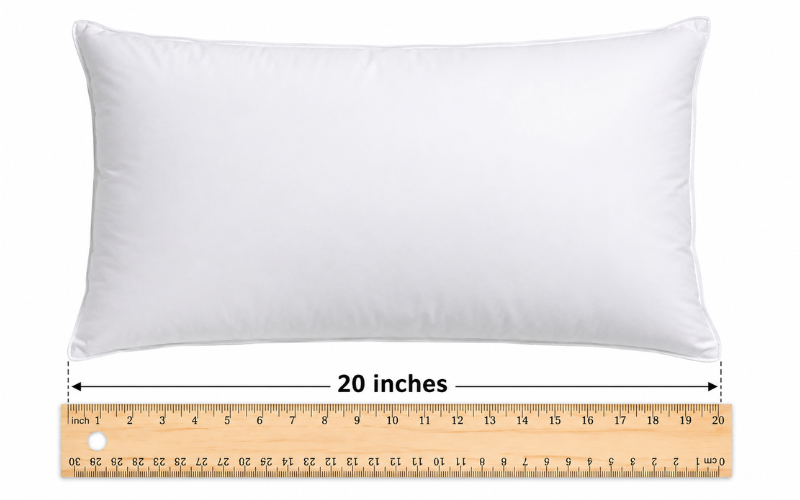
1. The Width of a Standard Bed Pillow 🛏️
One of the most universal objects you interact with every single day is your bed pillow. Regardless of whether you sleep on a Twin, Full, Queen, or King-sized mattress, the width (the short side) of a standard pillow remains incredibly consistent across the bedding industry.
In North America, standard pillows are cut to measure exactly 20 inches wide and 26 inches long.
Interestingly, even when you upgrade to larger pillows, the 20-inch width rarely changes. A Queen pillow measures 20 inches by 30 inches, and a King pillow measures 20 inches by 36 inches. Manufacturers keep the 20-inch width standard so that the pillow fits comfortably between the top of the mattress and the sleeper’s shoulders, providing optimal neck support without taking up too much vertical space on the bed. The next time you need to measure a 20-inch gap, just look at the short edge of your pillowcase.
2. An Average Newborn Baby 👶
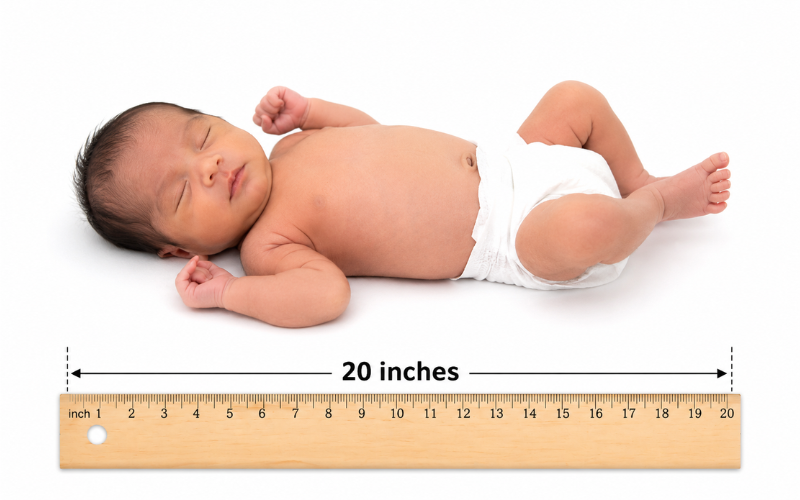
Human biology provides another excellent reference point for this measurement. According to the World Health Organization (WHO) and pediatric growth charts, the average length of a full-term newborn baby is right around 19.5 to 20 inches (roughly 50 centimeters).
When a baby is born, nurses measure their length from the top of their head to the heel of their extended foot. While premature babies will be shorter and some full-term babies can be longer, 20 inches is the widely accepted global average.
This is why baby clothes and bassinets are sized the way they are. The standard “newborn” clothing size is specifically tailored to fit a human measuring up to 20 inches. If you have ever held a newborn, the distance from your resting elbow to your fingertips is usually how the baby is cradled, which perfectly accommodates that 20-inch length.
3. A Standard Carry-On Suitcase Height 🧳
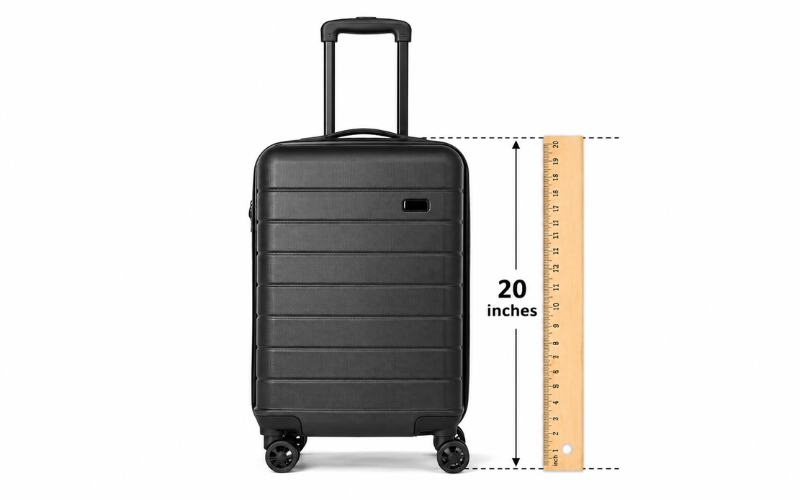
Frequent flyers are very familiar with the strict dimensions imposed by airlines. If you want to avoid expensive checked baggage fees, your luggage must fit within the overhead bin. For most domestic and international airlines, the sweet spot for a carry-on suitcase height is 20 inches.
Luggage manufacturers specifically design their most popular “weekender” and cabin bags to be 20 inches tall (often measuring 20 x 14 x 9 inches). This exact dimension ensures the bag can be stored vertically or horizontally in the overhead compartments of Boeing and Airbus aircraft.
When measuring luggage, the 20-inch length usually refers to the main body of the packing compartment. It is important to note that wheels and handles might add an extra inch or two, but the hard shell or fabric body of a cabin bag is fundamentally a 20-inch object.
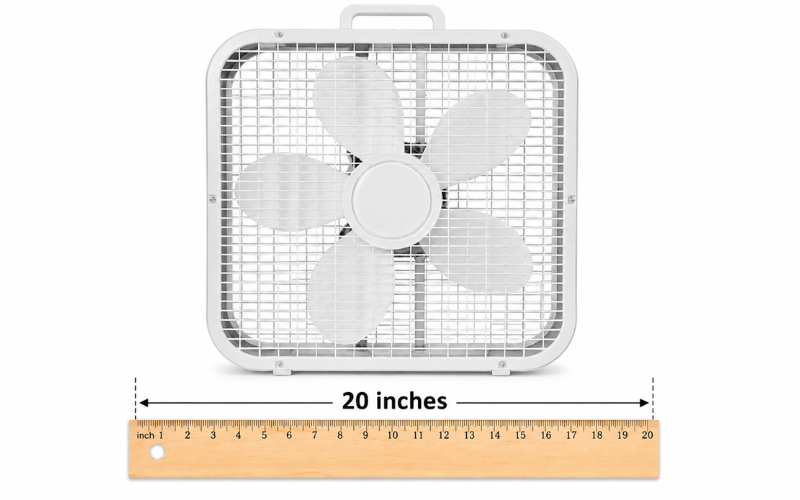
4. A 20-Inch Box Fan 🌬️
If you walk into any hardware store or home goods shop during the summer, you will see pallets of square box fans. The undisputed industry standard for these cooling appliances is the 20-inch box fan.
The measurement refers to the diameter of the fan blades inside the casing, but the metal or plastic square housing itself is typically just over 20 inches on all sides. This size did not become the standard by accident. Window frames in older homes and apartments were often built with widths that easily accommodate a 20-inch insert.
Placing a 20-inch box fan in a window to pull cool air in (or push hot air out) is a time-tested home cooling method. Because of this architectural consistency, manufacturers have stuck to the 20-inch dimension for decades. If you have one of these classic square fans sitting in a closet, you have a perfect two-dimensional 20×20 inch measuring tool.
5. A BMX Bicycle Wheel 🚲
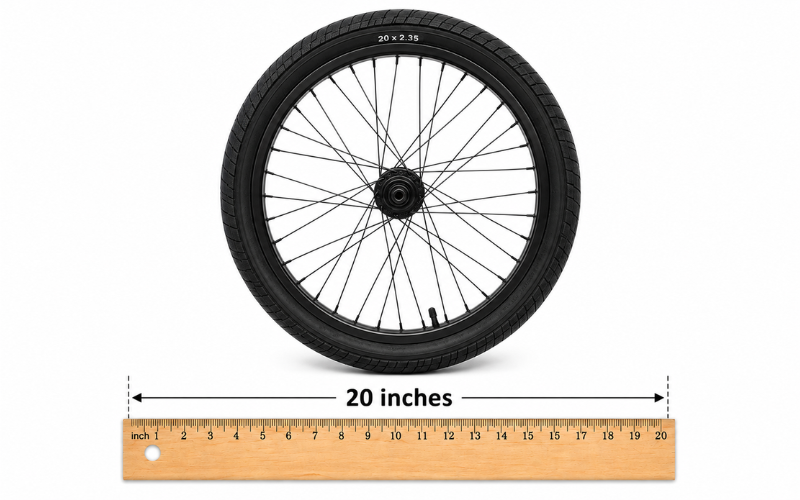
Bicycle wheels come in a wide variety of sizes, from the large 700c wheels found on road bikes to the chunky 29-inch wheels on modern mountain bikes. However, in the world of BMX (Bicycle Motocross) and youth cycling, the 20-inch wheel reigns supreme.
A standard BMX bike is built around wheels that have a 20-inch diameter. This specific size offers the perfect balance of lightweight maneuverability and structural strength. Smaller wheels are inherently stronger because the spokes are shorter, making them highly resistant to the heavy impacts of jumps, tricks, and hard landings at the skatepark.
If you see a teenager riding a BMX bike, or if you look at a standard bicycle designed for children between the ages of 7 and 10, you are looking directly at a 20-inch circle.
6. A Popular Windshield Wiper Size 🚘
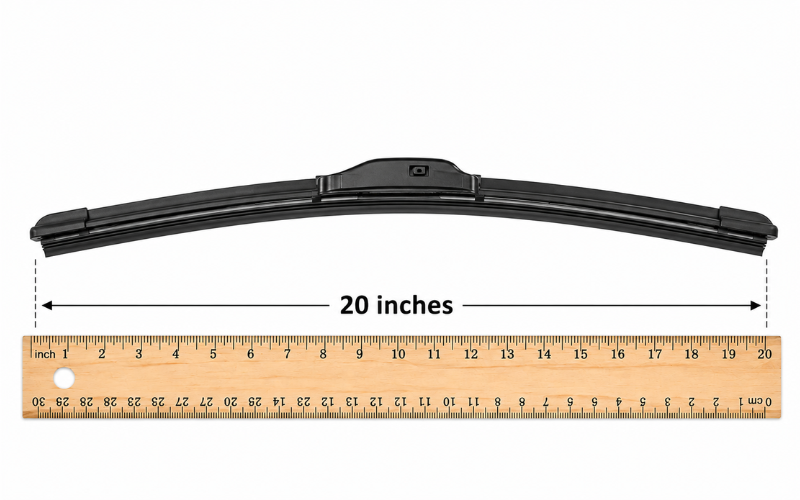
Automobile maintenance requires specific parts, and windshield wipers are among the most frequently replaced items. While wiper blades range anywhere from 12 inches on small rear windows to 28 inches on large trucks, 20 inches is one of the most frequently purchased sizes in the automotive industry.
Many mid-sized sedans, crossovers, and SUVs use a 20-inch wiper blade on either the driver’s side or the passenger’s side. The rubber blade and the tensioned metal frame are cut to exactly 20 inches to ensure a wide clearing arc across the glass without overlapping or hitting the windshield frame.
Next time you are walking through a parking lot, take a look at the wipers on a Honda Civic, a Toyota Camry, or a Ford Escape. Chances are high that at least one of the blades resting on the glass is exactly 20 inches long.
7. A Matinee Length Necklace Chain 💎
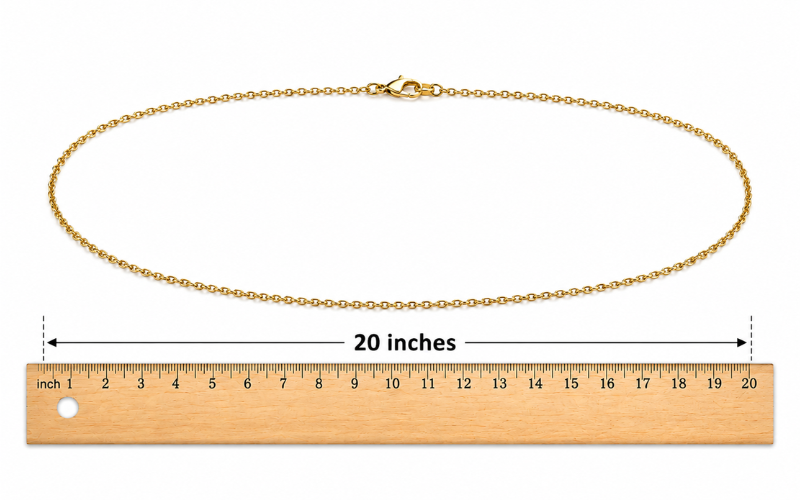
In the jewelry industry, necklace chains are categorized by specific standard lengths, each with its own traditional name. A chain that measures exactly 20 inches is known as a “Matinee” length.
A 20-inch necklace falls just below the collarbone and rests perfectly at the top of the bust. It is an incredibly popular length for both men’s and women’s jewelry. For women, it is the ideal length for wearing over a high-necked sweater or a plunging neckline. For men, a 20-inch chain is often the standard length for wearing pendants, dog tags, or religious medals, as it sits comfortably under a crewneck t-shirt.
Jewelers rely on this 20-inch standard because it accommodates the average adult neck circumference while leaving enough slack for the jewelry to drape naturally.
8. A Professional French Rolling Pin 🥖
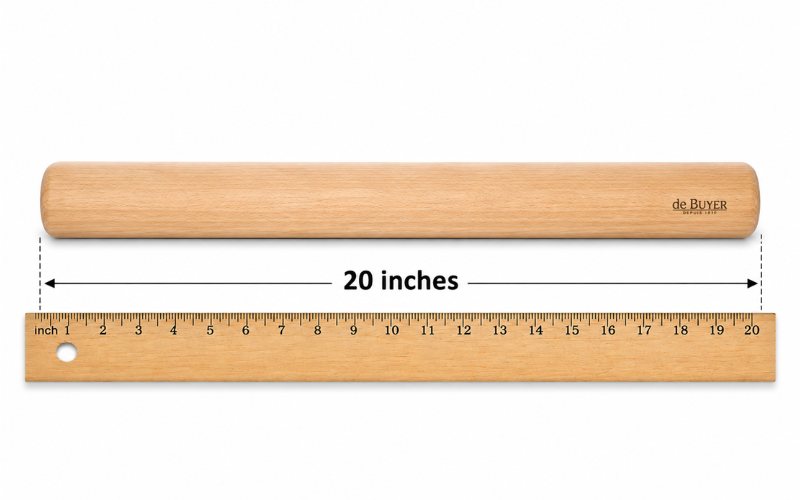
Baking requires precision, not just in ingredients, but in the tools used. A professional French rolling pin—the type favored by pastry chefs and serious home bakers—is typically exactly 20 inches long.
Unlike American-style rolling pins that have wooden handles attached to a central metal rod, a French rolling pin is a single, solid piece of wood that tapers gently at both ends. The 20-inch length is crucial for its function. When rolling out wide sheets of dough for croissants, pie crusts, or large pizzas, the baker needs a tool wide enough to cover the entire surface area without leaving ridges in the dough.
The 20-inch span allows a baker to rest their hands near the tapered ends while applying even pressure across the middle, making it an excellent culinary reference point for this measurement.
9. A 20-Inch Computer Monitor 🖥️
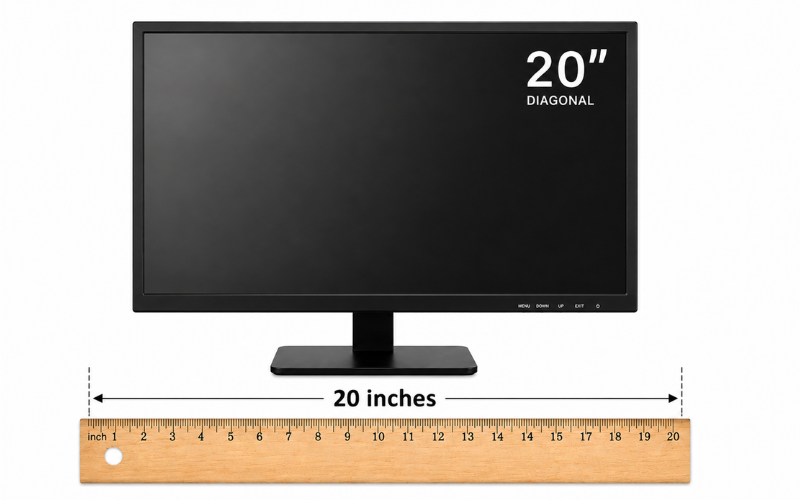
Screen sizes are always measured diagonally from one corner to the opposite corner. A 20-inch computer monitor was, for many years, the standard size for office desks and home computer setups.
While the modern trend leans toward larger 24-inch or 27-inch screens, 20-inch monitors are still widely used in dual-screen setups, point-of-sale systems, and compact home offices. If you take a tape measure and run it from the bottom left corner of the display glass to the top right corner (ignoring the plastic bezel), it will hit the 20-inch mark perfectly.
Because we spend so much time looking at screens, familiarizing yourself with the diagonal span of a 20-inch display gives you a highly accurate mental reference for that exact length.
10. A Heavy-Duty Chainsaw Bar 🪵
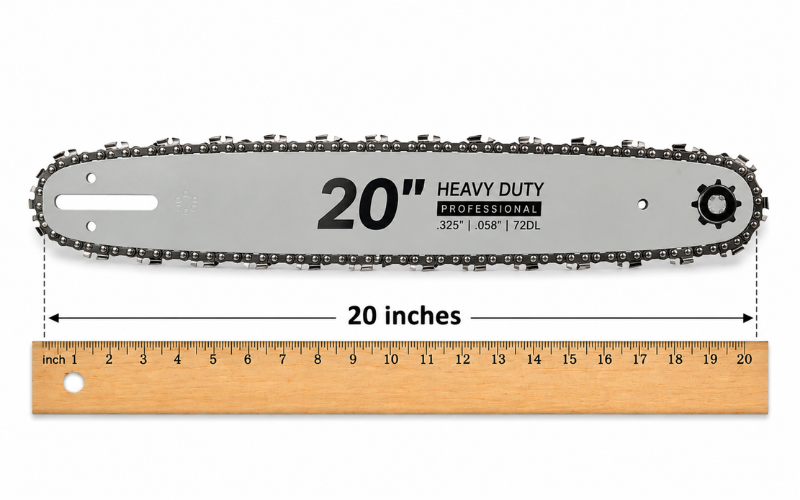
In forestry, landscaping, and heavy yard work, the size of a chainsaw is defined by the length of its guide bar—the metal blade that the cutting chain spins around. A 20-inch chainsaw bar is the standard size for farm, ranch, and professional tree-felling use.
A chainsaw with a 20-inch bar is powerful enough to handle large hardwood trees, thick branches, and firewood bucking. In theory, a 20-inch bar allows a lumberjack to cut down a tree with a diameter of up to 40 inches by making two passes from opposite sides.
This is a substantial, heavy piece of equipment. The metal bar itself, protruding from the motor casing, gives a very clear, rigid, and visual representation of what 20 inches looks like in a hardware setting.
Biowiki: 20-Inch Objects Data Table 📊
To help categorize these items, here is a quick reference table detailing the object, its category, and why its 20-inch dimension is significant.
| Object | Category | Dimension Note | Why it Matters |
| Bed Pillow | Home Goods | 20 inches wide | Standardized to fit twin through king beds. |
| Newborn Baby | Biology | 20 inches long | The global average length for a full-term birth. |
| Carry-On Luggage | Travel | 20 inches tall | Fits international overhead bin regulations. |
| Box Fan | Appliances | 20 x 20 inches | Designed to fit standard residential windows. |
| BMX Wheel | Sports & Outdoors | 20-inch diameter | Provides maximum strength for tricks. |
| Windshield Wiper | Automotive | 20 inches long | Clears maximum glass area safely. |
| Matinee Necklace | Fashion | 20 inches long | Sits perfectly below the collarbone. |
| French Rolling Pin | Kitchenwares | 20 inches long | Wide enough for large pastry doughs. |
| Computer Monitor | Electronics | 20 inches diagonal | Standard compact desktop display size. |
| Chainsaw Bar | Tools | 20 inches long | Standard for heavy-duty timber cutting. |
How to Measure 20 Inches Without a Ruler 📏
Sometimes you need to measure a 20-inch space, but you do not have a tape measure, ruler, or any of the objects listed above. In these situations, you can use basic everyday items to hack a measurement.
Use Standard Printer Paper
A standard piece of letter-size printer paper in the United States and Canada measures 8.5 inches by 11 inches.
- If you take two pieces of printer paper and lay them end-to-end lengthwise, you will get 22 inches. Just subtract two inches (about the length of your thumb), and you have an accurate 20-inch estimate.
- Alternatively, you can lay them side-by-side using the 8.5-inch width. Two sheets equal 17 inches. Add roughly half the width of a third sheet, and you are right at 20 inches.
Use Dollar Bills
United States currency is incredibly consistent. A standard US paper bill (whether it is a $1 or a $100 bill) is exactly 6.14 inches long.
- If you line up three dollar bills end-to-end, they will measure 18.42 inches.
- Add a quarter (which is roughly 1 inch in diameter) and a nickel, and you will hit exactly 20 inches.
Use Your Body
While human bodies vary wildly, you can learn your own measurements to use as a permanent ruler.
- For an average adult male, the distance from the tip of the middle finger to the point of the elbow (the cubit) is about 18 to 19 inches. Adding one or two inches to the end of your fingertips will give you 20 inches.
- The average adult shoe size (a men’s size 10) is roughly 10 inches long. Placing your two feet heel-to-toe on the ground will give you a very accurate 20-inch measurement.
Why 20 Inches is a Standard Manufacturing Size 🏭
You might wonder why so many disparate items—from pillows to fans to suitcases—converge on the 20-inch mark. The answer lies in manufacturing efficiency and human ergonomics.
In the imperial measurement system, 20 inches is highly divisible and easy to work with on factory floors. It represents exactly 1.66 feet. More importantly, human ergonomics play a massive role in product design. The average adult shoulder width is between 16 and 18 inches. Objects that are 20 inches wide or long (like a pillow or a suitcase) are large enough to be useful, but narrow enough that a human being can comfortably carry, hold, or sleep on them without the object feeling unwieldy.
Furthermore, 20 inches translates cleanly to metric conversions used globally. Twenty inches is precisely 50.8 centimeters. When international factories produce goods rounded to 50 centimeters, the American market receives items that are practically 20 inches, making it a universal sweet spot for global trade.
Frequently Asked Questions (FAQs) ❓
What is 20 inches in centimeters?
Twenty inches is equal to exactly 50.8 centimeters. To convert inches to centimeters manually, you multiply the inch value by 2.54.
Is 20 inches a common length for shipping boxes?
Yes. A 20x20x20 inch box is a highly standard size in the shipping and packaging industry. It is classified as a medium-to-large box and is frequently used for moving household goods, shipping small electronics, or packing clothing. It is large enough to hold significant volume but stays under the oversized package limits that trigger extra fees from carriers like UPS or FedEx.
How long is 20 inches compared to a human arm?
For an average adult, 20 inches is approximately the distance from the point of the elbow to the tips of the extended fingers, plus about one or two inches. This measurement, historically known as a “cubit,” has been used since ancient times for basic construction and tailoring.
What paper size is closest to 20 inches?
In the international A-series paper sizing standard, an A2 sheet of paper measures 16.5 inches by 23.4 inches. There is no standard paper size where one side is exactly 20 inches, but large format architectural prints and posters are frequently printed at 20 x 30 inches.
Can a 20-inch object fit in a standard backpack?
Typically, no. Most standard school and everyday commute backpacks are designed to hold 15-inch or 17-inch laptops and are roughly 18 inches tall. Attempting to put a rigid 20-inch object into a standard backpack will usually prevent the zipper from closing. You would need a specialized travel backpack or a hiking rucksack to fully enclose an object of this length.
Related Posts
- 12 Common Things That Are 19 Inches Long
- 12 Common Things That Are 18 Inches Long
- 10 Common Things That Are 17 Inches Long
- 12 Common Things That Are 16 Inches Long
Conclusion 🎯
Understanding the physical dimensions of the world around us makes everyday tasks significantly easier to navigate. By memorizing a few of these common 20-inch items—whether it is the width of your bed pillow, the height of a carry-on suitcase, or the span of a classic box fan—you equip yourself with a reliable mental measuring tape.
This practical spatial awareness allows you to confidently estimate room for new furniture, pack for a weekend flight, or tackle home improvement projects without always needing to track down a ruler. Ultimately, tying abstract numbers to familiar physical objects takes the guesswork out of sizing and helps you interact with your environment much more effectively. ✨
FOR MORE MEASUREMENTS VISIT: MEASURINGSPOT