
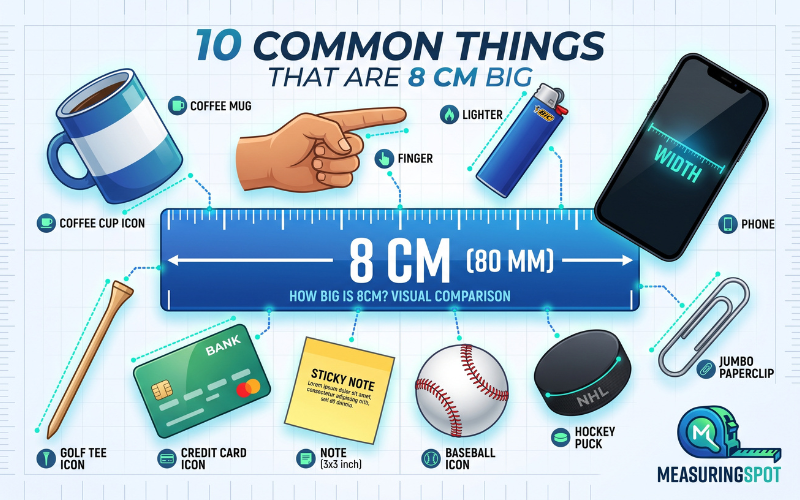
When trying to figure out the size of something online, raw numbers can be hard to visualize. If a product description says a tool, a toy, or a piece of jewelry is exactly 8 centimeters long, your brain might struggle to understand exactly what that looks like in the real world. That is exactly why comparing measurements to everyday objects is so helpful.
So, how big is 8cm? Let’s look at 10 incredibly common items you likely have sitting around your house or office right now that perfectly match this measurement.
How Big is 8cm at a Glance? 📏
If you need the exact conversions before we look at our list of items, here is the math. Eight centimeters is exactly 80 millimeters. If you are more accustomed to the imperial system, 8 cm is equal to 3.149 inches. For most daily estimates, you can comfortably round this to 3.15 inches, or just a tiny bit over 3 inches.
Here is a quick section summarizing the 10 items we will cover in detail below:
- Coffee Mug: The base diameter of a standard mug.
- Index Finger: The length of an average adult’s pointer finger.
- BIC Lighter: The length of a standard disposable lighter.
- Large Smartphone: The width of models like the iPhone Pro Max.
- Jumbo Paperclip: The length of extra-large office clips.
- Hockey Puck: The exact diameter mandated by the NHL.
- Baseball: The diameter of a standard professional baseball.
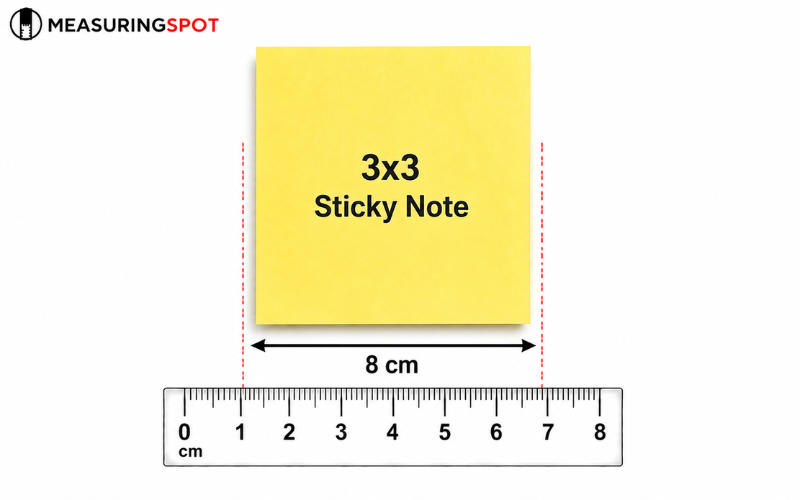
- Sticky Note: The width of a standard 3×3 square note.
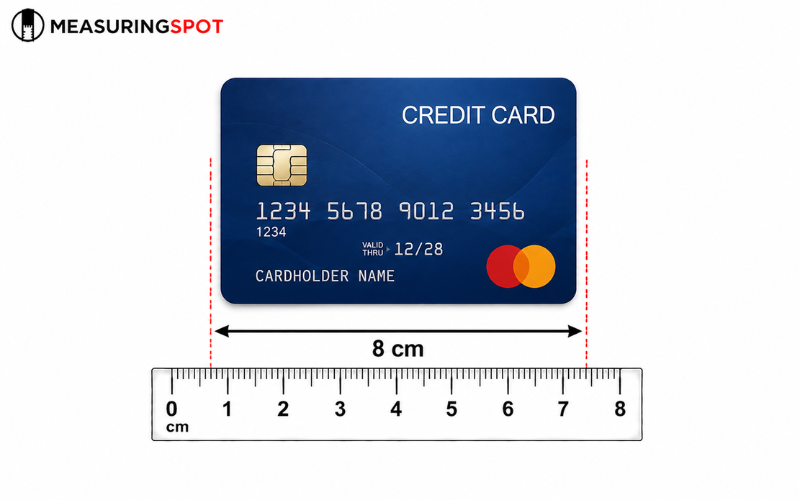
- Credit Card: The length of a standard bank card (8.5 cm).
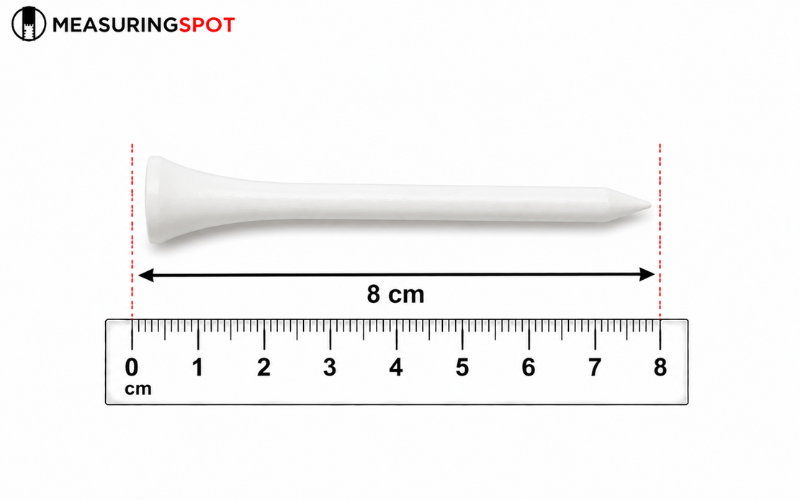
- Golf Tee: The length of a professional long tee (8.2 cm).
8cm Reference Table
Here is a quick reference table summarizing the exact dimensions of these common items and how they relate to our 8 cm target.
| Item | Dimension Measured | Exact Size (Metric) | Exact Size (Imperial) |
| Coffee Mug | Base Diameter | ~8.0 cm | ~3.15 inches |
| Index Finger | Base to Tip (Adult) | 7.5 – 8.0 cm | 2.9 – 3.15 inches |
| BIC Lighter | Total Length | 8.2 cm | 3.22 inches |
| Large Smartphone | Width | 7.7 – 8.0 cm | 3.0 – 3.15 inches |
| Jumbo Paperclip | Total Length | 8.0 cm | 3.15 inches |
| Hockey Puck | Diameter | 7.62 cm | 3.00 inches |
| Baseball | Diameter | 7.3 – 7.6 cm | 2.86 – 2.94 inches |
| Sticky Note | Width / Length | 7.62 cm | 3.00 inches |
| Credit Card | Long Edge Length | 8.56 cm | 3.37 inches |
| Golf Tee | Total Length | 8.25 cm | 3.25 inches |
1. The Diameter of a Standard Coffee Mug ☕
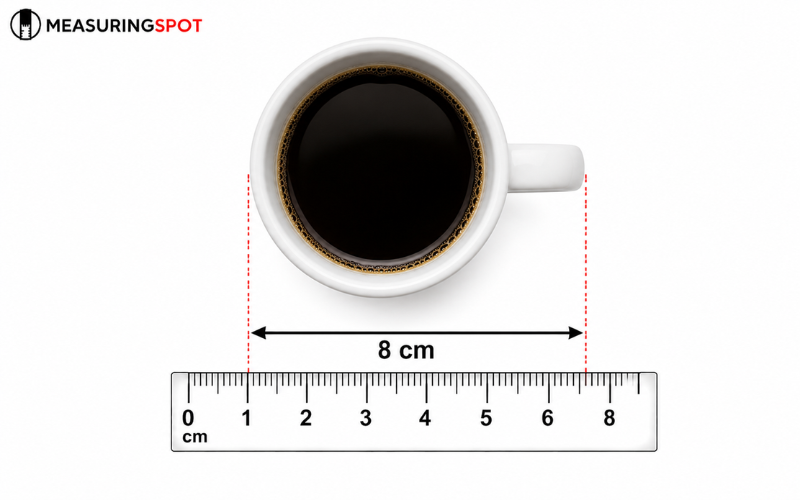
One of the absolute easiest ways to visualize 8 cm is to walk into your kitchen and grab a standard ceramic coffee mug.
Why Coffee Mugs Share This Size
While novelty mugs come in all shapes and massive sizes, the standard promotional or diner-style coffee mug holding 11 ounces of liquid has incredibly consistent dimensions. Manufacturers generally design these mugs to have a base and top diameter of roughly 8 centimeters. This specific size was not chosen by accident. It fits perfectly into standard cup holders, sits comfortably on small coasters, and, most importantly, allows the average human hand to wrap around the ceramic body without straining the fingers.
Visualizing 8cm with Your Morning Brew
If you are online shopping and need to know if a small potted plant, a decorative candle, or a desk toy will fit on your shelf, just think of the footprint of your favorite standard coffee mug. If the space can comfortably hold your mug, it can hold an item with an 8 cm base.
2. An Average Adult Human Index Finger ☝️
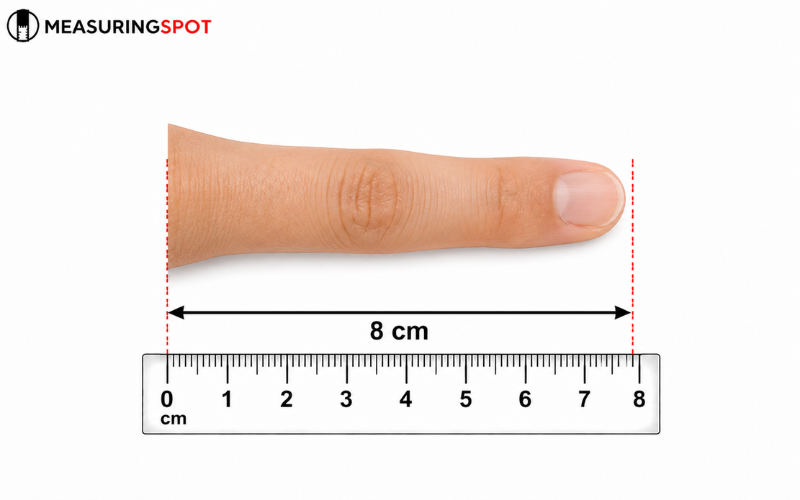
You don’t always need to look for an object to measure something; sometimes, you have a ruler attached right to your body. For the average adult, the index finger (also known as the pointer finger) is an excellent reference point.
Anatomical Variations
Human anatomy naturally varies from person to person based on height, genetics, and biological sex. However, multiple biometric studies show that the average adult male index finger is just over 7.5 to 8 centimeters long from the base crease to the tip. An average adult female index finger is slightly shorter but still falls very close to the 7.2 to 7.5 cm range.
A Built-In Ruler
Because your hand is always with you, using your index finger is highly practical when you are out shopping at a physical store. If you need to check if a pocket on a bag is at least 8 cm deep, you can simply slide your pointer finger inside. If your finger fits comfortably up to the main knuckle crease, you know you are looking at roughly 8 centimeters of depth.
3. A Standard BIC Lighter 🔥
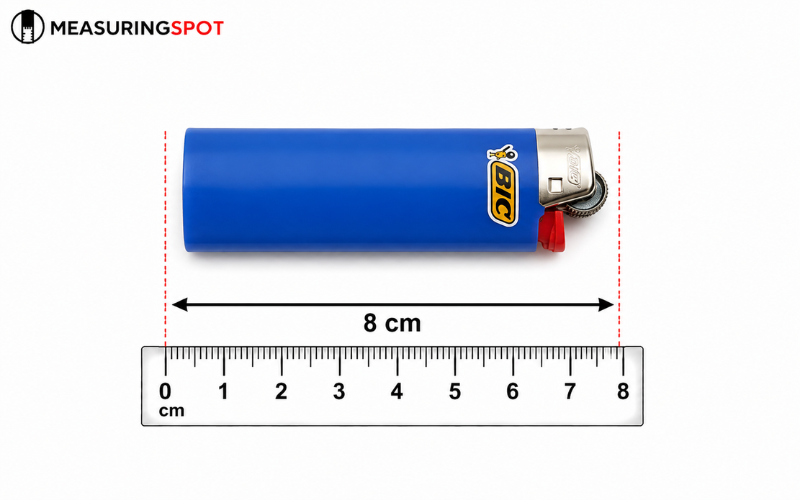
When it comes to mass-produced items with zero variation, the classic BIC Maxi lighter is a fantastic measuring tool.
The Design Process
The classic BIC lighter has maintained the exact same dimensions for decades. It is explicitly designed to fit comfortably in the palm of a hand and sit unobtrusively in a standard pants pocket. The total length of the lighter, from the flat plastic base to the top of the metal wind guard, is exactly 8.2 centimeters (3.22 inches).
Measuring with a Lighter
Because 8.2 cm is essentially identical to 8 cm for the sake of visual estimation, a lighter is an incredibly handy reference. Mechanics, trades workers, and crafters frequently use their pocket lighters to gauge the rough length of bolts, screws, or gaps when they don’t have a tape measure immediately on hand. If an object is slightly shorter than your standard lighter, it is right at the 8 cm mark.
4. The Width of a Large Smartphone 📱
Smartphones have grown significantly over the last decade. While older phones were incredibly narrow, the current generation of “Max” or “Pro” style phones provides another great real-world reference for 8 cm.
Screen Size vs. Grip Width
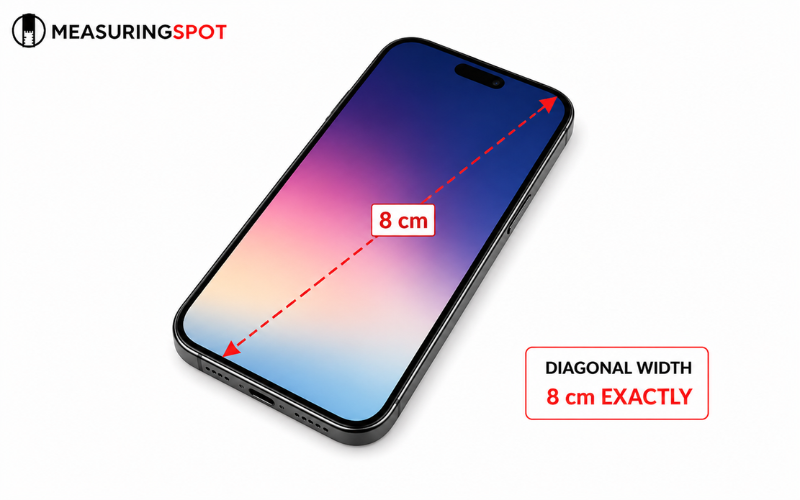
Take the iPhone 14 Pro Max or the iPhone 15 Pro Max as an example. The physical width of the device itself is 7.76 centimeters. Once you add a standard, slim silicone or leather protective case to the phone, the total physical width in your hand expands to exactly 8 centimeters.
Phone manufacturers spend millions of dollars in ergonomic research to determine exactly how wide a phone can be before it becomes completely unusable with one hand. They found that 7.8 to 8 cm is the absolute maximum width the average adult hand can grip securely without severe fatigue. So, the next time you hold a large modern smartphone in your hand, you are holding an object exactly 8 centimeters wide.
5. A Jumbo Paperclip 📎
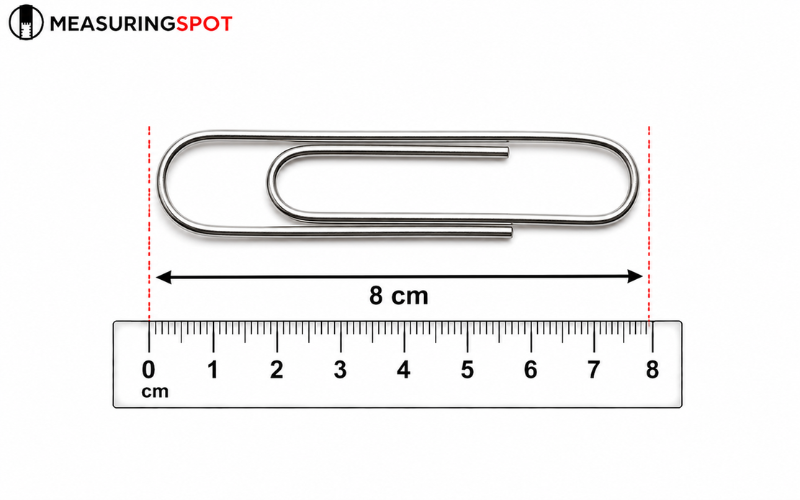
While a standard office paperclip is quite small (usually about 3 centimeters long), the “jumbo” or extra-large paperclips found in office supply closets offer a great visualization tool.
The Evolution of Paperclip Sizes
The standard Gem paperclip design has been around since the late 19th century. As businesses began dealing with thicker stacks of paper, legal documents, and cardstock, the jumbo clip was introduced. These oversized clips are manufactured to be exactly 3.15 inches long, which converts perfectly to 8 centimeters.
If you have a few of these large clips in your desk drawer, they are excellent for estimating size. Need to measure something that is 16 cm? Just lay two jumbo paperclips end-to-end on your desk.
6. A Standard Ice Hockey Puck 🏒
Sports equipment is heavily regulated, meaning the dimensions never change regardless of where you buy them or what brand manufactures them. An official ice hockey puck is a flawless example of this consistency.
The Strict Rules of the NHL
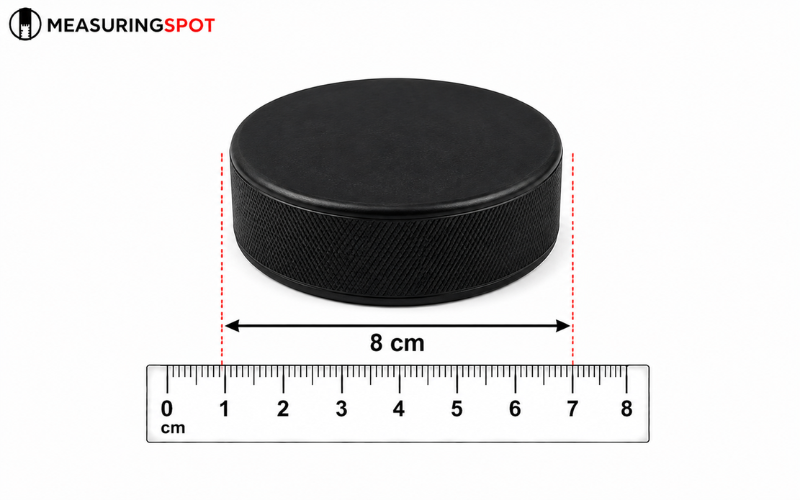
The National Hockey League (NHL) has incredibly strict rules regarding the equipment used on the ice to ensure fair play and predictable physics. Rule 13 of the NHL rulebook explicitly states that an official puck must measure exactly 3 inches in diameter. Converting 3 inches to metric gives us 7.62 centimeters.
While 7.62 cm is a few millimeters shy of a perfect 8 cm, visually, the difference is completely negligible. If you can remember the size of a heavy, vulcanized rubber hockey puck sliding across the ice, you have a near-perfect mental model for how big 8cm is.
7. A Baseball’s Diameter ⚾
Sticking with the theme of heavily regulated sports equipment, a standard baseball provides another excellent spherical reference for this measurement.
Precision in Sports Equipment
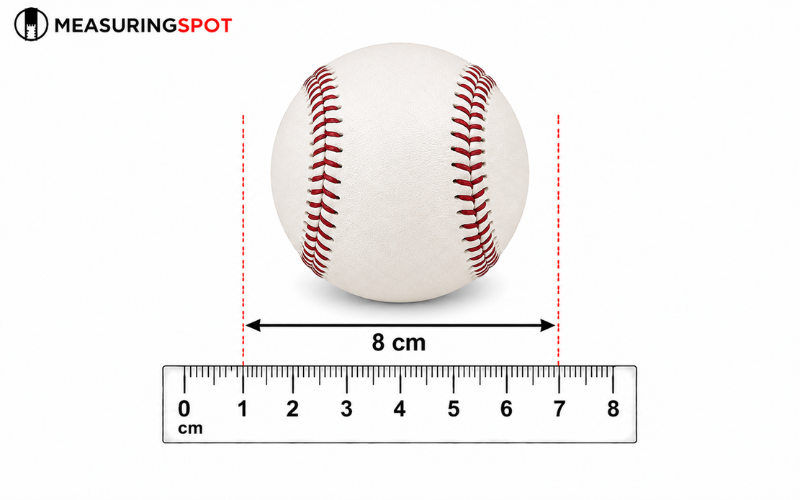
Major League Baseball (MLB) dictates that an official baseball must have a circumference between 9 and 9.25 inches. If we use basic geometry to calculate the diameter from that circumference, the diameter of a baseball falls perfectly between 7.3 and 7.6 centimeters.
Again, while this is slightly under 8 cm mathematically, holding a baseball in your hand gives you an immediate physical sense of the size. The distance straight across the center of the ball is just shy of 8 centimeters, making it an easy visual anchor for sports fans.
8. A 3×3 Sticky Note 📝
Walk into any office building in the world, and you will find pads of square sticky notes plastered over monitors, desks, and whiteboards.
The Metric vs. Imperial Standard
The most common size for a standard Post-it Note is a 3-inch by 3-inch square. Just like the hockey puck, 3 inches is equal to 7.62 centimeters. Because these notes are perfectly square, both the width and the length give you a highly accurate, very close approximation of an 8 cm measurement.
If you are trying to cut a piece of fabric, measure a space on a wall for a small picture frame, or gauge the size of a decal, holding up a standard square sticky note will show you almost exactly what an 8 cm by 8 cm footprint looks like.
9. A Standard Credit Card 💳
Your wallet is holding one of the best international measurement tools available to the public. Bank cards, credit cards, and driver’s licenses all share a universal, standardized size.
The Universal Wallet Standard
The size of financial cards is dictated by an international standard known as ISO/IEC 7810 ID-1. This standard mandates that every single credit card issued anywhere in the world must measure exactly 8.56 centimeters long and 5.398 centimeters wide.
The long edge of your credit card (8.56 cm) is just half a centimeter larger than 8 cm. This makes it an incredibly useful tool for estimation. If you are looking at a product listing that is 8 cm long, take out your debit card. The item you are looking at will be just a tiny fraction shorter than the length of that card.
10. A Standard Golf Tee ⛳
If you spend your weekends on the golf course, you have a perfect 8 cm reference sitting right in your golf bag.
Tee Length and Driver Size
Golf tees come in a variety of lengths depending on the club being used. However, the most popular tee used by amateur and professional golfers for hitting a modern driver is the “long tee,” which measures exactly 3.25 inches.
When you convert 3.25 inches to metric, you get 8.25 centimeters. When a golfer pushes that tee a quarter of a centimeter into the firm grass of the tee box, the portion of the wooden or plastic tee sticking out above the ground is exactly 8 centimeters long.
Frequently Asked Questions (FAQs)
How many inches is 8cm?
Eight centimeters is equal to approximately 3.149 inches. For general, non-scientific measurement purposes, it is completely acceptable to round this to 3.15 inches or simply view it as “a little over 3 inches.”
Is 8cm big or small?
This entirely depends on the context! For a smartphone bezel or a bezel on a TV, 8 cm would be massively thick. However, for the length of a pocket knife, a keychain, or a coffee cup base, 8 cm is quite small and compact.
How can I measure 8cm without a ruler?
The easiest way is to use the items listed in this article. Grab a standard bank card; the long edge is 8.5 cm, so 8cm is just slightly shorter than your card. Alternatively, use a standard 3×3 sticky note, which is 7.6 cm wide, falling just millimeters shy of 8 cm.
What is 8cm in millimeters?
To convert centimeters to millimeters, you simply multiply by 10. Therefore, 8 centimeters is exactly 80 millimeters.
Is a credit card exactly 8cm?
No, a credit card is slightly larger. Under international standards, a credit card is exactly 8.56 centimeters long. However, it is close enough that it serves as an excellent visual reference for 8 cm when a ruler is not available.
Related Posts
- 10 Common Things That Are 4 cm Big
- 10 Common Things That Are 3 cm Big
- 10 Common Things That Are Exactly 2 cm Long
- 10 Common Things That Are Exactly 1 Centimeter Long
Conclusion
Understanding how big is 8cm doesn’t require carrying a tape measure in your pocket at all times; it just requires a bit of environmental awareness. By connecting raw mathematical numbers to everyday items like your morning coffee mug, a jumbo paperclip, or the smartphone resting in your hand, sizing up products becomes incredibly easy. The next time you are shopping online and see an item listed at 80 millimeters or 8 centimeters, you won’t have to guess if it will fit on your desk—you will already know exactly what that size looks like in the real world.
FOR MORE MEASUREMENTS VISIT: MEASURINGSPOT