
Millimeters feel abstract until you hold one against an item in your pocket. Most people hear “9mm” and think immediately of handgun ammunition, yet this measurement pops up across nature, electronics, hardware, and home workshops every single day.
If you do not have a ruler with metric units handy, estimating nine millimeters feels tricky. It sits right in that middle zone between microscopic precision and everyday handheld dimensions.
Knowing how big nine millimeters looks gives you an instant shortcut for home improvement, shopping for jewelry, sorting fasteners, or checking craft materials without grabbing a tape measure.
Quick Answer: How Big is 9mm?
Nine millimeters equals 0.354 inches, or just a hair over one-third of an inch (about 11/32″). It equals 0.9 centimeters.
To gauge it instantly without tools:
- Stack 6 standard credit cards together. Their combined thickness equals roughly 9mm.
- Line up 6 US dimes flat against each other. Their total edge thickness matches 9mm.
- Check the diameter of an AAA battery. It measures just slightly larger at 10.5mm, making its cross-section a reliable visual benchmark.
Quick Reference: 9mm Dimensions and Conversions
Here is how 9 millimeters translates across common measurement systems.
| Unit System | Equivalent Measurement | Practical Comparison |
| Inches (Decimal) | 0.3543 in | Just over 11/32 of an inch |
| Inches (Fractional) | ~ 23/64 in | Slightly under 3/8 inch (0.375 in) |
| Centimeters | 0.9 cm | Just shy of 1 centimeter |
| Millimeters | 9.0 mm | Standard metric base |
| Points (Typography) | ~ 25.5 pt | Height of a large display headline |
| Microns (Micrometers) | 9,000 µm | Common scientific scale |
10 Common Everyday Things That Are 9mm Big
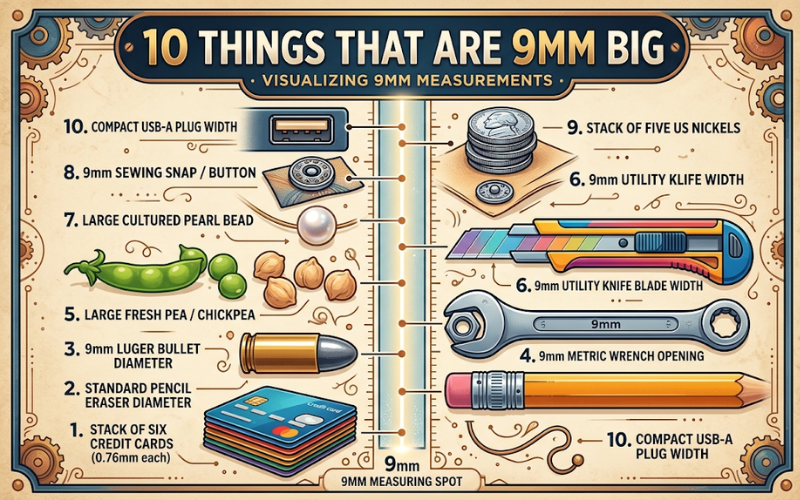
Finding real-world references makes sizing simple. Here are ten objects that measure approximately or exactly nine millimeters across thickness, diameter, length, or width.
1. A Stack of Five to Six Credit Cards
Pull out your wallet. Standard bank cards, driver licenses, and gift cards follow the international ISO/IEC 7810 ID-1 standard. This standard dictates a thickness of exactly 0.76 millimeters (0.03 inches).
When you stack six credit cards flat on top of each other, the stack reaches roughly 4.56 millimeters. Stack twelve, and you hit 9.12 millimeters. If you take five heavy-embossed cards or six modern flat debit cards placed firmly together, you get an immediate side profile that mirrors nine millimeters almost perfectly. Keep this trick handy when you need to check a gap in home framing or mechanical clearance.

2. A Standard Pencil Eraser Diameter
Look at the unused pink rubber eraser clamped into the metal ferrule at the top of a classic wooden pencil. While budget brands vary slightly, the standard diameter of that rubber plug across classic drafting and school pencils ranges between 7.5mm and 9mm.
Specifically, premium drawing pencils and hexagonal grip pencils feature an eraser casing with an outer diameter that sits directly at 9 millimeters. If you look straight down at the round circular stamp of a fresh eraser head, you are viewing a circle that spans nearly the exact diameter of nine millimeters.

3. A 9mm Luger Bullet Casing Diameter
The most famous nine-millimeter object in the world takes its name directly from its projectile caliber. The 9x19mm Parabellum, designed by Georg Luger in 1901, uses a bullet with an actual projectile diameter of 9.01 millimeters (0.355 inches).
The base of the brass casing measures 9.93 millimeters, while the casing mouth sits at roughly 9.65 millimeters. When you hold an unfired 9mm round, the circular lead or copper projectile seated in the tip shows you the precise diameter of 9mm in solid metal.

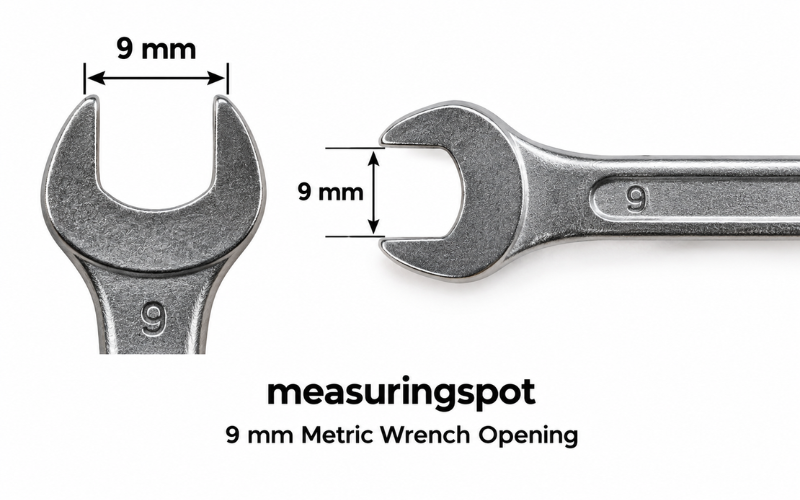
4. A Size 9 Metric Wrench Opening
Every standard mechanical toolset sold worldwide includes a 9mm combination wrench and a 9mm socket. The internal span between the two parallel steel jaws of an open-ended 9mm wrench measures exactly nine millimeters, with microscopic engineering tolerance to slip over a matching nut.
Hex head M5 and M6 specialty bolts frequently require a 9mm wrench head across their flats. If you want to know if a small bolt, screw head, or dowel pin is 9mm wide, try sliding it between the jaws of a 9mm open-ended spanner.
5. A Large Fresh Pea or Chickpea
Open a bag of frozen green garden peas or soak dried chickpeas in water. An average mature sweet pea measures between 8.5mm and 9.5mm across its widest curve.
Commercial sorting screens categorize medium-large grade peas by passing them through grates that capture specimens larger than 8.75mm. When you hold a plump, round garden pea between your thumb and forefinger, the distance between your fingertips spans practically nine millimeters.

6. The Width of a Slim Snap-Off Utility Knife Blade
Utility knives generally come in two primary standard widths: the heavy-duty 18mm box cutter blade and the compact, slimline 9mm detail craft blade.
Drafting artists, window tinters, and wallpaper installers rely on 9mm snap-off knives daily. The steel strip measures exactly nine millimeters from the flat dull spine to the razor-sharp cutting edge. The metal track on the plastic handle that guides the blade also features an interior opening sized directly to this 9mm spec.

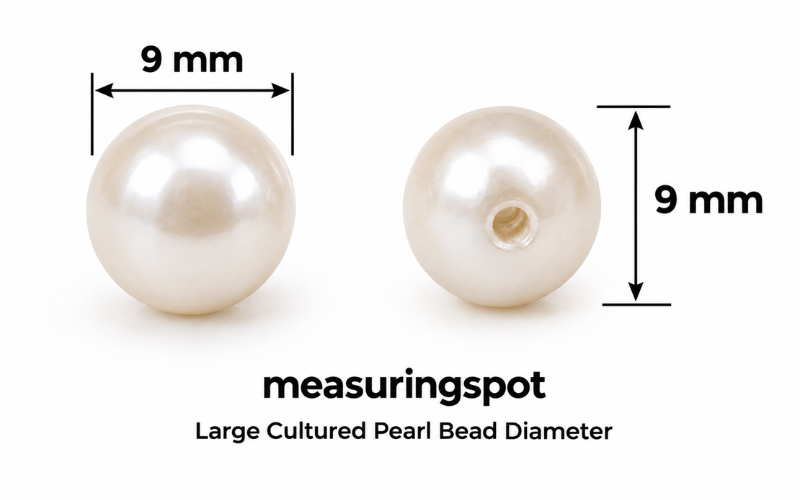
7. Large Cultured Pearl Beads
Jewelry makers classify freshwater and Akoya pearls millimeter by millimeter. While small accent pearls measure 4mm to 6mm, high-grade statement pearls measure between 8.5mm and 9.5mm.
A 9mm pearl necklace represents a luxury standard. The round orbs look bold and substantial against the collarbone without appearing overwhelmingly heavy. When you browse earrings or loose gemstones, a 9mm round gemstone holds substantial presence, carrying the same face-up diameter as roughly a 2.75 to 3.0 carat round brilliant-cut diamond.
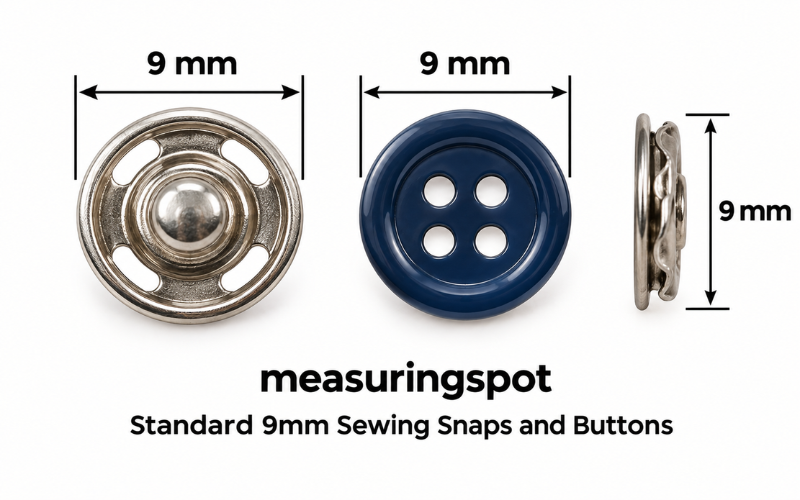
8. Standard 9mm Sewing Snaps and Buttons
Shirtmakers and tailors measure buttons using an old unit called “lignes,” but modern craft stores label fasteners in millimeters. The small metal snap buttons found on baby onesies, Western-style pearl snap shirts, and lightweight cardigans commonly measure 9mm in outer diameter.
These fasteners stay discreet and flat against fabric. When you snap your cuff or button up a light collared shirt, you are likely gripping a small metal disc engineered to a 9mm diameter.
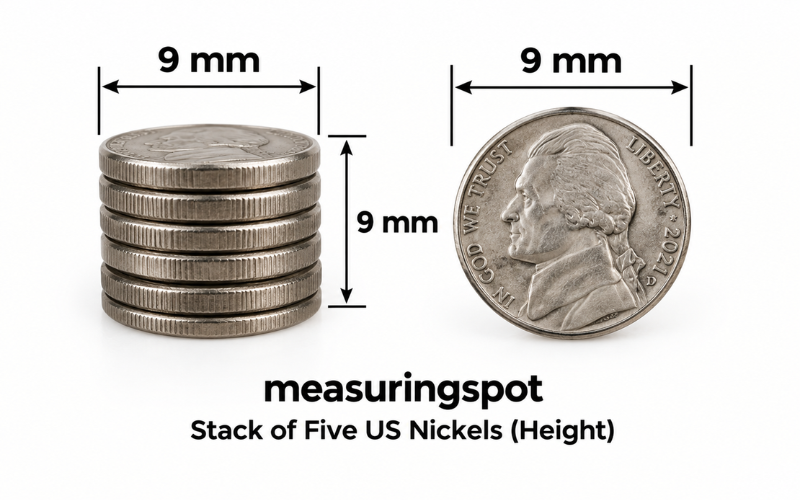
9. A Stack of Five US Nickels
Coins provide some of the best everyday measurement tools because government mints produce them with rigorous dimensional accuracy. A single United States nickel has a legal minted thickness of 1.95 millimeters.
Stack four nickels flat, and you reach 7.8 millimeters. Add a fifth nickel, and the stack reaches 9.75 millimeters. If you take four nickels and one worn dime (1.35mm thick), your stack measures 9.15 millimeters. Holding that small coin stack sideways gives you an unmistakable physical reference for 9mm height.
10. A Compact USB-A Connector Opening Height
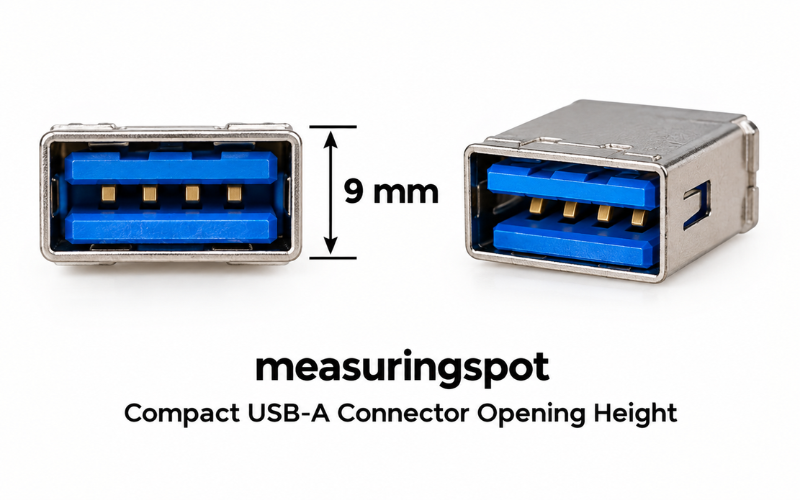
Take a standard rectangular USB Type-A plug, the classic connector on flash drives and desktop charging cables. While the outer metal shell measures roughly 12mm wide by 4.5mm thick, the interior clearance of many heavy-duty USB wall adapters and car charger ports sits around 9mm wide for internal component shielding.
Furthermore, the plastic grip housing on slimline USB flash drives measures right around 9 millimeters thick to allow easy side-by-side connection on laptop ports without blocking adjacent slots.
9mm in Practical Daily Life
Nine millimeters plays a functional role across manufacturing, personal care, and construction.
Personal Grooming and Hair Clippers
Anyone who cuts hair or trims a beard recognizes 9mm instantly. In hair clipper guard sizing, a Number 3 guard cuts hair to 3/8 of an inch, which equals 9.5 millimeters. European and international clippers often label this guard explicitly as 9mm. If you maintain a short, neat stubble or a buzz cut with a #3 attachment, you wear your hair at nine millimeters long.
Watch Straps and Jewelry Gauges
In body piercing, 9mm represents a 00 gauge (which spans from 9mm to 10mm depending on manufacturer rounding). For watchmakers, 9mm is a standard link width on tapered steel bracelets designed for women or vintage men’s dress watches.
Carpentry and Masonry Drill Bits
A 9mm drill bit serves as a standard metric tool size for tapping pilot holes, installing heavy wall anchors, and preparing wood dowel joints. Cabinetmakers frequently bore 9mm holes for specific European shelf support pins and specialized furniture cam locks.
How 9mm Compares to Similar Measurements
It helps to see where 9mm sits on the scale compared to surrounding metric and imperial benchmarks.
[ 5mm ] -> Diameter of a standard drinking straw
[ 7mm ] -> Standard diameter of a wooden pencil
[ 9mm ] -> 11/32″ / Width of a slim craft knife blade
[ 10mm ] -> Exactly 1 centimeter / Width of a fingernail
[ 12mm ] -> Just under 1/2 inch
Notice that nine millimeters sits right below one centimeter. An adult’s pinky fingernail typically measures about 10 millimeters across the widest part of the nail bed. If you look at your pinky nail and shave off just a paper-thin margin, you see nine millimeters.
Biowiki Reference Sheet: The 9mm Metric Standard
This quick technical profile outlines the standard properties, classifications, and historical context of the 9-millimeter measurement.
| Parameter | Technical Specification |
| Measurement Unit | Millimeter (mm) |
| System of Measurement | International System of Units (SI Metric) |
| Base Unit Relation | 1 mm = 0.001 meter ($10^{-3}$ m) |
| Imperial Equivalent | 0.3543307 inches |
| Fractional Approximation | ~ 11/32 inch (accurate within 0.01 inch) |
| Primary Industrial Sectors | Firearms & Ballistics, Tool Manufacturing, Fasteners, Jewelry, Electronics |
| Common Socket/Spanner Sizes | 9mm Metric (M5/M6 bolt applications) |
| Apparel Classification | No. 3 Hair Clipper Guard (9.5mm), 14-Ligne Button standard (~8.9mm) |
| Digital Manufacturing | Common extrusion width calibration step for 3D printers and CNC routers |
| Body Modification Scale | 00 Gauge (stretched earlobe jewelry spans 9.0mm – 10.0mm) |
Step-by-Step Guide: How to Measure 9mm Without a Ruler
When you need to verify a 9mm gap or component size and possess no measuring tape, use everyday household items to find it.
- Grab Three Pennies: A modern US penny measures 1.52 millimeters thick. Place six pennies flat in a clean column. The stack measures 9.12 millimeters tall.
- Use a Standard Sheet of Printer Paper: Standard 20lb copy paper measures 0.1 millimeters thick. A stack of 90 sheets gives you an exact 9mm thickness. You can quickly pinch roughly a small notebook section to find the width.
- Check a Wooden Pencil: Standard hexagonal pencils measure 7mm across the flats and roughly 8mm to 9mm across the widest opposing corners. Lay a pencil flat against your surface to quickly check clearance.
Frequently Asked Questions About 9mm
Is 9mm the same as 3/8 of an inch?
No, but it sits very close. Three-eighths of an inch (3/8″) converts to 0.375 inches, which equals 9.525 millimeters. Nine millimeters equals 0.354 inches (roughly 11/32″). The difference measures just over half a millimeter, which matters significantly in precision engineering and bolt sizing, though casual craft projects may treat them as similar.
How many centimeters are in 9mm?
Nine millimeters equals 0.9 centimeters. Because the metric system works on base ten, you simply divide the millimeter count by 10 to find the centimeter value.
Can a 9mm wrench turn a 3/8-inch bolt?
Generally, no. A 9mm wrench opening measures 9.0mm, while a 3/8-inch bolt head measures 9.53mm. A 9mm wrench will not fit over a true 3/8-inch nut. Conversely, an open-ended 3/8-inch wrench will slip loosely on a 9mm nut, potentially stripping the corners of the fastener under heavy torque.
How big is a 9mm pearl compared to a coin?
A 9mm round pearl has a diameter less than half the width of a US dime. A dime measures 17.91 millimeters in diameter. If you place two 9mm pearls side by side, their combined width matches the complete diameter of a single dime.
What size drill bit matches 9mm?
In imperial fractional drill bit sets, the closest size to 9mm is an 11/32-inch bit, which measures 8.73mm, or a 23/64-inch bit, which measures 9.13mm. If you must bore an exact 9mm hole for hardware or dowel pins, purchase a dedicated metric 9mm drill bit.
Nine millimeters represents a quiet sweet spot in our material world. It offers enough substance to hold heavy mechanical tension while staying small enough for precision handcrafts and sleek electronics.
Next time you need to estimate how big nine millimeters is, pull a few coins from your pocket, glance at your pencil eraser, or look at a slim utility blade. Those familiar shapes make modern metric measurements easy to read anywhere.
Related Posts
- 10 Common Things That Are 8 mm Big
- 10 Common Things That Are 7 mm Big
- 10 Common Things That Are 6 mm Big
- 10 Common Things That Are 5 mm Big
Conclusion
Gauging small metric dimensions does not require a specialized engineering toolkit. Once you anchor nine millimeters to familiar everyday items, like a stack of bank cards, a utility blade, or a fresh pencil eraser, you can easily judge scale and clearance on the spot.
Whether you are sizing jewelry, selecting hardware for a DIY project, or simply satisfying your curiosity, keeping these physical benchmarks in mind saves time. The next time you encounter a 9mm spec, reach into your pocket or glance at your desk to size it up with confidence.
FOR MORE MEASUREMENTS VISIT: MEASURINGSPOT