

If you hold your thumb and index finger slightly apart, trying to estimate a quarter of an inch, you are probably looking at roughly seven millimeters. Most people struggle to picture metric measurements without a ruler in hand. When you shop for jewelry, buy mechanical screws, or check a medical report, knowing exact dimensions prevents costly mistakes.
Seven millimeters sits in a unique middle ground. It is small enough to require precise manufacturing, yet large enough to identify easily on everyday household objects.
This guide breaks down exactly how big 7mm is by using real-world items you handle every day. From office supplies to breakfast ingredients, you will learn how to measure this dimension instantly without specialized equipment.
Quick Answer: How Big is 7mm?
Seven millimeters (7mm) equals exactly 0.2755 inches, which is just slightly larger than a quarter of an inch (1/4 inch or 0.25 inches). In terms of the metric system, 7mm equals 0.7 centimeters.
To check 7mm right now without a ruler, stack four standard US pennies or five modern dimes together. The total height of that small stack measures almost exactly 7 millimeters. You can also glance at the wooden barrel of an unsharpened standard pencil, which measures roughly 7mm to 8mm in diameter.
Quick Reference BioWiki: 7mm at a Glance
| Property | Measurement / Equivalent |
| Millimeters | 7 mm |
| Centimeters | 0.7 cm |
| Inches (Decimal) | 0.2756 in |
| Inches (Fractional) | ~9/32 inch (Just over 1/4 inch) |
| Meters | 0.007 m |
| Microns (Micrometers) | 7,000 µm |
| Coin Stack Equivalent | 4 US Pennies or 5 US Dimes |
| Common Caliber Equivalent | 7mm Remington Magnum / 7x57mm Mauser |
| Jewelry Standard | ~1.25 Carat Round Brilliant Diamond Diameter |
| Hardware Standard | Common automotive socket head (M4 / M5 bolt heads) |
10 Common Things That Are 7mm Big
When you want to know how big 7mm is in daily life, nothing beats hands-on comparisons. Here are ten common items you can find in your home, garage, or office that measure approximately seven millimeters across.
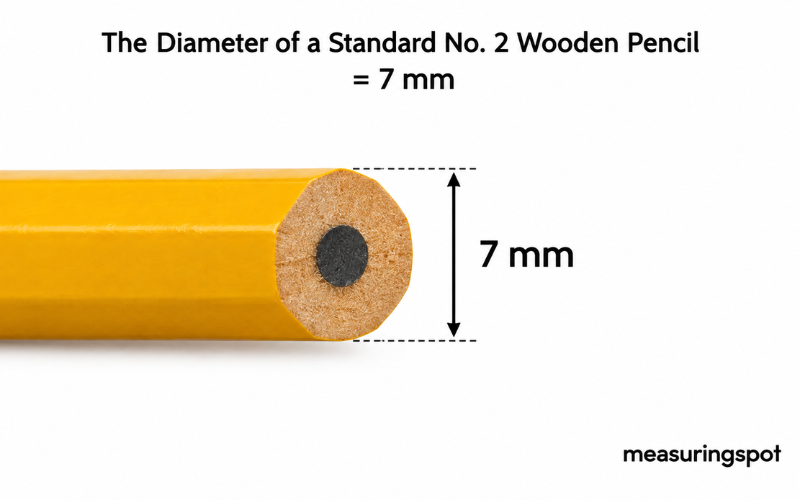
1. The Diameter of a Standard No. 2 Wooden Pencil
Take a close look at a classic yellow No. 2 hexagonal pencil. While people usually focus on the length of the writing tool or the sharpness of the graphite tip, the outer barrel provides a reliable physical reference.
A standard hexagonal or round wooden pencil measures between 7mm and 8mm in thickness. If you measure across the flat parallel sides of the hexagonal casing, the distance measures almost precisely 7mm. Manufacturers across the globe adhere to these dimensions so pencils fit standard manual sharpeners and classroom desk slots. If you need a fast visual gauge at your desk, the width of your pencil serves as an ideal baseline.
2. A Stack of Four US Pennies
Coins provide consistent thickness because government mints produce them with tight tolerances. The United States Mint strikes standard pennies at an official thickness of 1.52 millimeters.
When you place four pennies in a neat vertical pile on your desk, the math works out cleanly:
1.52mm4=6.08mm
Add the slight microscopic air gaps and surface relief from the stamped design, and the stack reaches right around 6.5mm to 7mm tall. If you use dimes, which measure 1.35mm thick, five stacked dimes hit roughly 6.75mm to 7mm. This gives you a fast pocket-change gauge wherever you go.

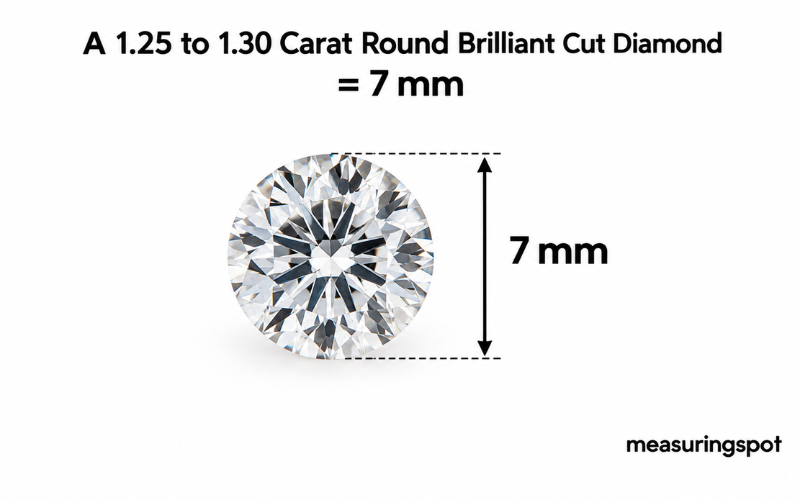
3. A 1.25 to 1.30 Carat Round Brilliant Cut Diamond
Jewelers use millimeters alongside carats because carat indicates weight rather than surface area. A poorly cut stone might look heavy on a scale but appear small from the top down.
A well-proportioned, ideal-cut round brilliant diamond weighing approximately 1.25 to 1.30 carats measures right around 6.9mm to 7.1mm across the girdle. When people shop for engagement rings or solitaire earrings, a 7mm diameter marks the point where a gemstone starts to command major finger presence. Pearls also share this sizing category, as 7mm freshwater pearls represent one of the most popular classic necklace sizes on the market.
4. A Single Large Dried Chickpea or Green Pea
Look inside your kitchen pantry to find natural biological references for 7mm. Dried chickpeas (garbanzo beans) sort into different commercial grades based on screen sizes during harvest.
The standard commercial size for medium-to-large dried chickpeas ranges from 7mm to 8mm in diameter. Fresh garden peas often settle into this exact bracket before cooking. While natural variations exist from pod to pod, sorting through a handful of raw, dried chickpeas will quickly yield several round seeds that hit the 7mm mark across their widest axis.

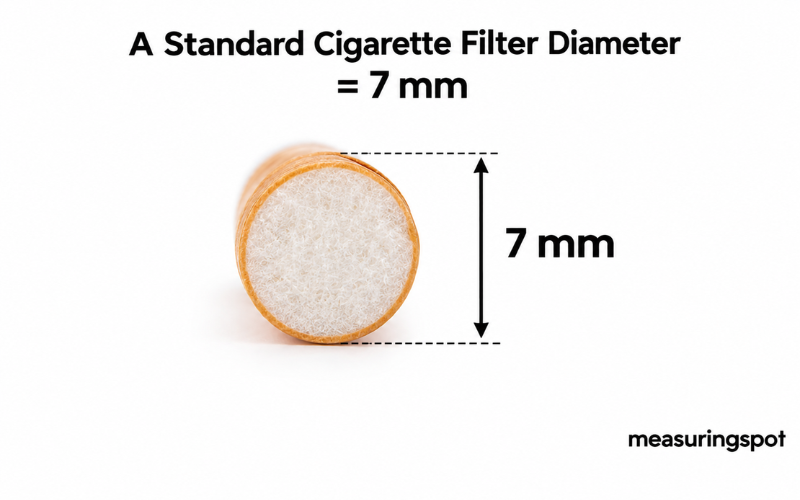
5. A Standard Cigarette Filter Diameter
Tobacco manufacturing relies on high-speed automation that demands millimeter precision. Standard king-size cigarettes measure roughly 7.8mm to 8mm in diameter, but “demi-slim” and classic roll-your-own slim filter tips are manufactured to exactly 7mm.
If you purchase standard pre-cut filter tips from a convenience store for roll-your-own tobacco, the regular size option is typically 7mm or 8mm wide. Holding one of these compact cellulose cylinders between your fingers shows you the exact volume and cross-section that 7mm occupies.
6. The Thickness of a Slim Smartphone or Tablet
Consumer electronics design underwent a race toward extreme thinness over the last decade. Many premier smartphones, such as various flagship iPhone and Android releases, settle around a chassis thickness of 7mm to 7.8mm.
For instance, the iPhone 6 measured just 6.9mm thick, while several modern tablets hover right at the 7.0mm threshold. When you run your fingers along the bare metal edge of a modern slim smartphone, you are feeling a cross-section of roughly seven millimeters. This flat edge gives a tactile demonstration of how compact 7mm feels in modern engineering.

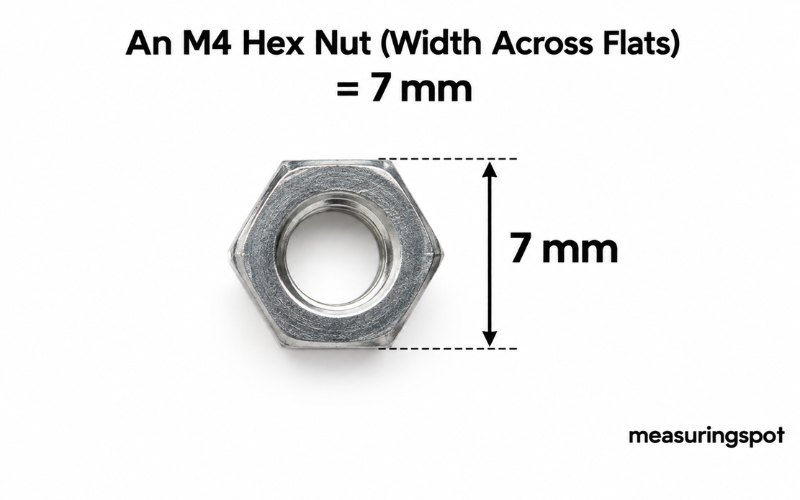
7. An M4 Hex Nut or Bolt Head Width
Mechanics and DIY hobbyists interact with seven-millimeter dimensions frequently. In metric hardware, wrench sizes correspond to the distance across the parallel flats of a bolt head or nut.
A standard metric M4 hex bolt head or matching hex nut often features an across-flats measurement of 7mm. When you open a standard socket set, you will find a 7mm socket head included in almost every automotive kit. Mechanics reach for this size when working on intake clamps, interior dashboard panels, and electrical mounting brackets.
8. A 2.5-Inch Laptop Solid State Drive (SSD)
Computer components adhere to universal form factors so cases and brackets remain interchangeable. Inside laptops, the traditional 2.5-inch hard drive originally measured 9.5mm thick.
As laptops grew thinner, manufacturers introduced the 7mm “z-height” standard for 2.5-inch SATA Solid State Drives. If you purchase an internal Crucial, Samsung, or Western Digital 2.5-inch SSD to upgrade an older machine, the metal enclosure measures exactly 7mm from top to bottom. It represents an industry benchmark for portable hardware density.

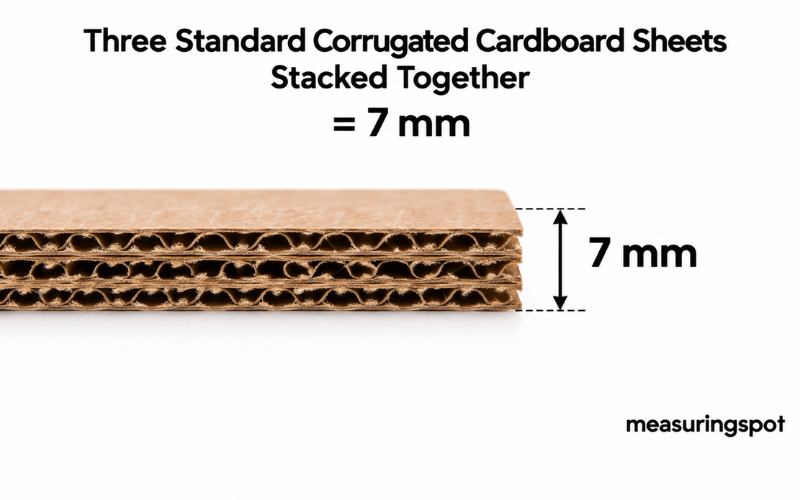
9. Three Standard Corrugated Cardboard Sheets Stacked Together
Packaging materials follow standardized fluting grades that determine how much cushion a shipping box provides. Single-wall corrugated cardboard using standard “B-Flute” measures roughly 2.2mm to 2.5mm thick, while “C-Flute” measures about 3.6mm thick.
If you cut three strips of standard B-Flute cardboard from an everyday shipping carton and press them together firmly, the resulting stack measures between 6.8mm and 7.2mm thick. This cardboard trick works well on job sites or packing stations when you need a quick spacer block without fetching a caliper.
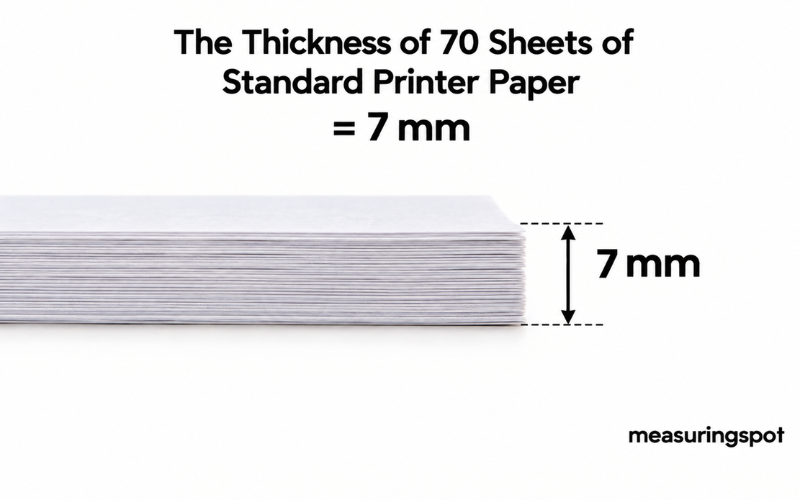
10. The Thickness of 70 Sheets of Standard Printer Paper
Standard office copy paper (20 lb bond or 75 to 80 GSM) features a consistent single-sheet thickness of roughly 0.10 millimeters (100 microns).
Stack seventy sheets of fresh, unused paper from a ream on a hard, flat desk surface. Without applying downward pressure to crush the sheet grain, the stack measures right at 7 millimeters tall. If you handle a standard 50-page notebook with slightly heavier stock and protective cardboard covers, the spine will also sit between 6.5mm and 7.5mm thick.
Metric Conversions: How 7mm Compares to Other Units
Converting metric numbers into fractional inches helps clarify exact distances for woodworking, metalworking, and general crafts.
| Unit System | Unit Name | Mathematical Calculation | Converted Value |
| Imperial | Inches (Decimal) | 725.4 | 0.27559 in |
| Imperial | Inches (Fraction) | Nearest 32nd | ~9/32 in |
| Imperial | Inches (Fraction) | Nearest 16th | ~1/4 in + 1/32 in |
| Metric | Centimeters | 710 | 0.7 cm |
| Metric | Micrometers / Microns | 71,000 | 7,000 µm |
| Metric | Meters | 71,000 | 0.007 m |
| Typography | Points (DTP) | 72.83465 | 19.84 pt |
| Typography | Picas | 74.233 | 1.65 pc |
The fraction 9/32 inch provides the closest traditional imperial equivalent. One quarter of an inch equals 8/32 inch (or 6.35mm). Therefore, 7mm measures just 0.65mm wider than a standard quarter inch. If you can picture a quarter inch on a carpenter’s tape measure, add the thickness of a fingernail to find 7mm.
Why 7mm Matters Across Different Industries
Dimensions around seven millimeters appear constantly in design, engineering, medicine, and recreation. Let us look at why this specific size plays such an active role across diverse fields.
Firearm Calibers and Ballistics
The term “7mm” holds major historical significance in ballistics. The 7x57mm Mauser cartridge, designed in the late 19th century, set a worldwide standard for military rifle accuracy and flat trajectories.
Hunters today prize modern cartridges like the 7mm Remington Magnum and 7mm-08 Remington. The 7mm projectile diameter (technically 7.2mm or .284 inches in groove diameter) offers an exceptional balance between aerodynamic efficiency, bullet weight, and recoil management. Long-range target shooters value bullets in this diameter because they resist wind drift over extreme distances.
Medical Science and Diagnostics
Doctors evaluate small tissue growths, kidney stones, and surgical margins using millimeter increments. A 7mm measurement represents a critical medical crossroads in multiple diagnostic procedures:
- Kidney Stones: Stones measuring 4mm or smaller pass through the urinary tract without surgical intervention in most patients. Once a kidney stone hits 7mm in diameter, the probability of spontaneous passage drops below twenty percent. Urologists typically schedule shockwave lithotripsy or ureteroscopy for 7mm stones.
- Skin Lesions and Melanoma: Dermatologists rely on the “ABCDE” criteria to assess mole safety. The “D” stands for diameter. Any mole that grows larger than 6mm (roughly the size of a standard pencil eraser) warrants clinical evaluation to rule out malignant melanoma. A 7mm irregular mole demands prompt dermatological scrutiny.
- Gallbladder and Thyroid Polyps: Radiologists monitor small polyps found during ultrasound scans. A 7mm polyp frequently requires annual or semi-annual surveillance imaging to verify stability and track growth rates.
Mechanical Engineering and Auto Repair
Automotive engineers design components with metric fasteners to balance tensile strength with packaging space. The 7mm hex profile appears frequently on hose clamps that secure radiator pipes, turbocharger silicone boots, and air intake tubes.
Bicycle mechanics also encounter 7mm wrenches when adjusting brake bleed nipples on hydraulic systems. In precision robotics, 7mm linear shafts and bearings handle moderate radial loads without adding unnecessary bulk to articulating joints.
Fashion, Piercings, and Body Modification
Body jewelry gauges decrease in gauge number as thickness increases, but larger body piercings transition directly to millimeter measurements.
A 7mm piercing corresponds to a 1-gauge (1G) size. Standard earlobe piercings start at 20G or 18G (less than 1mm thick). People who stretch their earlobes through the gauges often encounter 7mm as an essential intermediate “half-step” between 2G (6mm) and 0G (8mm). Attempting to jump directly from 6mm to 8mm tears delicate ear tissue; using a smooth 7mm glass plug prevents blowouts and ensures healthy stretching.
How to Measure 7mm Without a Ruler
If you find yourself on a job site, at a retail store, or in a workshop without a measuring tape, you can verify seven millimeters using these reliable practical techniques.
Technique 1: The Finger Crease Method
Look at your pinky finger. For many adults, the distance from the side of the pinky nail to the opposite skin edge measures between 8mm and 10mm.
However, look at the narrow skin creases on the palmar side of your fingers. The small distal interphalangeal crease on your pinky finger—the skin fold right below your final knuckle—often spans right around 7mm across its middle section on smaller hands. Measure your own finger creases once at home with a ruler so you possess a built-in caliper for life.
Technique 2: The Coin Alignment Trick
If you carry pocket change, you carry an accurate measuring tool. A United States quarter measures 24.26mm in diameter, a nickel measures 21.21mm, and a penny measures 19.05mm.
To find 7mm:
- Lay two US pennies flat on a table side-by-side.
- The thickness of one penny is roughly 1.5mm.
- Stack four pennies flat. The height of that stack equals roughly 6.5mm to 7mm.
If you are outside the United States, note that a Euro 1-cent coin measures 1.67mm thick. Four Euro 1-cent coins stacked together hit 6.68mm, providing an almost identical field estimate.
Technique 3: Folded Office Paper
Standard 20-pound printer paper provides an accurate micro-gauge:
- One sheet equals roughly 0.1mm.
- Fold the sheet in half once (2 layers = 0.2mm).
- Fold it in half again (4 layers = 0.4mm).
- Fold it five times total to produce 32 layers of paper (roughly 3.2mm thick).
- Place two identically folded 32-layer paper bundles together.
The resulting 64 layers of tightly pressed paper measure almost exactly 6.5mm to 7mm thick. This trick helps woodworkers check joinery gaps when calipers sit back in the tool shed.
Practical Everyday Comparison Scenarios
To help you remember how big 7mm is, review how this dimension interacts with everyday tasks.
Buying Drill Bits
When you look through a drill bit index, 7mm sits between common imperial fractions. A 1/4-inch drill bit measures 6.35mm. A 5/16-inch drill bit measures 7.94mm.
If an assembly manual instructions page tells you to drill a 7mm pilot hole, an imperial 1/4-inch bit will produce a hole that is too tight, while a 5/16-inch bit will ream out too much material. You need a dedicated 7mm bit or a 9/32-inch bit (7.14mm) to achieve the proper friction fit.
Selecting Jewelry and Gemstones
When ordering gemstone stud earrings online, photographs can mislead the eye. A retailer might zoom in on a small diamond, making it look massive on a white screen.
Knowing that 7mm equals the width of a wooden pencil gives you an instant reality check. A 7mm earring sits comfortably within the boundary of an adult earlobe without drooping or stretching the piercing tract downward, providing a balanced, classic profile.
Knitting and Crochet Needle Sizing
Knitters regularly work with 7mm needles, known as US Size 10.5 or 10 1/2. This needle diameter works best with bulky, chunky yarns.
If you hold a pair of 7mm wooden or aluminum knitting needles, the thick rod demonstrates how structural 7mm feels. It yields open, airy stitches on standard worsted yarn or dense, warm fabric on chunky wool.
Frequently Asked Questions About 7mm
Is 7mm close to 1/4 of an inch?
Yes. Seven millimeters is very close to one-quarter of an inch. Specifically, 1/4 inch equals 6.35mm. That means 7mm is only 0.65mm larger than a quarter inch, which matches the thickness of several sheets of paper.
How many millimeters make up an inch?
Exactly 25.4 millimeters make up one inch. To convert any millimeter measurement into decimal inches, divide the millimeter value by 25.4.
What size socket removes a 7mm bolt?
You need a metric 7mm socket or 7mm open-end wrench. If you only own imperial tools, a 9/32-inch wrench fits a 7mm fastener closely (9/32 inch equals 7.14mm), though it may slip if you apply high torque.
How big is a 7mm kidney stone?
A 7mm kidney stone is roughly the size of a large dried pea or the tip of a wooden pencil. In urology, medical providers consider 7mm a large stone because the average human ureter measures only 3mm to 4mm in diameter. Stones this size typically require medical procedures to break apart or extract.
What gauge is 7mm in body jewelry?
In body piercing standards, 7mm corresponds to a 1-gauge (1G) size. It serves as a half-size step between 2-gauge (6mm) and 0-gauge (8mm) jewelry.
What coin is closest to 7mm?
No common circulating coin measures 7mm in total diameter, as most coins span between 15mm and 30mm across. However, a stack of four US pennies or five US dimes measures approximately 7mm tall.
Seven millimeters is an accessible, practical measurement once you connect the number to physical items in your surroundings. Whether you measure the flats of an M4 bolt, glance at the barrel of your desk pencil, or stack a few coins from your pocket, you can picture this metric dimension with confidence.
Next time you encounter a 7mm specification on a project blueprint, a hardware purchase order, or a medical report, skip the search for a ruler. Use these ten common reference objects to gauge the size instantly.
Related Posts
- 10 Common Things That Are 4 mm Big
- 10 Common Things That Are 3 mm Big
- 10 Common Things That Are 2 mm Big
- 10 Common Things That Are 1 mm Big
Conclusion
Seven millimeters is an accessible, practical measurement once you link the number to items you see every day. Whether you check the flats of an M4 bolt, grab a standard wooden pencil from your desk, or stack four pennies on a table, you now possess reliable benchmarks to picture this distance instantly.
Using real-world objects removes the guesswork when you do not have a ruler or digital caliper within reach. Keep these quick comparisons in mind whenever you shop for jewelry, tackle a home repair, or read technical specifications.
FOR MORE MEASUREMENTS VISIT: MEASURINGSPOT