
Most people struggle to measure small metric units without a ruler handy. When you order jewelry online, pick a drill bit for a home repair, or check the thickness of laminate flooring, millimetric sizes often feel abstract. You might ask yourself: exactly How Big is 8mm in real life?
An 8mm measurement sits in a sweet spot between tiny mechanical components and medium-sized household fasteners. It equals roughly five-sixteenths of an inch (0.315 inches) or just under a centimeter. Because many everyday household items share this exact dimension, you do not need special tools to gauge it accurately.
Recognizing these dimensions through familiar objects saves you time and prevents costly buying mistakes. Below, you will find practical references, quick conversions, and ten common items you probably interact with every week that measure roughly 8 millimeters.
Quick Answer: How Big is 8mm?
An 8mm length equals:
- 0.315 inches (just under 5/16 of an inch).
- 0.8 centimeters.
- The thickness of roughly 8 stacked standard credit cards.
- The diameter of a typical fresh green garden pea or a standard pencil eraser.
If you pinch your thumb and index finger together with a credit card between them, then multiply that gap by eight, you have 8mm.
BioWiki Reference Table: 8mm Dimensions at a Glance
| Parameter | Measurement & Equivalents | Practical Context |
| Metric Value | 8 mm / 0.8 cm / 0.008 m | Base unit of measurement |
| Imperial Value | 0.31496 Inches (~5/16 in) | Fractional trade size |
| Points / Picas | 22.68 pt / 1.89 pc | Graphic design & print typography |
| Paper Thickness Equivalent | ~80 sheets of 20 lb copy paper | Standard office documentation |
| Coin Benchmark (US) | ~4 stacked US pennies | Thickness reference |
| Coin Benchmark (Euro) | ~3.4 stacked 1-Euro coins | Thickness reference |
| Jewelry Gauge | 0 Gauge (0G) body piercing | Plug & tunnel sizing |
| Mechanical Thread | M8 Metric Bolt | Common automotive & furniture bolt |
| Film Format | Standard 8mm / Super 8 | Classic home cinema film reel width |
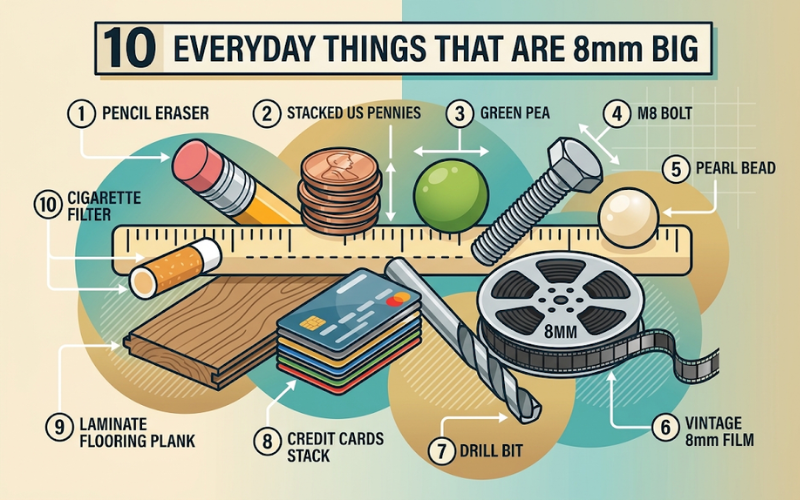
10 Common Everyday Things That Are 8mm Big
1. A Standard Pencil Eraser
Look at the end of a standard yellow No. 2 wooden pencil. The pink rubber eraser clamped into the metal ferrule measures between 7mm and 8mm in diameter. Most pencil manufacturers use 7.5mm to 8mm ferrules so the eraser holds enough rubber volume to wipe away graphite without snapping off under pressure. When you need a fast estimation, lay the circular flat head of the eraser against your surface.

2. Five Stacked US Pennies
A standard United States one-cent coin has a thickness of exactly 1.52 millimeters. When you stack five clean pennies flat on top of each other, the stack stands 7.6mm tall. If you include tiny variations from surface dirt and metal wear, five pennies come within a hair of 8mm. Keep a small stack of spare pocket change at your desk, and you possess an instant physical caliper for thickness.

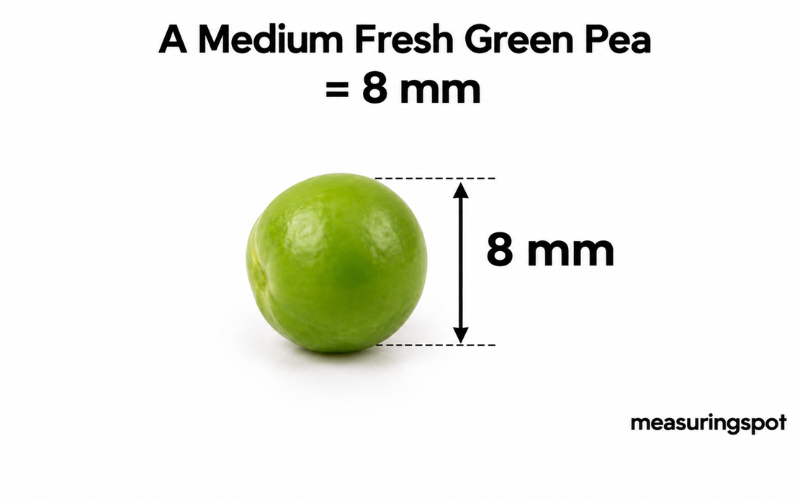
3. A Medium Fresh Green Pea
Open a fresh garden pea pod, and you will find spherical seeds lined in a row. While baby peas measure around 5mm and colossal marrowfat varieties exceed 11mm, an average sweet garden pea consistently hits 8mm across its center. Chefs frequently use this size standard because 8mm vegetables cook through evenly in simmering broths and sautés within three to four minutes.
4. A Standard M8 Bolt Head and Shaft
Walk into any hardware store, and you will encounter M8 hardware across every aisle. The “8” in M8 designates an exterior thread diameter of exactly 8 millimeters. Furthermore, the standard metric hex wrench or socket that turns an M8 bolt often fits a specific hex pattern, while smaller drywall screw heads measure right at 8mm across their flat driving face. If you assemble flat-pack furniture from retailers like IKEA, you handle 8mm dowels and bolts constantly.

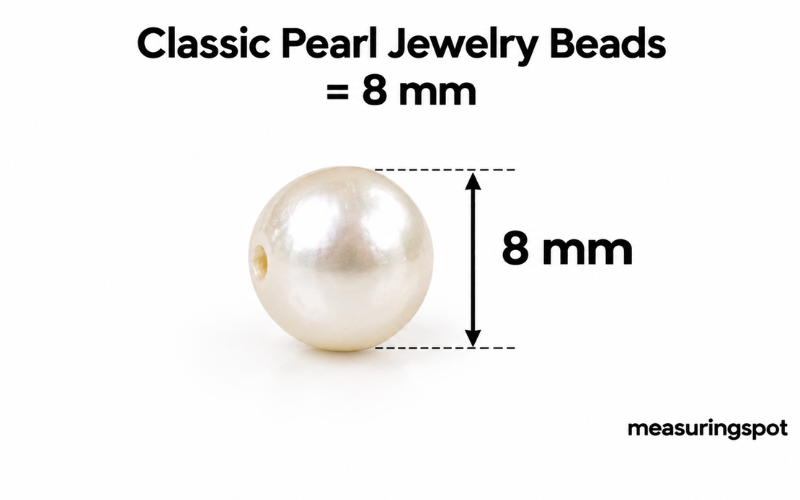
5. Classic Pearl Jewelry Beads
Fine jewelers categorize cultured freshwater and Akoya pearls by millimeter diameter. An 8mm pearl represents the quintessential sweet spot for classic stud earrings and strand necklaces. At 8mm, a pearl delivers enough presence on an earlobe to catch the light without drooping forward under excess weight. In body modification, an 8mm hole also corresponds to a 0-gauge (0G) piercing plug.
6. Standard Domestic Cigarette Filter Diameter
Standard commercial cigarettes share strict worldwide manufacturing dimensions. King-size and regular factory-rolled cigarettes feature a filter diameter of roughly 7.8mm to 8mm. Hand-rolling enthusiasts intentionally buy “regular size” filters matching this 8mm standard, distinct from 6mm “slim” or 5.3mm “extra slim” filter tips.

7. Common Laminate Flooring Thickness
Interior renovators know that laminate and vinyl plank flooring uses metric sizing as an industry standard. While bargain-grade planks sit at 6mm and commercial-grade boards reach 12mm, residential living room flooring overwhelmingly relies on an 8mm profile. This 8mm depth provides adequate structural rigidity for locking tongue-and-groove click systems while preventing the floor from feeling hollow underfoot.

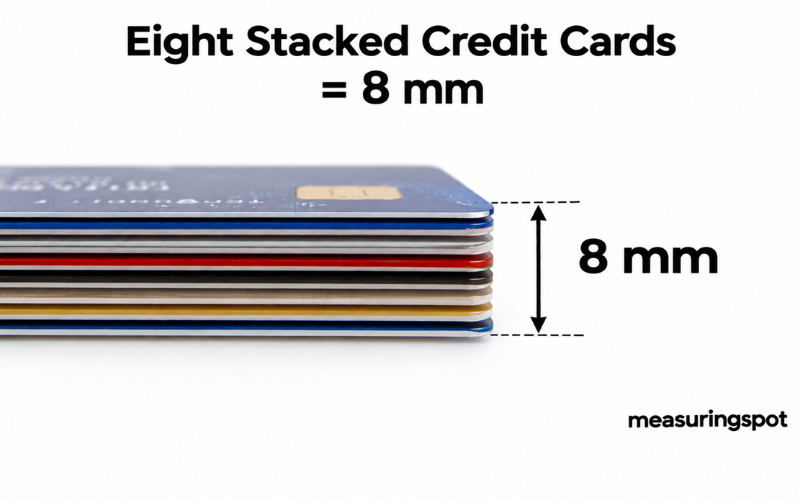
8. Eight Stacked Credit Cards
A standard plastic credit card, driver’s license, or bank card adheres to ISO/IEC 7810 ID-1 specifications. This standard dictates a precise thickness of 0.76mm. Stack eight cards together, and the combined plastic sandwich equals 6.08mm to 6.3mm. Add embossed numbers, tap chips, and microscopic air gaps between cards, and a bundle of nine to ten cards hits the 8mm mark instantly. If you hold eight smooth cards tightly pressed, you hold about three-quarters of a centimeter.
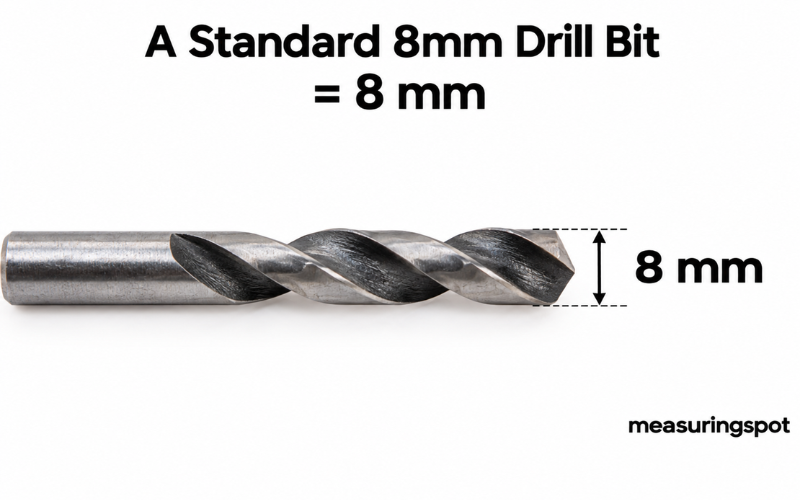
9. A Standard 8mm Drill Bit
Every standard drill bit index includes an 8mm bit. Contractors and DIY builders reach for the 8mm bit when setting heavy-duty wall anchors, running low-voltage speaker cables, or hanging solid floating shelves. The shank of an 8mm bit fills the palm slightly thicker than a wooden matchstick and creates a hole wide enough to slide a standard drinking straw through without resistance.
10. Super 8 Vintage Motion Picture Film
Motion picture history owes its golden age of home recording to this exact dimension. Introduced by Kodak in the mid-twentieth century, Super 8 film stock features a celluloid strip that measures 8mm wide from edge to edge. Even though digital sensors replaced chemical film reels decades ago, millions of legacy film reels and antique cameras around the globe preserve this physical 8mm standard.

How Big is 8mm Compared to Common Units?
Metric and imperial conversions can puzzle anyone who grew up using only one measurement system. Here is how 8mm stacks up against measurements you encounter on rulers, tape measures, and screens:
- 8mm vs Inches: 8 millimeters translates to 0.31496 inches. On an imperial tape measure, look at the 1-inch block. Divide that inch into 16 increments. Five of those marks equal 5/16 of an inch (0.3125 inches). 8mm is slightly thicker than 5/16 of an inch by just two-thousandths of an inch.
- 8mm vs Centimeters: Because one centimeter contains 10 millimeters, converting 8mm to centimeters simply requires moving the decimal point one place to the left. 8mm equals 0.8 centimeters, or just 2mm shy of one full centimeter.
- 8mm vs Millimeter Increments: 8mm equals twice the thickness of a 4mm corrugated cardboard box wall, four times the thickness of a 2mm metal coin, and eight times the thickness of an individual credit card.
Why 8mm Matters Across Different Industries
Precision manufacturing, healthcare, and retail rely on 8mm as a baseline metric. Small variances make massive differences across these trades.
Carpentry and Construction
Woodworkers use 8mm wood dowels as the universal joining standard for cabinets, chairs, and tables. An 8mm fluted dowel gives enough shear strength to lock hardwood joints together without splitting thinner pieces of wood. Similarly, drywall installers use 8mm plastic wall plugs (rawls) for medium-load hanging projects like mirrors, curtain rods, and small television mounts.
Medical and Dermatology Diagnostics
Dermatologists often use 8mm as an important threshold when checking skin lesions, moles, and biopsies. The clinical “ABCDE” criteria for melanoma detection uses 6mm (roughly the size of a pencil eraser) as a warning flag for atypical growths. When a dermatologist performs a punch biopsy on deeper skin tissue, they often select an 8mm circular blade to extract a complete skin sample that captures all epidermal layers safely.
Mechanical Engineering and Auto Repair
Car engines rely on 8mm fastener threads everywhere. Under the hood, manufacturers secure valve covers, wiring harness brackets, fluid lines, and intake manifolds using M8 bolts with 10mm or 13mm socket heads. If you work on metric motorcycles, bicycles, or cars, you will use an 8mm hex wrench or wrench more than almost any other tool in your box.
Common Misconceptions About 8mm
Many people confuse bolt shaft thickness with wrench size. When someone says, “Hand me an 8mm wrench,” they refer to the gap between the wrench jaws, not the thickness of the bolt shaft. An 8mm wrench turns an M5 bolt head, whereas an M8 bolt actually requires a 13mm wrench. Mixing up thread diameter with head size often causes trips back and forth to the hardware store.
Another misconception occurs in jewelry shopping. People often assume that jumping from a 6mm bead to an 8mm bead represents an insignificant difference because two millimeters sound tiny on paper. However, as the diameter of a sphere expands, its total volume and surface area grow exponentially. An 8mm pearl looks substantially heavier, fuller, and bolder on a person’s wrist or neck than a 6mm pearl.
Frequently Asked Questions About 8mm
How can I measure 8mm without a ruler?
Line up four modern pennies flat against a flat surface, or place the circular rubber eraser of a standard pencil against your target. If you have a deck of cards or wallet cards, stack eight cards together. These common items land within a fraction of a millimeter of 8mm.
Is 8mm bigger or smaller than a quarter of an inch?
8mm is larger than a quarter of an inch. One-quarter of an inch equals 0.25 inches (6.35mm). 8mm equals approximately 0.315 inches, making it about 1.65 millimeters larger than a standard quarter-inch mark.
Is an 8mm piercing considered large?
In body piercing, an 8mm gauge (known as 0G) ranks as a large, advanced stretch for earlobes. Getting to 8mm requires multiple gradual stretching steps over months to avoid tearing skin tissue. However, for a piercing hoop diameter, 8mm represents a very small, snug ring commonly used in nostril, helix, or septum piercings.
What size socket turns an 8mm bolt?
A standard metric M8 hex bolt typically requires a 13mm socket or spanner wrench to turn the head. Some Japanese industrial standard (JIS) automotive fasteners use a 12mm head on an M8 thread, while small interior fasteners might use an internal 6mm Allen key.
Does 8mm equal 1 centimeter?
No, 8mm does not equal 1 centimeter. One centimeter contains exactly 10 millimeters. Therefore, 8 millimeters equals 0.8 centimeters, leaving it 2 millimeters short of a full centimeter.
Gaining an intuitive feel for small metric measurements removes guesswork from your daily projects. Whether you are assembling flat-pack shelves, picking the right pearl necklace, or grabbing the correct drill bit, keeping everyday benchmarks like pencil erasers, pennies, and green peas in mind gives you an instant ruler anywhere you go.
Once you know that 8mm sits just shy of a third of an inch, sizing up hardware, crafts, and home decor becomes second nature. Store a couple of these visual comparisons in memory, and you will never need to second-guess small measurements again.
Related Posts
- 10 Common Things That Are 4 mm Big
- 10 Common Things That Are 3 mm Big
- 10 Common Things That Are 2 mm Big
- 10 Common Things That Are 1 mm Big
Conclusion
Understanding metric dimensions does not require technical training or specialized tools. When you remember that 8mm matches the diameter of a standard pencil eraser, the thickness of a small stack of pennies, or a sweet green garden pea, you carry an accurate measuring reference wherever you go.
These everyday mental benchmarks streamline your shopping decisions and home improvement tasks. Next time you need to pick the correct drill bit, evaluate jewellery sizes, or purchase hardware online, you can proceed with complete confidence in your measurements.
FOR MORE MEASUREMENTS VISIT: MEASURINGSPOT