
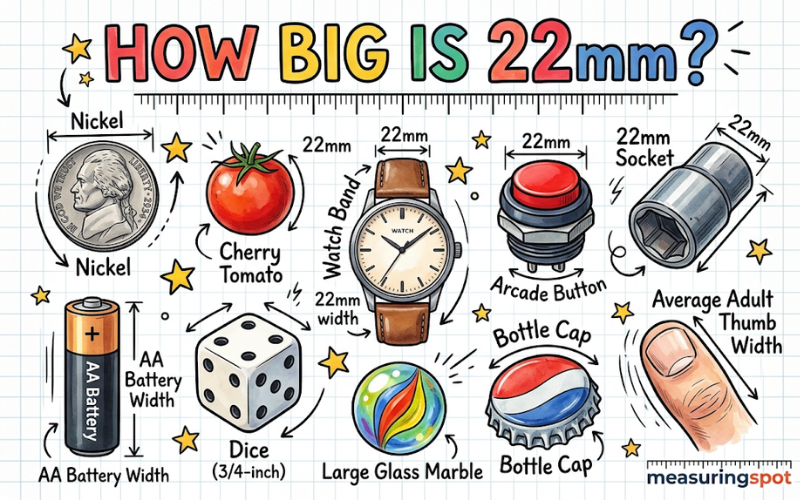
When you tackle a home repair project, buy a replacement watch strap, or choose the right plumbing fittings, precise measurements matter. Many hardware guides and product listings quote metric values like 22 millimeters without showing how that size feels in your hand.
Learning how this measurement translates to everyday household objects saves time and prevents shopping mistakes. You do not always need a precision caliper to confirm whether an item fits. A quick look inside your pocket, desk drawer, or tool chest often gives you the exact reference you need.
Quick Answer: How Big is 22mm?
How Big is 22mm? In plain terms, 22mm measures exactly 2.2 centimeters or 0.866 inches. It sits just shy of seven-eighths of an inch.
To check this size instantly without a ruler, grab a standard US nickel. A nickel measures 21.21mm wide. If you add the thickness of a fingernail to its edge, you have 22mm. If you live in Europe or the UK, a 20 Euro cent coin measures 22.25mm across, while a British Sovereign gold coin measures exactly 22mm in diameter.
Quick Reference Biowiki Table
The table below summarizes the exact dimensions, category, and practical comparison for ten everyday items that measure right around 22mm.
| Item Name | Primary Category | Exact Dimension | Real-World Application |
| British Full Sovereign Coin | Currency and Bullion | 22.05 mm diameter | Standard monetary benchmark |
| 22mm Watch Lug Strap | Horology and Fashion | 22.00 mm width | Modern sport and dive watch bands |
| 7/8-Inch Hex Nut | Hardware and Fasteners | 22.22 mm width across flats | Heavy structural bolts and machinery |
| 20-Cent Euro Coin | Currency | 22.25 mm diameter | Everyday European pocket change |
| 7/8-Inch Copper Pipe Outer Diameter | Plumbing and HVAC | 22.22 mm outer diameter | Standard UK and US domestic water pipes |
| Standard 36-Ligne Garment Button | Apparel and Haberdashery | 22.86 mm diameter | Suit coat fronts, pea coats, and blazers |
| Bicycle Handlebar Grip Diameter | Sports and Cycling | 22.20 mm outer tube diameter | Universal flat handlebars and grips |
| US 5-Cent Nickel (With Slight Offset) | Currency | 21.21 mm diameter | Handheld reference point in North America |
| Skateboard Bearing Outer Ring (608) | Sporting Goods | 22.00 mm outer diameter | Roller skates, skateboards, and fidget spinners |
| Standard 22mm Industrial Pushbutton | Electrical Controls | 22.50 mm panel cutout | Industrial control panels and emergency stops |
10 Common Things That Are 22mm Big
1. The British Gold Sovereign
The British Gold Sovereign offers one of the oldest and most strictly regulated 22mm physical objects in the world. First minted in its modern form in 1817 under King George III, the Royal Mint produces this coin with exact physical specifications.
The sovereign measures 22.05 millimeters across and carries a thickness of 1.52 millimeters. Because the Royal Mint maintains tight quality controls, coin collectors, gold stackers, and jewelers treat the sovereign as a benchmark for 22mm sizing. When you hold an authentic gold sovereign flat in your palm, its span shows you the physical profile of 22mm without variation.
The coin contains 22-karat gold (an alloy of 91.67 percent gold and 8.33 percent copper), which gives it a distinct reddish-yellow hue and a hefty weight of 7.98 grams. Because people traded sovereigns across the British Empire for generations, the size became deeply embedded in historical trade standards. If you handle gold bullion, this coin serves as the ultimate pocket reference for 22mm.

2. Standard 22mm Watch Straps and Lug Widths
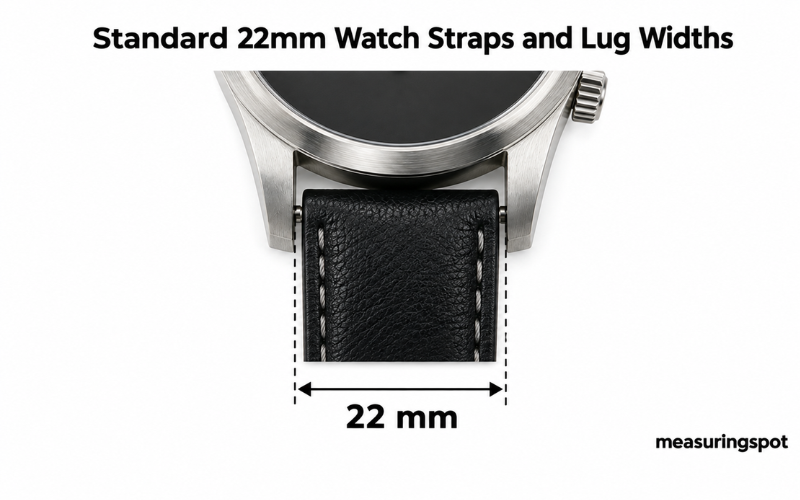
If you wear a modern diver watch, chronograph, or smartwatch, your wrist likely holds a 22mm component every day. The distance between the inner lugs of watch cases follows distinct industry conventions. While dress watches traditionally favor 18mm or 20mm bands, larger sports cases rely on 22mm lug openings to maintain balanced proportions.
Popular models like the Samsung Galaxy Watch 46mm, various Garmin tactical GPS watches, the Seiko SKX007, and many Citizen dive watches feature a 22mm strap width. When you buy a replacement silicone, leather, or NATO nylon strap for these watches, the strap measures exactly 22mm across at the mounting spring bar. Placing a 22mm watch strap flat against an unknown gap quickly tells you whether the opening matches that dimension.
Watchmakers prefer 22mm lug widths for wristwatches with cases spanning 42mm to 46mm across. A narrower 18mm or 20mm band on a heavy diver case creates top-heavy instability, causing the case to wobble on the wrist bone. The 22mm strap profile anchors the watch case flat, spreading weight evenly over your arm.
3. The 7/8-Inch Hex Nut (Width Across Flats)
In mechanics and structural construction, you encounter the 7/8-inch standard constantly. When converted directly into the metric system, 7/8 of an inch equals 22.225 millimeters. Mechanics routinely reach for a 22mm metric wrench when working on tight 7/8-inch fasteners because the 0.22mm difference is negligible in most non-critical field applications.
The distance across the flat sides of a medium-sized structural nut measures 22.2mm. Mechanics who work on automotive suspension arms, trailer hitches, and industrial frames regularly manipulate fasteners of this size. If you place a standard 22mm combination wrench on your workbench, the interior jaw width illustrates the size profile of a 22mm opening.
Heavy equipment manufacturers specify 22mm bolt heads because they provide enough surface area for high-torque impact wrenches without stripping or rounding off the corners. If you open a standard home socket set, the 22mm socket stands out as one of the largest hand-tool sockets before you move into heavy commercial truck tools.

4. The 20 Euro Cent Coin
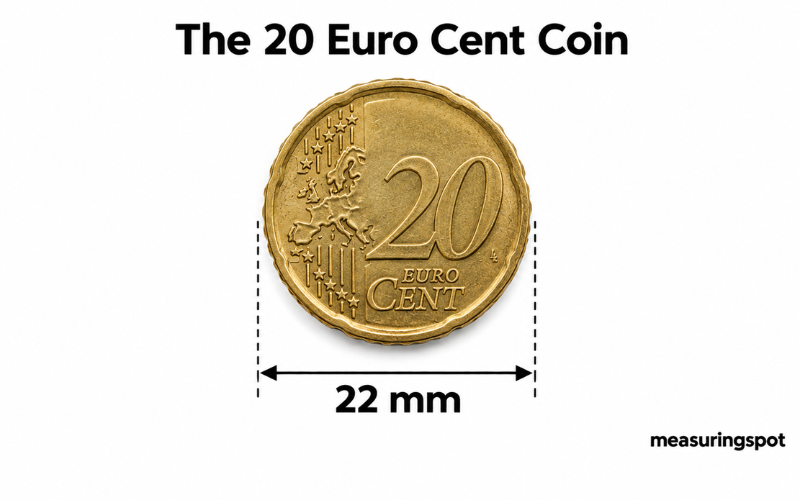
For anyone living in or traveling through the Eurozone, the 20-cent coin provides the most accessible physical reference for 22 millimeters. The European Central Bank designed the euro coinage system with distinct steps in size, weight, and edge designs to help visually impaired individuals differentiate denominations.
The 20-cent coin features the Spanish flower design with seven distinct indentations around its rim. Its outer diameter measures 22.25 millimeters, and it has a thickness of 2.14 millimeters. Because it is made from Nordic Gold (an alloy of copper, aluminum, zinc, and tin), it resists tarnish and maintains its exact shape through years of heavy circulation. If you keep a handful of pocket change from Europe, this coin matches a 22mm reference gauge within a fraction of a hair.
Vending machine developers, coin sorters, and public transport turnstiles across 20 European nations calibrate optical sensors to detect this specific 22.25mm boundary. You can lay the coin edge-to-edge on paper to quickly trace and mark off a circle that fits 22mm openings with outstanding accuracy.
5. 22mm Plumbing Copper Pipe
Plumbing systems rely heavily on standardized tube sizing to guarantee watertight connections across different manufacturers. In the United Kingdom and across mainland Europe, 22mm copper pipe serves as the standard size for main central heating lines and primary domestic cold water supplies.
In North America, plumbers designate standard nominal 3/4-inch copper tube (Type L or Type K) by its internal flow rating, but its actual external diameter measures 7/8 of an inch (22.22 millimeters). When you hold a copper tube designed for domestic radiator connections or boiler loops, the pipe measures 22mm from outer edge to outer edge. Plumbers use specialized 22mm pipe cutters and push-fit compression fittings built specifically for this dimension.
The external diameter must remain accurate within fractions of a millimeter. If the copper tube measures 23mm, it will not slide into solder sleeves or press-fit elbows. If it measures 21mm, water pressure blows the solder joint apart. This makes modern plumbing tubing one of the most reliable industrial examples of 22mm sizing in your home.

6. Standard 36-Ligne Garment Buttons (Suit Coats and Blazers)
The fashion and textile manufacturing industries do not measure buttons in inches or millimeters. Instead, tailors use an archaic French measurement unit called the ligne (often abbreviated as “L”). One ligne equals 0.635 millimeters.
A 36-ligne button calculates to 22.86 millimeters in diameter, which settles right near the 22mm mark. Suit makers use 36-ligne buttons as the primary front closures on heavy winter overcoats, pea coats, trench coats, and men’s double-breasted suit jackets. If you look at the main front buttons on an autumn wool jacket or military-style coat, you look directly at an object that spans roughly 22mm across.
Buttonholes for 36-ligne buttons are slit to 24mm or 25mm to allow smooth passage of the button disk through the cloth layers without pulling threads loose. Next time you slip on a winter pea coat, hold the main front button between your fingers. It will give you a tactile impression of 22mm to 23mm thickness and width.

7. Universal Mountain Bike and Commuter Handlebars
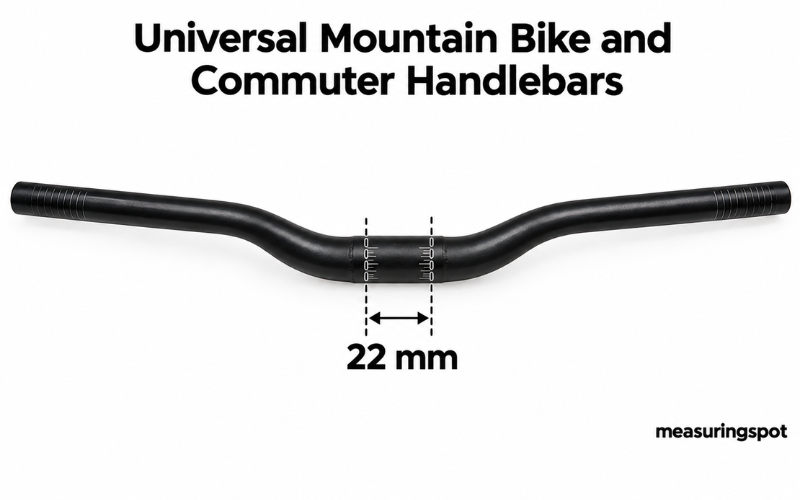
Bicycle component manufacturers follow rigid outer diameter dimensions so that brake levers, shifters, and handlebar grips can swap across brands without slipping. For straight, riser, and flat handlebars on mountain bikes, hybrid bikes, and city commuters, the grip area diameter is globally standardized at 22.2 millimeters.
While the center stem clamp on modern bikes might widen to 31.8mm or 35mm for structural stiffness, the bar tapers down to 22.2mm where your hands rest. Every standard rubber slide-on grip, locking grip collar, and trigger shifter clamp features an inner diameter of 22.2mm. If you wrap your fingers around a mountain bike grip, the metal tube underneath measures precisely 22mm wide.
This dimension dates back over a century to early motorcycle and bicycle throttle controls. By sticking to 22.2mm, bicycle accessory brands can produce grips, bell mounts, GPS clamps, and phone holders that fit millions of bicycles across the world without requiring custom mounting adapters.
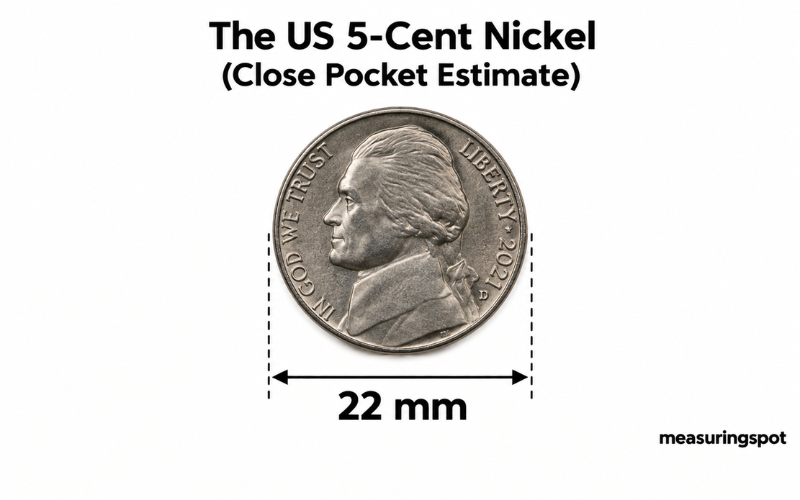
8. The US 5-Cent Nickel (Close Pocket Estimate)
When you do not have foreign currency, sports watches, or specialized tools nearby, an ordinary American nickel gives you a reliable reference point. The United States Mint specifies that a five-cent Jefferson nickel must have a diameter of 21.21 millimeters and a thickness of 1.95 millimeters.
While 21.21mm falls slightly short of 22mm, the discrepancy equals only 0.79 millimeters. That is thinner than the edge of an ordinary plastic credit card. If you place a US nickel flat against an unknown opening and observe roughly half a millimeter of clearance around the perimeter, the opening measures 22mm. For fast daily estimation, the nickel remains the most practical everyday comparison tool in North America.
The nickel also provides a handy weight reference of 5.0 grams and has an un-reeded smooth edge. When stacked together, eleven US nickels on their sides form a line almost identical to the diameter of a 22mm disc.
9. Standard 608 Skateboard Bearings (Outer Diameter)
Skateboard wheels, inline skates, and roller skates rely on one ubiquitous industrial bearing: the model 608 ball bearing. During the late 2010s, this identical bearing gained worldwide visibility as the central rotating core inside handheld fidget spinners.
Industrial manufacturing guidelines dictate the exact exterior measurements of a 608 bearing. It features an 8mm internal bore hole, a 7mm width, and an outer ring diameter of exactly 22.00 millimeters. Whether you buy performance bearings from Bones Swiss or an unbranded replacement from an industrial supply house, the steel outer casing measures 22mm across. Mechanics and hobbyists often press these 22mm steel cylinders directly into 3D-printed gears and skate wheel hubs.
Because bearing tolerances require precision ground steel, you will rarely find any variation in this size. If a bearing measures 22.05mm instead of 22.00mm, it will crack polyurethane skate wheels during press fitting. If it measures 21.95mm, it rattles loose inside the wheel bore.

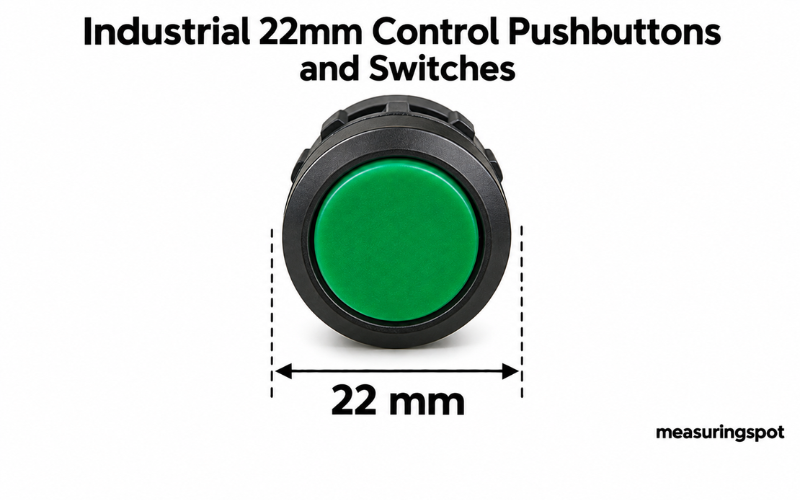
10. Industrial 22mm Control Pushbuttons and Switches
Walk through any manufacturing facility, commercial elevator lobby, or water treatment plant, and you will see arrays of green start buttons, red mushroom-style emergency stop plungers, and key switches. The automation industry relies on the international IEC 60947-5-1 standard, which designates 22.5 millimeters as the standard mounting hole cutout diameter for industrial control panels.
Electricians and panel builders refer to these hardware pieces simply as “22mm operators.” When technicians cut holes in sheet metal enclosures or commercial machine consoles, they use 22.5mm chassis punches. The body of the switch drops directly through the 22mm hole, while the wider decorative bezel clamps against the outer face.
This standardization means an engineer can replace a broken button made by Siemens with a switch manufactured by Schneider Electric, Allen-Bradley, or Eaton without cutting or modifying the steel panel. The 22mm round hole cutout remains the universal industry standard worldwide.
Metric vs. Imperial: Why 22mm Appears Everywhere
You might wonder why 22 millimeters surfaces across so many unrelated fields, from cycling components to plumbing hardware. The answer lies in the historic intersection between the British Imperial measurement system and modern metric manufacturing standards.
The Conversion Factor of 7/8 Inch
The fraction 7/8 inch appears throughout traditional carpentry, machine tooling, and pipefitting. When engineers convert imperial designs into metric equivalents, 7/8 of an inch translates to:
- 7 divided by 8 equals 0.875 inches
- 0.875 inches multiplied by 25.4 millimeters per inch equals 22.225 millimeters
When factories worldwide modernized their tooling during the mid-20th century, European and Asian factories rounded imperial fractions to the nearest whole metric numbers. Consequently, parts designed to match 7/8-inch imperial components became standardized at 22mm in metric catalog sheets.
Ergonomic Scaling for the Human Hand
Physical objects intended for human handling gravitate toward common sizes. The human grip wraps comfortably around cylindrical shafts between 20mm and 25mm in diameter.
A 22mm tube allows fingers of average length to wrap securely around a bicycle bar or tool handle without straining the hand tendons. Similarly, a 22mm garment button offers enough surface area for cold or gloved fingers to grasp and slide through a fabric slit without creating an awkward bulge on the front of a coat.
Product designers know that human biomechanics dictate tool sizing. Handles smaller than 18mm cause hand cramping under high grip force, while handles thicker than 30mm restrict the grip strength of individuals with smaller palms. The 22mm size sits right at the optimal intersection of comfort, control, and material efficiency.
Practical Methods to Measure 22mm Without a Ruler
You do not always have a metric ruler or digital dial caliper in your pocket when you inspect parts at a hardware store or garage sale. You can use several reliable household tricks to check for a 22mm span.
The Credit Card Edge Method
Standard credit cards, driver’s licenses, and transit cards follow the international ISO/IEC 7810 ID-1 specification. This standard dictates that a credit card must measure 85.60 millimeters long by 53.98 millimeters wide, with a thickness of 0.76 millimeters.
If you divide the 85.6mm long edge of a credit card into four equal quarters, each quarter measures 21.4 millimeters. That brings you within half a millimeter of 22mm. Alternatively, stacking 29 credit cards flat on top of one another creates a vertical stack that measures almost exactly 22.04 millimeters tall.
The Standard Paper Clip Length
The common small steel wire paper clip (Size No. 3) measures approximately 25 to 26 millimeters long in its standard commercial format. However, mini craft paper clips and the internal folded loop of a standard paper clip often hit between 21mm and 22mm. If you take a standard small paper clip and measure the distance from its inner curve to the free wire tip inside, you find a consistent 22mm span.
Finger Joint Landmarks
Human hands differ in size, but you can calibrate your own fingers against a ruler once to establish personal physical benchmarks. For many adults, the distance from the corner of the thumbnail across to the opposite nail edge measures between 18mm and 22mm.
Take a moment to measure the middle joint of your index finger across its widest knuckle. Once you determine which finger knuckle measures 22mm wide, you carry a permanent metric gauge with you wherever you go.
Common Mistakes When Measuring 22mm
When people identify or order 22mm components, several common measurement mistakes lead to returns, leaked plumbing joints, or loose watch straps.
Confusing Inner Diameter (ID) and Outer Diameter (OD)
The single most frequent mistake in pipe fittings and mechanical bushings involves confusing inner diameter with outer diameter. In plumbing, a pipe sold as “22mm” in Europe refers strictly to its outer diameter (OD). This allows external compression joints to seal properly against the exterior wall.
However, in certain industrial hose and automotive rubber tubing applications, numbers refer to internal bore diameter (ID) to measure fluid capacity. If you buy a rubber hose marked 22mm ID, its outer wall can easily exceed 28mm or 30mm. Always verify whether the blueprint or spec sheet calls out internal or external clearance before purchasing hardware.
Overlooking Watch Spring Bar Flanges
When watch owners order new straps online, they frequently measure the width of the old buckle or the middle of the strap instead of the distance between the case lugs. Leather straps often taper down by 2mm or 4mm toward the buckle end. A watch with 22mm lugs might use an 18mm or 20mm buckle.
If you measure the buckle, you will buy a replacement strap that slides loosely inside the lugs, exposing the spring bar and risking dropped watches. Always use a flat ruler or caliper directly across the gap between the watch case horns where the strap mounts.
Parallax Error with Standard Rulers
Plastic school rulers feature printed measurement lines on their top surface. When you hold a ruler above an object and view it from an angle, the apparent measurement shifts by 1mm to 2mm due to line of sight distortion. This optical effect is called parallax error.
To avoid parallax error when checking for 22mm, always tilt the ruler on its edge so that the graduation lines make direct physical contact with the object surface. View the markings directly from above with your eye perpendicular to the surface.
22mm in Everyday Hobbies and Sports
The 22mm dimension plays a vital role across multiple recreational pursuits, from target shooting to board gaming and audio engineering.
Tabletop Gaming Bases and Miniatures
Miniature wargamers and hobby painters deal with standardized round bases daily. While games like Warhammer commonly use 25mm, 28mm, and 32mm circular bases, older historical wargame systems and custom roleplaying tokens frequently mount small infantry troops on 22mm round slotted plastic bases. These small bases ensure troops fit closely within tight movement trays.
Camera Lens Filter Steps
Photographers encounter millimeter markings on every lens barrel, denoting focal length and front filter thread sizes. While primary screw-on filters jump in common increments such as 49mm, 52mm, and 58mm, internal optical elements inside vintage rangefinder lenses and CCTV security camera lenses commonly carry 22mm thread diameters. Macro photographers often use step-up rings to adapt miniature 22mm sensor lenses to wider modern DSLR bodies.
Guitar Knobs and Potentiometer Bodies
Musicians working on electric guitar electronics encounter the 22mm measurement underneath the pickguard. Full-size CTS brand control potentiometers (pots) used to adjust volume and tone on Fender Stratocasters and Gibson Les Pauls feature a metal casing base that measures roughly 24mm across, but compact Japanese Alpha brand pots measure 16mm. The plastic bell knobs that slide over the exterior splined shafts of vintage Gibson guitars feature a base skirt diameter of right around 22.5mm.
Frequently Asked Questions About 22mm
How Big is 22mm in inches?
22mm equals approximately 0.86614 inches. This puts 22mm slightly below 7/8 of an inch, which equals 0.875 inches. The difference between 22mm and 7/8 of an inch is only 0.0089 inches (0.225mm).
How Big is 22mm compared to a US coin?
A standard US nickel measures 21.21mm in diameter, making it the closest American coin to 22mm. The nickel is just 0.79mm smaller than 22mm. A US quarter is noticeably larger at 24.26mm, while a US penny is smaller at 19.05mm.
Can you use a 22mm wrench on a 7/8-inch nut?
Yes, in most home and light automotive applications. A 7/8-inch nut equals 22.225mm across the flat sides. A 22mm wrench measures 0.225mm smaller than the nut. Many combination wrench jaws include enough tolerance to slip onto a 7/8-inch nut, though high-torque applications risk rounding off corners if you do not use the exact imperial socket.
How does 22mm compare to 20mm and 24mm watch straps?
A 22mm watch strap is two millimeters wider than an everyday 20mm dress watch strap, giving the watch a more rugged, athletic stance. A 24mm strap is two millimeters wider still, and is usually reserved for oversized pilot watches or bulky tactical dive watches with case diameters exceeding 45mm.
Is 22mm the same as 2.2 cm?
Yes. The metric system uses base ten conversions. One centimeter contains 10 millimeters, so dividing 22 millimeters by 10 yields 2.2 centimeters.
What socket size replaces a 22mm socket?
A 7/8-inch socket is the closest imperial equivalent to a 22mm socket. Because 7/8 inch equals 22.225mm, a 7/8-inch socket fits slightly looser on a 22mm bolt head than a dedicated metric tool, but it will work effectively for lower-torque tasks.
Related Posts
- 10 Common Things That Are 20 mm Big
- 10 Common Things That Are 19 mm Big
- 10 Common Things That Are 18 mm Big
- 10 Common Things That Are 17 mm Big
Conclusion
Measuring 22 millimeters accurately does not require complicated conversion charts or specialized workshop calipers. Once you recognize that this dimension lands just under seven-eighths of an inch, everyday items like a US nickel, a 20 Euro cent coin, or a standard skateboard bearing turn into instant sizing guides.
Whether you are swapping a watch strap, installing domestic plumbing pipes, or picking the right hardware wrench, these familiar objects give you a dependable reference right in the palm of your hand. Keep a few of these common benchmarks in mind, and you will judge 22mm clearances quickly and accurately on your next project.
FOR MORE MEASUREMENTS VISIT: MEASURINGSPOT