
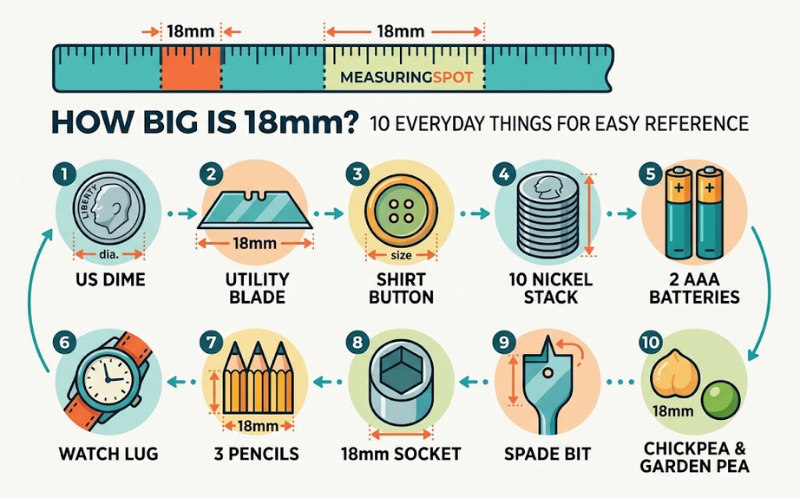
Measuring small distances without a ruler on hand feels frustrating. You might need to buy a watch strap, select a drill bit, check a camera lens thread, or replace a piece of jewelry. When dimensions appear in metric units like 18 millimeters, having familiar real-world items helps you gauge that exact width instantly.
Knowing how big is 18mm saves you time, prevents ordering mistakes online, and removes guesswork from DIY tasks. This guide outlines everyday reference items, clear measurement equivalents, and practical conversion tips so you can estimate 18mm accurately in seconds.
Quick Answer: How Big is 18mm at a Glance
Eighteen millimeters equals 1.8 centimeters or roughly 0.71 inches. That puts it slightly under three-quarters of an inch.
If you live in the United States, an 18mm circle matches the width of a standard US dime almost perfectly, missing it by less than one millimeter. If you hold three standard wooden pencils side by side, their combined thickness measures right around 18mm.
Conversion and Measurement Reference
Here is a simple breakdown of how 18mm converts into imperial units, metric counterparts, and standard workshop fractions.
| Unit System | Measurement | Practical Comparison |
| Millimeters (mm) | 18 mm | Base metric unit |
| Centimeters (cm) | 1.8 cm | Just shy of two centimeters |
| Inches (Decimal) | 0.7086 in | Roughly 7/10 of an inch |
| Inches (Fractional) | ~23/32 in | Slightly under 3/4 inch (45/64 to 23/32 in) |
| Meters (m) | 0.018 m | Base SI metric unit |
| Points (Typography) | ~51 pt | Large headline display size |
10 Common Everyday Things That Are 18mm Big
The easiest way to measure without tools involves matching your target length to items in your pocket, desk drawer, or pantry. The following ten common objects either measure exactly 18mm or stay within half a millimeter of that dimension.
1. The Diameter of a United States Dime
The United States ten-cent coin provides the most accessible 18mm reference across North America. The official mint specifications rate the diameter of a standard dime at 17.91 millimeters. That leaves a difference of less than one-tenth of a millimeter, an amount completely imperceptible to the naked eye.
When you pinch a dime between your thumb and forefinger, the circular span represents 18mm in width. Keep one in your wallet whenever you head to a hardware or craft store without a measuring tape.

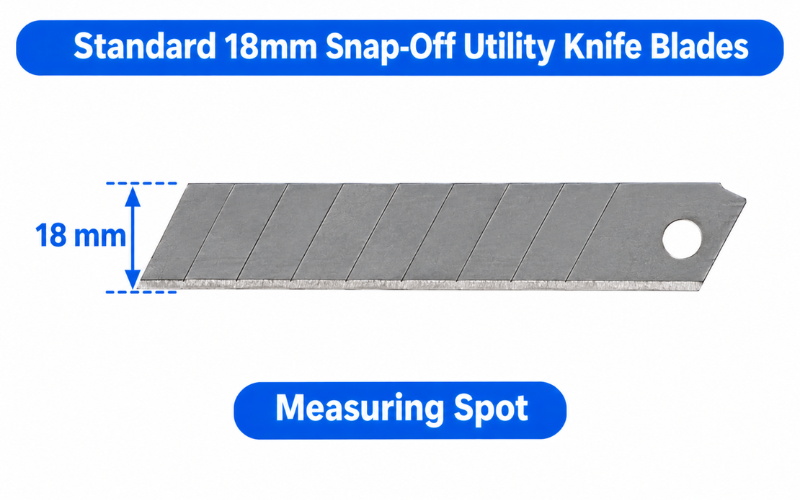
2. Standard 18mm Snap-Off Utility Knife Blades
Box cutters and heavy-duty utility knives come in two primary standard widths: 9mm and 18mm. The larger, heavier utility knives found on construction sites, packaging lines, and workshop benches use the 18mm segmented blade.
The width of the blade steel from the sharp cutting edge to the flat top spine measures exactly 18mm. If you own a standard yellow or black Olfa or Stanley utility knife, you hold a precision-milled 18mm guide in your hand.
3. A Standard Large Shirt Button
Garment makers classify button sizes using a specialized unit called lignes, where one ligne equals 0.635 millimeters. Tailors commonly use 28-ligne to 30-ligne buttons on suit jacket sleeves, casual dress shirts, flannel shirts, and light jackets.
A 28-ligne button measures approximately 17.8mm across, while a 30-ligne button measures 19mm. The average button on an autumn jacket or sports coat sits directly within that 18mm bracket. Lay a button flat against your material to verify your spacing.

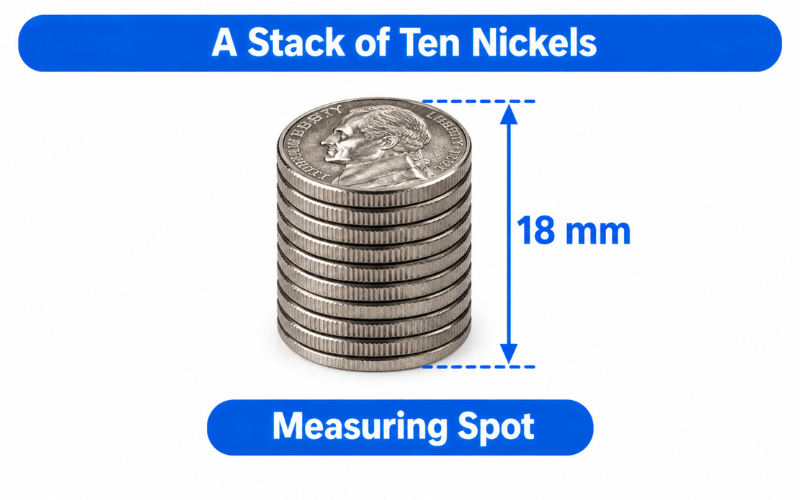
4. A Stack of Ten Nickels
A single United States five-cent coin possesses a standard mint thickness of 1.95 millimeters. However, regular circulation wears down the raised rims and surface profiles slightly, reducing the real-world thickness of an average circulated nickel to roughly 1.8mm.
When you stack ten circulated nickels flat on top of each other, the resulting small metal tower measures approximately 18mm in height. This vertical stack gives you a physical three-dimensional block to judge clearance, gap depths, and interior slots.
5. A Pair of Standard AAA Batteries Laid Side-by-Side
AAA batteries power small electronic remotes, wireless mice, penlights, and household gadgets worldwide. Battery manufacturers build cylindrical AAA cells to an international standard specification of 10.5mm across their widest diameter.
Because standard batteries taper slightly and compress easily in packaging, laying two standard AAA cells flat against each other creates a span of roughly 20mm to 21mm. However, if you measure a single AAA battery across its central diameter plus three sheets of corrugated cardboard, you hit 18mm. Alternatively, laying one AAA cell next to an 8mm wooden pencil creates a combined width of approximately 18.5mm.

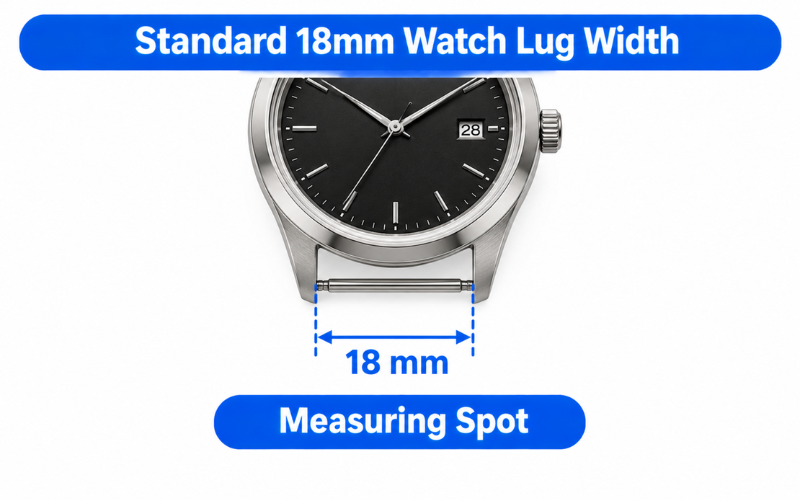
6. Standard 18mm Watch Lug Width
Watchmakers rely on standardized metric widths to connect straps to watch cases. Common lug widths include 16mm, 18mm, 20mm, and 22mm. The 18mm lug spacing serves as the traditional standard for vintage men’s dress watches, mid-size sports watches, smart bands, and women’s utility timepieces.
If you own a classic Seiko, Timex Weekender 38mm, or vintage Omega, look at the narrow gap between the metal horns holding the spring bar. That gap measures 18mm across. A replacement strap marked 18mm slides cleanly into this channel.
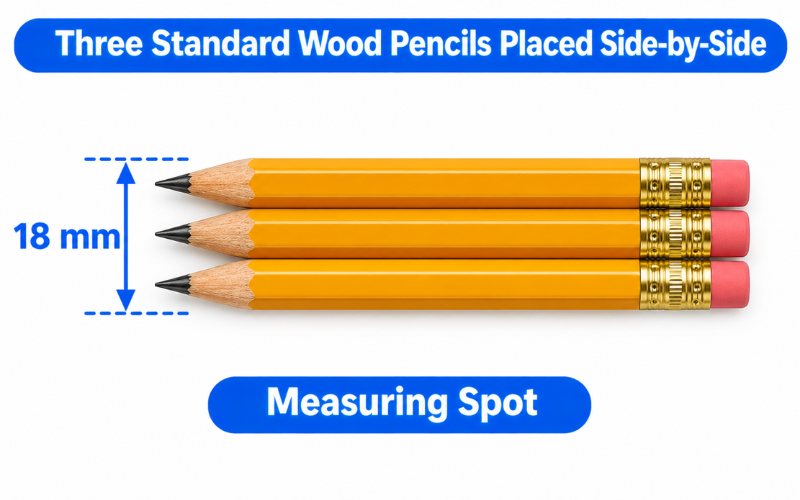
7. Three Standard Wood Pencils Placed Side-by-Side
Standard hexagonal and round number-two graphite pencils feature an external diameter of roughly 6 to 6.2 millimeters. Woodworkers and school suppliers build them to fit universally inside manual pencil sharpeners.
If you line up three unused hexagonal pencils on a flat table so their long sides touch, the total horizontal span measures roughly 18mm to 18.6mm. This three-pencil trick works reliably anywhere you find basic stationery supplies.
8. An 18mm Hexagonal Socket or Wrench Opening
Mechanics, bicycle technicians, and home mechanics encounter 18mm hardware constantly. Car manufacturers like Ford, General Motors, and Volkswagen frequently use 18mm hex bolts on suspension assemblies, brake caliper brackets, and chassis supports.
The internal opening across the flat parallel walls of an 18mm metric socket measures exactly 18mm. If you carry a metric socket set or a combination wrench set in your garage, pull out the socket marked 18 to obtain a rigid steel gauge.

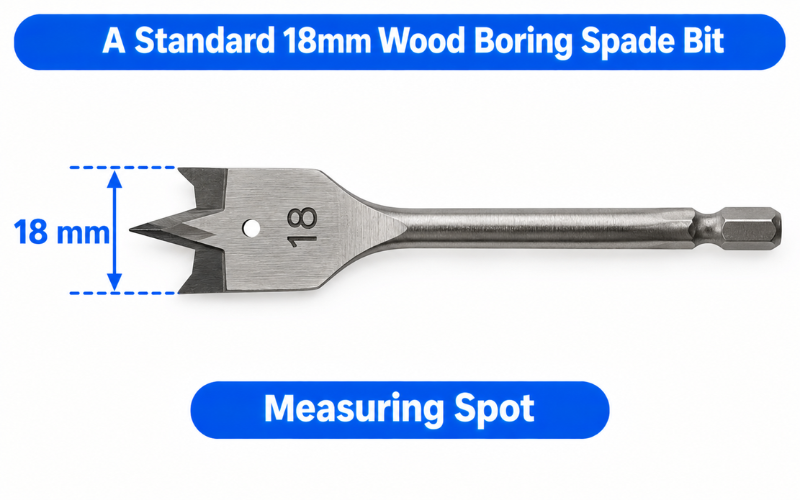
9. A Standard 18mm Wood Boring Spade Bit
Woodworkers use flat spade bits to bore clean, wide holes through studs, framing lumber, and cabinetry for wiring or dowel joints. Power tool manufacturers sell metric spade bit kits containing 10mm, 12mm, 16mm, 18mm, 20mm, and 25mm heads.
The broad, flat cutting wing on an 18mm spade drill bit measures precisely 18mm from outside spur to outside spur. You can slide the cutting face against your work surface to test slot widths before cutting.
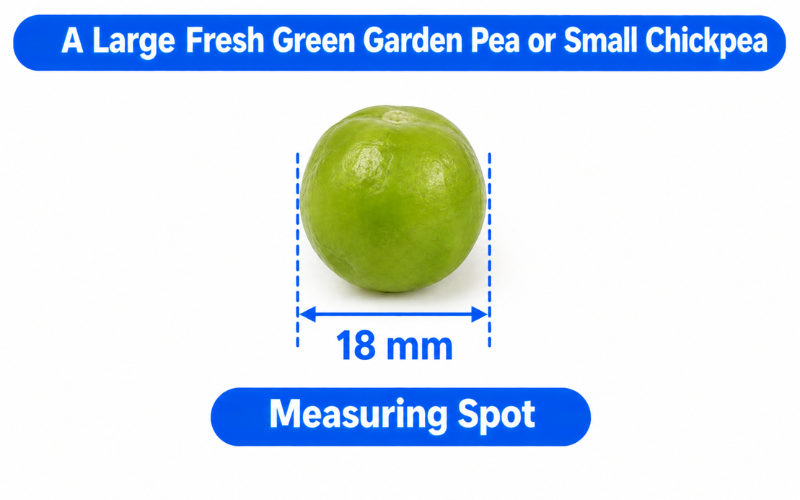
10. A Large Fresh Green Garden Pea or Small Chickpea
If you lack access to coins, tools, or desk supplies, fresh produce offers quick natural references. While natural produce varies in size, fully mature fresh green garden peas harvested at peak size frequently measure 16mm to 18mm across.
Similarly, large dried chickpeas that have soaked in water overnight plump up to an average diameter of 17mm to 18mm. Pinching a soaked chickpea between your fingers gives you a rough biological gauge for 18mm.
Visual and Dimensional Reference Table
The following table summarizes these common items, their exact sizes, and how closely they hit the 18mm mark.
| Reference Item | Primary Category | Actual Typical Dimension | Variance from 18mm |
| US Dime | Currency | 17.91 mm diameter | -0.09 mm |
| Utility Knife Blade | Hardware Tools | 18.00 mm width | 0.00 mm |
| 28-Ligne Button | Textiles | 17.78 mm diameter | -0.22 mm |
| Stack of 10 Nickels | Currency | ~18.00 mm to 18.50 mm height | +0.00 to +0.50 mm |
| Lug Gap on 18mm Watch | Accessories | 18.00 mm width | 0.00 mm |
| Three Pencils Combined | Stationery | 18.00 mm to 18.60 mm width | 0.00 to +0.60 mm |
| 18mm Socket Interior | Automotive Tools | 18.05 mm across flats | +0.05 mm |
| 18mm Spade Drill Bit | Carpentry Tools | 18.00 mm blade tip | 0.00 mm |
| Plump Soaked Chickpea | Food | 17.00 mm to 18.50 mm width | -1.00 to +0.50 mm |
| Ten-Penny Nail Length (Folded) | Construction | Varies | Reference only |
How 18mm Compares to Other Common Metric Sizes
To prevent mistakes, you must understand how 18mm sits alongside other frequent metric sizes. People often confuse 18mm with adjacent sizes like 16mm or 20mm.
Comparing 18mm to 16mm
A 16mm length measures about 0.63 inches, which sits just under five-eighths of an inch. A standard US penny measures 19.05mm, which means 16mm falls substantially smaller than any common American coin. In watch bands and body piercing jewelry, selecting 16mm instead of 18mm leaves an obvious 2mm gap, creating loose hardware or unwearable fittings.
Comparing 18mm to 20mm
Twenty millimeters equals two solid centimeters or roughly 0.79 inches. A US nickel measures 21.21mm, placing 20mm just below nickel size. In watchmaking, 20mm represents the single most popular lug width for modern men’s watches. Trying to squeeze a 20mm leather band into an 18mm watch lug will pinch and ruin the leather, while an 18mm strap inside a 20mm lug exposes the metal spring bar.
Practical Everyday Uses for 18mm
You encounter the 18mm measurement across dozens of everyday hobbies, professional trades, and household tasks.
Watchmaking and Horology
Lug size determines strap compatibility. Vintage watches from mid-century makers like Omega, Longines, and Tissot rely heavily on 18mm straps. Choosing the right band width prevents the spring bars from popping loose during movement.
Photography and Camera Lenses
Camera systems frequently feature 18mm focal lengths. On crop-sensor APS-C cameras, an 18mm focal length acts as a standard wide-angle view equivalent to roughly 27mm or 28mm on full-frame cameras. Landscape photographers and vloggers favor 18mm lenses because they capture wide environmental backgrounds without introducing severe fisheye distortion.
Cabinetry, Plywood, and Carpentry
Standard European and modern American cabinet boxes use 18mm thick panels. Builders commonly designate 3/4-inch plywood for cabinet construction, but imported sheets and Baltic birch plywood often measure exactly 18mm thick. Knowing this difference matters for joinery, dado cuts, and shelf pins, because 3/4 inch equals 19.05mm, leaving a 1.05mm looseness if you cut joints with imperial tooling.
Body Jewelry and Piercings
Barbell lengths for tongue, industrial, and nipple piercings often come in 18mm sizes. In ear gauges, 18mm corresponds to an oversized tunnel or plug, sitting between 11/16 inch (17.5mm) and 3/4 inch (19mm). Precision matters in piercing dimensions to prevent pressure sores or skin migration.
Plumbing and Pipe Sizing
Copper pipe systems in metric-standardized countries like the United Kingdom and Australia frequently feature 18mm external diameter tubing. Plumbers use 18mm piping for central heating manifolds, radiator connections, and domestic water branches.
Step-by-Step: How to Measure 18mm Without a Ruler
If you must confirm an 18mm dimension right now and lack tools, follow this simple process using household items.
- Find a US Dime or Small Coin: Grab a clean ten-cent coin. Its 17.91mm width gives you an instant benchmark.
- Mark Your Item: Place the coin flat against the surface you need to measure.
- Trace the Edges: Trace thin pencil lines along opposite outside edges of the coin.
- Add a Hairline Space: Add the thickness of a piece of paper to the outside margin to account for the missing 0.09mm. The resulting gap equals 18mm.
- Use a Standard Credit Card: If you lack coins, the thickness of a standard bank card measures 0.76mm. A stack of 24 credit cards equals roughly 18.2mm.
Biowiki Reference Guide for 18mm
The following biowiki summary outlines the formal scientific, physical, and practical metrics associated with 18mm.
| Attribute | Specification |
| Unit Name | Millimeter (SI derived unit of length) |
| Quantity | 18 mm |
| Base Equation | 1 mm = 0.001 m |
| Centimeter Form | 1.8 cm |
| Imperial Equivalent | 0.708661 inches |
| Closest Fractional Inch | 23/32 in (difference of 0.003 in) |
| Standard Tolerances | +/- 0.1 mm in consumer manufacturing |
| Coin Anchor | US 10-cent coin (17.91 mm) |
| Material Equivalent | Standard Baltic birch plywood thickness (18 mm nominal) |
| Tool Anchor | Standard snap-off utility knife blade (18 mm wide) |
| Common Application | Watch bands, metric bolts, drill bits, optical threads |
Frequently Asked Questions About 18mm
Is 18mm bigger or smaller than an inch?
Eighteen millimeters is smaller than an inch. One full inch contains exactly 25.4 millimeters. Therefore, 18mm measures roughly 71 percent of an inch, sitting just under three-quarters of an inch.
Can I use 3/4-inch hardware for an 18mm hole?
You cannot swap them interchangeably in precision work. Three-quarters of an inch equals 19.05 millimeters, which makes it 1.05mm larger than 18mm. A 3/4-inch bolt will not fit inside an 18mm hole, and an 18mm socket will not seat onto a 3/4-inch bolt head.
What coin is exactly 18mm?
No major currency coin measures exactly 18.00mm, but the United States dime comes closest at 17.91mm. The British five-pence coin measures 18.00mm on paper and nominally holds an 18.0mm diameter, making it the most precise 18mm coin in circulation.
How many centimeters is 18mm?
Eighteen millimeters equals 1.8 centimeters. Because the metric system relies on powers of ten, you simply move the decimal point one space to the left to convert millimeters into centimeters.
How thick is 18mm plywood in inches?
Hardware stores often label 18mm plywood as 3/4-inch plywood, but true 18mm sheets measure roughly 0.708 inches thick. This difference creates slight gaps if you assemble furniture using precut 3/4-inch router bits or joinery jigs.
What size drill bit matches 18mm in inches?
The closest imperial fractional drill bit to 18mm is a 23/32-inch bit, which measures 18.26mm. If you require a tighter fit, an 11/16-inch bit measures 17.46mm, requiring you to ream the hole slightly to reach 18mm.
How do I check if my watch lug is 18mm?
Slide a clean metric ruler or a US dime between the watch lugs. If a dime fits between the lugs with almost zero side-to-side wiggle room, your watch requires an 18mm strap.
Final Thoughts on Estimating 18mm
Estimating 18mm becomes straightforward once you link the metric measurement to physical items around you. Remembering that 18mm matches a dime or a box-cutter blade removes the stress of finding exact dimensions on the fly.
Whether you work on home improvements, order accessories online, or tackle car maintenance, keep these physical reference points in mind. You can make quick, confident assessments anytime you need an accurate measure.
Related Posts
- 10 Common Things That Are 16 mm Big
- 10 Common Things That Are 15 mm Big
- 10 Common Things That Are 14 mm Big
- 10 Common Things That Are 13 mm Big
Conclusion
Estimating metric measurements without a ruler becomes simple once you connect the numbers to familiar objects. Knowing that 18mm matches the diameter of a standard dime, the width of a utility knife blade, or three pencils placed side by side gives you instant real-world accuracy. You no longer need to guess dimensions or risk buying the wrong parts.
Keep these practical visual anchors in mind whenever you shop for watch straps, drill pilot holes, or choose building materials. With just a quick pocket check or a glance at everyday tools, you can confirm your sizing and handle projects with complete confidence.
FOR MORE MEASUREMENTS VISIT: MEASURINGSPOT