

When you look at an online product listing or a technical manual, metric sizes can feel disconnected from daily life. A specification like how big is 20 mm sounds technical and abstract if you work primarily with inches or if you simply do not carry a pocket ruler.
Knowing how big is 20 mm translates into physical space saves you time when buying hardware, selecting jewellery, fitting watch straps, or choosing lenses. Everyday items sitting on your desk or in your pocket offer immediate, precise benchmarks that settle any guesswork.
Quick Answer: How Big is 20mm?
how big is 20 mm equals exactly 2 centimeters or 0.787 inches, which sits just shy of 13/16 of an inch.
If you want a quick visual marker, reach into your pocket: a British one-penny coin measures exactly 20mm across. If you live in the United States, 20mm sits right between the width of a standard penny (19.05mm) and a nickel (21.21mm). It is also almost the exact width of a standard adult thumbnail or the face of a classic medium shirt button.
10 Common Everyday Things That Are 20mm Big
1. The British One Penny Coin
The British decimal 1p coin serves as the international gold standard for a 20mm reference object. The Royal Mint manufactures this copper-plated steel coin with an official diameter of precisely 20.3mm, making it an almost flawless match for this metric unit.
If you slide a 1p coin across a desk, you hold the exact physical boundary of 20mm. People frequently use it in crafting, photography scaling, and woodworking when a physical gauge is missing from the workbench.

2. A Classic Men’s Shirt Button (32 Ligne)
Clothing manufacturers classify buttons using an archaic unit called “lignes,” where 40 lignes equal one inch. A 32-ligne button translates to precisely 20.32mm, or roughly 0.8 inches.
You find these buttons on the front closure of heavy flannel shirts, winter pea coats, cardigans, and casual suit cuffs. If you lay a tape measure across the widest edge of a main coat button, the outer rim stops right at the 20mm mark.

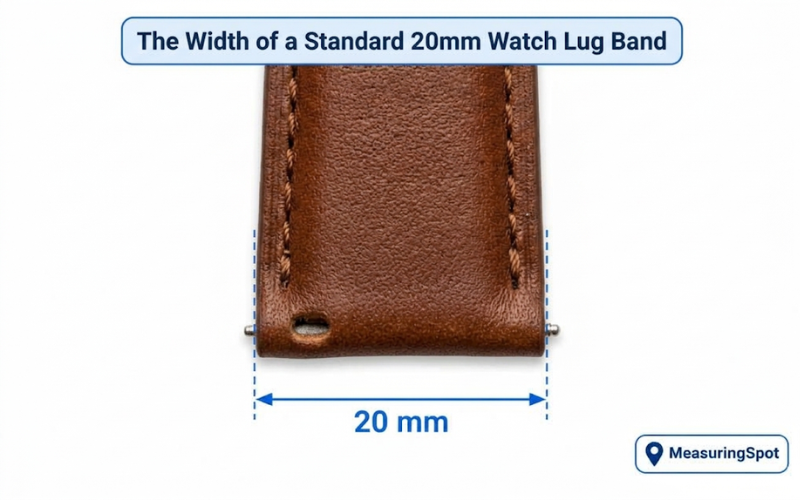
3. A Standard 20mm Watch Lug Band
Anyone who collects or repairs wristwatches encounters 20mm constantly. It represents the single most popular lug width in modern watch design. Premium brands like Omega, Rolex, and Seiko build their most iconic sports and dress models around a 20mm spring bar bracket.
When you purchase a replacement leather strap, nylon NATO band, or stainless steel mesh bracelet, a 20mm strap spans slightly over three-quarters of an inch. Holding a strap between your thumb and forefinger reveals the ideal proportion between strength and wrist comfort.
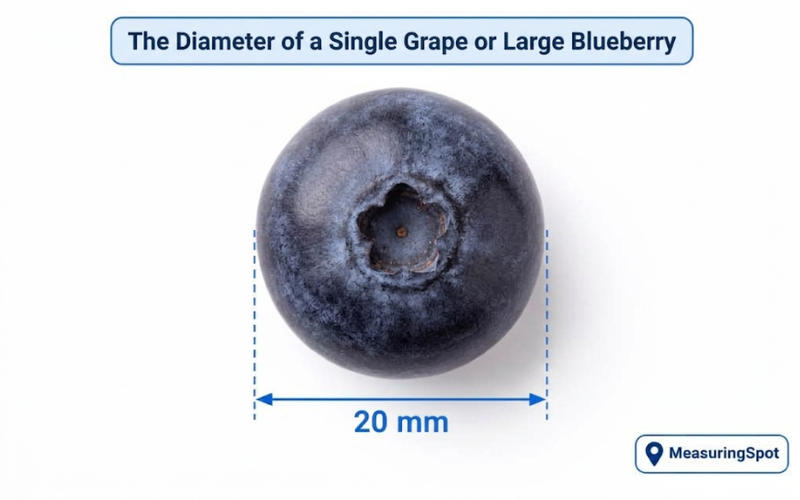
4. A Single Grape or Large Blueberry
Nature produces reliable size brackets, and round produce often conforms to standard agricultural sorting metrics. Commercial grocery stores grade large blueberries, medium grapes, and Bing cherries in the 19mm to 21mm cross-section category.
When you pinch an individual table grape across its center equator, your fingers rest roughly 20mm apart. Chefs and commercial food suppliers rely on this specific diameter to guarantee uniform roasting and freezing times across batches.
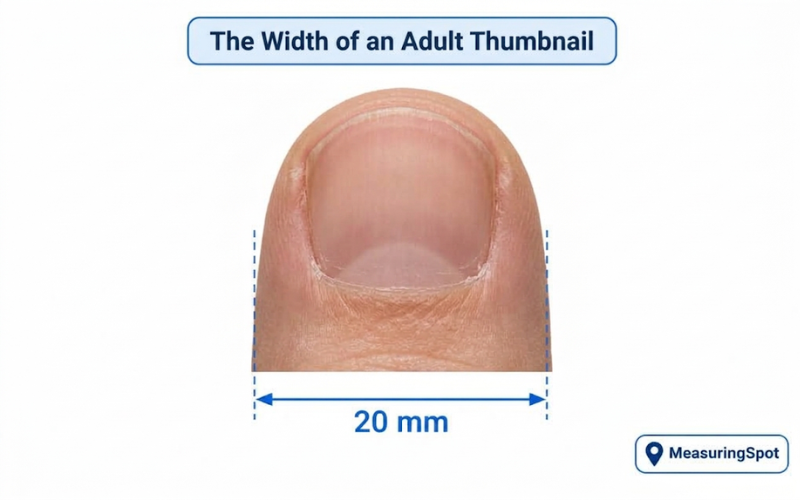
5. An Adult Thumbnail
Human anatomy provides quick field estimates when physical tools are unavailable. On most adult men and many women, the widest part of the thumb cuticle from edge to edge measures approximately 20 millimeters.
Place your thumb flat against a piece of paper and pencil two lines touching either side of your nail bed. On average hands, the distance spans within one millimeter of 20mm. It functions as an instant caliper whenever you need to check bolt sizes at the home improvement store.
6. A Standard Metric M20 Hex Nut
Mechanics, plumbers, and fabricators reach for M20 fasteners when working on structural framing, machinery, and automotive suspensions. The internal thread of an M20 nut measures exactly 20mm in nominal diameter.
While the outside flats require a larger wrench (typically 30mm), the round hole in the center matches a 20mm rod or bolt shank. Holding an M20 nut lets you visualize the exact clearance required for medium-heavy mechanical assemblies.

7. Three Standard Playing Cards Stacked End-to-End (Edge Width)
While individual playing cards are thin, their standard proportions follow strict manufacturing norms. However, if you look at miniature gaming elements, miniature hobby bases, or tabletop counter tokens, 20mm marks a universal baseline.
Historical wargamers and tabletop players frequently base 15mm-scale and 28mm-scale infantry models on round 20mm plastic bases. When you deploy a line of small soldiers across a battle mat, each soldier’s feet occupy a plastic circular footprint exactly 20 millimeters across.

8. A 20mm Camera Prime Lens Diameter
Photographers know 20mm in two distinct contexts: focal length and front glass elements on pancake lenses. An ultra-wide 20mm prime lens captures expansive landscape scenes and architectural spaces by projecting an ultra-wide field of view onto a camera sensor.
Furthermore, the physical aperture opening on compact camera optics or small filter threads frequently spans 20mm. Small optical components like prism finders and mini drone lenses rely on a 20mm barrel diameter to maintain lightweight flight weights and balanced profiles.

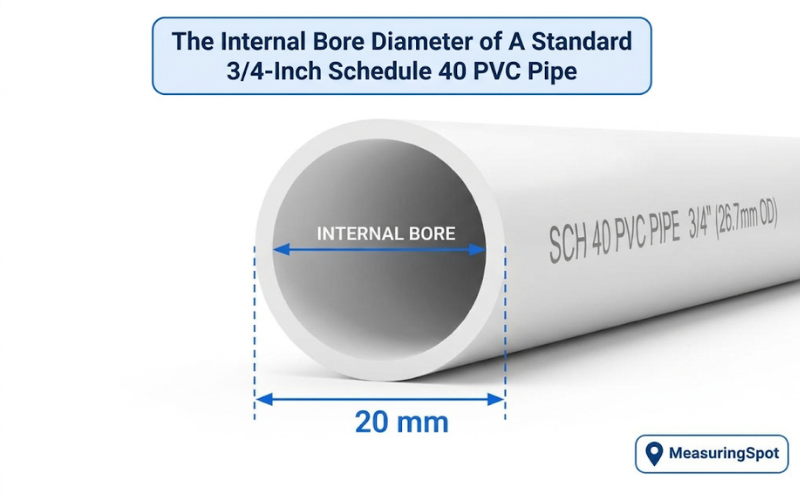
9. A Standard 3/4-Inch Schedule 40 PVC Pipe (Internal Bore)
Plumbing specifications in North America use imperial labels, but the actual dimensions align neatly with metric realities. Standard 3/4-inch Schedule 40 PVC pipe features an internal diameter of approximately 0.804 inches, which translates to 20.4 millimeters.
When you look straight down the open bore of a home irrigation pipe or electrical conduit, you are looking at an aperture roughly 20mm across. Tradespeople working on international job sites treat 20mm conduit and 3/4-inch American pipe as functional counterparts for wire pulling.
10. Two Dimes Stacked Front-to-Back or a Nickel’s Diameter
The United States Mint sizes the five-cent nickel at 21.21mm, while the common copper penny measures 19.05mm. This means 20mm sits right between the two coins.
If you do not possess a British penny, place a US penny next to a nickel. The midway gap between their respective profiles marks 20 millimeters with exceptional accuracy. If you need a vertical reference instead, stack 15 standard credit cards together; their combined edge thickness measures approximately 20mm tall.

20mm Metric Conversions and Comparative Sizing
Understanding how 20mm fits into multiple measurement systems prevents costly mistakes during DIY projects, sewing tasks, and online ordering.
| Unit System | Equivalent Measurement | Common Use Case |
| Millimeters (mm) | 20.0 mm | Engineering drawings, watch lugs, optics |
| Centimeters (cm) | 2.0 cm | School rulers, tailoring, retail packaging |
| Meters (m) | 0.02 m | Architectural schematics, construction surveying |
| Inches (Decimal) | 0.7874 in | Machining, 3D printing tolerances |
| Inches (Fractional) | ~ 25/32 in (or slightly under 13/16 in) | Woodworking, general fabrication |
| Lignes | ~ 31.5 Lignes | Button making, garment design |
| Points (Typography) | 56.7 pt | Graphic design, page layout grids |
Converting 20mm to inches simply requires dividing 20 by 25.4. This yields 0.7874 inches, which falls slightly short of the 0.8-inch mark. In fractional terms, 13/16 of an inch equals 0.8125 inches. Thus, 20mm sits about 1/40th of an inch below a standard 13/16-inch ruler mark.
Technical Specifications: The 20mm Metric Dimension
The following reference table outlines the technical properties of the 20mm metric standard across physical, mechanical, and material applications.
| Attribute | Specification |
| Base Dimension | 20 Millimeters (2.0 Centimeters) |
| Imperial Equivalent | 0.787402 Inches |
| Fractional Approximation | ~ 13/16 Inch (minus 0.025 in) |
| SI Base Equivalent | 2.010-2 Meters |
| Surface Area (of 20mm Circle) | 314.16 mm2 (3.1416cm2) |
| Circumference (of 20mm Circle) | 62.83 Millimeters |
| Volume (of 20mm Sphere) | 4,188.79 mm3 (4.189cm3) |
| Water Weight (of 20mm Sphere) | ~ 4.19 Grams (at 4°C) |
| Common Industrial Fastener | ISO Metric M20 Bolt / Nut Thread |
| Common Watch Strap Width | 20mm Straight / Tapered Lug |
| Military Caliber Equivalency | 20×102mm (M61 Vulcan cannon shell) |
| Typical Household Equivalent | British 1p coin, large blueberry, coat button |
Where You Encounter 20mm in Specialized Industries
Horology and Watchmaking
Watchmakers rely heavily on standardized millimeters. Wrist ergonomics dictate case and strap sizes with extreme care. While cases range from 36mm to 44mm in diameter, the strap attachment point dictates wearability.
A 20mm lug width creates an optimal balance on wrists measuring between 6.5 and 7.5 inches. Watch straps narrower than 20mm can look overly delicate on sports watches, while straps wider than 22mm often feel bulky and stiff.
Manufacturers also design internal mechanical movements with 20mm clearance targets. Modern automatic calibers measure between 20mm and 28mm across, allowing engineers to pack dozens of gears, springs, and jewels into an area no larger than a coin.
Photography and Videography
Camera lenses and optical sensors utilize the 20mm dimension in multiple ways:
- Field of View: On a full-frame 35mm sensor, a 20mm lens delivers an expansive 94-degree diagonal field of view. Real estate photographers, landscape artists, and documentary filmmakers use 20mm glass to capture wide interior rooms without introducing the extreme edge distortions found in fisheye lenses.
- Filter Rings and Step-Up Adapters: While full-size SLR lenses take 67mm to 82mm filters, action cams, drones, and smartphone cine-rigs use miniature 20mm threaded lens filters to control exposure via neutral density filters.
- Cinema Focus Gears: Professional cine lenses utilize standardized 0.8-mod pitch gears. The offset between focus gear rings on compact cine bodies frequently maintains a 20mm minimum spacing to allow dual-motor integration for wireless focus and zoom controllers.
Construction, Carpentry, and Plumbing
Trades rely on standard sizing to guarantee part interchangeability on building sites.
Electricians route low-voltage cabling and single-circuit power feeds through 20mm rigid or flexible conduit. This size balances bend flexibility inside wall studs with enough internal volume to pull three to four conductors without causing heat buildup.
In cabinetry and furniture assembly, carpenters frequently cut 20mm holes into workbench tops (popularized by European work tables like the Festool MFT system). These 20mm dog holes accept specialized clamps, stops, and hold-downs that keep workpieces secure during routing and cutting.
Military Hardware and Ballistics
The term “20mm” carries weight in defense manufacturing. It marks the formal boundary between heavy small arms and autocannon artillery.
Projectiles with a bore diameter of 20mm or larger fire explosive shells rather than solid lead slugs. The M61 Vulcan rotary cannon mounted on modern fighter jets fires 20mm ammunition rounds at speeds topping 3,400 feet per second. Each individual high-explosive round measures 20 millimeters in projectile width, delivering substantial payload volume within a compact, high-velocity package.
Practical Measuring Tricks When You Do Not Have a Ruler
If you must check whether a gap, screw, or strap equals 20mm, try these simple household measuring methods:
- The Credit Card Edge: Standard plastic credit cards, driver’s licenses, and transit passes measure 0.76mm thick. A stack of 26 cards measures almost exactly 20mm high.
- The US Coin Wedge: A US penny measures 19.05mm across. If you need a 20mm opening, a penny should slip inside with roughly 1 millimeter of extra wiggle room. Conversely, a US nickel measures 21.21mm; it should not fit inside a true 20mm hole.
- Notebook Paper Grids: Standard metric graph paper features grid squares that measure 5mm by 5mm. Exactly four grid squares laid out horizontally span 20 millimeters.
- Standard Staples: A strip of classic office staples (type 26/6) measures approximately 12.7mm across the crown, while heavy-duty packaging staples feature widths right at 20mm.
Frequently Asked Questions About 20mm Dimensions
Is 20mm larger or smaller than 1 inch?
Twenty millimeters is smaller than 1 inch. One full inch contains 25.4 millimeters. Therefore, 20mm equals approximately 0.79 inches, leaving it about 5.4mm short of a full inch.
What US coin is closest to 20mm?
No modern circulating US coin measures exactly 20mm. The closest circulating coin is the United States one-cent penny, which has a diameter of 19.05mm. The five-cent nickel is slightly larger at 21.21mm.
How many centimeters are in 20mm?
There are exactly 2 centimeters in 20 millimeters. To convert millimeters to centimeters, divide the millimeter value by 10.
What fractional inch is closest to 20mm?
The fractional inch measurement closest to 20mm is 13/16 of an inch (0.8125 inches). Twenty millimeters (0.7874 inches) sits roughly 1/40th of an inch smaller than 13/16 of an inch.
Can I use a 20mm strap on an 18mm or 22mm watch?
No, watch straps must match the lug width precisely. A 20mm strap will not fit into an 18mm watch case without trimming, which ruins the strap. A 20mm strap mounted on a 22mm watch leaves an unsightly 2mm gap that allows the spring bars to slide, risking accidental detachment.
Mastering standard measurements becomes simple once you link numbers to tangible objects. Whenever you encounter a 20mm measurement, think of a British penny, an adult thumbnail, or a jacket button. These reliable benchmarks eliminate the need to hunt for a ruler every time you plan a project or shop online.
Metric measurements provide clean, uniform sizing across global industries. Keeping these common items in mind lets you make swift, confident decisions on watch bands, fasteners, clothing, and everyday home improvements.
Related Posts
- 10 Common Things That Are 16 mm Big
- 10 Common Things That Are 15 mm Big
- 10 Common Things That Are 14 mm Big
- 10 Common Things That Are 13 mm Big
Conclusion
Grasping the true scale of 20 millimeters becomes second nature once you pair the number with everyday objects. Whenever you spot this measurement on a product tag or technical drawing, simply call to mind a British penny, an adult thumbnail, or a standard jacket button. These physical touchpoints give you an accurate gauge without needing a ruler in hand.
Translating abstract figures into tangible benchmarks eliminates hesitation when ordering hardware, crafting, or tailoring garments. By keeping these reference points in your mental toolkit, you can tackle home repairs, choose the right accessories, and work with metric dimensions smoothly and decisively.
FOR MORE MEASUREMENTS VISIT: MEASURINGSPOT