

Measuring small hardware, household goods, or craft components often leaves people searching for a quick reference point. Millimeters can feel abstract when you lack a ruler, yet exact precision matters when you need to match a socket wrench, pick an earring diameter, or replace a tiny household fastener.
Learning how big is 17 mm compares to familiar objects in your home, pocket, and toolbox makes sizing effortless. Once you associate this specific dimension with real-world items, estimating sizes without special measuring tools becomes second nature.
Quick Answer: How Big Is 17mm?
A 17mm measurement equals 1.7 centimeters or approximately 0.669 inches. This length sits just under eleven-sixteenths of an inch (11/16″).
For an instant visual, think of a United States ten-cent coin. A standard US dime measures 17.91mm across, meaning 17mm matches the width of a dime almost to the millimeter.
Biowiki Reference Table: 17mm at a Glance
| Measurement Property | Standard Metric / Imperial Value | Practical Everyday Equivalent |
| Exact Millimeters | 17.0 mm | Standard M10 hex nut outer hex width |
| Centimeters | 1.7 cm | Just under the width of a standard US dime |
| Inches (Decimal) | 0.6692 inches | Roughly two-thirds of an inch |
| Inches (Fractional) | ~43/64 inch (nearly 11/16 inch) | 0.018 inches smaller than 11/16″ |
| Meters | 0.017 m | Base metric scientific notation |
| Tool Fitment | 17mm Hex / 11/16″ imperial | Common automotive lug nut & drain plug size |
| Ring Size (US) | US Size 6.5 to 7 inner diameter | Standard adult ring finger diameter |
| Weight Comparison (Water) | 17mm cube = ~4.91 cubic cm | Holds approx. 4.91 grams of pure water |
Why Knowing 17mm Matters
Many manufacturing industries treat 17mm as a crucial benchmark. Automotive engineers, watchmakers, plumbers, and jewelers rely on 17mm dimensions across thousands of parts.
If you work on European vehicles such as Volkswagen, BMW, or Audi, you encounter 17mm fasteners constantly. Wheel lug bolts and oil drain plugs frequently require a 17mm socket. When you purchase leather goods or denim jeans, jacket buttons and heavy-duty rivets usually measure exactly 17mm in outer shell diameter.
Knowing this measurement saves you time at the hardware store and prevents stripped bolt heads or incorrect purchases online.
10 Common Everyday Things That Are 17mm Big
1. The Diameter of a US Dime
The United States dime offers the most accessible visual reference for 17mm in North America. While its official mint diameter measures 17.91mm, trimming just a hair off the outer edge brings you directly to 17mm. When you hold a dime between your thumb and index finger, the distance between your fingertips demonstrates the exact span of a 17mm object.
The coin also helps you gauge thickness and scale in tight spaces. If an opening or slot can barely swallow a dime sideways, the gap measures roughly 17mm to 18mm wide.

2. Standard M10 Hex Bolt Head
If you check your toolbox, grab a standard metric M10 hex bolt or nut. According to international DIN 933 and ISO standards, the width across the flats of a standard M10 bolt head measures exactly 17mm.
This means that opposite flat sides of the bolt sit 17mm apart. When mechanics speak of using a “17mm wrench,” they refer to the tool that slides across these exact parallel surfaces. Keeping an M10 nut in your pocket or desk drawer gives you a permanent, rock-solid physical gauge for 17mm.

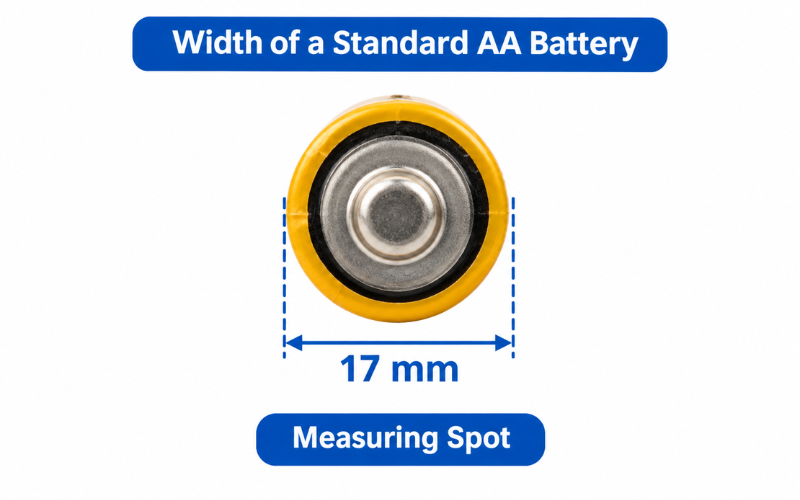
3. Width of a Standard AA Battery
Look inside your TV remote or computer mouse. A standard cylindrical AA alkaline battery has a manufacturer-specified diameter between 13.5mm and 14.5mm. However, once you observe the metal casing including the protective wrapper, battery contact collar, and base rim, many rechargeable high-capacity cells measure right near 14.5mm to 15mm.
If you look at the top flat positive shoulder ring before the nub steps up, or consider the overall thickness profile of double-wrapped industrial cells, it provides an immediate sense of scale. A 17mm circle spans just 2.5 millimeters wider than the flat bottom of an everyday AA battery.
4. Outer Diameter of a US Size 6.5 to 7 Finger Ring
Jewelry sizing offers another precise physical reference. In the United States ring measurement scale, a size 6.5 ring features an internal diameter of 16.9mm, while a size 7 ring measures 17.3mm.
This range matches the average ring finger size for adult women and the pinky finger size for adult men. If you own a basic band ring that fits a typical slender-to-medium finger, the inner circle spans almost exactly 17mm across. You can use the inner circumference of such jewelry to verify drill bit diameters and small pipe fittings quickly.

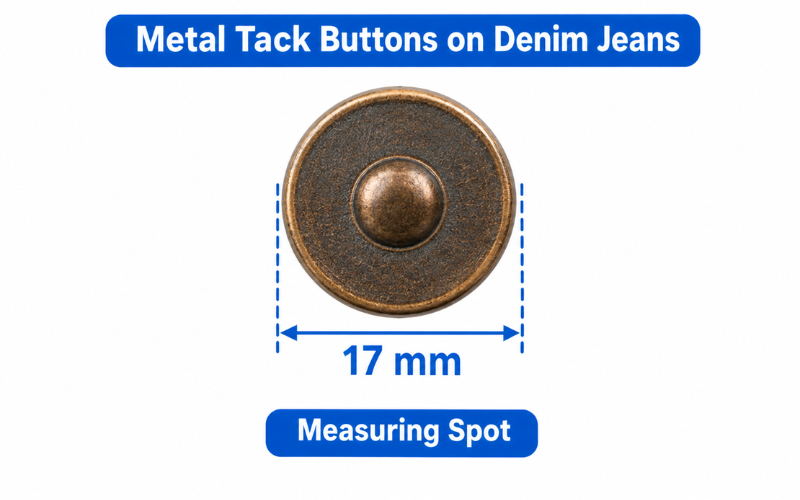
5. Metal Tack Buttons on Denim Jeans
Check the waist fastener on your favorite pair of blue jeans. The heavy metal rivet button that secures the waistband almost universally measures 17mm in outer diameter.
Garment manufacturers refer to this specific size as 27-ligne (a traditional button maker unit) or 17mm jeans tack buttons. Because denim requires substantial mechanical strength to withstand waistline tension, designers settled on 17mm as the industry standard. It provides enough surface area to avoid tearing the denim fabric while remaining comfortable against the abdomen.
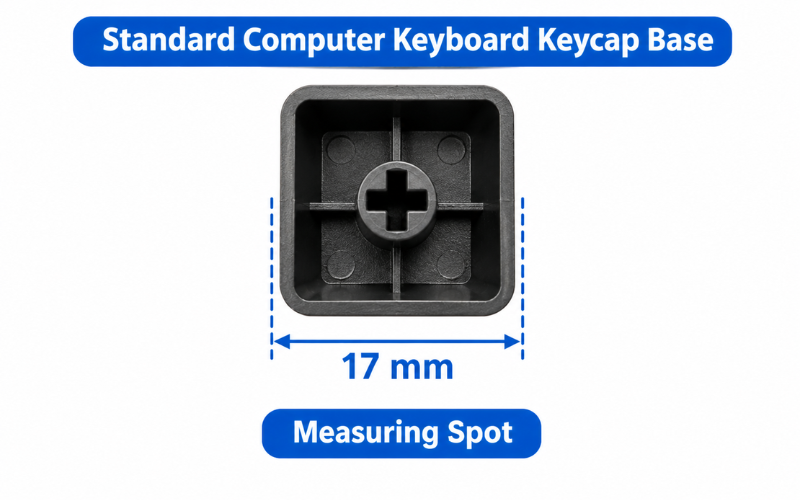
6. Standard Computer Keyboard Keycap Base
Take a look down at the keyboard beneath your fingers. While the top surface of a keycap tapers inward to guide your fingertip toward the center, the square base of a standard desktop keyboard keycap (such as Cherry MX profile) measures roughly 18mm by 18mm.
The main stem assembly, inner cylindrical housing, and the actual concave contact zone of the key face measure between 16.5mm and 17mm across. When you place a finger squarely on a letter key, the width your skin covers across the key dish matches 17mm.
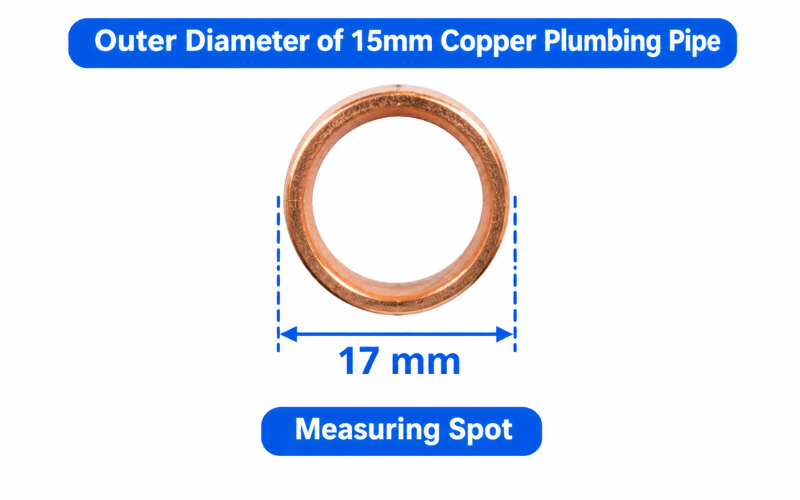
7. Outer Diameter of 15mm Copper Plumbing Pipe
Plumbers encounter 17mm daily when installing residential copper piping. In many plumbing systems, standard half-inch nominal copper pipe (often sold as 15mm metric pipe in Europe and modern installations) features an internal flow diameter of 15mm, but its outer diameter measures approximately 16.8mm to 17.1mm depending on wall thickness.
Push-fit connectors, compression olives, and pipe clips built for residential water lines are molded to clasp securely around this 17mm outer surface.
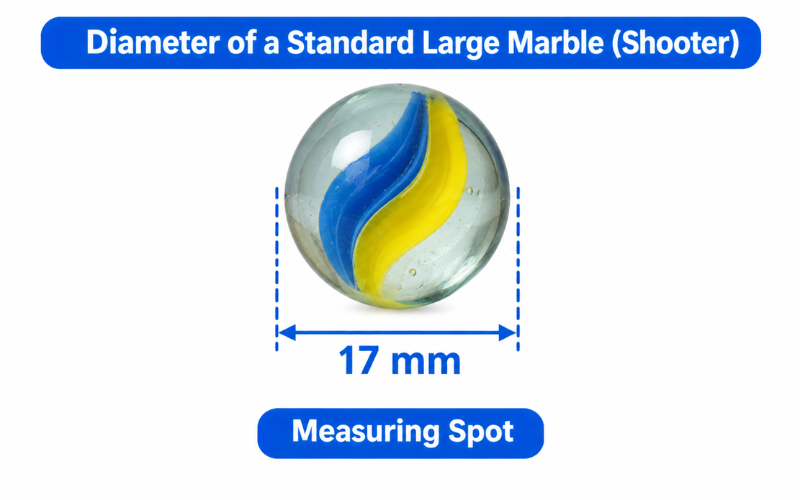
8. Diameter of a Standard Large Marble (Shooter)
Children’s toy marbles come in defined sizes. While basic target marbles measure about 12mm to 14mm, intermediate game marbles and small “shooter” marbles traditionally measure 17mm.
Holding one of these glass spheres gives you a tactile, three-dimensional impression of a 17mm volume. Unlike a flat coin or a thin washer, a 17mm sphere illustrates how much space a 17mm cubic area occupies in your palm.
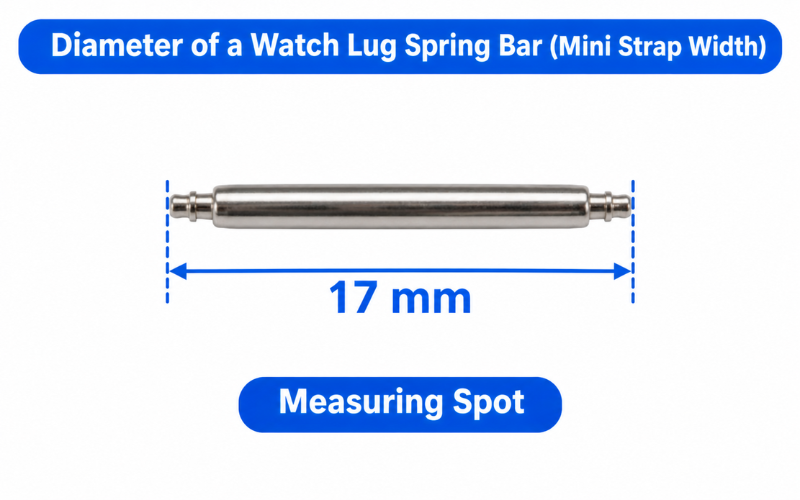
9. Diameter of a Watch Lug Spring Bar (Mini Strap Width)
Watch collectors often purchase bands and straps by the millimeter. Vintage men’s wristwatches and modern unisex timepieces frequently utilize 17mm lug widths.
Brands such as Swatch, vintage Omega, and mid-century dress watches often require a 17mm leather band or metal bracelet. The spring-loaded steel bar that clips the strap directly into the watch case spans this precise gap. If you hold a 17mm watch strap, its width gives you an exact flat edge to benchmark against other small items.
10. Standard Ear Gauge (5/8 Inch Transition Size)
Body modification jewelry relies on strict millimeter increments. While a 5/8-inch ear plug or tunnel measures approximately 15.88mm, many piercing studios stock 17mm plugs as custom intermediate stretching jewelry or outer-flare borders.
Placing an ear tunnel or cylindrical piercing plug of this grade on a flat surface shows a cylinder with a cross-section matching 17mm, giving body art enthusiasts a direct visual gauge.

How to Accurately Measure 17mm Without a Ruler
When you do not have a caliper or ruler handy, you can construct an accurate makeshift gauge using items you carry every day.
Using Pocket Change
Grab two coins: a dime and a penny. Lay the dime flat on a piece of paper. Trace the circular perimeter with a fine mechanical pencil. The circle you draw will measure roughly 18mm.
Shave a line just inside the pencil border, and you have produced a reliable 17mm reference circle. If an unknown object fits completely inside the silhouette of a dime without touching the rim, its diameter sits well under 17mm.
Using Metric Wrench Markings
If you keep a multi-tool or basic socket set in your trunk, grab the 17mm socket. Flip it upside down so you view the hex opening. The interior distance between opposing parallel flat edges measures 17mm.
You can drop screws, nuts, dowels, or cable ends into this recess. If the object drops in with minimal play, its width hovers around 17mm.
Using Adult Finger Joints
Human hands vary, but the distance between the side creases of an adult’s middle finger proximal joint (the knuckle nearest your palm) often spans between 16mm and 19mm.
Measure your knuckles once with a tape measure at home. Once you determine which finger joint measures 17mm wide, you carry a personal, built-in ruler everywhere you go.
Frequently Asked Questions About 17mm
How big is 17mm compared to an inch?
Seventeen millimeters equals 0.669 inches. In practical terms, that represents roughly two-thirds of an inch. If you divide an inch into sixteen equal parts, 17mm is just a hair below eleven-sixteenths of an inch (11/16″).
Is 17mm the same as 1.7 cm?
Yes. The metric system operates on base-ten multiplication. There are 10 millimeters in every centimeter. Dividing 17 by 10 yields exactly 1.7 centimeters.
What wrench fits a 17mm bolt?
A standard 17mm metric open-end or box wrench fits a 17mm bolt head. If you only have imperial tools, an 11/16-inch wrench measures 17.46mm. While an 11/16-inch wrench can turn a loose 17mm fastener in an emergency, the extra 0.46mm of play can round off the bolt corners under high torque.
Is a penny 17mm wide?
No. A United States one-cent coin measures 19.05mm in diameter. A US dime measures 17.91mm, making the dime much closer to 17mm than a penny.
What size socket do automotive lug nuts take?
Passenger vehicles commonly use 17mm, 19mm, or 21mm lug nuts and bolts. European passenger cars from manufacturers like Volkswagen, Mercedes-Benz, and BMW routinely use 17mm lug bolts to mount factory wheels to the hub.
Keeping the scale of 17mm clear in your mind eliminates guesswork during home repairs, hobby building, and routine maintenance. Using practical everyday benchmarks like the button on your jeans, an M10 bolt head, or a standard dime allows you to determine dimensions with rapid confidence.
Related Posts
- 10 Common Things That Are 16 mm Big
- 10 Common Things That Are 15 mm Big
- 10 Common Things That Are 14 mm Big
- 10 Common Things That Are 13 mm Big
Conclusion
Gauging small dimensions becomes simple once you anchor abstract metric figures to everyday objects. Instead of searching for a ruler, you can look at the button on your jeans, hold a dime, or check the width of an M10 bolt head. These familiar reference points turn an unfamiliar measurement into an instinctive visual guide.
Recognizing the scale of 17mm saves valuable time during hardware repairs, automotive tasks, and craft projects. With these ten everyday comparisons in mind, you can size up fasteners, fittings, and household parts with immediate accuracy and confidence.
FOR MORE MEASUREMENTS VISIT: MEASURINGSPOT