
Have you ever looked at a measurement like how big is 14 mm on paper and wondered what it actually looks like in real life? Metric measurements are simple on a ruler, but translating small numbers into tangible everyday items can be tricky without a physical reference nearby.
Fourteen millimeters sits right in that sweet spot where an object is too substantial to miss, yet compact enough to hold between the tips of your fingers. Whether you are buying replacement hardware, picking out jewelry, or shopping for camera equipment, knowing what 14mm looks like helps you make the right choice instantly.
Here is a straightforward visual guide to 14 millimeters, complete with common household items, handy reference charts, and practical comparisons you can find right in your home.
Quick Answer: How Big is 14mm?
Fourteen millimeters equals exactly 1.4 centimeters, or roughly 0.55 inches. That makes it just slightly larger than half an inch.
If you want an instant everyday comparison, place a standard dime flat on a table. A US dime measures about 17.9mm wide, so 14mm is roughly three-quarters of that diameter. Alternatively, look at the thick end of a standard AA battery or the width of an adult fingernail. Both hover right around the 14mm mark.
Quick Conversion & Reference Guide
Here is how 14mm converts into other standard units of measurement used across the globe.
Standard Measurement Conversions
| Unit of Measurement | Equivalent Value |
| Millimeters (mm) | 14 mm |
| Centimeters (cm) | 1.4 cm |
| Meters (m) | 0.014 m |
| Inches (in) | 0.551 inches (approx. 9/16 in) |
| Feet (ft) | 0.0459 feet |
Biowiki Reference Chart: 14mm at a Glance
| Attribute | Specification Details |
| Exact Dimension | 14 millimeters / 1.4 centimeters |
| Imperial Fractional Estimate | Roughly 9/16 of an inch (just over 1/2 inch) |
| Standard Tool Socket Equivalent | 14mm Metric Socket (common M8 bolt size) |
| Watch Lug Fit | Common slim strap size for vintage and women’s wristwatches |
| Common Lens Thread | Ultra-wide focal length in full-frame photography |
| Body Jewelry Gauge Equivalent | Roughly equivalent to 9/16″ plugs or tunnels |
| Best Household Analogue | Diameter of an AA battery base or standard snap button |
| Weight Class Reference | Comparable to diameter of marble game target spheres |
10 Everyday Things That Are 14mm Big
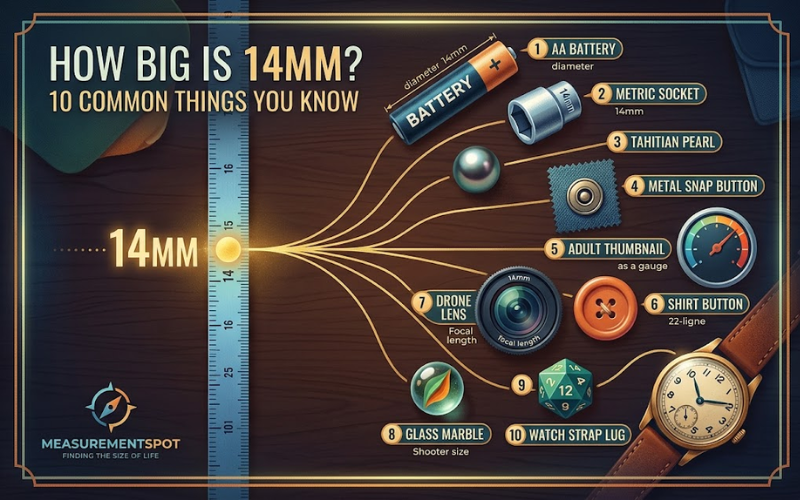
When you do not have a caliper or ruler handy, your surroundings offer plenty of exact measuring benchmarks. Here are ten widely recognized items that capture the 14mm dimension.
1. The Diameter of an AA Battery
Batteries power countless remote controls, toys, and wall clocks, making them one of the easiest tools for a fast size check. Standard AA cylindrical cells measure almost exactly 14 millimeters in diameter across their circular base (specifically ranging between 13.5mm and 14.5mm according to international manufacturing standards).
When you stand an AA battery on end and trace the circular base onto a piece of paper, you produce a circle that matches 14mm across. If you are ever trying to figure out whether a bolt head or a bead will fit through an opening, testing it against the rim of an AA battery gives you an instant verdict.

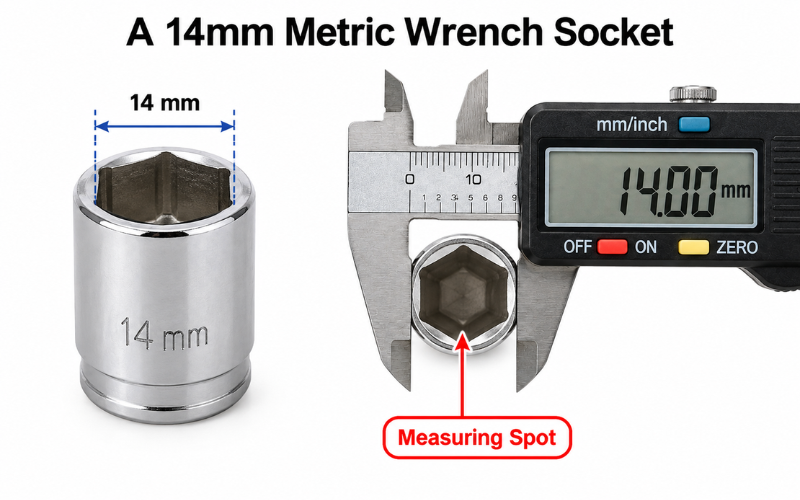
2. A 14mm Metric Wrench Socket
Anyone who works on imported cars, bicycles, or flat-pack furniture knows the 14mm socket very well. In mechanical engineering and automotive assembly, 14mm is one of the most widely used wrench sizes worldwide.
The inner opening of a 14mm hex socket fits over standard M8 bolts with Japanese Industrial Standard heads or common M10 bolt heads. When you hold that hexagonal opening in your hand, you are looking at exactly 14 millimeters from one flat interior edge to the opposing flat interior edge. It provides a precision-machined reference that does not change or warp over time.
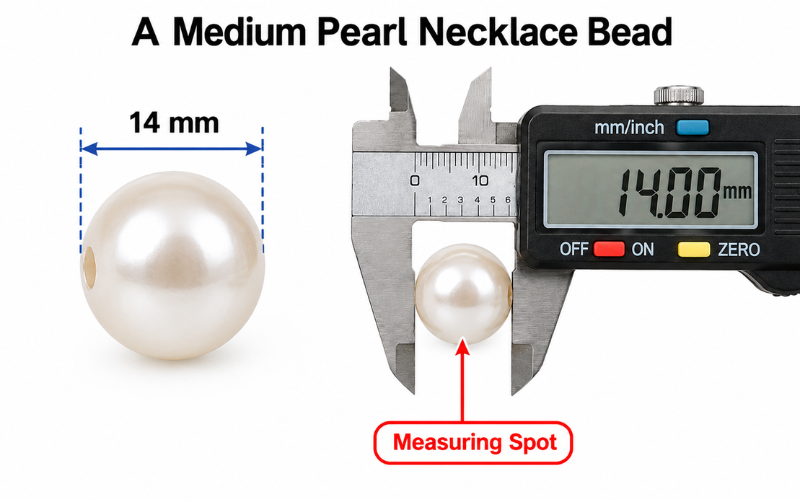
3. A Medium Pearl Necklace Bead
Jewelry makers classify natural and cultured pearls by their millimeter diameter. While entry-level freshwater pearls usually fall between 6mm and 8mm, high-end South Sea and Tahitian cultured pearls frequently reach the coveted 14mm threshold.
A 14mm pearl makes a bold statement as a solo pendant on a chain or as the centerpiece of a formal necklace. It is roughly the size of a large marble, resting comfortably across the collarbone without feeling overly bulky. If you pick up a premium Tahitian cultured black pearl, its sphere represents 14mm in three dimensions.
4. A Standard Metal Jacket Snap Button
Look closely at your winter parka, denim trucker jacket, or canvas backpack. Most heavy-duty metal press studs (snap fasteners) use caps that measure exactly 14 millimeters across the front face.
Garment manufacturers label these as size 20 to 24 snaps, which correspond to a surface diameter of 14mm to 15mm. When snapped shut, the circular decorative cap covers a neat 14mm footprint on fabric. It gives you a reliable reference point that is often already hanging in your closet.

5. An Average Adult Thumbnail Width
Human bodies vary, but human anatomy often mirrors standardized metric increments with surprising regularity. For many adult women and men with medium-sized hands, the widest part of the fingernail on the index or middle finger measures between 13mm and 15mm.
If you press your middle fingernail flat against a desk, the horizontal distance across the cuticle or mid-nail plate frequently sits at 14mm. While you should not use your finger to mill airplane parts, it serves as a wonderful pocket-free gauge when you browse hardware stores or craft aisles.

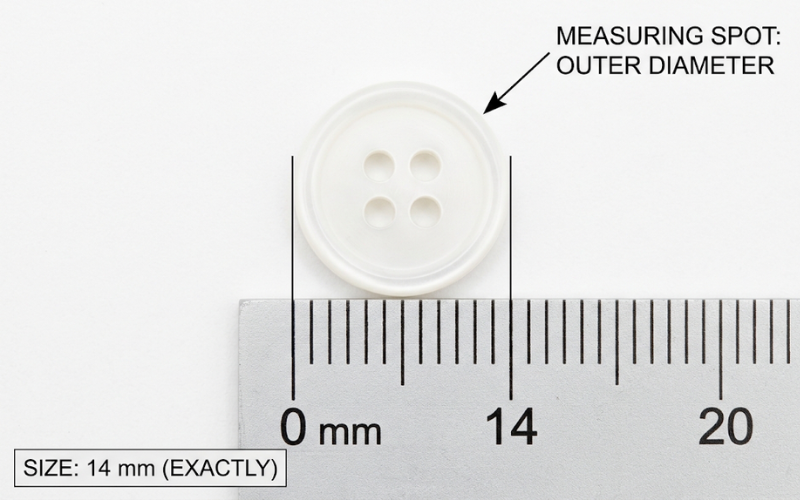
6. A Standard Four-Hole Dress Shirt Cuff Button
Tailors rely on a specialized scale known as lignes to measure button sizes, where 1 ligne equals 0.635 millimeters. Medium-large utility buttons, specifically 22-ligne buttons, measure approximately 14 millimeters across.
You commonly find 14mm buttons on the cuffs and collars of casual shirts, the waistbands of tailored trousers, and lightweight cardigans. When you unbutton your sleeve cuff before rolling it up, you are gripping a flat disc that matches the 14mm standard.
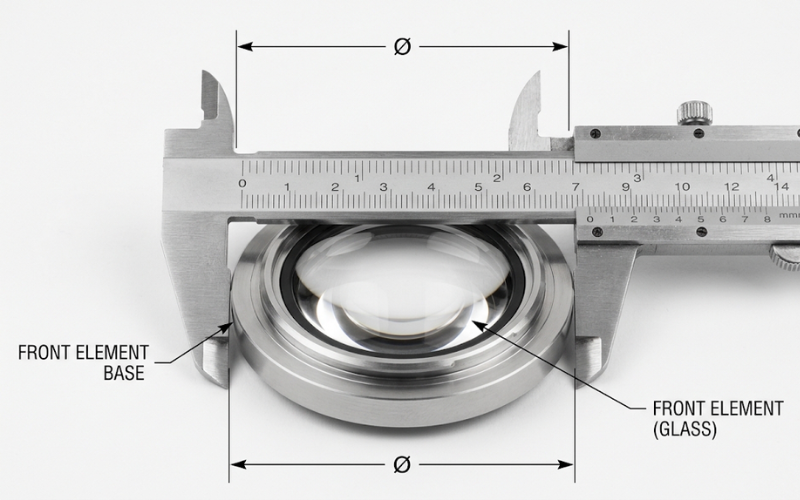
7. A 14mm Camera Lens Front Element Base
Photographers revere 14mm as a legendary focal length for ultra-wide angle landscape and architectural captures. While the exterior housing of a 14mm camera lens is much larger, the focal length itself describes the optical center’s distance to the sensor plane: exactly 14mm.
Beyond focal lengths, several compact action cameras and drone gimbal units use front protective glass filters and sensor covers with an aperture diameter of exactly 14 millimeters. When you look at the tiny round lens opening on several modern mini drones, you are looking at a 14mm aperture opening.
8. A Large Glass Marble (Shooter Marble)
Traditional marble games feature two main sizes: common target marbles and shooter marbles. While regular playing marbles measure about 12mm or 1/2 inch, the smaller variety of shooter marbles measures 14mm in diameter.
These colorful glass spheres sit comfortably between your thumb and index finger. When rolled down an inclined track or held up to the light, their spherical diameter measures 14mm from pole to pole.

9. A Standard D12 Polyhedral Gaming Die Face
Tabletop gaming enthusiasts who play role-playing games use twelve-sided dice (d12s). While standard six-sided dice usually measure 16mm across their cube bodies, a standard 12-sided die features individual pentagonal face heights that hover right at 14mm.
Additionally, mini-sized polyhedral sets feature six-sided dice designed at 14mm cubes instead of full 16mm tabletop standards. If you grab a travel-sized gaming die from a tabletop set, its flat edge-to-edge profile showcases 14mm.

10. A 14mm Watch Strap Lug Width
Watch straps attach to the watch case between two metal prongs called lugs. In vintage timepieces and elegant ladies’ watches, 14mm is one of the most common standard lug widths.
If you measure the leather strap where it connects directly to the metal watch body with a spring bar, a 14mm band measures exactly that width across the leather edge. It creates a refined, understated profile on the wrist compared to contemporary 20mm or 22mm sports watch straps.

Why 14mm Matters Across Different Industries
Measurements take on different levels of importance depending on the trade. A difference of a single millimeter can ruin an engineering project or change the value of a gemstone by thousands of dollars.
Mechanical Engineering and Auto Repair
Mechanics keep multiple 14mm wrenches, ratchet extensions, and sockets in their rolling toolboxes for a reason. Modern vehicle manufacturers (especially Honda, Toyota, Nissan, and Subaru) use M10 threaded fasteners with 14mm hex heads extensively throughout the engine bay, brake caliper assemblies, and suspension linkages.
When you perform a brake pad change or loosen an alternator bracket, a 14mm wrench is often the exact tool required. Stripping a 14mm fastener head with an ill-fitting 9/16-inch imperial tool causes severe headaches, proving why exact metric sizing remains crucial in mechanical trades.
Body Jewelry and Piercings
In body modification, jewelry gauges step up incrementally. While fine ear piercings start at 20 gauge (0.8mm) or 16 gauge (1.2mm), stretched lobe piercings eventually cross into fractional inch and millimeter territory.
The 14mm threshold represents 9/16 of an inch in stretched ear plugs and tunnels. At this size, the jewelry becomes wide enough to view clear light directly through the lobe. Piercers monitor these dimensions meticulously because jumping past 14mm requires careful tissue adjustment and strict healing timelines.
Crafting, Sewing, and Haberdashery
Crafters and leatherworkers rely on 14mm eyelets, metal rivets, and decorative conchos. When constructing a leather tote bag, 14mm rivets provide enough surface area to bind thick 8-ounce leather straps without pulling through the fibers under tension.
Similarly, paper crafters use 14mm circular hole punches to create customized sticker seals, coin envelope closures, and scrapbooking embellishments.
Common Misconceptions About 14mm
People frequently mix up metric measurements because the jump between units sounds subtle to the untrained ear.
Confusing 14mm with Half an Inch
Many people assume that 14mm and 1/2 inch are interchangeable. In reality, 1/2 inch converts precisely to 12.7 millimeters.
That means 14mm is 1.3 millimeters larger than half an inch. While 1.3mm might seem negligible when you look at a wall frame, it makes a massive difference in plumbing fittings, bolt threads, and jewelry settings. A 1/2-inch wrench will not fit over a 14mm bolt head, and a 14mm wrench will slip and strip a 1/2-inch bolt.
Mixing Up 14mm and 1.4 Centimeters
Some people get thrown off when moving decimal points between millimeters and centimeters. Keep in mind that 14mm and 1.4cm describe the exact same length. Metric units work on multiples of ten, so you simply divide millimeters by ten to find centimeters.
If you see a product listing with dimensions given in centimeters, a 1.4cm measurement is identical to 14 millimeters.
How to Measure 14mm Without a Ruler
If you find yourself without a metric ruler or digital calipers, you can still estimate 14mm with high accuracy using basic items from your wallet or pocket.
The Coin Stacking Method
Coins feature strict governmental minting tolerances, making them exceptional improvised measuring tools.
Take standard US pennies, which have an official thickness of 1.52 millimeters each. If you stack nine standard copper-plated zinc pennies flat on top of each other, the total height of the stack equals approximately 13.68 millimeters, which is less than a third of a millimeter shy of 14mm.
If you use European currency, an eight-stack of 2-Euro-cent coins (each 1.67mm thick) lands just over 13.3mm, while standard 10-cent Euro coins (1.93mm thick) stacked seven high reach 13.5mm.
The Folded Paper Method
A standard sheet of printer paper offers a convenient measuring aid. Standard office paper measures 8.5 by 11 inches in North America or 210 by 297 millimeters internationally (A4 format).
If you use an A4 sheet, its narrow width is exactly 210mm. By folding the narrow side into three equal sections, you obtain 70mm panels. Folding that panel in half yields 35mm. While folding paper repeatedly introduces minor creases, five precision folds can bring you within striking distance of small metric checks.
However, relying on an AA battery base or a 14mm hex bolt remains far faster and considerably more accurate.
Frequently Asked Questions About 14mm
How big is 14mm compared to an inch?
Fourteen millimeters is slightly larger than half an inch. One inch contains 25.4 millimeters, which places 14mm at approximately 0.551 inches. On an imperial tape measure, 14mm falls between 1/2 inch (12.7mm) and 9/16 inch (14.28mm), sitting right near the 9/16-inch hash mark.
Is 14mm considered large for jewelry?
For rings and fine chain links, 14mm is quite large. A 14mm gemstone or pearl creates a prominent statement piece. However, for watch straps and brooch pins, 14mm represents a petite or standard medium size. For body piercing plugs, 14mm (9/16″) marks an intermediate-to-large gauge.
What size socket replaces a 14mm if I only have imperial tools?
A 9/16-inch socket comes closest to a 14mm socket, measuring 14.288mm. While a 9/16-inch tool might turn a loose 14mm bolt in an emergency, it fits slightly loose. Using it on tight or rusted hardware risks rounding off the corners of the bolt head. You should always use a true 14mm socket whenever possible.
What coins have a 14mm diameter?
Very few circulating modern coins have a diameter as small as 14mm because such tiny coins slip through pockets and fingers too easily. For comparison, the smallest current US coin (the dime) is 17.91mm, and the UK five-pence piece is 18mm. However, historical coins like small silver three-cent pieces or antique gold coins frequently measured between 14mm and 15mm.
How many millimeters are in 1.4 centimeters?
There are exactly 14 millimeters in 1.4 centimeters. Because the metric system uses base-10 increments, you simply multiply centimeters by 10 to calculate the total number of millimeters.
How do I check if my watch takes a 14mm band?
Take a ruler with millimeter markings and measure the space between the inside edges of the watch lugs where the strap sits. If the distance from the inside of the left prong to the inside of the right prong reads 1.4 centimeters, your watch requires a 14mm replacement strap.
Related Posts
- 10 Common Things That Are 12 mm Big
- 10 Common Things That Are 11 mm Big
- 10 Common Things That Are 10 mm Big
- 10 Common Things That Are 9 mm Big
Conclusion
Recognizing how big 14mm is becomes simple once you connect it to familiar objects around you. Instead of guessing how 1.4 centimeters translates into the real world, you can rely on the base of an AA battery, a jacket snap button, or a standard metric socket as reliable, everyday benchmarks.
Keeping these quick reference points in mind saves you time and prevents mistakes when shopping online, tackling DIY repairs, or choosing the right accessories. Whether you work with tools, jewelry, or craft projects, you now have an easy visual anchor whenever the 14mm measurement appears.
FOR MORE MEASUREMENTS VISIT: MEASURINGSPOT