
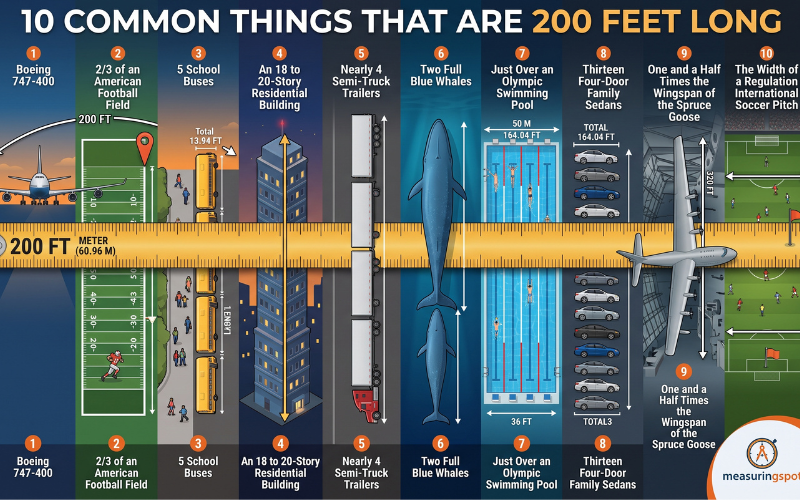
Have you ever stood in the middle of a wide open field or looked up at a high-rise building and wondered, how long is 200 feet long?
Distances measured in hundreds of feet can be deceptively tricky for human eyes to measure accurately without a measuring tape. Two hundred feet is far beyond arm’s reach, yet it sits right in that sweet spot where everyday structures, athletic fields, and transportation vehicles operate.
In this guide, you will discover exactly what 200 feet looks like through familiar landmarks, vehicles, and sporting grounds, alongside a helpful quick-reference guide and interactive breakdown.
Quick Reference: How Long is 200 Feet Long?
To get an immediate sense of scale before exploring individual objects, here is how 200 feet translates into standard units and universal everyday comparisons:
- In Yards: Exactly 66.67 yards (roughly two-thirds of an American football gridiron).
- In Meters: Approximately 60.96 meters.
- In Inches: 2,400 inches.
- In Average Human Walking Steps: Around 80 to 85 paces for an adult walking at a natural stride.
- In Standard City Lots: About 4 to 5 standard residential suburban home frontages placed shoulder to shoulder.
- In School Buses: Nearly 5 full-length school buses parked bumper-to-bumper.
Biowiki & Dimension Factsheet: The Anatomy of 200 Feet 📊
| Attribute / Measurement Metric | Exact Value / Common Equivalent | Real-Life Perspective |
| Imperial Distance | 200 Feet (ft / ‘) | The distance an arrow travels from a standard target archer |
| Metric Distance | 60.96 Meters (m) | Just over the length of an Olympic swimming pool (50 m) |
| Total Inches | 2,400 Inches (in / “) | Equivalent to 200 12-inch rulers laid end to end |
| Total Centimeters | 6,096 Centimeters (cm) | Standard scientific conversion |
| Statute Miles | ~0.03788 Miles | Roughly 1/26th of a standard US road mile |
| Adult Walking Duration | ~45 to 50 seconds | Assuming a casual pedestrian pace of 3.0 mph |
| Average Sound Travel Time | ~0.177 seconds | Speed of sound through 68°F (20°C) ambient air |
| Highway Vehicle Coverage | ~2.04 seconds | For a car traveling at 65 mph (covers ~95.3 ft/sec) |
| Average Bowling Lanes | 3.3 lanes | Traditional 60-foot lane foul line to headpin |
| Standard Semitrailer Units | ~3.8 trailers | Standard 53-foot dry van logistics haulers |
1. The Wingspan of a Boeing 747-400 Jumbo Jet
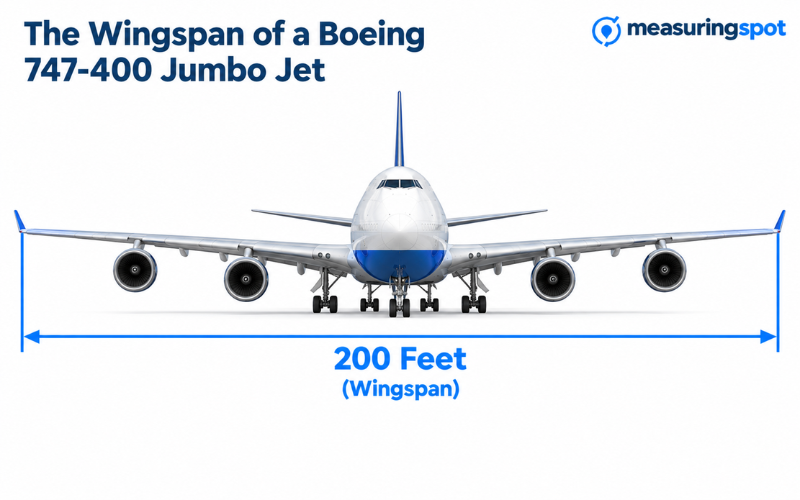
Commercial aviation provides some of the most reliable visual benchmarks for immense distances. The legendary Boeing 747-400—often called the “Queen of the Skies”—features a wingspan measuring almost exactly 211 feet and 5 inches (64.4 meters).
If you step back and observe the aircraft from directly in front, the straight-line span between the two wingtips gives you an almost flawless real-world impression of what 200 feet spans horizontally.
Why This Comparison Works
- The primary passenger cabin alone is massive, but the sweep of the titanium and aluminum wings stretches outward over two hundred feet to generate the lift needed for 400 tons of aircraft.
- When you board a widebody jet at an international terminal gate, glance out the window along the wing towards the winglet. You are looking across just over two hundred feet of aeronautical engineering.
2. Two-Thirds of an American Football Field
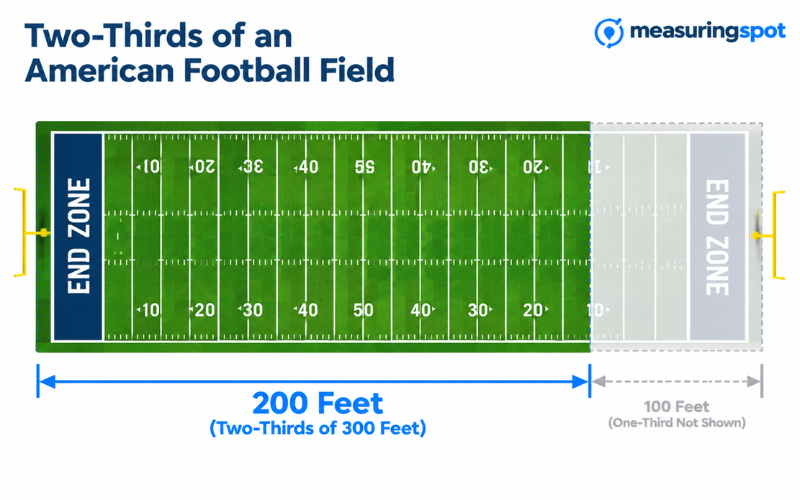
For sports fans in North America, the football field is the gold standard for measuring spatial distance. A full regulation American football field spans 360 feet from the rear of one end zone to the rear of the opposite end zone, with the active playing field measuring 300 feet (100 yards).
Breaking Down the Gridiron
- A distance of 200 feet equals exactly 66 yards and two feet.
- If an offense starts on their own goal line, a drive of 200 feet takes them all the way past midfield and down to the opponent’s 33-yard line.
- Alternatively, if you stand at one goal line and look straight across to the opposite 33-yard marker, that entire span of turf is precisely the 200-foot distance.
3. Five Full-Sized School Buses Parked Bumper to Bumper
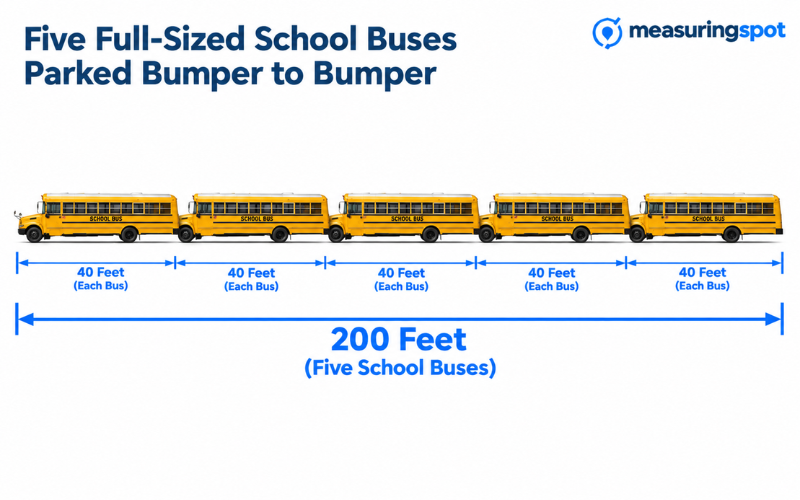
Nearly everyone has ridden on, driven behind, or walked past a yellow school bus. The classic Type D full-capacity school bus typically measures between 38 and 40 feet in length, accommodating up to 72 or 84 passengers.
How the Math Lines Up
- Take five of these full-size 40-foot buses and line them up bumper-to-bumper along a curb.
- 5 buses × 40 feet = 200 feet total length.
- If you include a tiny six-inch gap between bumpers for realism, four 45-foot coach transit buses or five standard 40-foot district buses land right at the 200-foot finish line.
The next time you see a line of buses waiting outside a school or sports complex in the afternoon, count five buses down the line to visually grasp 200 linear feet.
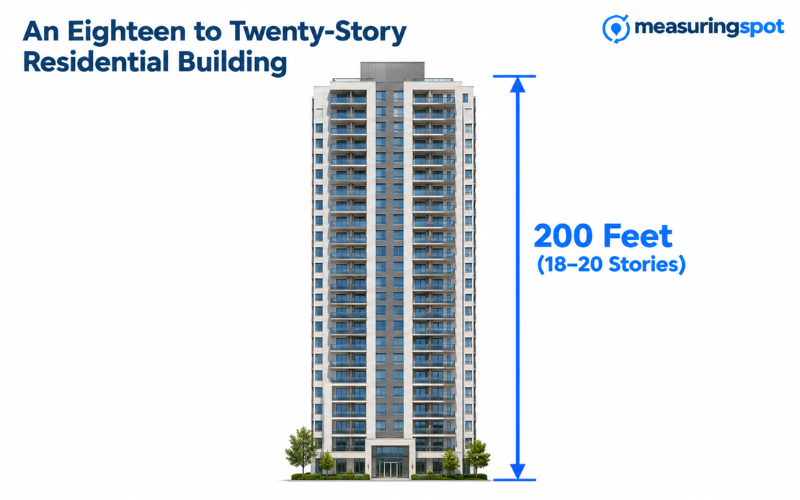
4. An Eighteen to Twenty-Story Residential Building
While horizontal measurements are easy to pace out, vertical distance often carries a dramatic sense of scale due to gravity and perspective. Architectural planning calculates roughly 10 feet per story for typical multi-family residential buildings, and approximately 11 to 13 feet per floor for commercial office structures with suspended ceilings.
Looking Upward
- A standard residential tower of 18 to 20 stories stands approximately 180 to 200 feet tall.
- If you stand on the street pavement and tilt your head up toward a 20th-floor balcony, the vertical span from your shoes to the railing above is almost exactly 200 feet.
- Notable historic monuments share this height: the famous Wings of the Republic and several city hall clock towers across mid-sized cities hover around the 190-to-205-foot mark.
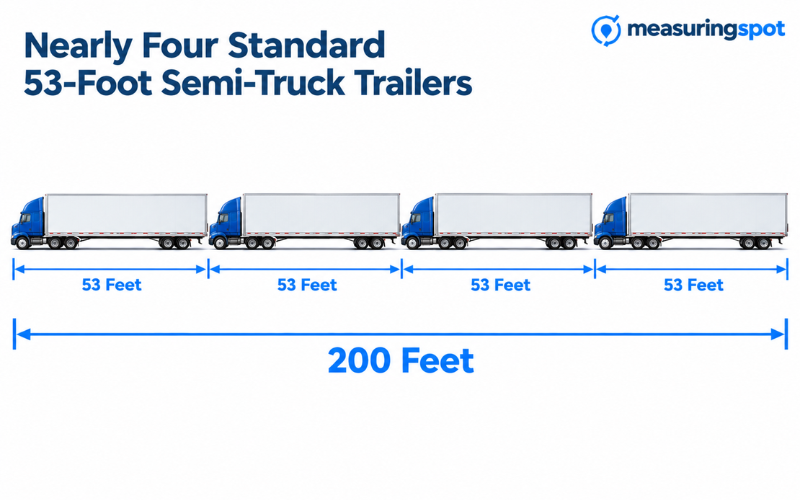
5. Nearly Four Standard 53-Foot Semi-Truck Trailers
Freight shipping trailers crisscross highways across the world every single day. The standard dry van trailer pulled by Class 8 tractor trucks in North America is the ubiquitous 53-foot trailer.
Industrial Perspective
- Each trailer box alone is 53 feet long (excluding the cab).
- Three trailers parked in a line equal 159 feet.
- Add three-quarters of a fourth trailer, and you reach 200 feet.
- If you include the truck cab itself (which brings a typical semi rig to roughly 70 to 72 feet overall), three complete tractor-trailers parked in a single lane equal approximately 210 feet—making three passing big rigs on the highway an excellent roadside benchmark.
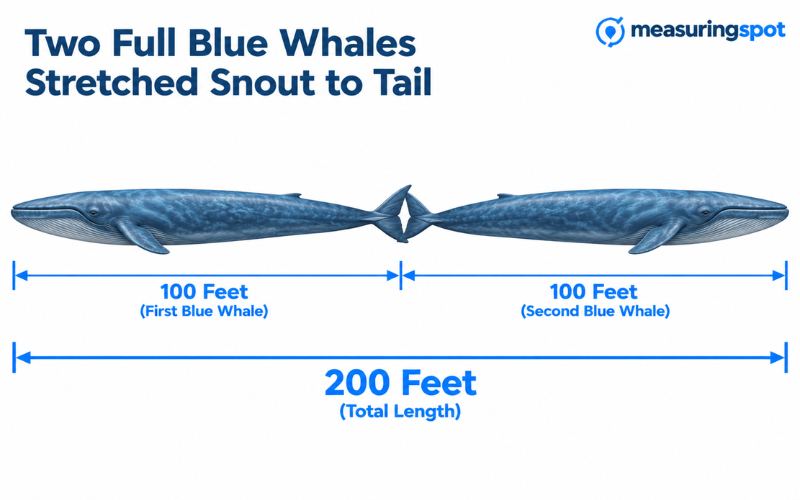
6. Two Full Blue Whales Stretched Snout to Tail
The blue whale (Balaenoptera musculus) holds the title of the largest animal known to have ever lived on Earth, surpassing even the largest titanosaur dinosaurs in total bulk and mass.
Nature’s Marvel of Measurement
- A fully grown mature adult blue whale reaches an average length of 80 feet to 100 feet (24 to 30 meters).
- Aligning two maximum-sized mature blue whales end-to-end from their broad rostrums to their massive flukes yields an astonishing distance of roughly 190 to 200 feet.
- Visualizing two of these gentle giants swimming nose-to-tail offers one of the most vivid biological impressions of two hundred feet imaginable.
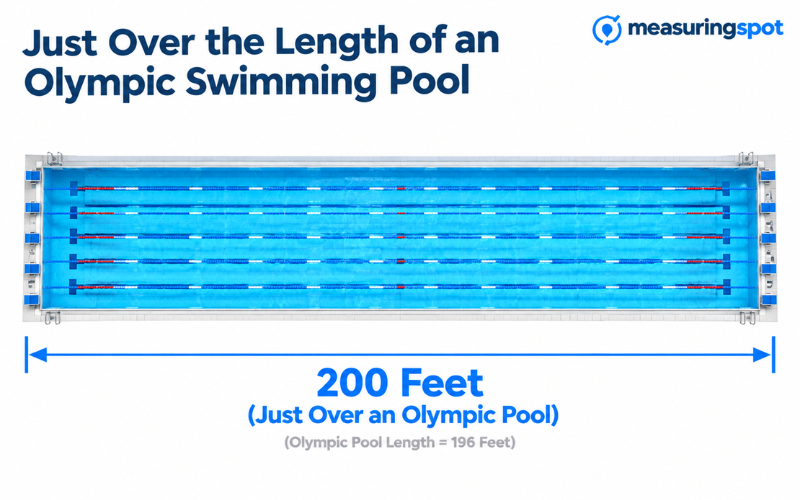
7. Just Over the Length of an Olympic Swimming Pool
Anyone who has swum competitive laps knows how daunting a long-course pool appears from the starting blocks. Olympic-size competition pools are built to strict global standards overseen by World Aquatics.
Poolside Math
- A regulation Olympic competition pool measures exactly 50 meters in length, which equals 164.04 feet.
- While 164 feet is short of 200 feet, you only need to add roughly 36 feet (the length of about two mid-size passenger sedans) to reach 200 feet.
- If you swim one length of an Olympic pool and then continue for approximately 3.5 additional strokes off the wall, you have covered precisely 200 linear feet in the water.
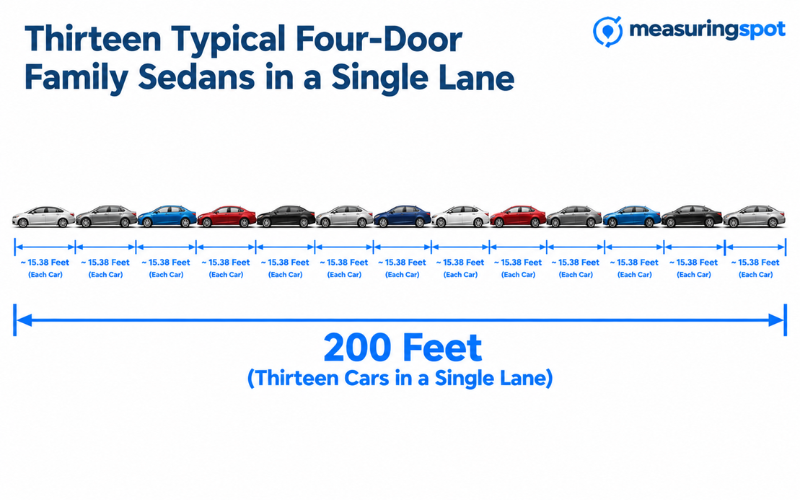
8. Thirteen Typical Four-Door Family Sedans in a Single Lane
Vehicles parked along a suburban avenue provide an accessible urban measuring stick. The average mid-size family car—such as a Toyota Camry, Honda Accord, or Ford Fusion—measures roughly 15.5 to 16.0 feet (4.8 to 4.9 meters) from front grille to rear tailpipe.
Calculating the Parking Row
- If you park mid-size sedans tightly bumper-to-bumper:
- 12.5 to 13 cars measure roughly 200 feet.
- In real-world parallel street parking conditions, where drivers leave around 3 feet to 4 feet of maneuverability between vehicles:
- Roughly 10 parallel parked cars along a city street take up almost exactly 200 feet of curb space.
- If you want to know how much curb 200 feet covers, count ten cars parked outside your local post office or grocery store.
9. One and a Half Times the Wingspan of the Spruce Goose 🪵
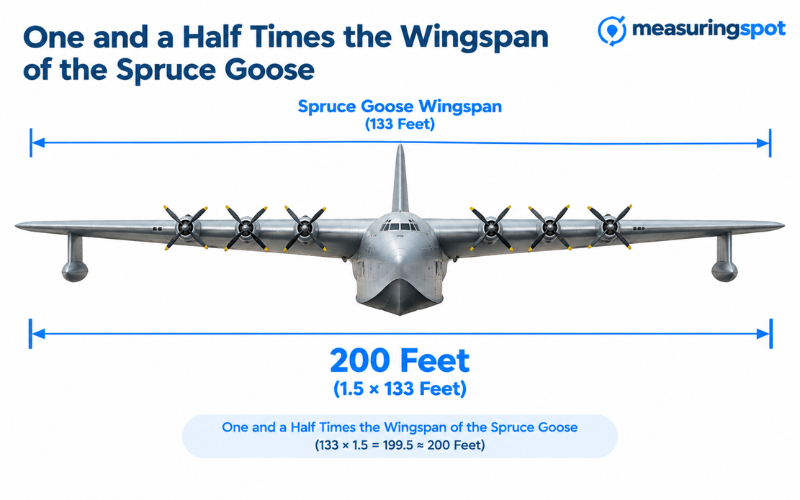
Aviation history enthusiasts often recall Howard Hughes’ iconic H-4 Hercules, affectionately known as the Spruce Goose. For decades, this wooden mammoth held the title for the widest wingspan of any operational aircraft ever flown.
Massive Aviation Proportions
- The wingspan of the Spruce Goose is an astonishing 320 feet (97.5 meters).
- Looking at the reverse comparison, the fuselage (body) of the Spruce Goose from the cockpit nose to the tip of the tail control surface measures roughly 218 feet.
- Walking alongside the central fuselage of this historic flying boat at the Evergreen Aviation & Space Museum in Oregon takes you across just over 200 feet of vintage laminated birchwood construction.
10. The Width of a Regulation International Soccer Pitch
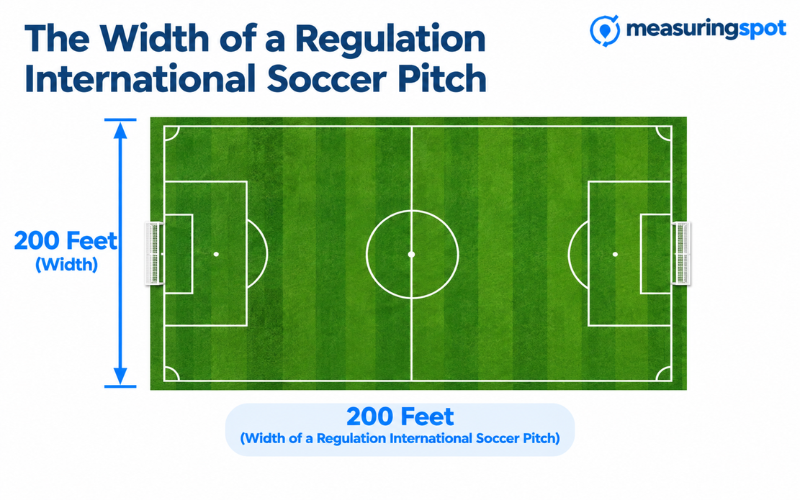
While casual fans focus on the goal-to-goal length of a soccer field, the width (the touchline-to-touchline distance) often hits near the 200-foot mark.
Pitch Dimensions
- FIFA guidelines for international matches mandate a field width between 70 and 75 yards (210 to 225 feet).
- However, for many domestic league grounds, high school stadiums, and community turf fields, regulation field widths are commonly set at 65 to 70 yards (195 to 210 feet).
- When a winger boots a cross from one touchline directly across the pitch to the far sideline, the ball travels across roughly 200 feet of grass.
How Long Does It Take to Walk, Run, or Drive 200 Feet?
Experiencing distance through time and bodily motion helps cement spatial awareness. Here is how long it takes to traverse 200 feet through various human activities:
1. Casual Walking Pace (3 Miles Per Hour)
The average adult walking speed is between 2.8 and 3.2 mph, which equals approximately 4.4 feet per second.
- At this rate, walking 200 feet takes roughly 45 to 48 seconds.
- It requires around 80 to 85 casual walking steps.
2. Sprinter Speed (15 to 20 Miles Per Hour)
A trained high school or collegiate sprinter running at full tilt covers approximately 25 to 30 feet every second.
- Clearing 200 feet (roughly 61 meters) takes an athlete between 6.8 and 8.0 seconds.
- That is roughly the duration of an indoor 60-meter sprint race.
3. Highway Driving (65 Miles Per Hour)
At 65 miles per hour, your car travels at roughly 95.33 feet per second.
- You cover 200 feet in just 2.1 seconds.
- A brief glance down at a dashboard gauge or radio screen means your car has rolled across 200 feet of asphalt before you look back up.
Everyday Practical Scenarios Involving 200 Feet
Knowing what 200 feet looks like is surprisingly practical across various trade professions and hobbyist pursuits:
Real Estate & Property Boundary Surveys
In rural and suburban property listings, lot depths frequently measure 150 to 200 feet. A lot measuring 100 feet wide by 200 feet deep comprises roughly 20,000 square feet—just under half an acre (0.46 acres). When walking the property lines of an acreage parcel, 200 feet represents a generous backyard space with room for a patio, lawn, garden shed, and mature tree line.
Home Improvement & Garden Hoses
Standard heavy-duty commercial garden hoses typically come in 50-foot and 100-foot sections. Connecting two 100-foot hoses gives you 200 feet of reach. If you have ever dragged two connected contractor hoses from your outdoor spigot around the corner of your garage out to a far flower bed, you have experienced the physical weight and drag of 200 linear feet of hose.
Wireless Signals & Drone Flight Regulations
- Many standard home Wi-Fi routers operate reliably up to an outdoor line-of-sight range of 150 to 200 feet before the 5 GHz band begins dropping packets.
- Aviation authorities often mandate visual line-of-sight rules for recreational consumer drones. Keeping your drone within 200 feet keeps it crisp and easily distinguishable against open skies without needing binoculars.
Frequently Asked Questions (FAQs) ❓
How many seconds does it take to walk 200 feet?
At a normal walking pace of 3 miles per hour (around 4.4 feet per second), it takes an average adult between 45 and 48 seconds to walk 200 feet.
How many steps is 200 feet?
An average adult stride length is roughly 2.3 to 2.5 feet. Walking 200 feet takes between 80 and 88 normal footsteps. If you take long strides, you can cover it in about 70 to 75 steps.
How long is 200 feet compared to a football field?
A full 100-yard American football field (excluding end zones) is 300 feet long. Therefore, 200 feet is two-thirds (66.7%) of a standard football field, or exactly 66 yards and 2 feet.
How many meters is 200 feet?
200 feet is equal to 60.96 meters.
How many stories is a 200-foot building?
A 200-foot building is typically 18 to 20 stories tall for residential towers (around 10 feet per story) or 15 to 16 stories for commercial office buildings that require higher utility ceilings.
Can you throw a baseball 200 feet?
Yes. An average adult recreational player can throw a baseball roughly 120 to 160 feet. However, amateur athletes, high school outfielders, and trained amateur players can throw a baseball 200 to 250 feet on a fly with proper technique and arm conditioning.
Related Posts
- 10 Common Things That Are 90 Feet Long:
- 10 Common Things That Are 80 Feet Long:
- 10 Common Things That Are 70 Feet Long
- 10 Common Things That Are 60 Feet Long
Conclusion
Understanding how long is 200 feet long transforms an abstract number into tangible, everyday reality. Rather than relying on guesswork, you can now anchor this 60.96-meter distance to familiar markers you encounter every day—whether that means picturing five full-sized yellow school buses parked in a straight row, tracing two-thirds of a turf football field from the goal line to the 33-yard marker, glancing up at the balcony of a 20-story apartment tower, or taking roughly 85 walking paces down your neighborhood street. Whether you are surveying a suburban property line, mapping out home improvement projects, or simply gauging distances on your daily commute, keeping these common benchmarks in mind makes visualizing 200 linear feet second nature.
FOR MORE MEASUREMENTS VISIT: MEASURINGSPOT