
When someone mentions a distance like 5 feet or 10 feet, your brain grabs an instant reference point—a person’s height or the width of a bedroom door. But what happens when that number climbs up to 70 feet?
Unless you carry a commercial tape measure in your pocket everywhere you go, estimating a span of seventy feet can feel tricky. You might ask yourself: How long is 70 feet in everyday terms? Is it as long as a city bus, a bowling alley, or a two-story building?
Whether you are sizing up a piece of land, planning an event layout, checking vehicle clearances, or simply curious about spatial measurement, anchors from daily life make large numbers tangible. Let’s break down exactly how long is 70 feet, look at quick metric and imperial conversions, and explore 10 common things that measure around this length. 📏✨
Quick Reference: How Long Is 70 Feet at a Glance? ⚡
If you need a fast mental snapshot before diving into individual items, use these quick benchmarks:
- In Meters: Exactly 21.336 meters (around 21.3 m).
- In Inches: 840 inches.
- In Yards: 23.33 yards (nearly a quarter of an American football field).
- In Human Paces: Roughly 28 to 30 natural walking strides for an average adult (assuming a 2.5-foot stride).
- In Sedans: Approximately 4.5 to 5 midsize passenger cars parked bumper to bumper.
- In Building Height: Roughly a 6 to 7-story residential building tipped over on its side.
70 Feet Conversion & Dimensional BioWiki 📊
Here is a quick-look BioWiki reference table summarizing the exact dimensions, conversions, and practical equivalents of 70 feet across different measurement systems:
| Measurement Metric | Exact Value | Everyday Conceptual Equivalent |
| Feet (ft) | 70 ft | Standard building setback or lot depth |
| Meters (m) | 21.336 m | Slightly longer than an Olympic swimming pool width (21 m) |
| Inches (in) | 840 in | 70 standard 12-inch rulers laid end to end |
| Yards (yd) | 23.33 yd | About 23% of an American football field |
| Centimeters (cm) | 2,133.6 cm | Height of about 12 adults stacked vertically |
| Millimeters (mm) | 21,336 mm | Engineering scale reference |
| Average Human Steps | ~28–30 paces | Walking briskly for about 7 to 8 seconds |
| Standard School Busses | ~1.75 buses | One and three-quarter 40-foot transit buses |
| Sedan Lengths | ~4.7 cars | 4 full-size sedans plus front bumper overhang |
| Typical Travel Time (at 60 mph) | ~0.79 seconds | The distance a car covers in less than one second on the highway |
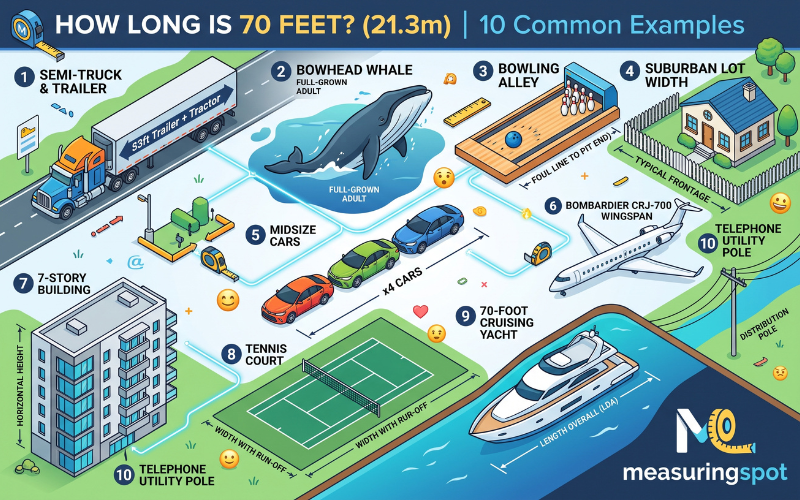
10 Common Things That Are 70 Feet Long 🚛🐋
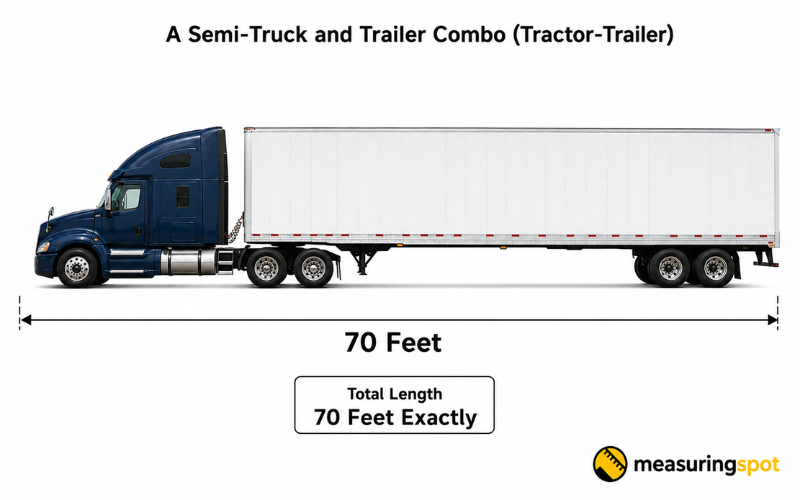
1. A Semi-Truck and Trailer Combo (Tractor-Trailer) 🚛
Anyone who drives on multi-lane highways passes 18-wheelers constantly, but few realize that a tractor pulling a standard 53-foot dry van trailer measures right around 70 to 72 feet total length.
While the cargo box itself is 53 feet long, you must account for the tractor unit upfront, which includes the engine bay, cab, sleeper berth, and the hitch connection (the fifth wheel coupling). The tractor adds between 16 and 20 feet of length depending on whether it has a sleeper cabin or a day cab configuration.
When you pass an entire commercial semi-trailer on the interstate, your car is passing a moving object that measures practically 70 feet from grill to rear bumper.
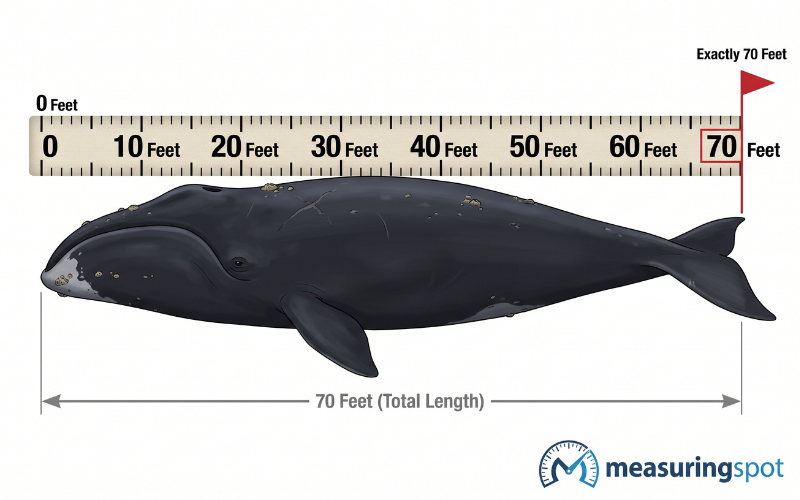
2. A Fully Grown Bowhead Whale 🐋
The ocean holds giants, and while the blue whale takes the crown as the largest animal on Earth, the Bowhead Whale (Balaena mysticetus) grows to an average maximum adult size right around 60 to 70 feet (18 to 21 meters).
These Arctic giants possess the largest mouth of any animal on Earth—nearly a third of their total body length—and a massive triangular skull built to break through sea ice up to seven inches thick. Reaching weights of up to 100 metric tons, a mature 70-foot female bowhead whale floating parallel to a dock gives an unforgettable perspective on biological scale.
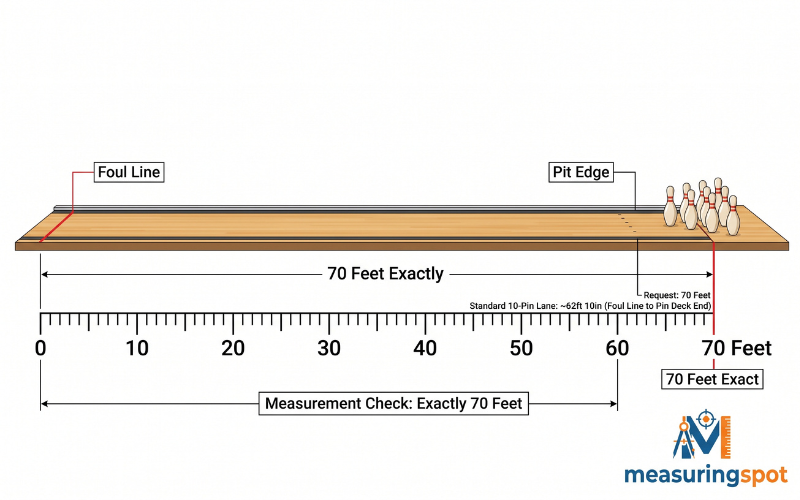
3. A Standard Ten-Pin Bowling Alley (Foul Line to Pit Edge) 🎳
Most bowlers know that the distance from the foul line to the headpin is exactly 60 feet. However, a complete bowling lane installation does not stop at the headpin!
When you factor in:
- The distance from the foul line to the pins (60 feet)
- The pin deck where the pins stand (roughly 3 feet)
- The pit area behind the pin deck where the ball collector and sweep operate (roughly 4 feet)
- The approach lane behind the foul line where bowlers take their steps (around 15 feet minimum)
The main operational lane—from the foul line straight back through the pin deck to the rear cushion of the pit machine—spans right around 67 to 70 feet. If you walk the boundary line from your release point to the back collection wall, you are walking the length of 70 feet.
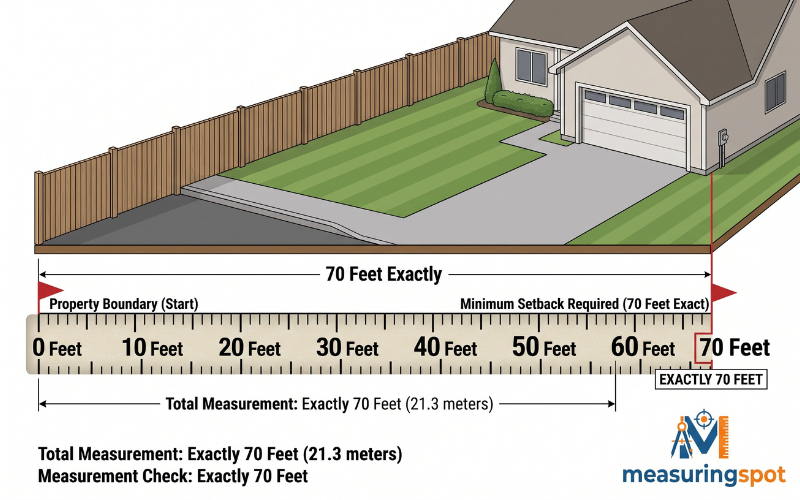
4. A Typical Suburban Residential Lot Width or Setback 🏡
If you own a home or have browsed real estate listings in North America, you will encounter the number 70 frequently in subdivision zoning plats.
A standard mid-size suburban parcel commonly features a frontage width of 60 to 70 feet. Additionally, many residential zones enforce a 70-foot front setback or back garden depth requirement, meaning the space between the street curb and your front porch or from the rear patio door to the back fence line runs roughly 70 feet.
Next time you step into a standard suburban backyard, glancing from the back deck to the boundary fence gives you a realistic grasp of 70 feet on dry land.
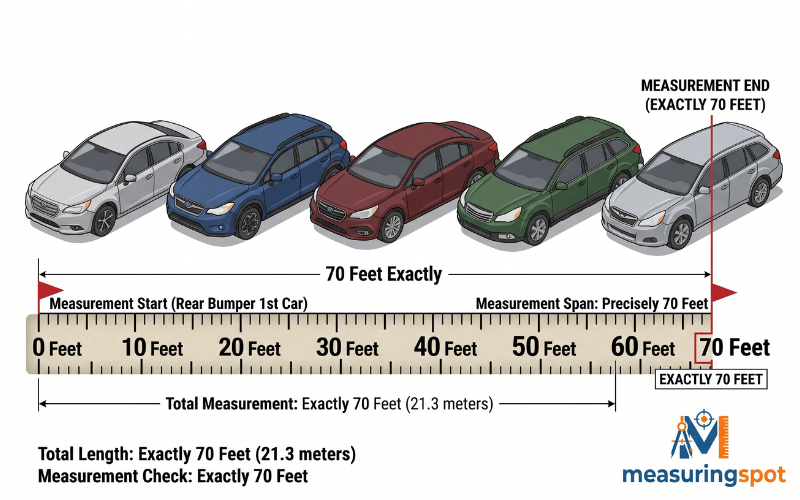
5. Four to Five Midsize Family Cars Parked Bumper-to-Bumper 🚗
Need an everyday mental yardstick you can visualize anywhere? Think about standard family passenger cars like a Toyota Camry, Honda Accord, or Subaru Outback.
- A modern midsize sedan measures roughly 15.5 to 16 feet in overall bumper-to-bumper length.
- If you park four full-sized sedans nose-to-tail without leaving any gaps, they stretch roughly 62 to 64 feet.
- Adding a fifth compact car (or counting normal 1.5-foot parking clearance gaps between bumpers) brings the entire line to exactly 70 feet.
If you look down a city street or driveway and see four large sedans parked in a tidy line, that total span represents 70 feet.
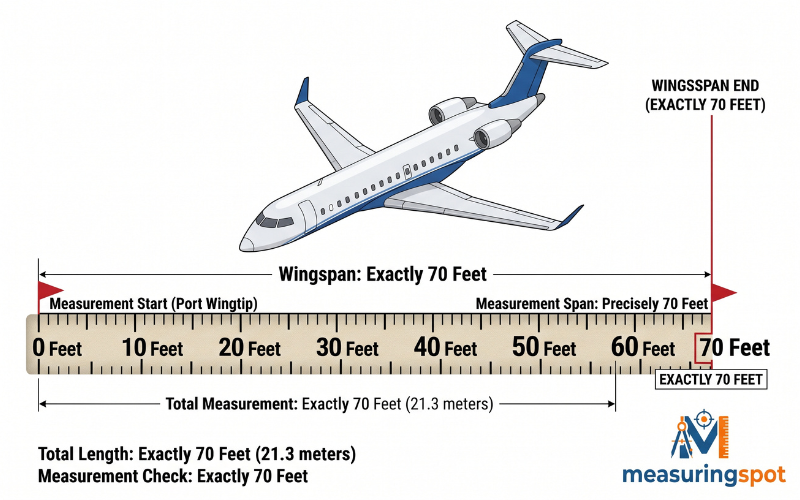
6. The Wingspan of a Bombardier CRJ-700 Regional Jet ✈️
For frequent fliers, regional feeder jets operated by major carriers (like American Eagle, Delta Connection, or United Express) are familiar sights on the tarmac.
The Bombardier CRJ-700, one of the most common commercial regional passenger jets in the world, has an official wingspan of 76 feet 3 inches (23.2 m), while older business jets like the Gulfstream III measure right at 77 feet, and tactical transports often hover near 70 feet tip-to-tip.
When standing at an airport terminal gate looking out at a commuter jet parked right outside the glass, looking from the left winglet across the fuselage to the right winglet reveals an aerial expanse of around 70 feet.
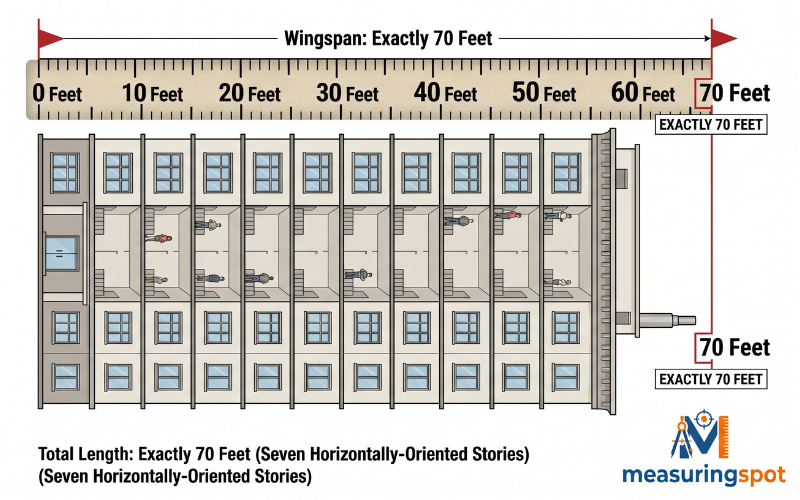
7. Seven Stories of a Typical Building (Turned Horizontally) 🏢
Visualizing horizontal distance on flat pavement can be harder than judging vertical height. Converting distance into building stories creates a quick visual shortcut.
In standard residential and apartment architecture:
- One story (floor-to-ceiling plus joists, subfloor, and mechanical clearance) averages 10 feet.
- Therefore, a 7-story residential apartment complex stands roughly 70 feet tall.
- Commercial office buildings typically have higher 12-to-14-foot ceilings, meaning a 5-story office tower reaches around 70 feet.
If you mentally tip a seven-story apartment building onto its side along a sidewalk, its rooftop would hit the 70-foot mark.
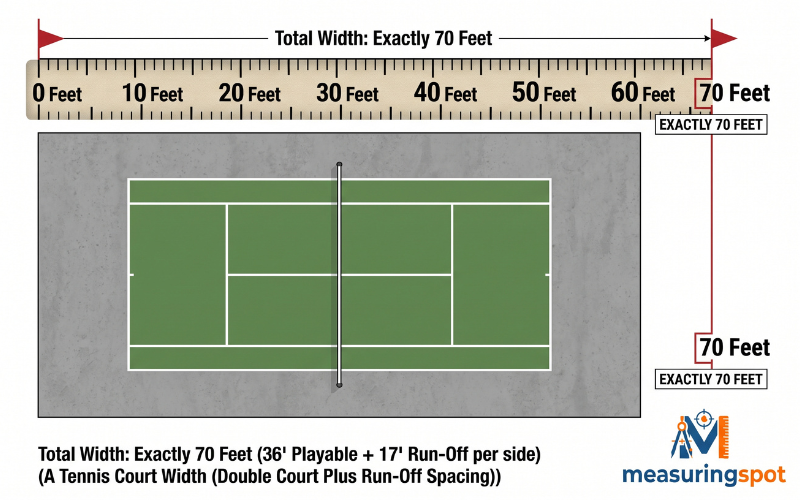
8. A Tennis Court Width (Double Court Plus Run-Off Spacing) 🎾
A regulation international tennis court measures:
- 78 feet long from baseline to baseline.
- 36 feet wide for doubles play.
While the baseline-to-baseline playing surface is slightly longer at 78 feet, the full width of a dedicated tournament court enclosure—including the regulation side-run off zones where players chase down wide balls—spans 60 to 70 feet wide.
Similarly, the distance from one baseline to just beyond the net post lands right at 70 feet. If you are standing behind the baseline and look across the court toward the opposite service line, that interior playing span is nearly 70 feet.
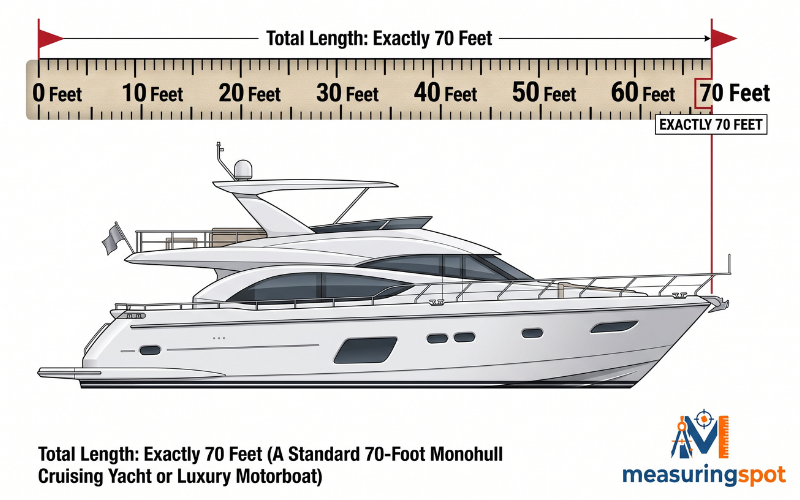
9. A Standard 70-Foot Monohull Cruising Yacht or Luxury Motorboat ⛵
In maritime circles, boat sizes are categorized by length overall (LOA). A 70-foot yacht marks a notable milestone: it is generally considered the threshold where an owner moves from an owner-operator craft to needing a full-time professional captain and deck crew.
A 70-foot yacht features multiple decks, three to four full staterooms, a wide beam of 18 to 20 feet, and substantial displacement. Seeing a 70-foot vessel tied up along a harbor marina slip puts the sheer volume of this distance into perspective; it fills out an entire marina finger pier.
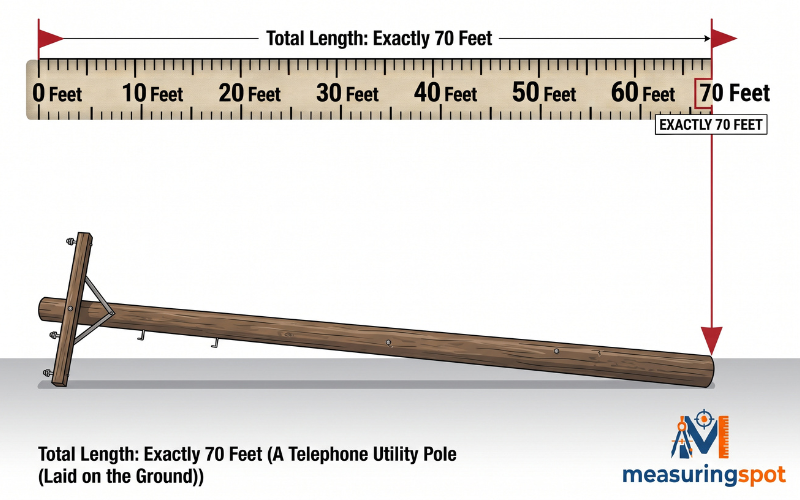
10. A Telephone Utility Pole (Laid on the Ground) 🪵
When you drive down rural highways or city avenues, utility poles blend into the background scenery. While standard neighborhood residential electricity poles stand roughly 35 to 40 feet tall, the heavy-duty distribution and transmission poles carrying higher-voltage lines frequently measure 65 to 75 feet in total length.
Keep in mind that utility companies bury about 10% of the pole length plus an extra two feet below ground level for structural stability. A pole showing 60 feet of clearance above the sidewalk is actually a single timber or concrete trunk measuring 70 feet from base to tip.
How to Measure 70 Feet Without a Tape Measure 🥾
What if you are out on an empty field, in an empty warehouse, or planning landscaping in your yard and need to estimate 70 feet right on the spot? You can use several reliable physical estimation hacks:
Method 1: The Walking Pace Method (The Stride Count)
The average adult human walking stride (from heel strike of one foot to heel strike of the opposite foot) measures roughly 2.3 to 2.6 feet.
- To measure 70 feet, walk in a straight, steady line and count 28 normal steps.
- If you are taller (over 6 feet), count 26 steps.
- If you have a shorter gait, count 30 steps.
- For most people, 28 to 29 paces will land within inches of 70 feet.
Method 2: The Car Length Projection
Visualize standard parking bays or the cars parked on your street. As noted earlier, four to five average cars parked tight together equal 70 feet. If you can visually drop four imaginary sedans across your open lawn, you have marked your 70-foot perimeter.
Method 3: The Garden Hose Benchmark
Standard consumer garden hoses are sold in modular lengths of 25 feet, 50 feet, 75 feet, and 100 feet.
If you own a standard 75-foot heavy-duty garden hose, stretching it out fully and pulling it back by about five feet gives you a spot-on, physical 70-foot boundary without needing a survey crew.
Why Understanding 70 Feet Matters in Real Life 🏗️
Grasping a clear sense of 70 feet carries practical weight across several real-world situations:
- Property Setbacks and Zoning: In construction and zoning laws, many jurisdictions require minimum clearances between septic tanks, wells, structure foundations, and wetland boundaries. A 70-foot buffer zone is a frequent legal requirement to protect groundwater sources.
- Towing and RV Maneuvers: Drivers operating heavy fifth-wheel trailers or recreational vehicles often have to watch out for combined vehicle lengths. A full-size truck pulling an extended travel trailer can reach 60 to 65 feet, pushing right up against the 65-to-70-foot maximum vehicle combination limits allowed on non-designated highways in several states without special permits.
- Fire Safety Clearance: In wildfire-prone areas, forestry services and fire protection agencies recommend creating “Defensible Space” zones around structures. Zone 2 often extends from 30 feet out to 100 feet away from the home; being able to gauge 70 feet helps homeowners prune trees and clear brush at the proper defensive perimeter.
- Sporting and Athletics: Coaches, personal trainers, and athletes frequently set up sprint drills, agility ladders, and shuttle runs. Seventy feet is roughly 23 yards—a convenient distance for working on explosive acceleration and short-burst speed drills.
Frequently Asked Questions About 70 Feet (FAQ) ❓
How long does it take to walk 70 feet?
At a casual walking pace of 3 miles per hour (which translates to about 4.4 feet per second), an average adult covers 70 feet in roughly 16 seconds. At a brisk walk (4 mph), you will cover 70 feet in just under 12 seconds.
How many yards are in 70 feet?
There are 23.33 yards in 70 feet. Because one yard equals 3 feet, you divide 70 by 3 (70 ÷ 3 = 23.333 yards, or 23 yards and 1 foot).
How long is 70 feet compared to a school bus?
A standard full-size Type D school bus (the typical 72-passenger yellow bus) measures 35 to 40 feet long. Therefore, 70 feet is almost exactly the length of two full-sized school buses parked end-to-end (or roughly 1.75 extra-long models).
How many meters is 70 feet?
Seventy feet converts to exactly 21.336 meters. For practical day-to-day estimations, you can round this to 21.3 meters.
How many square feet are in a 70×70 foot area?
A square parcel of land or building foundation measuring 70 feet on all four sides covers 4,900 square feet (70 × 70 = 4,900 sq ft). That is slightly more than one-tenth of an acre (one acre equals 43,560 square feet).
Wrapping Up: Making 70 Feet Easy to Picture 🎯
Whenever you need to gauge how long is 70 feet, do not let the large number intimidate your sense of scale. Just recall one of these easy real-life visual anchors:
- Look at a highway tractor-trailer driving past.
- Imagine four or five sedans parked in a tidy line.
- Think of a bowling lane from the approach to the back pin pit.
- Picture a 7-story building laid flat on its side.
Keeping these everyday objects in your mental toolbox makes judging distance intuitive, accurate, and effortless!
Related Posts
- 10 Common Everyday Things That Are 1 Foot Long
- 10 Common Things That Are 2 Feet Long
- 10 Common Things That Are 3 Feet Long
- 10 Common Everyday Things That Are 4 Feet Long
Conclusion 🏁
Grasping how long is 70 feet becomes simple once you tie the number to concrete, everyday visuals instead of abstract measurements. Whether you picture a full-sized semi-truck rolling down the highway, four to five family cars parked bumper-to-bumper, or a seven-story residential building tipped onto its side, these tangible benchmarks instantly bring the 21.3-meter span into clear focus. Using practical reference points—like pacing out 28 natural steps or unrolling a standard garden hose—allows you to estimate property lines, plan renovations, or assess vehicle clearances with total confidence and zero guesswork.
FOR MORE MEASUREMENTS VISIT: MEASURINGSPOT