
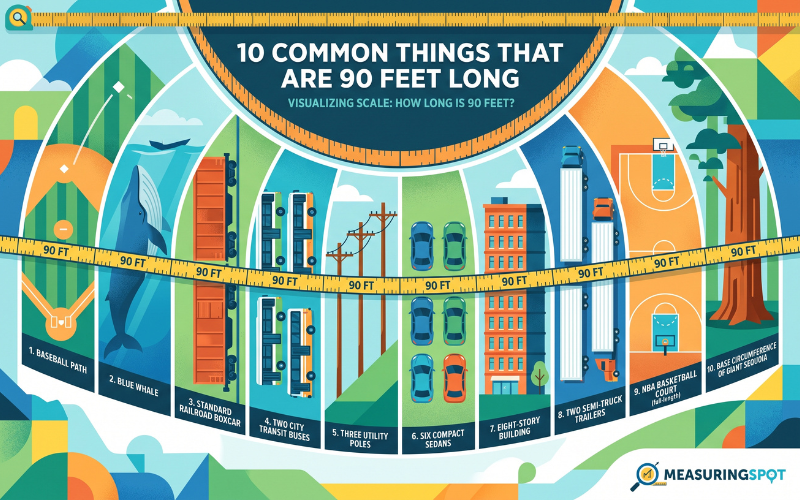
Have you ever tried to gauge distance across an open field, along a property boundary, or down a warehouse aisle without a measuring tape in hand? Most of us can gauge an inch, a foot, or even a yard fairly well. But once distances stretch toward triple digits, our spatial intuition gets murky. That brings us to a frequent practical and trivia question: how long is 90 feet?
Ninety feet equals exactly 30 yards, roughly 27.43 meters, or 1,080 inches. In architecture, urban planning, maritime transport, and athletics, 90 feet is an indispensable milestone measurement. Whether you are mapping out a backyard project, calculating a safety setback, or simply satisfying your curiosity, anchoring this measurement to familiar real-world benchmarks makes estimating it straightforward.
Here is an in-depth reference guide covering common objects, animals, and structures that span right around 90 feet.
Quick Reference Summary: How Long Is 90 Feet at a Glance? ⚡
If you need a fast mental snapshot, here is how 90 feet breaks down across familiar everyday terms:
- In Paces: An average adult walking stride covers about 2.5 feet. Walking 90 feet takes roughly 36 steady paces.
- In Sports: It is the exact distance between consecutive bases on an official Major League Baseball infield.
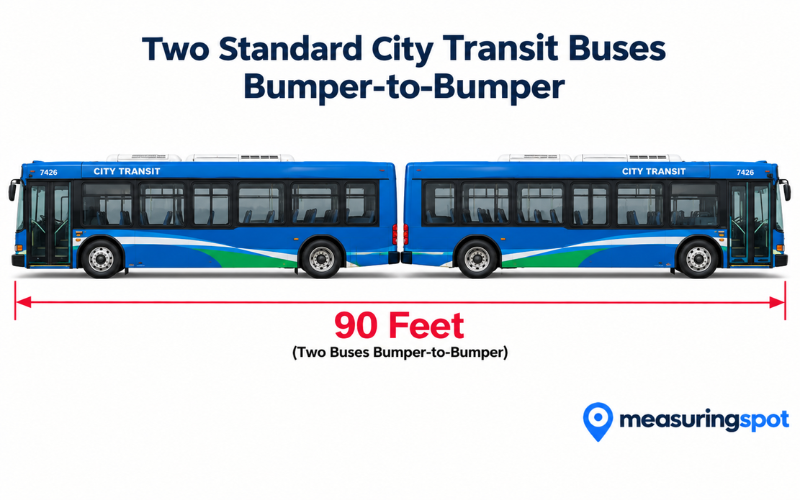
- In Vehicles: It matches approximately two city transit buses parked bumper-to-bumper or six compact cars parked in a row.
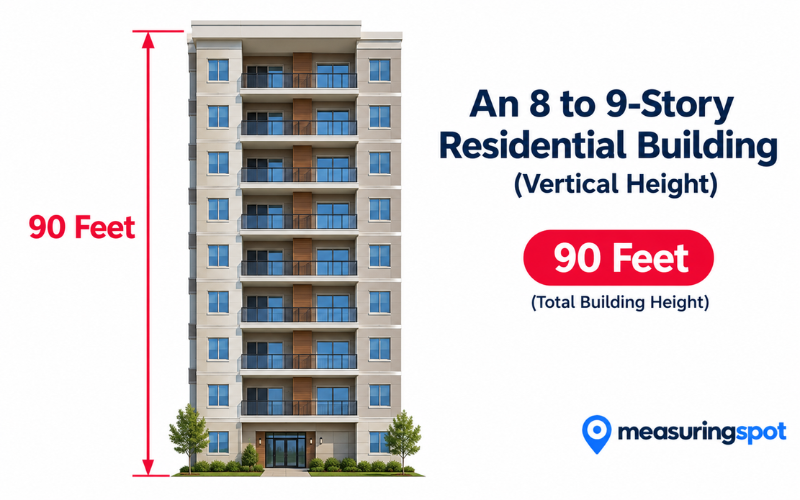
- In Buildings: It equals the height of an average 8 to 9-story apartment building.
- In Metric Units: Exactly 27.432 meters.
90 Feet BioWiki & Dimension Matrix 📊
This summary matrix compares dimensions, weights, and daily applications for 10 common benchmarks that measure right at or near 90 feet:
| Benchmark / Object | Category | Typical Dimension | Weight / Scale Range | Where You Encounter It |
| MLB Base Path | Athletics / Sports | 90 ft (27.43 m) | Flat ground surface | Major League Baseball diamonds |
| Adult Blue Whale | Marine Biology | 80–100 ft (avg. 90 ft) | 100–150 metric tons | Open oceans worldwide |
| Standard Railroad Boxcar | Freight Transport | 60–86 ft (up to 90 ft over couplers) | ~30 tons empty; up to 100+ tons loaded | Rail spurs, freight trains |
| Two City Transit Buses | Public Transit | ~80–90 ft combined | 28,000–38,000 lbs each | City streets, transit depots |
| Three Standard Telephone Poles | Utilities / Infrastructure | 30–35 ft each (3 laid end-to-end = 90–105 ft) | ~1,000–2,000 lbs each | Roadside power lines |
| Six Compact Sedans | Automotive | ~15 ft each (6 in a row = 90 ft) | ~3,000 lbs per car | Parking lots, gridlock traffic |
| Eight-Story Residential Building | Architecture | ~80–90 ft vertical height | Thousands of metric tons | Urban residential neighborhoods |
| Two Semi-Truck Trailers | Logistics | ~45 ft each (pair = 90 ft) | Up to 80,000 lbs combined GCWR | Highway lanes, loading docks |
| NBA Basketball Court (Length) | Indoor Athletics | 94 ft baseline-to-baseline (~90 ft playable interior) | Hardwood court floor | Professional basketball arenas |
| Mature Giant Sequoia (Width) | Botany / Forestry | Up to 90–102 ft ground circumference | Hundreds of tons | Sierra Nevada mountain groves |
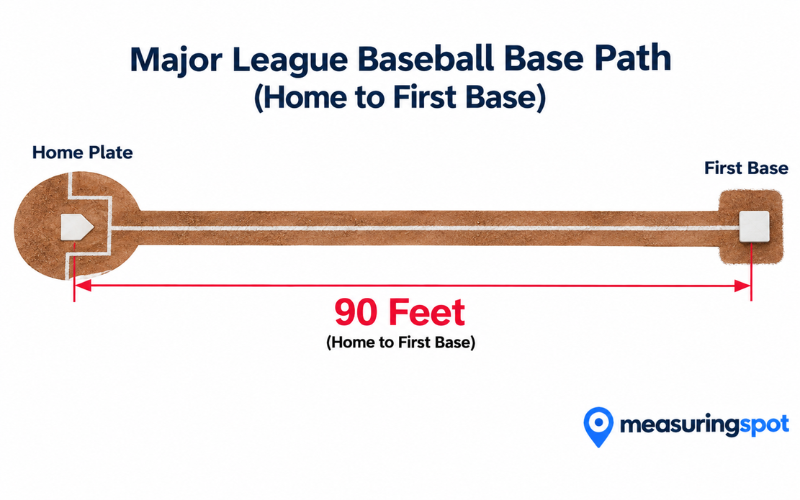
1. Major League Baseball Base Path (Home to First Base) ⚾
When sports historians and architects debate the greatest numbers in athletics, 90 feet invariably sits at the top of the list.
Alexander Cartwright and the Knickerbocker Base Ball Club codified the 90-foot distance between bases in the mid-19th century. Remarkably, this exact distance has stood unaltered at the professional level for well over a century.
Why 90 Feet Is So Significant in Baseball
The genius of 90 feet lies in human physiology and running mechanics:
- A routine ground ball fielded by an infielder takes roughly 3.8 to 4.3 seconds to field, transfer, and throw to first base.
- An average Major League runner sprinting flat-out from home plate to first base arrives in approximately 4.1 to 4.4 seconds.
- Because the distance is precisely 90 feet, hundreds of plays each season are decided by mere fractions of a second or inches at the bag. If the base path were 85 feet, fielders would rarely record an out; if it were 95 feet, base hits on infield grounders would virtually disappear.
Next time you watch a game or stand by an official baseball infield, look down the dirt path from home to first or from first to second: that is the golden standard for how long 90 feet looks in the real world.
2. An Adult Blue Whale (Balaenoptera musculus) 🐋
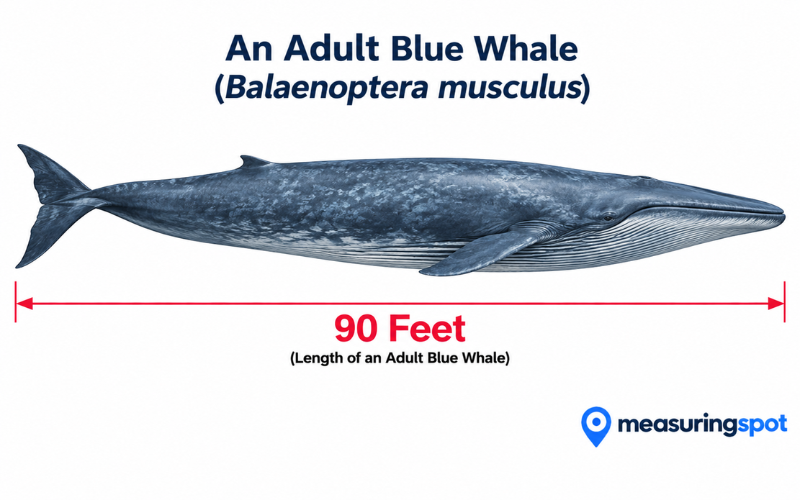
Nature features its own colossal benchmark for 90 feet. The blue whale is the largest animal ever known to have lived on planet Earth—eclipsing even the biggest sauropod dinosaurs of the Mesozoic Era.
Size and Scale of the Ocean Giant
- Average Length: Mature females in the Southern Hemisphere often reach between 85 and 95 feet, with 90 feet serving as an accurate benchmark for a fully grown adult specimen.
- Mass: An animal of this length weighs anywhere from 100 to 150 metric tons (equivalent to roughly 25 to 30 adult African elephants).
- Anatomy: A 90-foot blue whale has a heart roughly the size of a standard golf cart and a tongue that alone can weigh as much as an entire elephant.
Visualizing a creature whose body matches the distance between home plate and first base gives immediate perspective on the sheer magnitude of ocean megafauna.
3. High-Capacity Railroad Boxcars 🚂
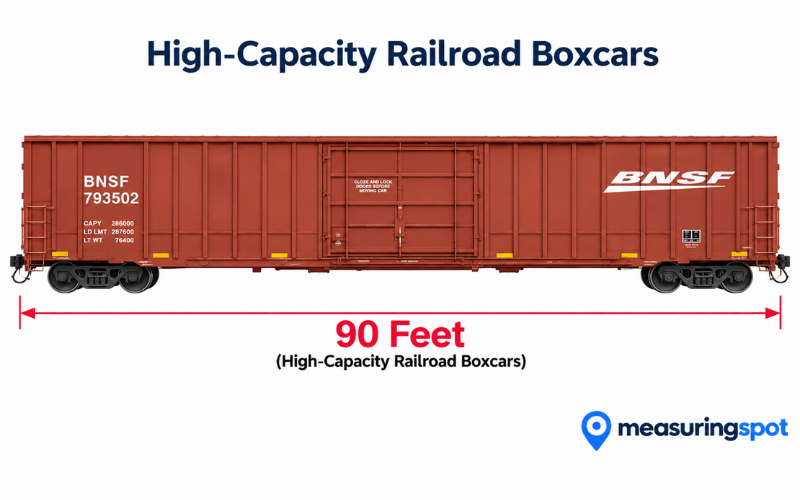
Freight trains snake through every continent, hauling raw materials and consumer goods. While vintage freight cars measured 40 feet to 50 feet, modern rail supply chains rely heavily on high-capacity cars designed to maximize payload volume.
Railcar Dimensions and Layout
Modern high-cube boxcars, specialized auto-rack carriers, and center beam flatcars used for moving lumber frequently reach overall lengths between 60 feet and 86 feet. When measured over the coupler pulling faces (the mechanical links at both ends connecting adjacent cars), many extended freight cars hit right at 89 to 90 feet.
When waiting at a railroad crossing, watching a single extended autorack car clear your field of vision means you have just observed 90 feet of continuous heavy steel rolling past.
4. Two Standard City Transit Buses Bumper-to-Bumper 🚌
If you commute through any metropolitan area, public transit vehicles offer an immediate, familiar visual aid.
Transit Bus Measurements
- A standard single-unit municipal bus (such as those manufactured by Gillig or New Flyer) measures 40 feet in length (with select suburban variants reaching 45 feet).
- When two standard 40-foot transit buses park bumper-to-bumper with normal spacing between them, their total combined length runs between 85 and 90 feet.
- By contrast, an articulated “bendy” bus with an accordion midsection typically spans 60 feet. Adding half of another standard bus brings you right to that identical 90-foot threshold.
If you ever need to estimate whether a plot of land or a commercial lot measures 90 feet, ask yourself: could two full-size city buses pull in end-to-end? If the answer is yes, you are looking at approximately 90 feet.
5. Three Standard Utility Poles Laid End-to-End 🪵
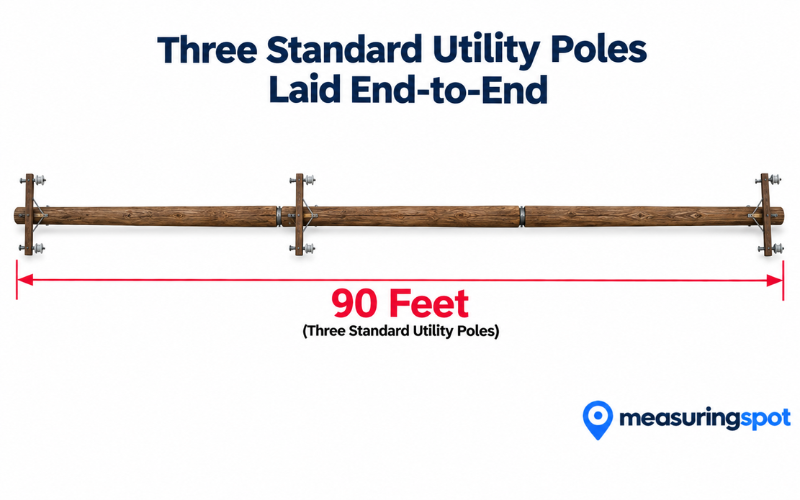
Utility and telephone poles line residential roads, highways, and rural corridors around the world. Because utility infrastructure follows rigid engineering standards, these wooden structures offer an accessible reference point.
Utility Pole Specifications
- Most residential distribution poles stand between 30 and 35 feet tall (with approximately 5 feet to 6 feet embedded securely underground).
- If you took three standard 30-foot poles and laid them end-to-end on the ground, the span would equal exactly 90 feet.
- Utility poles along a street are typically spaced roughly 100 feet to 125 feet apart in urban neighborhoods. Looking between two adjacent utility poles gives you a distance that is slightly longer than 90 feet.
6. A Line of Six Compact Passenger Cars 🚗
For motorists, parking lots and highways provide continuous exposure to vehicle dimensions.
Calculating Automotive Length
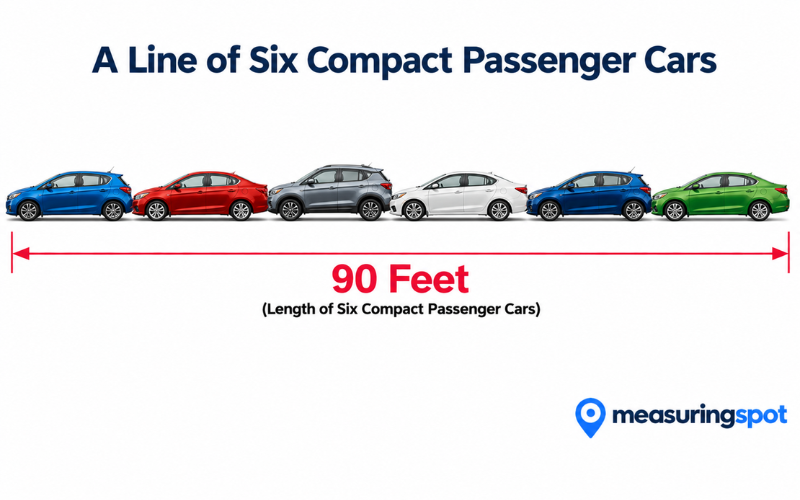
- The average modern compact sedan (such as a Honda Civic, Toyota Corolla, or Volkswagen Jetta) measures approximately 15 feet long (roughly 180 inches).
- When you arrange six of these vehicles tightly in a row:
$$\text{Total Length} = 6 \times 15\text{ ft} = 90\text{ ft}$$ - Even in heavy bumper-to-bumper city traffic, a queue of 5 to 6 passenger sedans waiting at a red light occupies roughly 90 to 100 feet of road surface.
This comparison is particularly useful when estimating street frontages, driveway lengths, or roadside parking spots.
7. An 8 to 9-Story Residential Building (Vertical Height) 🏢
Ninety feet does not just apply horizontally across the ground; it represents a common vertical milestone in structural engineering and municipal zoning codes.
Measuring Vertical Stories
- In modern residential architecture, each individual story averages approximately 10 feet from floor to ceiling, factoring in floor joists, ductwork, and structural slabs.
- Commercial office buildings typically have higher ceilings—often 12 to 14 feet per floor to accommodate heavy mechanical systems.
- An 8 to 9-story apartment complex reaches right around 80 feet to 90 feet tall.
Municipal fire departments frequently design ladder trucks (aerial apparatus) around this exact standard. Many standard turntable ladder trucks feature telescopic extensions of 100 feet, specifically engineered to reach the roofs of 8 to 9-story structures measuring up to 90 feet.
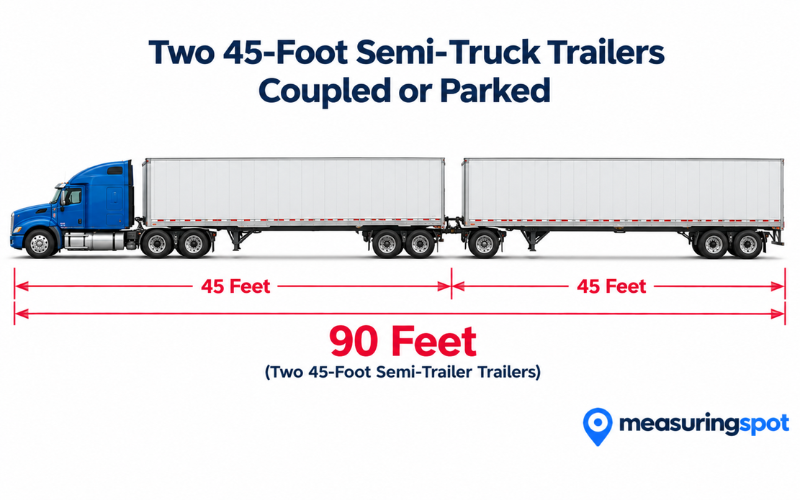
8. Two 45-Foot Semi-Truck Trailers Coupled or Parked 🚚
Logistics and freight distribution rely on standardized trailer sizes to haul dry goods across interstate highway networks.
Dry Van Dimensions
- While 53-foot trailers dominate long-haul highway routes, 40-foot and 45-foot shipping containers and dry vans remain industry standards for intermodal shipping and regional delivery.
- Placing two 45-foot trailers back-to-back equals precisely 90 feet.
- Alternatively, a full tractor-trailer setup pulling double “pup” trailers (popular with freight delivery companies like FedEx Freight or UPS) measures between 75 and 85 feet from the front bumper of the tractor to the rear bumper of the trailing unit.
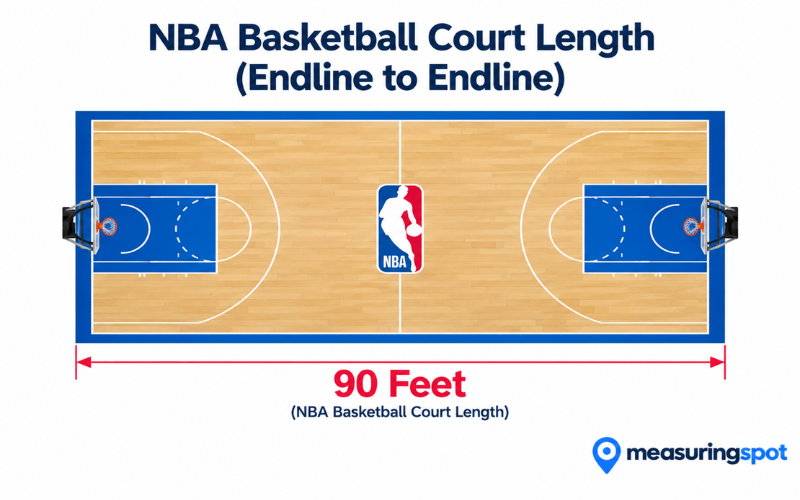
9. NBA Basketball Court Length (Endline to Endline) 🏀
Basketball courts are familiar athletic grounds for millions of people worldwide. Whether you play pickup games at a local gym or follow professional sports, an arena floor provides an excellent spatial reference.
Court Measurements
- An official NBA and NCAA regulation basketball court measures 94 feet long by 50 feet wide.
- High school basketball courts are slightly shorter, measuring 84 feet long by 50 feet wide.
- A regulation 94-foot NBA court extends just 4 feet beyond 90 feet. If you stand on the baseline under one backboard and look toward the opposing baseline, you are viewing an expansive 94-foot surface—nearly an exact replica of 90 feet.
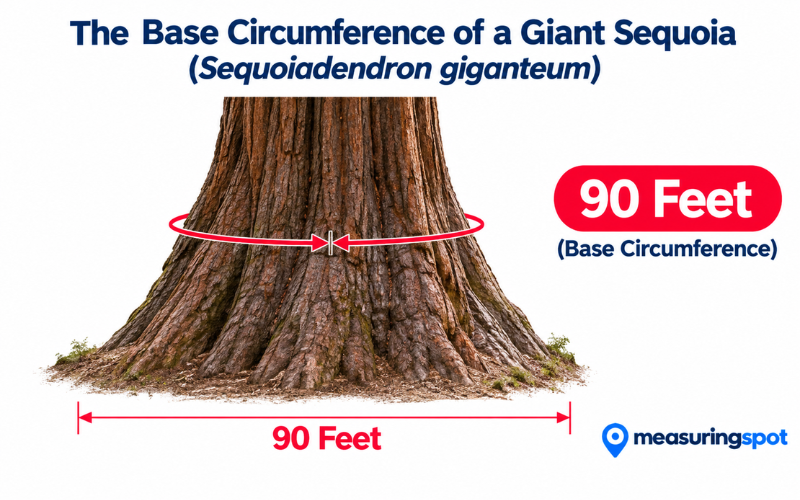
10. The Base Circumference of a Giant Sequoia (Sequoiadendron giganteum) 🌲
While height is the first thing that comes to mind with redwoods, their sheer ground footprint is equally mind-boggling. The ancient Giant Sequoias native to California’s Sierra Nevada range boast some of the largest trunk girths on Earth.
Botanical Breadth
- The famous General Sherman Tree in Sequoia National Park has a ground circumference of approximately 102.6 feet, with a base diameter of over 36 feet.
- Several other mature Giant Sequoias feature ground circumferences hovering right at 85 to 90 feet.
- That means if you and a group of friends stretched a measuring tape around the fluted base of one of these mature trees, you would need a full 90-foot line to circle its base.
Everyday Methods to Measure 90 Feet Without a Tape Measure 📐
Need to stake out 90 feet on a job site, farm field, or backyard without specialized surveying tools? Here are three reliable field methods you can use anytime:
The 36-Pace Rule
Human gait remains surprisingly consistent when walking at a steady, natural tempo:
- An average adult male has a walking stride of about 2.5 to 2.6 feet; an average adult female stride is about 2.2 to 2.4 feet.
- Walking 36 normal steps will bring an average adult within a couple of feet of 90 feet.
- For greater precision, calibrate your pace: measure out 30 feet once, count your natural paces across that distance, and multiply by three.
The Garden Hose Benchmark
Standard commercial garden hoses are manufactured in uniform lengths:
- The most common retail consumer hose lengths are 25 feet, 50 feet, 75 feet, and 100 feet.
- Connecting a 50-foot hose and a 25-foot hose gives you 75 feet.
- A standard 100-foot heavy-duty garden hose with about 10 feet coiled or held back gives you an immediate, physical 90-foot measurement across your lawn.
The Vehicle Length Technique
If you are measuring roadside property or a long driveway:
- Pull your personal vehicle to the starting line.
- Most standard midsize crossovers, SUVs, and midsize sedans measure right around 15 to 16 feet from bumper to bumper.
- Estimating the length of six car lengths will give you a practical estimate within 5% of 90 feet.
Common Misconceptions About 90 Feet ⚠️
When visualizing intermediate distances, people often confuse athletic lines, nautical measurements, and architectural elevations. Here are common pitfalls to avoid:
- Confusing Football Yards with Feet: Because American football relies heavily on 10-yard increments, people often think of 90 yards (270 feet) instead of 90 feet (30 yards). Ninety feet covers only from the goal line to the 30-yard line—less than one-third of the total playing field!
- Bowling Lane Confusion: A regulation bowling lane appears long from the approach, but it measures only 60 feet from the foul line to the headpin. A 90-foot distance is a full 50% longer than a bowling lane.
- Tennis Court Length: A regulation tennis court is 78 feet long from baseline to baseline. While close, 90 feet extends 12 feet past the far baseline—roughly the extra depth where players stand to return deep serves.
Frequently Asked Questions (FAQs) ❓
How many yards are in 90 feet?
There are exactly 30 yards in 90 feet. Because 1 yard equals 3 feet:
$$\frac{90\text{ ft}}{3\text{ ft/yd}} = 30\text{ yards}$$
How long is 90 feet in meters?
Ninety feet converts to 27.432 meters. One foot equals exactly 0.3048 meters, so:
$$90 \times 0.3048 = 27.432\text{ m}$$
How long does it take an average human to run 90 feet?
A fit adult sprinting at top speed covers 90 feet in roughly 3.5 to 4.2 seconds. Elite Major League Baseball players run the 90 feet from home to first base in about 3.9 to 4.2 seconds from the left-handed batter’s box and 4.1 to 4.3 seconds from the right-handed box.
How many human steps are in 90 feet?
For an average adult with a step length of roughly 2.5 feet, it takes approximately 36 steps to travel 90 feet.
How high is a 90-foot structure compared to trees?
A 90-foot structure is roughly equivalent to a mature forest canopy tree, such as a fully grown oak, mature white pine, or tall maple. In suburban settings, 90 feet is tall enough to stand out comfortably above the roofs of surrounding one- and two-story homes.
Related Posts
- 12 Common Things That Are 10 Inches Long
- 10 Common Things That Are 1 Inch Long
- 11 Common Things That Are 2 Inches Long
- 10 Common Things That Are 3 Inches Long
Conclusion 🏁
Visualizing 90 feet becomes second nature once you anchor the number to recognizable benchmarks in the physical world. Whether you picture the sprint between home plate and first base on an official baseball diamond, a fully grown blue whale cutting through open waters, two city transit buses parked nose-to-tail, or an eight-story apartment building reaching upward, this 30-yard span is woven throughout modern infrastructure, athletics, and the natural landscape. Remembering that 90 feet translates to roughly 36 walking paces or six parked sedans gives you an intuitive, reliable mental ruler to gauge property lines, project layouts, and open spaces accurately without needing to reach for a measuring tape.
FOR MORE MEASUREMENTS VISIT: MEASURINGSPOT