
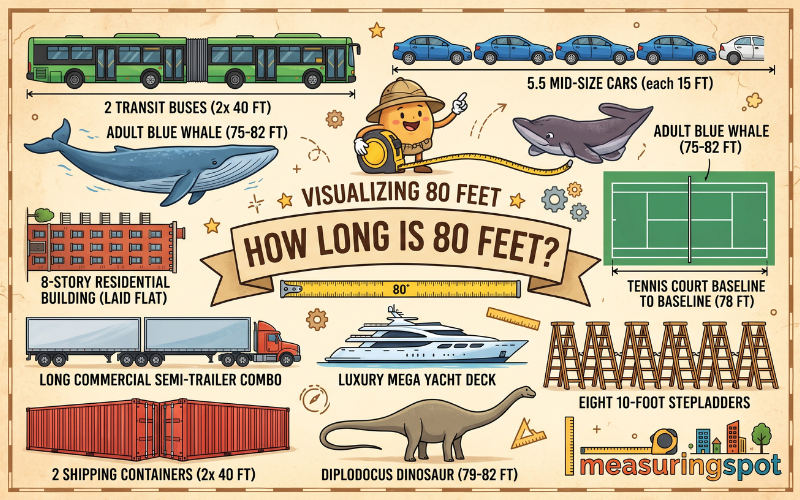
Eighty feet is a measurement that sounds straightforward on paper, but visualizing it in the physical world can bend your perspective. When someone tells you that a plot of land, a luxury yacht, or an industrial warehouse is eighty feet across, what does that actually look like?
Understanding how long is 80 feet is surprisingly practical. Whether you are measuring a rural property line, purchasing a garden hose extension, checking municipal zoning setbacks, or simply trying to imagine the scale of ancient wildlife, having concrete reference points transforms an abstract number into something intuitive.
Quick Reference: 80 Feet at a Glance ⚡
If you need a fast conversion or an immediate mental anchor, here are the core numbers:
| Measurement Unit | Equivalent Value |
| Feet | 80 ft |
| Inches | 960 in |
| Yards | 26.67 yd |
| Meters | 24.38 m |
| Centimeters | 2,438.4 cm |
| Average Human Paces | ~32 to 34 walking steps |
| Average Car Lengths | ~5.3 mid-size sedans parked bumper-to-bumper |
How Long Is 80 Feet? Making Sense of the Distance 🧠
To grasp how long is 80 feet, it helps to begin with things you walk past every day.
Eighty feet equals exactly 26 yards and 2 feet, or roughly 24.38 meters. In architectural terms, an average residential story stands roughly 9 to 10 feet tall. That means an 80-foot span matches the height of an 8-story apartment block laid flat across the asphalt.
If you decided to walk it at a normal gait, the average adult human stride measures roughly 2.5 feet from heel strike to opposite heel strike. Stepping out 80 feet requires between 32 and 34 continuous strides. That is a noticeable trek across a yard, roughly four seconds of a full sprint, or the distance a highway vehicle travels in under one second at 60 miles per hour.
10 Everyday & Natural Things That Measure 80 Feet 🚛
Here are ten real-world objects, structures, and creatures that show what 80 feet looks like.
1. Two Standard City Transit Buses 🚌
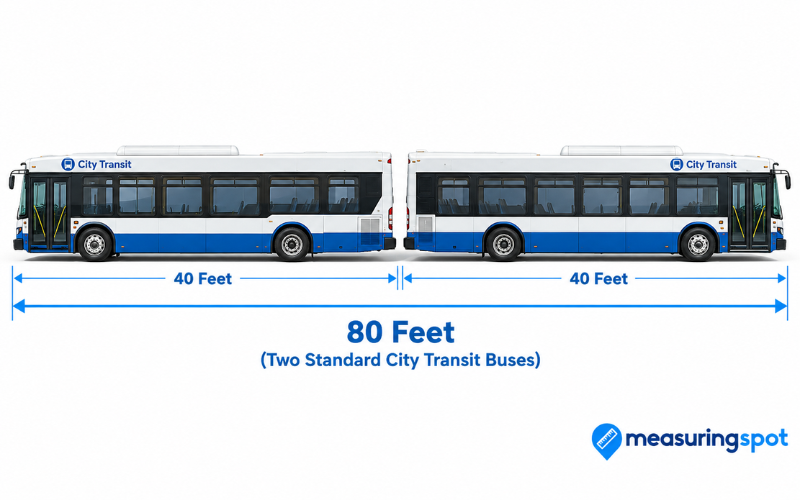
If you have ever waited at a busy urban bus stop, you know the physical presence of a municipal transit bus.
- Standard Bus Length: Standard urban transit buses across North America and Europe, such as the Gillig Low Floor or New Flyer Xcelsior, measure 40 feet in total bumper-to-bumper length.
- The 80-Foot Match: Line two of these full-sized passenger coaches bumper-to-bumper, and you hit precisely 80 feet.
Looking down a city block past two full transit vehicles gives you a sharp perspective on this distance. It represents eight sets of double passenger doors, dozens of vehicle windows, and enough steel frame to seat roughly 80 seated commuters.
2. Five and a Half Mid-Size Sedans Parked in a Row 🚗
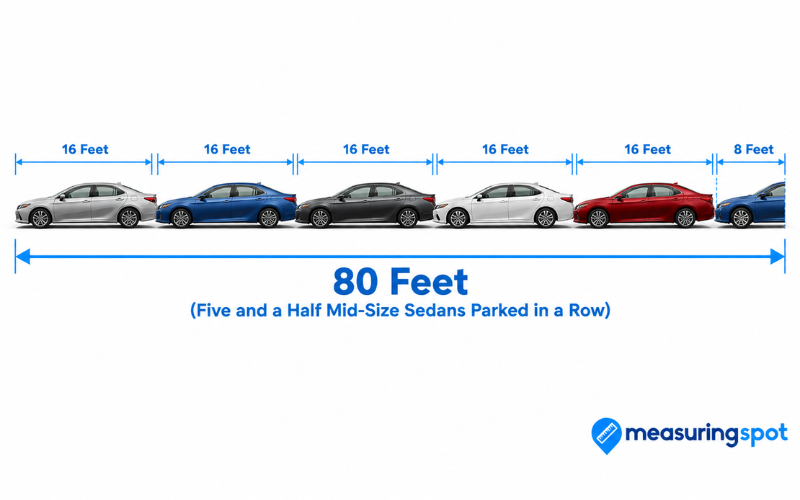
Private vehicles provide one of the most accessible visual tools for daily measurements because they sit on every neighborhood driveway and strip-mall lot.
- Typical Vehicle Length: A standard mid-size commuter car—think a Honda Accord, Toyota Camry, or Ford Fusion—measures roughly 15 feet from front grille to rear tail-light.
- The Math: Parking five of these sedans tightly nose-to-tail spans 75 feet. Add one more front half of an adjacent car, and you stand at exactly 80 feet.
If your driveway can hold five full sedans parked in a single straight file, your property boundary runs just shy of the 80-foot mark.
3. An Adult Blue Whale 🐋
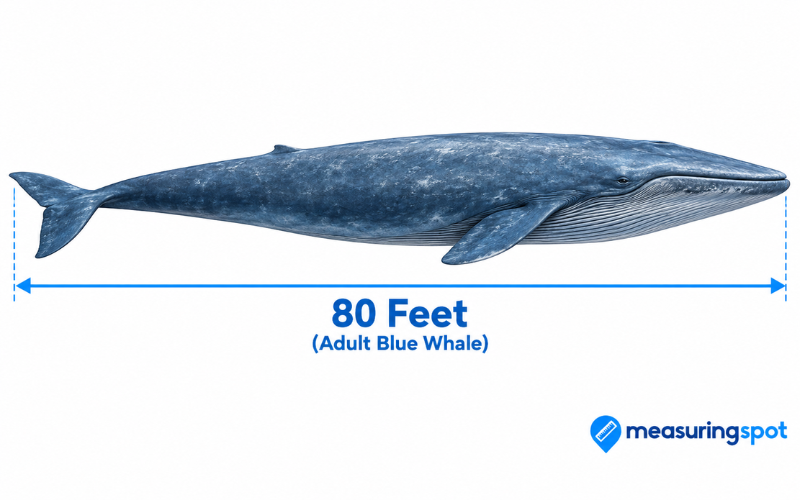
The blue whale (Balaenoptera musculus) is the heaviest and largest creature ever known to exist on Earth, easily eclipsing the biggest discovered dinosaurs in total mass.
- Average Adult Dimensions: While female blue whales in the Antarctic can touch nearly 100 feet, the typical mature North Atlantic or North Pacific blue whale averages between 75 and 82 feet in total length.
- Physical Scale: An 80-foot adult whale features a heart the size of a golf cart, a tongue that weighs as much as an entire adult elephant, and flippers spanning over 8 feet alone.
Seeing an 80-foot line drawn on concrete is impressive, but realizing that a living, breathing mammal fills that entire span with 150 metric tons of flesh and bone puts scale into perspective.
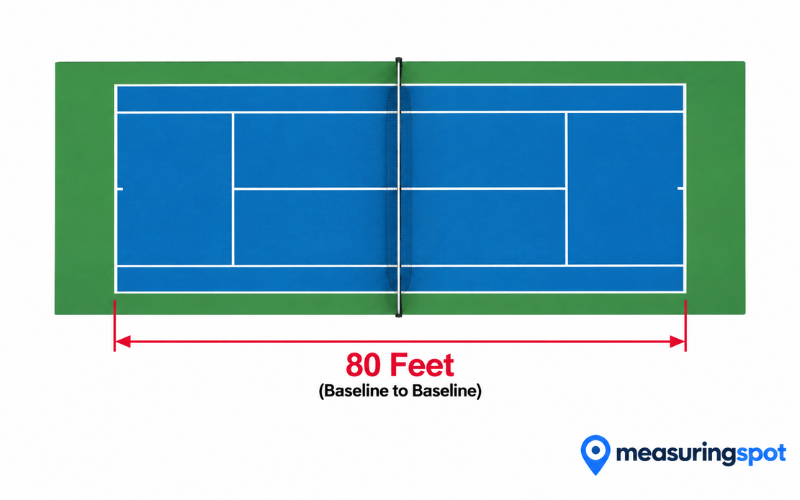
4. A Standard Tennis Court (Baseline to Baseline) 🎾
Athletic fields use strictly codified dimensions regulated by international bodies, making them prime tools for visualizing distance.
- Court Regulations: Under International Tennis Federation (ITF) rules, a regulation singles and doubles court measures exactly 78 feet from the outside edge of one baseline to the outside edge of the other.
- Reaching 80 Feet: Adding just one foot of run-off surface behind each baseline gives you an even 80 feet of court surface.
The next time you watch a tennis match, look at the expanse between the two opposing baselines where the players trade groundstrokes. That entire competitive corridor represents what 80 feet looks like on a sports surface.
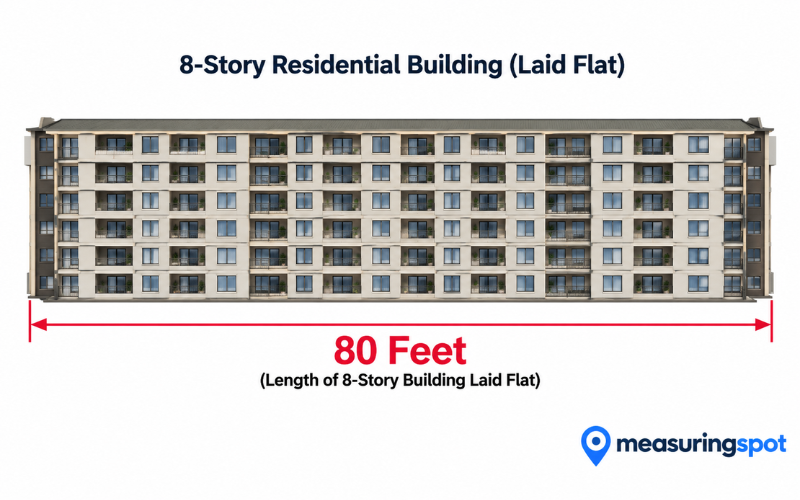
5. An 8-Story Residential Building (Laid Flat) 🏢
Vertical height is often harder to judge than horizontal ground distance, but architectural standards remain predictable.
- Floor Heights: In modern multistory residential construction, floor-to-floor heights—including the living clearance, ceiling joists, subflooring, and finish materials—average roughly 10 feet per floor.
- The Comparison: An 8-story residential structure stands roughly 80 feet into the air.
Imagine tipping that 8-story building over onto its side along a sidewalk. The roofline would touch the ground 80 feet away from the foundation.
6. The Longest Commercial Semi-Trailer Combinations 🛣️
Long-haul logistics relies on standardized freight configurations designed to maximize highway cargo capacities while staying within DOT limits.
- Trailer Dimensions: A typical single semi-trailer measures 53 feet. However, specialized freight hauling utilizes “Turnpike Doubles” or “Rocky Mountain Doubles”—twin 33-foot trailers coupled by a converter dolly—or extended heavy-haul platform rigs that reach up to 80 feet in total freight deck span.
- Scale on the Road: Passing an 80-foot commercial road train on an interstate highway requires sustained acceleration, especially when driving past the entire length at high speeds.

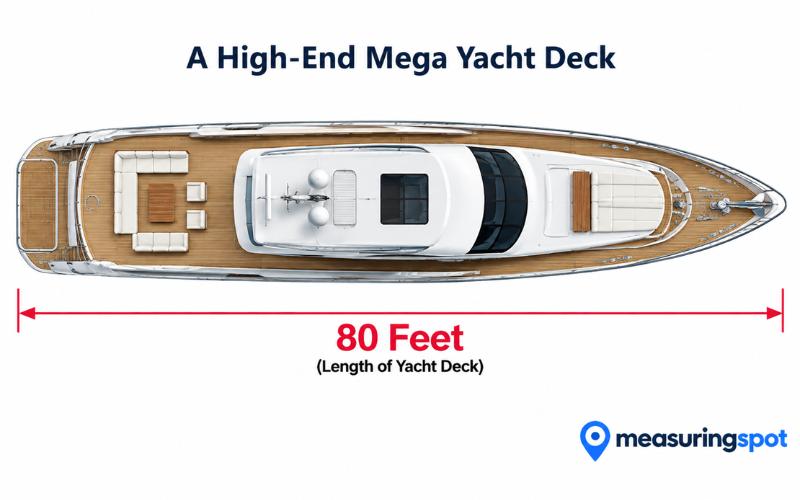
7. A High-End Mega Yacht Deck 🛥️
In marine architecture, boats cross into the official “superyacht” or “luxury motor yacht” classification once they clear 78 to 80 feet in length overall (LOA).
- Vessel Anatomy: An 80-foot luxury yacht (such as an Azimut 80 or Sunseeker 80) typically features three distinct levels: a flybridge, a main salon, and a lower guest deck accommodating four staterooms, crew quarters, and twin diesel engine bays.
- Visualizing the Span: Walking from the swim platform at the transom up to the anchor winch on the bow pulpit covers 80 feet of deck space.
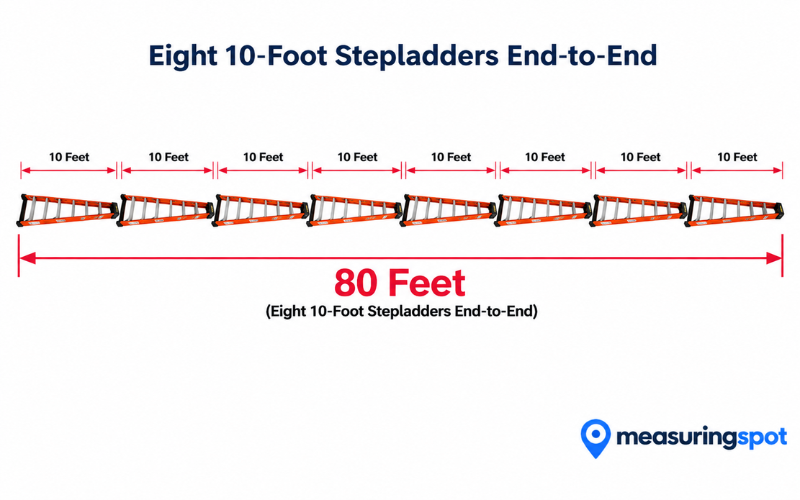
8. Eight 10-Foot Stepladders End-to-End 🪜
For homeowners and contractors, professional-grade aluminum and fiberglass stepladders are common job-site tools.
- Contractor Standards: A standard tall tradesman stepladder stands 10 feet tall, built for working on commercial ceilings and gutter installations.
- The Alignment: Laying eight of these industrial ladders end-to-end creates an unbroken 80-foot track.
Because the human eye struggles to measure empty space, breaking down 80 feet into eight easily manageable 10-foot ladder lengths makes it simple to map out property corners or interior construction zones.
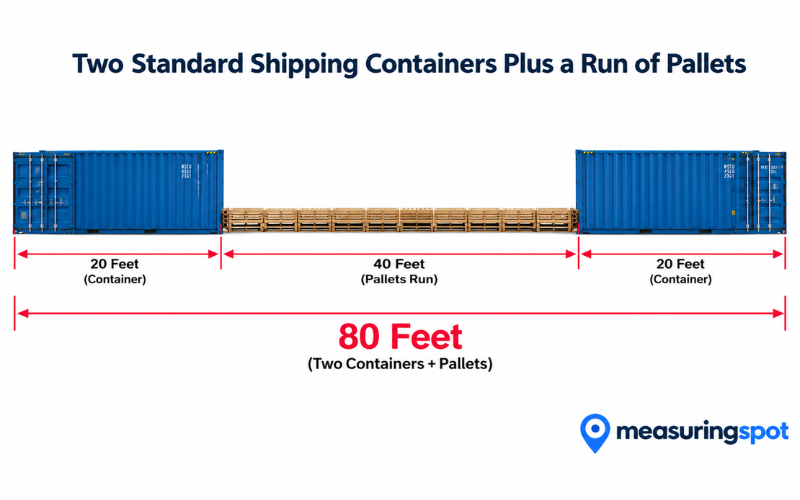
9. Two Standard Shipping Containers Plus a Run of Pallets 🚢
Intermodal shipping containers are the workhorses of global trade, engineered to fit onto trains, flatbed trucks, and container ships.
- Container Specs: The most ubiquitous marine freight container in the world is the 40-foot intermodal dry van (ISO box).
- Building 80 Feet: Stacking two 40-foot shipping containers end-to-end on the ground produces an 80-foot steel freight wall that stands 8.5 feet tall.
This exact footprint has become widely popular in modern modular architecture, where pairs of 40-foot containers are joined lengthwise to create 80-foot-long container homes or commercial pop-up shops.
10. The Diplodocus Dinosaur 🦕
During the late Jurassic period roughly 150 million years ago, long-necked sauropod dinosaurs dominated the prehistoric landscape of North America.
- Fossil Evidence: Skeletal remains of Diplodocus carnegii, preserved in museums worldwide, reveal a typical adult total body length of 79 to 82 feet.
- Body Distribution: Much of this 80-foot span was divided between a 21-foot neck and an whip-like tail that spanned roughly 45 feet, counterbalancing its massive midsection.

Biowiki Reference Profile: The 80-Foot Dimension 📋
| Metric / Attribute | Specification Data |
| Common Term | Eighty Feet |
| Abbreviation | 80 ft / 80′ |
| System of Measurement | Imperial / US Customary System |
| Metric Conversion | 24.384 Meters (Exact) |
| International Foot Base | 1 ft = 0.3048 m |
| Total Area (as a Square) | 6,400 sq. ft. (~0.147 Acres) |
| Running Paces (Athletic) | ~18 to 22 strides |
| Walking Paces (Casual) | ~32 to 36 footsteps |
| Standard Building Levels | ~8 residential stories |
| Sports Reference | Regulation tennis court length + 2 feet |
| Notable Biological Match | Adult female Blue Whale (Balaenoptera musculus) |
| Notable Automotive Match | 2 Standard 40-foot City Transit Buses |
| Notable Industrial Match | 2 Intermodal ISO 40-foot cargo containers |
Why Understanding 80 Feet Matters in Daily Life 🏡
Knowing what 80 feet looks like is not just trivia; it has tangible real-world applications across various fields:
- Real Estate & Property Lines: Suburban parcels often come with frontages or rear yard depths specified at 75 to 80 feet. Being able to spot an 80-foot span helps you visualize whether there is room for an outbuilding, a pool installation, or an expanded garden layout without constantly pulling out a surveyor’s tape.
- Fire Safety & Hose Runs: Firefighters frequently deploy attack lines packaged in 50-foot increments. Understanding that an 80-foot setback requires connecting two 50-foot sections (giving 100 feet total) is an operational necessity in emergency response.
- Landscaping & Irrigation: Residential water pressure drops noticeably over hose runs longer than 75 to 100 feet. If your spigot sits 80 feet from your perimeter garden, you need to factor in line friction and choose heavy-duty 3/4-inch supply hoses rather than light 1/2-inch lines to preserve working water volume.
- Outdoor Lighting: Hanging festive patio string lights or running underground conduits across an 80-foot span requires planning for wire sag, mid-span guy wires, and electrical voltage drop.
Practical Ways to Pace Out 80 Feet Without a Tape Measure 🚶♂️
When you are out on an open field or touring a vacant parcel of land, you likely will not have a long surveyor’s reel with you. Here are three straightforward methods to measure 80 feet on the fly:
The Calibration Walk Method
Most people have a natural walking step of approximately 2.5 feet. Count your single steps as you walk at an unhurried, comfortable pace:
- Take 32 deliberate steps.
- Check your footing: each full stride (left heel to left heel) spans roughly 5 feet, so 16 full strides will land you right around the 80-foot mark.
The Vehicle Method
If you are parked along a straight curb or rural fence:
- Walk off the length of a standard car, noting that bumper-to-bumper clearance spans 15 feet.
- Count five full car lengths down the roadway, then add half a car length. You are now standing 80 feet from your starting point.
The Standard Hose Method
Most commercial garden hoses are sold in 25-foot and 50-foot coils:
- One 50-foot hose paired with one 25-foot hose gives you 75 feet.
- Add approximately two steps past the nozzle end, and you have paced out an 80-foot distance with reliable accuracy.
Frequently Asked Questions About 80 Feet ❓
How many yards is 80 feet?
Eighty feet equals 26.67 yards, or 26 yards and 2 feet. Since a yard contains exactly 3 feet, you divide 80 by 3 to reach this number.
How long does it take to walk 80 feet?
At a normal adult walking speed of 3 miles per hour (which translates to 4.4 feet per second), walking 80 feet takes roughly 18 seconds. If you are jogging or sprinting, you can clear the distance in 4 to 6 seconds.
How many meters is 80 feet?
Eighty feet converts to 24.384 meters. To calculate this directly, multiply 80 by the international conversion factor of 0.3048.
Is an 80-foot lot considered large?
In suburban real estate, an 80-foot lot width (frontage) is considered generous, providing ample room for a wide home design, a two- or three-car attached garage, and side yard setbacks. An 80-foot deep lot is relatively standard for compact modern developments, offering enough room for a manageable patio and lawn.
What sports fields are around 80 feet in size?
A regulation tennis court is 78 feet long from baseline to baseline, falling just two feet short of 80 feet. Additionally, baseball basepaths measure 90 feet between bases, meaning an 80-foot sprint takes a runner nearly the entire way from home plate to first base.
Can an 80-foot tree hit a house if it falls?
Yes. An 80-foot mature tree (such as an established oak, pine, or maple) has a fall radius of at least 80 feet from its root flare. Arborists typically recommend keeping large canopy species that reach 80 feet in mature height planted well away from home foundations, driveways, and overhead utility lines.
Related Posts
- 12 Common Things That Are 10 Inches Long
- 10 Common Things That Are 1 Inch Long
- 11 Common Things That Are 2 Inches Long
- 10 Common Things That Are 3 Inches Long
Conclusion 🏁
Grasping how long is 80 feet comes down to anchoring an abstract measurement to recognizable objects in your daily surroundings. Whether you picture two standard transit buses parked bumper-to-bumper, an 8-story building laid out flat along a sidewalk, or the sweeping silhouette of an adult blue whale, these concrete reference points turn 24.38 meters into something immediate and intuitive. From pacing out property setbacks and mapping garden hose runs to admiring the colossal scale of prehistoric sauropods, knowing the true span of 80 feet gives you a reliable, practical yardstick for navigating both the built and natural world with confidence.
FOR MORE MEASUREMENTS VISIT: MEASURINGSPOT