
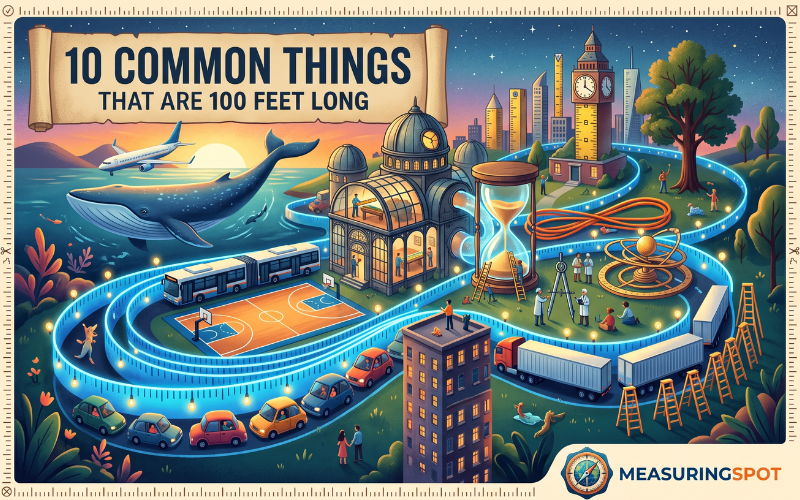
Have you ever looked across an empty parking lot, glanced at a high-voltage utility pole, or stepped outside onto a soccer pitch and wondered: How Long is 100 Feet Long?
Distance on paper often feels abstract. Numbers like 100 feet look neat in a contractor blueprint or a property deed, but our brains struggle to map raw measurements onto the physical world without everyday benchmarks. Knowing what 100 feet looks like is surprisingly practical. It helps homeowners plan landscaping borders, tells drivers how much braking buffer they actually have at highway speeds, and helps drone pilots stay within legal sightlines.
Quick Reference Snapshot: Understanding 100 Feet at a Glance
If you need a quick mental benchmark before digging into the full details, here is the short answer.
- Metric equivalent: 30.48 meters (or 3,048 cm)
- Inches: 1,200 inches
- Yards: 33.33 yards
- Human walking distance: Roughly 40 to 45 normal adult steps
- Fastest human sprint time: About 3 seconds flat (at Olympic sprinter speed)
- Average home comparison: The width of two standard suburban house frontages combined
Quick Comparison Table: Common Things Measuring ~100 Feet
The table below compiles 10 everyday, natural, and engineered items that hover right at or around the 100-foot mark.
| Object / Reference | Category | Typical Measurement | Quick Visualization Cue |
| Blue Whale | Marine Biology | 90–105 ft (27–32 m) | The largest animal on Earth from snout to fluke 🐋 |
| Boeing 737-100 Fuselage | Aviation | 94–100 ft (28.6–30.5 m) | The original twin-engine short-haul passenger jet ✈️ |
| Two City Transit Buses | Transportation | ~80–100 ft (24–30.5 m) | Two standard 40-ft city buses parked bumper-to-bumper 🚌 |
| NBA Basketball Court | Sports | 94 ft (28.65 m) | Baseline to baseline in an arena (plus 3 ft on each end) 🏀 |
| Seven Mid-Size Sedans | Automotive | 98–105 ft (30–32 m) | Seven Toyota Camrys parked nose-to-tail in traffic 🚗 |
| Ten-Story Building Height | Architecture | ~100–110 ft (30–33.5 m) | 10 vertical residential floors stacked at 10 ft each 🏢 |
| Adult Blue Gum / Mature Oak | Flora / Nature | 90–100 ft (27–30.5 m) | Fully grown deciduous canopy towering over two-story roofs 🌳 |
| Contractor Extension Cord | Tools / Hardware | Exactly 100 ft (30.48 m) | Standard full-spool commercial outdoor heavy-duty cord 🔌 |
| Two Tractor-Trailer Cargo Beds | Logistics | 96–106 ft (29–32 m) | Two standard 48-to-53 foot shipping trailers unhitched 🚛 |
| Nine 10-Foot Stepladders | Construction | ~90–100 ft (27–30.5 m) | Nine A-frame ladders laid end-to-end flat on the ground 🪜 |
Breaking Down Distance: How Long is 100 Feet Long?
To understand How Long is 100 Feet Long, it helps to strip away the abstractions and turn measurements into physical sensory experiences.
One foot equals exactly 12 inches (0.3048 meters). When multiplied by 100, you are looking at 1,200 inches, or just a hair over 30.48 meters. In American football terms, 100 feet accounts for exactly one-third of the playing field (excluding the end zones). If you stand on the goal line, 100 feet lands you directly on the 33.3-yard line.
For the average adult walking at a casual pace with a 2.5-foot stride, covering 100 feet takes roughly 40 consecutive strides. If you were to walk heel-to-toe—placing the heel of one shoe directly against the toes of the other—a person wearing standard US Men’s size 10 shoes (which measure roughly 10.5 inches in outer sole length) would have to take around 114 consecutive steps to span that distance.
The 10 Everyday Things That Are Around 100 Feet Long
Here is a closer breakdown of ten distinct items, structures, and living organisms that hit right around 100 feet in length.
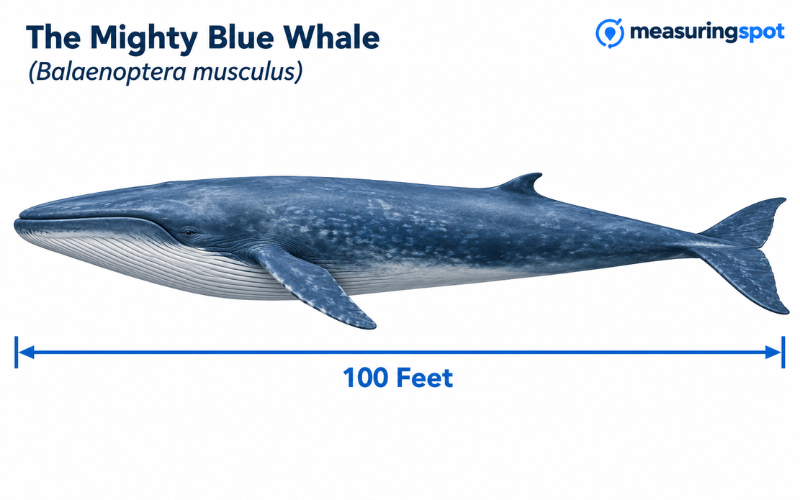
1. The Mighty Blue Whale (Balaenoptera musculus)
When biologists search for the absolute boundary of biological scale, the blue whale stands alone. An adult Antarctic blue whale regularly reaches lengths between 90 and 105 feet.
To put that in perspective, a creature measuring 100 feet long weighs up to 200 tons—equivalent to roughly 33 wild African elephants combined. Its heart alone weighs roughly 400 pounds and rivals the size of a small golf cart, while its tongue can weigh as much as a mature female hippopotamus. Seeing a 100-foot whale cruise alongside an ocean vessel puts human-scale machines into instant humility.
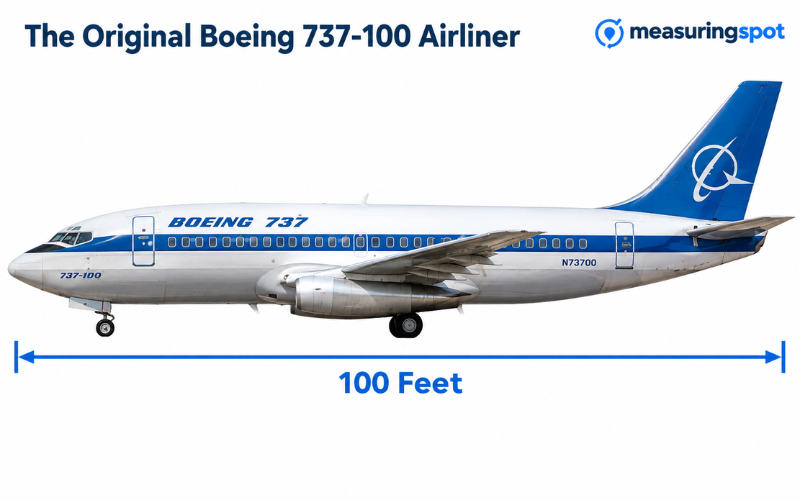
2. The Original Boeing 737-100 Airliner
Commercial aviation offers a tangible way to picture 100 feet. While modern stretched variants like the Boeing 737-800 or 737 MAX 9 reach 130 to 140 feet, the classic Boeing 737-100—the model that first made regional jet travel ubiquitous—measured 94 feet flat, expanding to just under 100 feet when accounting for structural variants and nose probes.
If you board a commuter flight today, stepping onto the jetway and glancing from the radome (the nose cone) down the aluminum fuselage to the edge of the horizontal stabilizer gives you an accurate 100-foot visual corridor.
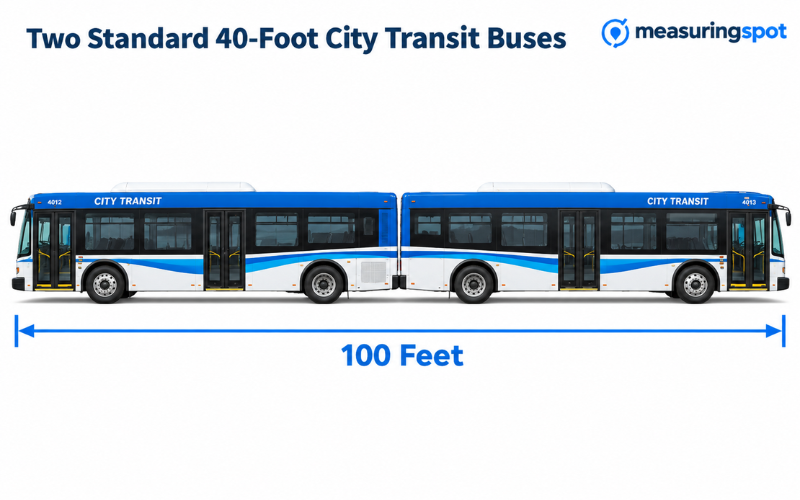
3. Two Standard 40-Foot City Transit Buses
Look at any busy city intersection during morning rush hour. Standard municipal transit buses (such as those manufactured by Gillig or New Flyer) measure 40 feet in overall bumper length.
When two of these buses pull up directly behind one another at a red light, leaving about 10 to 15 feet of safe stopping distance between them, the span from the front grille of the lead bus to the tail exhaust of the trailing bus totals approximately 95 to 100 feet. It is one of the easiest ways to gauge 100 feet while waiting on a street corner.
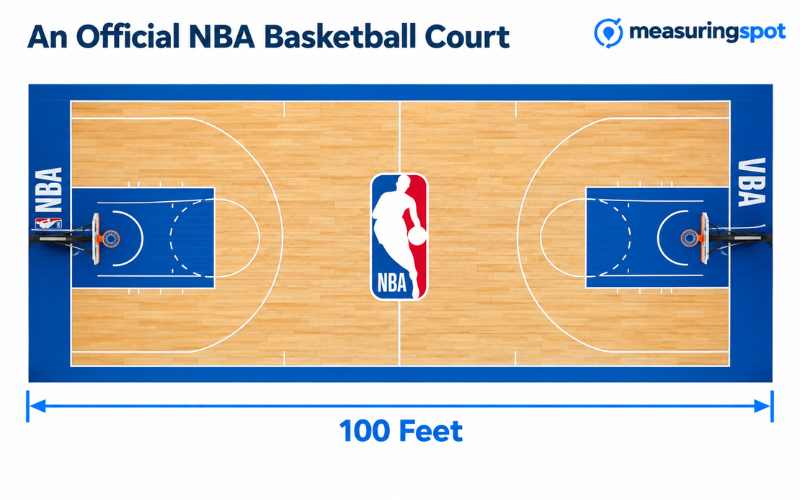
4. An Official NBA Basketball Court
Anyone who has played pickup basketball or watched professional games on television has spent hours staring at a 100-foot plane without realizing it.
An official National Basketball Association (NBA) and NCAA competition floor measures 94 feet long along the boundary sidelines from baseline to baseline, with an overall width of 50 feet. If you add the required three feet of padded hardwood run-off space behind each basket stanchion where baseline camera crews and coaches sit, the total physical wooden footprint measures almost exactly 100 feet from wall to wall.
5. A Line of Seven Mid-Size Family Sedans
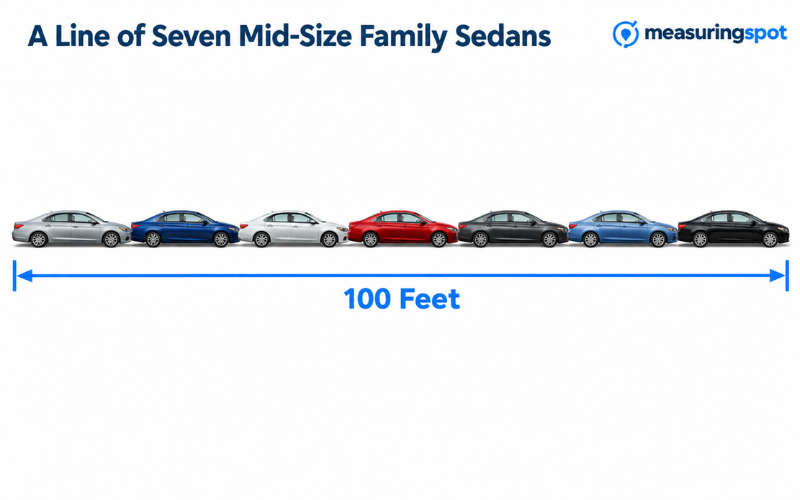
The typical modern mid-size family car—think a Toyota Camry, Honda Accord, or Subaru Legacy—has an overall vehicle length of approximately 16 feet (192 inches).
If a dealership lines up seven of these family sedans bumper-to-bumper with zero gap between them:
$$7 \times 16\text{ ft} = 112\text{ ft}$$
If you step down to compact compact hatchbacks (around 14.2 feet long), seven cars parked in a straight row land right at 99.4 feet. Whenever you are stuck in slow-moving traffic and see a column of six to seven cars ahead of you, you are looking straight down a 100-foot corridor of pavement.
6. The Height of a Typical 10-Story Residential Building
While horizontal spans are easy to map out on asphalt, vertical distance carries a different visual weight. In general residential architecture, a single story (including the ceiling clearance, floor joists, subflooring, and utility plenums) measures roughly 10 feet in floor-to-floor height.
A standard 10-story urban apartment building or dormitory climbs approximately 100 feet up from street level. If you drop an imaginary plumb line from the roof parapet of a 10th-floor balcony to the sidewalk below, you have mapped out 100 vertical feet.

7. A Mature English Oak or Blue Gum Eucalyptus
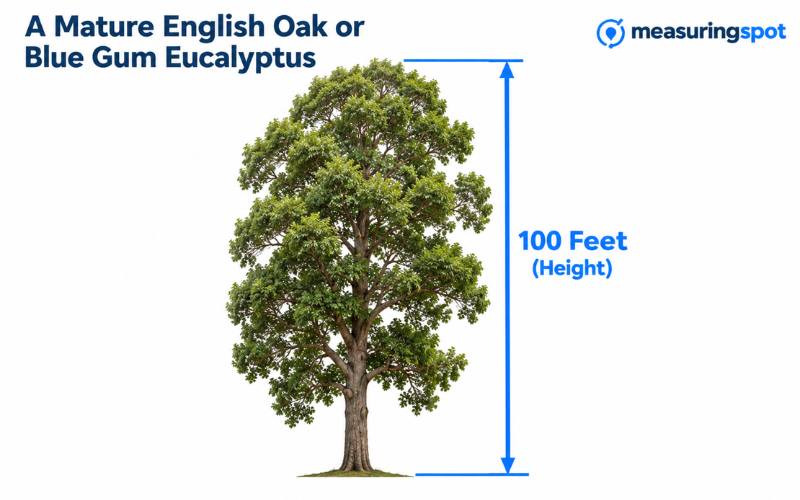
Nature matches human construction with remarkable ease. While coastal redwoods and sequoias command headlines by breaking 300 feet, standard full-canopy hardwood and evergreen trees across North America and Europe max out their mature growth around the century mark.
A fully mature English Oak (Quercus robur), American White Elm, or Blue Gum Eucalyptus growing in deep, fertile soil regularly tops out between 90 and 105 feet tall. If one of these majestic trees were felled and laid flat across an open meadow, its trunk and highest branches would span the distance of a 100-foot lot line.
8. A 100-Foot Contractor-Grade Power Extension Cord
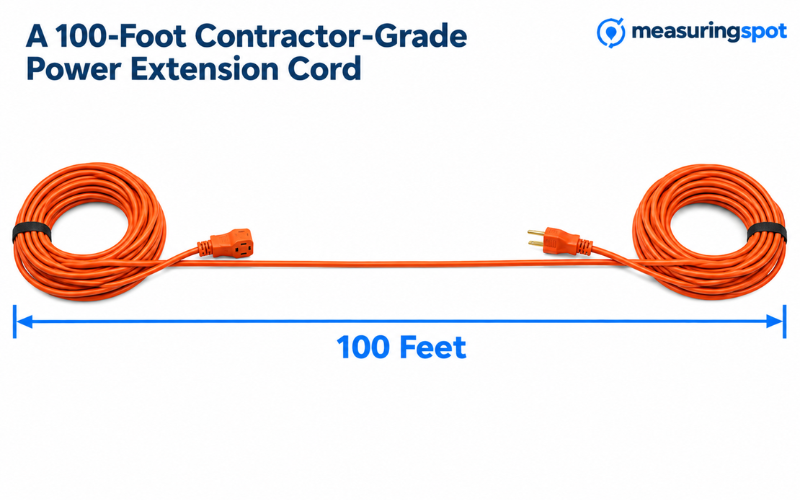
Homeowners, stagehands, and construction crews interact with 100 feet every time they tackle heavy outdoor projects. The standard high-visibility orange or yellow commercial outdoor extension cord sold at hardware stores comes pre-packaged in 25-foot, 50-foot, and 100-foot coils.
When unspooled from an exterior GFCI outlet along a driveway to power an electric pressure washer, a wood splitter, or perimeter holiday lights, that single bright cord unwinds to precisely 100 feet without a break.
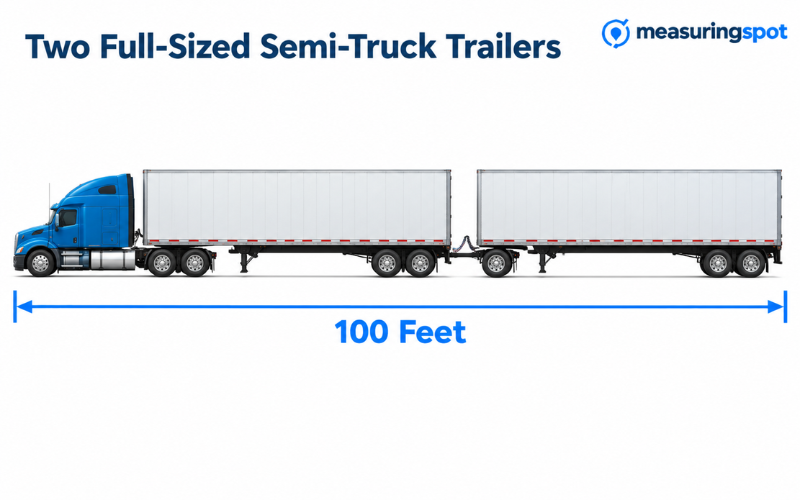
9. Two Full-Sized Semi-Truck Trailers
Logistics networks rely on standard dimensions established by transportation departments. The dry van trailers hauled by freight semi-trucks on interstate highways come in two standardized lengths: 48 feet and 53 feet.
Take two 48-foot trailers sitting detached in a freight distribution warehouse bay, park them end-to-end, and the result is 96 feet. If you take two modern 53-foot trailers, you hit 106 feet. Seeing two trailers stacked along a railroad flatcar gives an instant, industrial reference point for 100 feet.
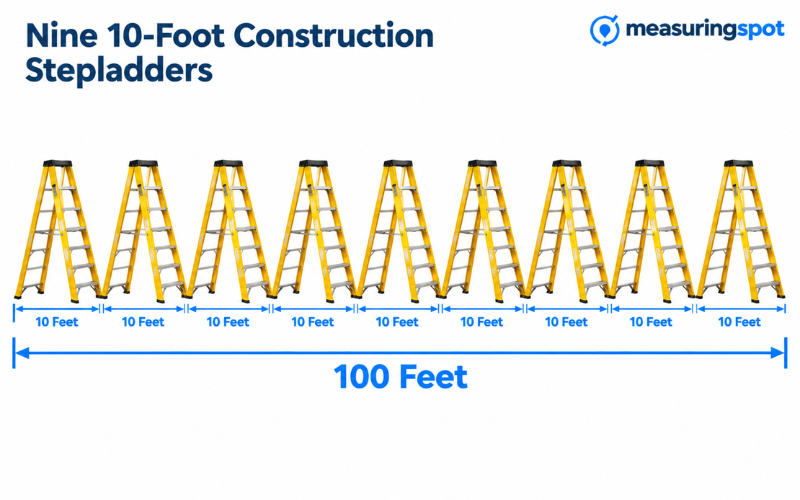
10. Nine 10-Foot Construction Stepladders
For anyone working in trades or DIY remodeling, the heavy-duty aluminum or fiberglass A-frame ladder is a constant companion. A standard 10-foot stepladder is designed to let an electrician or painter reach high residential ceilings or commercial ductwork.
If you lay nine of these 10-foot industrial ladders flat along a sidewalk end-to-end, they cover 90 feet. Add a tenth partially extended or account for safety feet spacing, and you hit 100 feet with zero guesswork.
Real-World Applications: Why Knowing 100 Feet Matters
Understanding distance is not just about trivia—it has real practical uses across daily life:
- Automotive Stopping Distances: At 35 mph (56 km/h) on dry asphalt, an average passenger vehicle takes roughly 60 feet of braking distance once the pedal is pressed, plus another 40 feet of reaction time distance. Knowing what 100 feet looks like tells you whether your following distance is safe or tailgating.
- Property Lines and Zoning: Municipal residential setbacks often require sheds, accessory dwelling units (ADUs), or detached garages to sit specific distances (such as 25, 50, or 100 feet) from wetlands, septic tanks, or property boundaries.
- Sports Field Awareness: Coaching youth soccer, baseball, or flag football often requires setting up practice cones without a wheel tape. Knowing that 100 feet is roughly 33 yards allows you to set up drills quickly.
Frequently Asked Questions (FAQs) ❓
How long does it take an average person to walk 100 feet?
At a comfortable walking speed of roughly 3 to 3.5 miles per hour (around 4.4 to 5.1 feet per second), an adult walks 100 feet in approximately 20 to 23 seconds.
How many steps make up 100 feet?
For a typical adult with an average step stride of 2.5 feet, it takes 40 steps. For shorter strides (around 2.1 to 2.2 feet), expect between 45 and 48 steps.
What does 100 feet look like from above?
From an airplane window or a commercial drone cruising at 400 feet, a 100-foot object looks roughly like the length of a small passenger jet fuselage or about the width of three standard residential building lots set side-by-side.
How does 100 feet compare to an Olympic swimming pool?
An Olympic-size swimming pool is 50 meters long, which translates to roughly 164 feet. Therefore, 100 feet covers just under two-thirds (about 61%) of an Olympic pool length.
Related Posts
- 10 Common Things That Are 90 Feet Long:
- 10 Common Things That Are 80 Feet Long:
- 10 Common Things That Are 70 Feet Long
- 10 Common Things That Are 60 Feet Long
Conclusion
Gauging How Long is 100 Feet Long becomes second nature once you anchor the measurement to familiar, real-world objects rather than abstract numbers on a tape measure. Whether you visualize the majestic span of a mature blue whale gliding through the ocean, the baseline-to-baseline length of an NBA basketball court, or simply two city transit buses parked nose-to-tail at an intersection, having these visual reference points bridges the gap between raw data and practical reality. From setting up safe vehicle following distances and mapping out property boundaries to organizing local sports fields, recognizing this 30.48-meter milestone equips you with an intuitive, reliable spatial sense for everyday life.
FOR MORE MEASUREMENTS VISIT: MEASURINGSPOT