

When you come across a measurement like 23 mm on a product label, a mechanical schematic, or a watch specification sheet, it can feel surprisingly hard to picture. Metric measurements in tiny increments often feel abstract until you place them directly against items you handle on a daily basis.
Knowing the real-world scale of 23mm saves time when you shop online, tackle DIY home repairs, or select the right jewelry and accessories. Instead of searching around your house for a metric ruler or pulling out a set of calipers, you can use familiar household objects to check the size right away.
This guide breaks down exactly how big 23mm is through direct conversions, a quick comparison table, and detailed looks at ten common items that match this exact footprint.
Quick Answer: How Big is 23mm?
Twenty-three millimeters equals 2.3 centimeters or roughly 0.905 inches. That puts it just under one full inch—specifically about 29/32 of an inch.
For an immediate visual reference, think of a standard US quarter, which measures 24.26mm. A 23mm object is just a hair smaller than that coin. If you hold a quarter in your palm and imagine shaving off half a millimeter around the rim, you are holding something that is exactly 23mm across.
Metric and Imperial Dimension Reference
Before looking at individual items, keep these basic conversions and physical values handy for quick cross-referencing.
| Dimension / Metric | Value | Notes & Common Equivalents |
| Millimeters (mm) | 23 mm | Base measurement |
| Centimeters (cm) | 2.3 cm | Slightly smaller than a standard postage stamp width |
| Inches (Decimal) | 0.9055 in | Just shy of 15/16 inch (0.9375 in) |
| Fractional Inch | ~ 29/32 in | Approximately 1/10 inch less than 1 full inch |
| Meters (m) | 0.023 m | Standard SI derived length |
| Feet (ft) | 0.0754 ft | Micro-architectural scale |
| US Coin Benchmark | 24.26 mm | US Quarter (23mm is ~95% of a quarter) |
| Euro Coin Benchmark | 23.25 mm | 1 Euro coin (virtually identical to 23mm) |
| UK Coin Benchmark | 22.5 mm | 1 Pound coin (fractionally smaller) |
| Everyday Comparison | Diameter | Standard plastic soda bottle cap outer base |
10 Common Things That Measure 23mm
Here are ten concrete items that measure approximately or exactly 23mm across their diameter, height, or width.
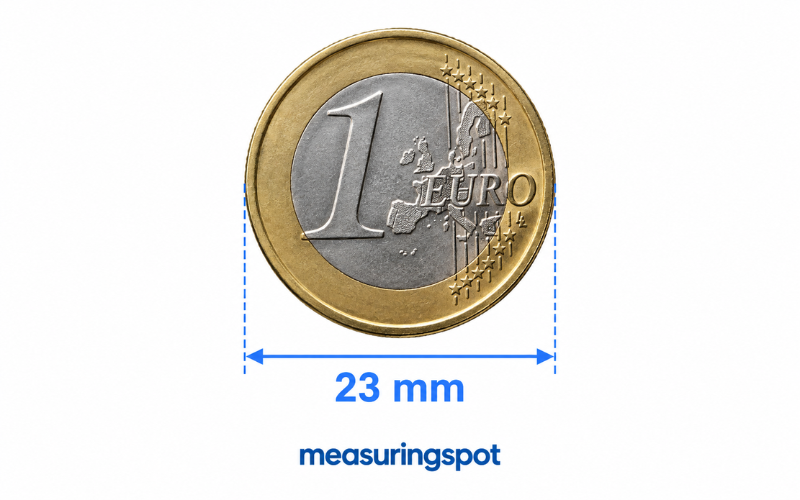
1. The 1 Euro Coin
If you live in Europe or keep leftover travel currency in a drawer, the 1 Euro coin serves as the most accurate reference you can find.
The European Central Bank manufactures the 1 Euro coin with an official diameter of 23.25 millimeters. That leaves a difference of only a quarter of a millimeter, an amount invisible to the naked human eye without magnification. The coin features a distinct two-tone design, combining a nickel-brass outer ring with a cupronickel center.
When you need to gauge watch lug widths, camera filter rings, or drill bits, setting a 1 Euro coin flat on your workpiece gives you a benchmark within 1% of 23mm.
2. A Standard US Quarter (Minus Its Rim)
In the United States, the quarter dollar coin ranks as the most accessible pocket reference. The United States Mint sets the official diameter of a quarter at 24.26 millimeters.
While a quarter is slightly larger than 23mm, the difference is only 1.26 millimeters—roughly the thickness of a thumbnail. If you look at the raised reeded edge along the rim of a quarter, that rim measures roughly 0.6mm wide on either side.
If you mentally remove that thin textured border, the inner face of the coin spans almost precisely 23 millimeters across George Washington’s portrait.

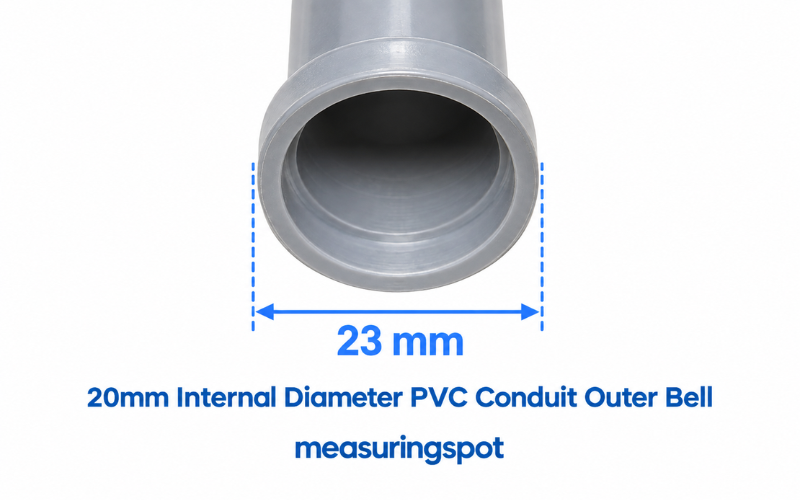
3. A 20mm Internal Diameter PVC Conduit Outer Bell
Electricians and home renovators handle PVC conduit and copper plumbing lines every single day. While pipe fittings use nominal internal measurements, their exterior boundaries tell a different story.
A conduit pipe labeled with a 20mm internal passage carries a wall thickness of roughly 1.5mm. When you measure the outer body of that pipe, the cross-sectional width hits right around 23 millimeters.
The same holds true for standard household mini-ball valve fittings and several types of 1/2-inch PEX pipe couplings. Holding one of these plastic or brass components gives you a solid feel for the girth of 23mm in three dimensions.
4. Men’s Medium Shirt Buttons and Blazer Buttons
Clothing buttons come in standard industry sizing called “lignes” (where 1 ligne equals 0.635mm), but tailoring supply houses routinely categorize them by millimeters.
A standard suit jacket sleeve button measures around 15mm, while the primary front buttons on a winter overcoat, trench coat, or heavy double-breasted blazer typically measure 36 lignes, which translates directly to 22.86mm to 23mm.
These buttons are large enough to secure thick wool or twill fabrics without slipping through the buttonhole under tension. The next time you put on a formal suit jacket or heavy winter peacoat, take a look at the closure buttons on the front torso—they sit right at the 23mm mark.

5. A Standard Wine Bottle Cork Diameter
Standard natural wine corks designed for commercial 750ml glass bottles measure 24mm uncompressed, while the internal diameter of the bottle neck measures around 18.5mm to 19mm.
Once a cork extraction tool pulls that stopper from the bottle neck, the cork expands slightly while remaining partially compressed, resting between 23mm and 23.5mm along its midsection. Synthetic wine stoppers and tasting corks with plastic caps frequently feature a body molded to an exact 23mm outer diameter.
If you have a used wine cork sitting on your kitchen counter, roll it between your fingers; its circular cross-section reflects 23mm almost perfectly.

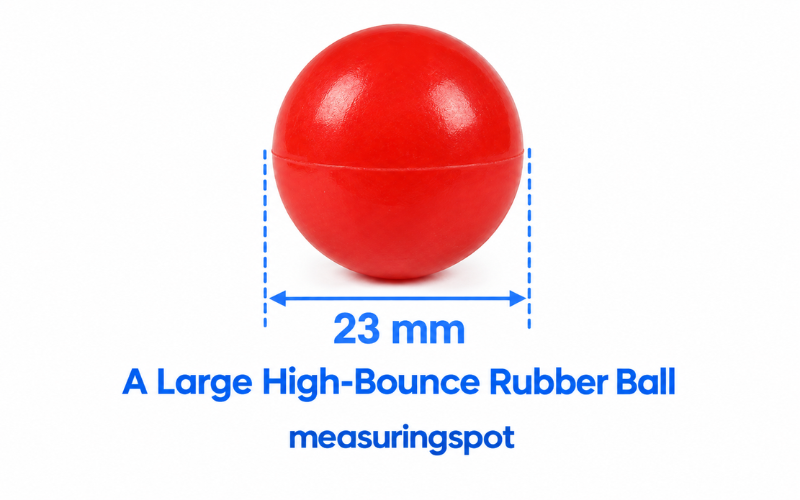
6. A Large High-Bounce Rubber Ball
Small gumball machine bouncy balls usually measure around 19mm (3/4 inch), but premium mini bouncy balls and classic party-favor bounce toys often step up to the 23mm to 24mm mold category.
These dense rubber spheres fit neatly inside an adult palm when your fingers curl halfway over them. You can also find standard multi-sided gaming dice—particularly oversized twenty-sided dice (d20) used in tabletop roleplaying games—that measure roughly 23mm point-to-point across their widest axis.
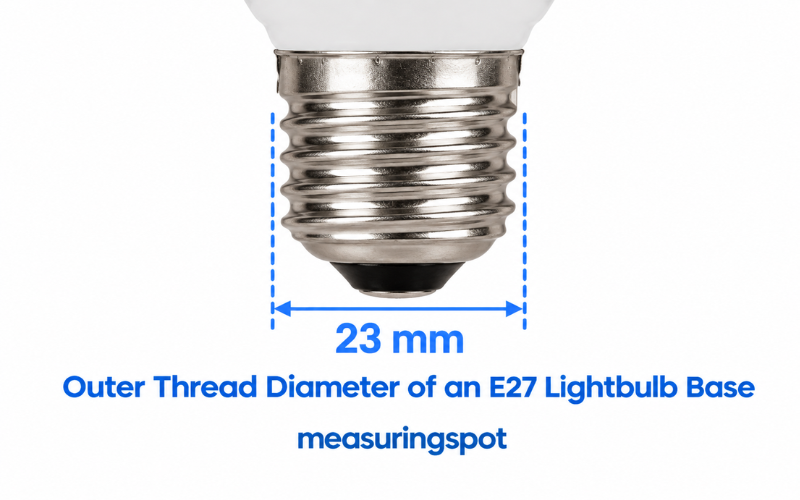
7. Outer Thread Diameter of an E27 Lightbulb Base
Household incandescent and LED lightbulbs in North America utilize an E26 screw base (26mm), but several specialized sockets, international threaded bulbs, and appliance light housings rely on intermediate threaded mounts.
Certain European and specialty tubular candelabra bulbs use decorative caps that run 23mm along their main socket casing. More commonly, the inner glass stem that protects the filament inside vintage-style Edison bulbs carries an outer envelope width right at 23 millimeters before flaring into the globe.
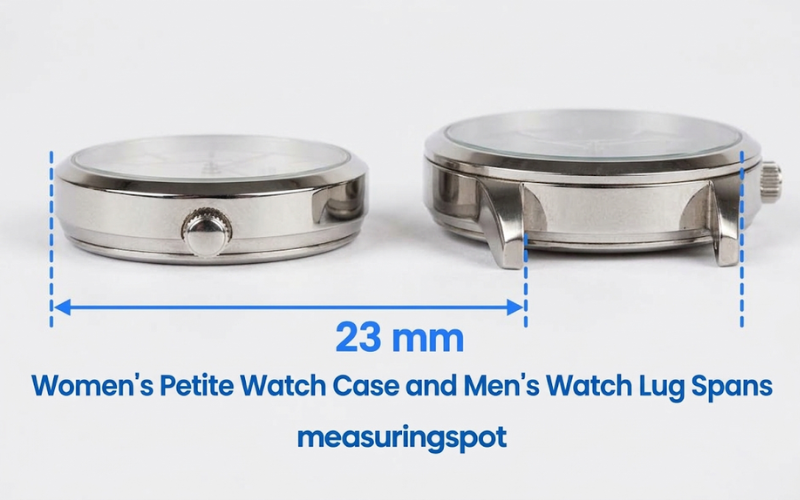
8. Women’s Petite Watch Case and Men’s Watch Lug Spans
In horology, millimeter increments define the entire aesthetic of a timepiece. An adjustment of just one or two millimeters completely alters how a watch sits on the wrist.
Traditional vintage dress watches made for women frequently feature a main case diameter of 23mm. For instance, classic luxury timepieces like the Cartier Panthère (Medium model) feature a case width of roughly 22mm to 23mm.
On the men’s side of watchmaking, you will encounter 23mm as an uncommon, proprietary lug width—the gap between the watch horns where the leather strap or steel bracelet attaches. High-end brands like Blancpain and certain Citizen models manufacture watches with exact 23mm lug gaps, requiring specialized strap sizing.
9. A Standard 15/16-Inch Mechanics Socket Outer Profile
If you spend time working under an automobile hood or assembling machinery, you likely own a socket wrench kit. While the hex drive inside grabs the bolt, the exterior walls of the metal socket add measurable width.
A compact 1/2-inch drive socket built for 10mm or 11mm nuts typically features an outer cylinder diameter right around 23 millimeters.
Similarly, an open-ended combination wrench labeled 17mm features steel jaws whose total head profile spans roughly 23mm across its outer contours. Mechanics often use these predictable exterior dimensions to check whether a wrench will fit inside tight engine bays before turning a bolt.

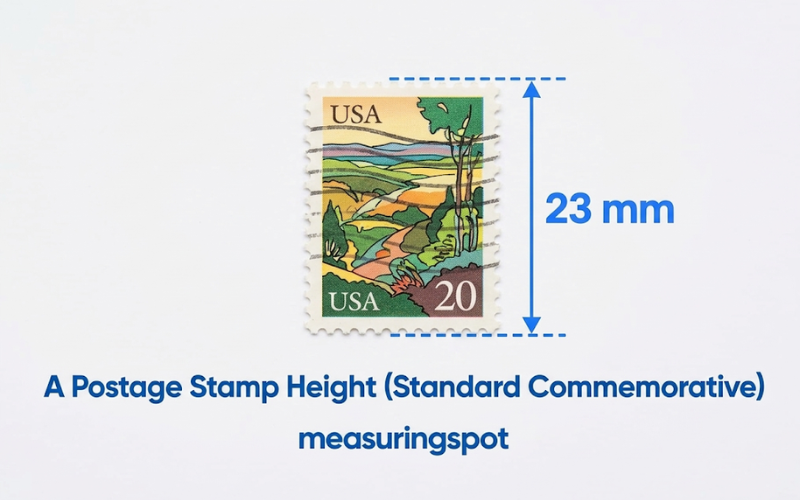
10. A Postage Stamp Height (Standard Commemorative)
While large commemorative stamps vary, the standard definitive stamps produced by postal services worldwide stick to strict geometric layouts.
The classic United States definitive “flag” coil stamps, as well as definitive stamp issues across the Commonwealth, stand 22.5mm to 23mm tall from the lower perforations to the top teeth.
When you place a standard domestic postage stamp on an envelope, you are looking at a paper rectangle whose vertical height provides a direct snapshot of 23mm.
The Math Behind 23mm: Conversions and Ratios
Understanding how 23mm stacks up against different measurement systems helps prevent costly mistakes during ordering and construction.
Millimeters to Inches Breakdown
The metric system divides units cleanly by tens, whereas imperial measurements rely on binary fractions (halves, quarters, eighths, sixteenths, thirty-seconds, and sixty-fourths). Because 1 inch is defined internationally as exactly 25.4 millimeters, converting 23mm requires a simple division step:
$$23 \div 25.4 = 0.9055118\dots\text{ inches}$$
To find the closest practical fraction on an imperial tape measure:
- 7/8inch=0.875inches (roughly 22.22 mm)
- 29/32inch=0.90625inches (roughly 23.02 mm)
- 15/16inch=0.9375inches (roughly 23.81 mm)
The fraction 29/32 of an inch matches 23mm with an error margin of less than two hundredths of a millimeter. For everyday woodwork or craft projects, using the line just past 7/8 inch on your tape measure gives you an accurate physical marker.
Surface Area and Volume of 23mm Objects
When you move from a flat line to surfaces and three-dimensional spaces, a 23mm measurement behaves in specific ways:
- Circle Area: A circle with a 23mm diameter has a radius (r) of 11.5mm. Using the circle area formula:
- Area=r2=3.14159(11.5)2415.48mm2(or4.15cm2)
- Sphere Volume: A ball bearing or marble with a 23mm diameter occupies:
- Volume=43r3=433.14159(11.5)36,370.6mm3(or6.37cm3)
These values explain why a 23mm steel sphere feels surprisingly heavy in your hand; six cubic centimeters of solid carbon steel carries a mass of almost 50 grams (1.76 ounces).
Why 23mm Matters Across Different Industries
Engineers, jewelers, and designers do not pick 23mm at random. Specific industrial standards and ergonomic parameters make 23mm a natural landing spot for tools, consumer goods, and biological measurements.
Watchmaking and Personal Jewelry
In jewelry production, 23mm represents a critical pivot point between delicate and statement pieces:
- Finger Rings: A standard US Men’s ring size 14 has an inner diameter of 23mm. That accommodates large hands and heavy knuckles.
- Hoop Earrings: Medium-sized everyday hoops frequently use a 23mm outer diameter. This size drops just below the earlobe without brushing against the collar of a shirt or jacket.
- Pendants and Medallions: Religious medals, commemorative coins, and locket necklaces commonly choose 23mm to 25mm blanks. This size offers ample canvas for detailed engravings while remaining light enough to hang comfortably on a fine chain.
Photography and Camera Hardware
Photographers handle millimeter measurements constantly when swapping lenses and mounting filters:
- Sensor Widths: The Micro Four Thirds camera sensor standard uses a sensor measuring 17.3mm by 13mm, giving a diagonal measurement of 21.6mm—just under 23mm.
- Lens Caps and Thread Steps: While common front filter threads run 49mm, 58mm, or 77mm, small rangefinder lenses and vintage Leica optics frequently incorporate 23mm screw-in filters or 23mm push-on slip caps.
- Eyecup Diameters: The rubber viewing rings surrounding optical viewfinders on classic SLR bodies hover right around 22mm to 23mm to seal flush against the human eye socket.
Cycling and Tire Clearances
For road cyclists, tire width dictates rolling resistance, grip, and comfort on the asphalt:
- The 23c Road Standard: For decades, professional peloton riders and recreational road cyclists considered 23mm (labeled as 700x23c) the gold standard tire width. Mechanics inflated these high-pressure, narrow tires up to 110–120 PSI to reduce aerodynamic drag on smooth racing velodromes and highways.
- Frame Clearance Constraints: Many vintage racing frames built between 1980 and 2010 were engineered with tight fork arches that max out at 23mm. Attempting to fit modern 28mm or 32mm tires onto these classic bikes causes the rubber to rub against the metal brake calipers and chainstays.
Everyday Measurement Hacks: Measuring 23mm Without a Ruler
When you are standing in a store or working in your garage without measuring instruments, simple body markers and common pocket items can help you approximate 23mm.
The Finger Joint Method
For most adults, the distance across the middle knuckle of the index finger or thumb offers a consistent scale:
- Lay your hand flat on a table.
- Examine the middle segment (between the first and second knuckles) of your index finger.
- For an average adult hand, the width across this bone measures between 21mm and 24mm.
Measure your knuckles with a ruler once at home, note which finger sits closest to 23mm, and you will always have an emergency gauge attached to your body.
The Stacked Coin Method
If you need precise imperial conversions, combining common pocket coins provides reliable increments:
- Four US Dimes Stacked Flat: A single US dime has an official edge thickness of 1.35mm. Stacking 17 dimes produces 22.95mm—virtually an exact 23mm height.
- Standard AA Battery Width: The common AA battery that powers remote controls measures 14.5mm in diameter. That means 23mm is roughly one and a half AA battery widths placed side by side.
- SD Memory Card: A standard full-size SD card measures 24mm wide by 32mm tall. If you hold a camera memory card between your fingertips, its short edge sits within one single millimeter of 23mm.
BioWiki Table: Quick Spec Sheet for 23mm
| Specification Attribute | Details and Verified Data |
| Exact Millimeters | 23.00 mm |
| Centimeter Equivalence | 2.30 cm |
| Decimal Inch Value | 0.90551 inches |
| Nearest 16th Inch | 15/16 inch (slightly smaller) |
| Nearest 32nd Inch | 29/32 inch (accurate to 0.02 mm) |
| Nearest 64th Inch | 58/64 inch |
| International Paper Match | Margin width on standard DIN A4 documents |
| Closest Circulating Coin | 1 Euro coin (23.25 mm) |
| Closest US Currency Coin | US Quarter (24.26 mm) |
| Closest UK Currency Coin | 1 Pound Coin (22.50 mm) |
| Classic Bicycle Tire Width | 700x23c road racing slick |
| Men’s US Ring Equivalent | Size 14 to 14.5 inner diameter |
| Automotive Hardware | M14 bolt head outer hex spread (standard metric) |
| Plumbing Standard | Outer sleeve on 3/4-inch push-fit pipe fittings |
Frequently Asked Questions About 23mm
Is 23mm larger or smaller than 1 inch?
23mm is smaller than 1 inch. One full inch equals exactly 25.4 millimeters. That leaves 23mm about 2.4 millimeters (roughly 3/32 of an inch) short of a full inch.
How many centimeters are in 23mm?
There are exactly 2.3 centimeters in 23 millimeters. The metric system uses a base-10 scale, so dividing millimeters by 10 yields the centimeter value immediately.
What US coin is closest to 23mm?
The US quarter is the closest common American coin. A quarter measures 24.26mm across, making it roughly 1.26mm larger than 23mm. If you want an even closer comparison, a US nickel measures 21.21mm, meaning 23mm sits right in the gap between a nickel and a quarter.
Can I use a standard tape measure to mark 23mm?
Yes. Most modern tape measures include both metric and imperial markings. Look for the 2cm line, then count three individual millimeter tick marks past it. If your tape measure only features inches, mark the line halfway between 7/8 inch and 15/16 inch (the 29/32-inch position).
What does a 23mm socket wrench loosen?
A 23mm socket wrench fits standard M14 or specialized M16 heavy structural metric hex nuts and bolts. You frequently find these fasteners on heavy agricultural equipment, industrial framing, suspension control arms, and commercial machinery mounts.
Why is 23mm such a popular size for watch straps?
While 20mm and 22mm dominate the watch industry, several manufacturers use 23mm odd-lug dimensions to encourage owners to buy original manufacturer replacement straps. High-end chronographs with bold 43mm or 44mm cases also adopt 23mm straps to keep the proportions balanced against the watch body.
Is 23mm the same as 7/8 inch?
Not quite. 7/8 of an inch equals 0.875 inches, which converts to 22.225mm. That makes 23mm roughly 0.775mm larger than 7/8 inch. While they are close enough for rough carpentry or flexible fabric cuts, mechanical fittings require exact sizing to prevent loose tolerances.
Visualizing 23mm becomes straightforward once you pair the number with everyday objects. Rather than wrestling with conversion formulas or guessing scales on an online product page, you can rely on items like a 1 Euro coin, the face of a US quarter, or the width of a suit button to get an accurate read.
Keep these physical comparisons in mind whenever you handle hardware projects, watch shopping, or fabric work. Having these mental reference points ready ensures you pick the right dimensions on the first attempt without second-guessing your sizing.
Related Posts
- 10 Common Things That Are 20 mm Big
- 10 Common Things That Are 19 mm Big
- 10 Common Things That Are 18 mm Big
- 10 Common Things That Are 17 mm Big
Conclusion
Gauging 23mm becomes effortless once you link the number to everyday objects. Instead of struggling with conversion charts or guessing product dimensions on a screen, you can reliably picture a 1 Euro coin, the face of a US quarter, or a heavy coat button to verify the scale immediately.
Whether you are swapping a watch strap, fitting bicycle tires, or shopping for hardware online, these physical touchpoints eliminate the guesswork. Keeping these familiar items in mind ensures you select the correct size with confidence every single time.
FOR MORE MEASUREMENTS VISIT: MEASURINGSPOT