
Have you ever tried measuring a space in your living room or truck bed without a tape measure handy? Estimating measurements on the fly often leads to mismatched furniture, ill-fitting car cargo, or awkward home renovation mishaps.
Learning how long 42 inches is by referencing familiar household goods solves this problem instantly. Once you anchor this specific dimension to everyday objects, you can accurately estimate lengths anywhere without reaching for a ruler.
Quick Answer: How Long Is 42 Inches?
42 inches equals exactly 3.5 feet, 106.68 centimeters, or 1.0668 meters.
For an immediate physical comparison:
- It reaches roughly navel or rib height on an average adult.
- It matches the standard height of a commercial bar or kitchen pub counter.
- It equals the length of three and a half standard 12-inch school rulers lined up end to end.
42 Inches Quick Conversion and BioWiki Table
| Measurement Unit | Equivalent Value | Common Application / Context |
| Feet (ft) | 3.5 ft | Standard architectural plan notation |
| Yards (yd) | 1.167 yd | Fabric, upholstery, and textile retail |
| Centimeters (cm) | 106.68 cm | Metric building layouts and carpentry |
| Meters (m) | 1.0668 m | International shipping specs |
| Millimeters (mm) | 1066.8 mm | Precision engineering and fabrication |
| Inches (in) | 42 in | Screen diagonals, counter heights, guardrails |
| Handbreadths | ~10.5 hands | Equestrian measuring (1 hand = 4 in) |
| Pica / Points | 252 picas / 3024 pt | Commercial printing layouts |
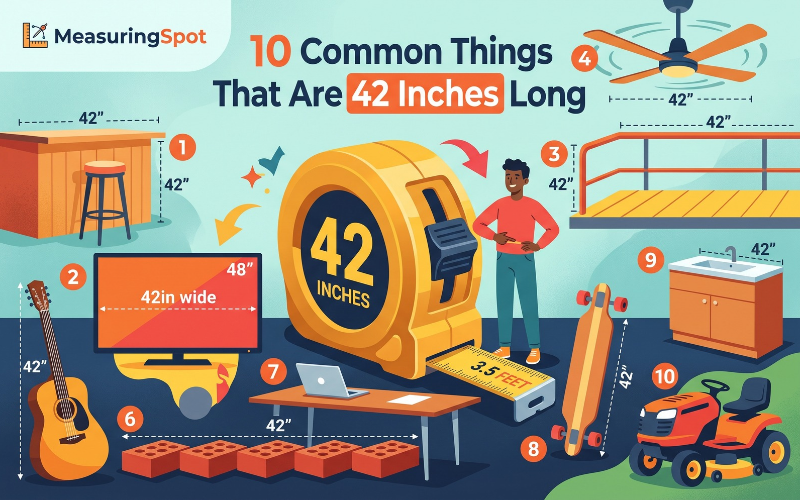
10 Common Everyday Things That Measure 42 Inches
1. Standard Bar-Height Dining Counters and Kitchen Islands
Step into any modern kitchen, cafe, or sports bar, and you stand right next to a 42-inch benchmark. While standard kitchen prep countertops stand 36 inches high to suit food chopping while standing, bar-height counters consistently measure 42 inches from the floor to the top surface.
Interior designers select this height deliberately. It allows a standing person to lean comfortably against the counter without bending their back, while also pairing naturally with 30-inch bar stools. When you install a raised breakfast bar or order high-top pub dining furniture, contractors build the framework precisely to 42 inches.
If you ever need to determine whether a sofa table, dog gate, or piece of wall art matches this length, stand beside a kitchen bar counter to gauge the distance instantly.

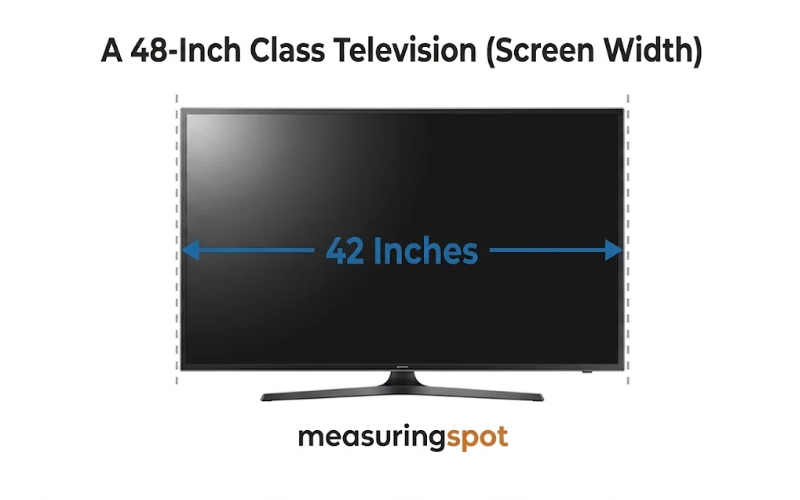
2. A 48-Inch Class Television (Screen Width)
Television marketing creates endless confusion because manufacturers measure screens diagonally across corners rather than horizontally across the frame. When you buy a modern 48-inch flat-panel television with a standard 16:9 widescreen aspect ratio, the horizontal width measures roughly 41.8 to 42 inches across the display.
The screen frame itself adds only a fraction of an inch due to ultra-thin modern bezels. Because millions of households mount 48-inch displays in bedrooms, dens, and living rooms, you can easily use your TV console or screen width as an accurate horizontal ruler. If a space between two bookcases looks roughly equal to your bedroom TV width, that space measures almost exactly 42 inches.
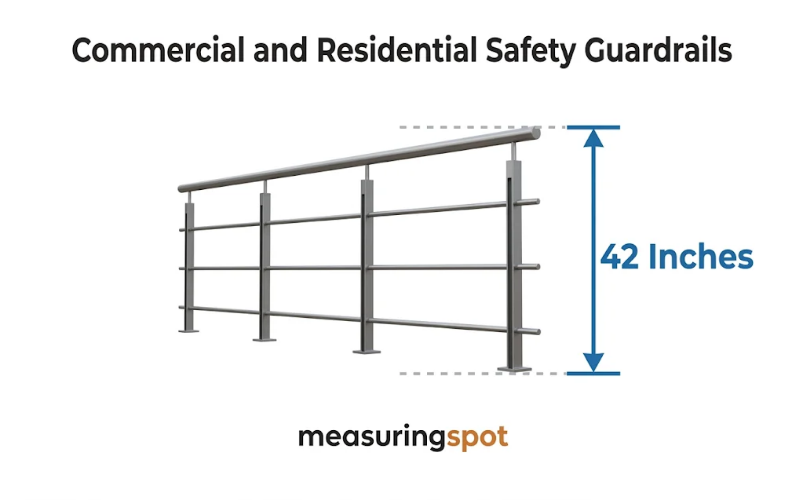
3. Commercial OSHA and Residential Safety Guardrails
Safety codes dictate physical measurements across public spaces, commercial job sites, and residential balconies. The Occupational Safety and Health Administration (OSHA) requires standard perimeter guardrails, scaffolding rails, and industrial safety barriers to stand 42 inches (plus or minus 3 inches) above the walking surface.
Civil engineers choose this specific height because it sits safely above the average human body’s center of gravity. A rail at mid-thigh height might cause a tripping hazard during a sudden stumble, whereas a 42-inch top rail hits an adult around the upper waist, catching momentum and preventing falls. The next time you walk past an office staircase overlook, an apartment balcony rail, or a stadium deck barrier, look at the top railing—you are staring at a 42-inch standard.
4. Standard 42-Inch Ceiling Fan Blade Spans
When cooling small-to-medium rooms—such as guest bedrooms, home offices, and breakfast nooks—HVAC technicians and electricians recommend ceiling fans with a 42-inch blade sweep. The blade span refers to the full circular diameter from the tip of one blade across the motor center to the opposite tip.
A 42-inch ceiling fan moves between 3,000 and 4,500 cubic feet of air per minute without overwhelming rooms that measure between 100 and 150 square feet. Because these fixtures mount in millions of homes, the span between opposite blade tips gives you a reliable overhead ruler.

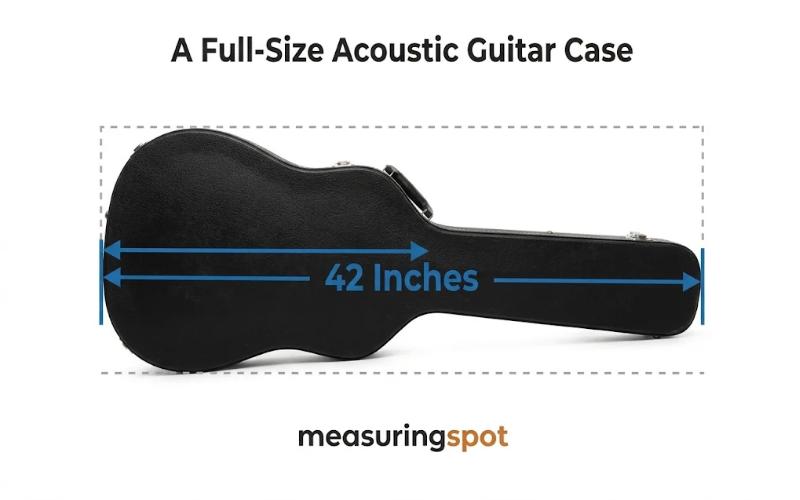
5. A Professional Full-Size Acoustic Guitar Case
Musicians and travelers interact with 42-inch luggage every day. While the scale length of a standard acoustic guitar neck measures roughly 24.75 to 25.5 inches, the full instrument body—from the base of the lower bout to the tip of the headstock—stretches to approximately 40 to 41 inches.
To protect the instrument during transport, standard hard-shell dreadnought cases measure 42 to 43 inches in overall exterior length. Luggage compartments, airplane coat closets, and car trunks are frequently designed with this 42-inch threshold in mind so musicians can lay their instrument cases flat.
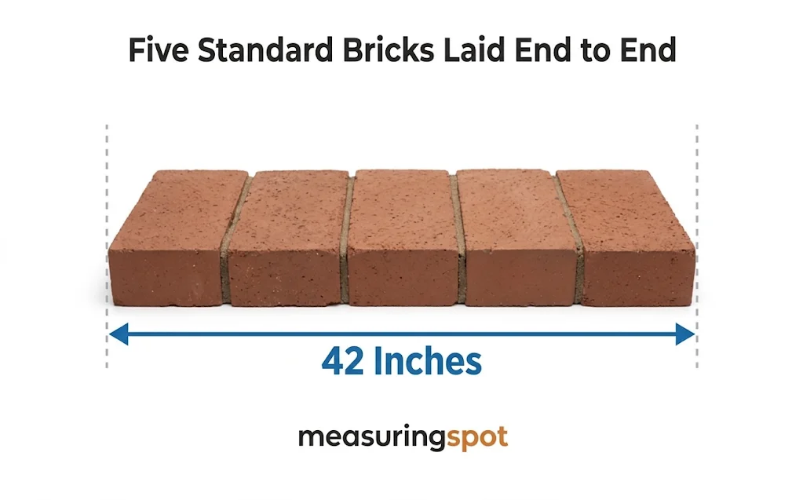
6. Five Standard Bricks Laid End to End
Standard residential modular construction relies on consistent physical building blocks. In the United States, a standard modular clay brick measures 8 inches long, including the typical 3/8-inch mortar joint.
When masons lay modular bricks along an outdoor walkway, retaining wall, or home facade:
- One brick plus joint: ~8.4 inches
- Two bricks: ~16.8 inches
- Three bricks: ~25.2 inches
- Four bricks: ~33.6 inches
- Five bricks: exactly 42 inches
If you are working outside in the garden or along an exterior patio wall, count five consecutive horizontal bricks along a single course to map out 42 inches without tools.
7. Large Office Conference Table and Desk Depths
In commercial corporate offices, executive desks and round collaborative conference tables frequently share a 42-inch diameter or depth.
While individual cubicle work surfaces typically measure 24 to 30 inches deep, collaborative boardroom tables require extra clearance. A depth of 42 inches provides room for two seated workers across from one another to open 15-inch laptops, spread out legal-size file folders, and share center-mounted power hubs without knocking knees. Round 42-inch conference tables also form the backbone of small team huddle rooms, seating up to four professionals comfortably.

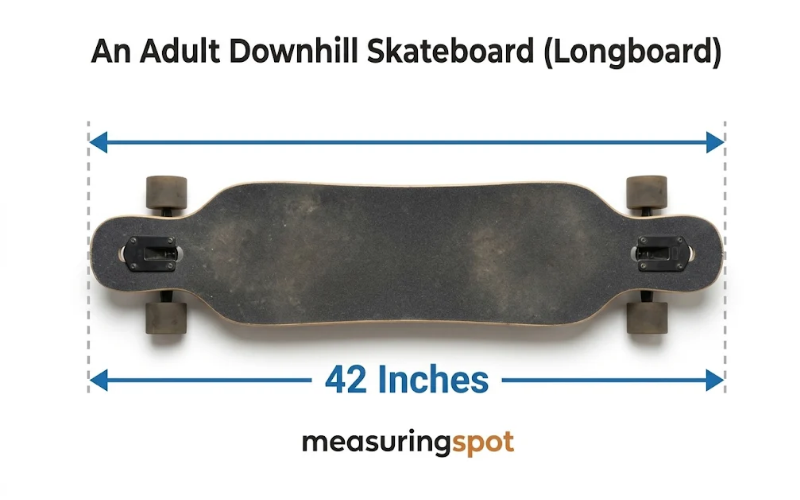
8. An Adult Downhill Skateboard (Longboard)
Skateboards come in multiple configurations, but downhill speed boards, distance cruisers, and carving longboards commonly measure 42 inches from nose to tail.
While street skateboards measure around 31 inches to 33 inches to favor kickflips and technical grinding, 42-inch downhill decks prioritize aerodynamic stability and wide stances. The extended wheelbase dampens high-speed speed wobbles when riding down steep grades. Standing a carving longboard upright next to your hip reveals how closely it aligns with the standard 42-inch bar counter height.
9. A Standard 42-Inch Bathroom Vanity
Home supply stores categorize pre-assembled bathroom vanities into standard width increments: 24, 30, 36, 42, 48, and 60 inches. The 42-inch vanity serves as the premier mid-size single-sink solution for master bathrooms and spacious guest baths.
A 36-inch vanity often feels cramped for homeowners wanting side drawers, while a 48-inch cabinet demands excessive floor space. The 42-inch cabinet bridges this gap by accommodating a centered undermount porcelain sink basin alongside dedicated three-tier drawer banks on either side. Cabinetmakers build these frames across the entire home improvement industry to exact 42-inch exterior casework dimensions.

10. The Wheelbase of a Compact Riding Lawn Mower
Maintaining a half-acre yard usually involves a residential lawn tractor or zero-turn mower. If you examine the mechanical specs of popular entry-level riding mowers featuring 36-inch or 42-inch cutting decks, the distance between the front axle and rear axle—the vehicle’s wheelbase—frequently measures 42 inches.
Automotive and equipment engineers select a 42-inch stance to balance a tight turning radius against driver stability on mild slopes. If you park your lawn tractor in a garage shed, you can quickly gauge 3.5 feet along the floor by glancing at the distance separating the front and rear wheel hubs.

The Practical Physics of 42 Inches: Why Manufacturers Choose It
Why does the number 42 appear so consistently across unrelated fields like architecture, furniture manufacturing, and occupational safety codes?
The Golden Ratio of Ergonomics
The human body drives modern industrial design. The average worldwide adult height sits between 5 feet 4 inches and 5 feet 10 inches. At this height range:
- The human elbow bends at roughly 39 to 43 inches above the floor.
- Countertops built to 42 inches allow you to rest an arm or place a drink with zero shoulder elevation.
- Railings built below 38 inches create a dangerous pivot point near the femoral axis, while rails above 45 inches feel unwieldy.
Therefore, 42 inches represents an ergonomic sweet spot for safety and physical comfort.
Modularity in Construction Materials
Modern American construction operates on the 4×8 sheet goods standard. Plywood, drywall, and subflooring come from mills measuring 48 inches wide by 96 inches long.
When builders cut modular components, fractions of 84 and 42 inches produce minimal scrap waste. A 42-inch segment integrates cleanly with framing studs spaced at 16-inch or 24-inch centers, optimizing material usage and saving job-site costs.
Quick Body Hacks: Measuring 42 Inches Using Yourself
When you are walking through an empty house or shopping at a flea market, you rarely carry a tape measure. You can turn your own anatomy into a calibrated measuring instrument using these simple checks:
- The Navel/Belly Button Test: On an individual standing 5 feet 8 inches to 5 feet 10 inches tall, 42 inches lands directly at the navel or bottom of the rib cage. Stand straight against a wall once, mark your 42-inch line, and memorize where that height meets your shirt buttons.
- The Extended Arm Span Fraction: The average human wingspan roughly equals their total height. For a 5-foot-9 adult (69-inch span), 42 inches matches the distance from your fingertips on one hand straight across your chest to the opposite shoulder collarbone.
- The Natural Walking Stride: While an easy walking pace spans roughly 30 inches from heel to heel, a deliberate, extended marching step from an adult male measures roughly 40 to 42 inches. Practice stretching your legs to hit this distance reliably.
Frequently Asked Questions About 42-Inch Measurements
How long is 42 inches compared to a human body?
On an average adult standing 5 feet 8 inches, 42 inches reaches the waistline or navel. On a child around 5 to 6 years old, 42 inches matches their entire standing height from head to toe.
Can 42 inches fit across the back seat of a standard sedan?
Yes. Most mid-size and full-size passenger sedans offer rear seat hip and shoulder widths between 52 and 56 inches. A 42-inch longboard, guitar case, or curtain rod lays flat across the rear bench with room to spare.
How many feet and inches make up 42 inches?
42 inches converts to 3 feet and 6 inches (3.5 feet). Because twelve inches make up a foot, divide 42 by 12, which yields 3 with a remainder of 6 inches.
Is a 42-inch TV the same as a 42-inch width?
No. Television manufacturers measure screens diagonally from opposite corner to corner. A screen marketed as a 42-inch TV only measures approximately 36.6 inches wide horizontally. Conversely, a TV with an actual physical width of 42 inches falls into the 48-inch to 50-inch diagonal class.
How wide of a walkway do I need for a 42-inch dining table?
Architectural accessibility standards recommend keeping at least 36 to 42 inches of open floor clearance around all sides of a dining table. This spacing ensures guests can slide chairs back and walk behind seated diners without bumping walls.
Mastering spatial awareness does not require carrying a bulky measuring tape everywhere you go. By associating 42 inches with universal items like kitchen bar counters, acoustic guitar cases, five modular bricks, and 48-inch TVs, you can evaluate spaces quickly and accurately.
Keep these physical references in mind the next time you design a home improvement layout, browse furniture stores, or organize cargo. Connecting raw measurements to tangible, everyday goods makes estimating lengths second nature.
Related Posts
- 10 Common Things That Are 38 Inches Long
- 10 Common Things That Are 37 Inches Long
- 10 Common Things That Are 36 Inches Long
- 10 Common Things That Are 35 Inches Long
Conclusion
Mastering spatial awareness does not require carrying a bulky measuring tape everywhere you go. By associating 42 inches with everyday items like kitchen bar counters, acoustic guitar cases, and five modular bricks, you can evaluate spaces quickly and accurately in any setting.
Whether you are arranging furniture, packing vehicle cargo, or planning a weekend renovation, these tangible anchors remove the guesswork. Keep these practical benchmarks in mind to make estimating lengths an effortless, second-nature habit.
Next time you find yourself without a ruler, trust these familiar objects to guide your judgment. With just a quick glance at your surroundings, tackling home projects and spatial planning becomes simpler, faster, and far more intuitive.
FOR MORE MEASUREMENTS VISIT: MASURINGSPOT