
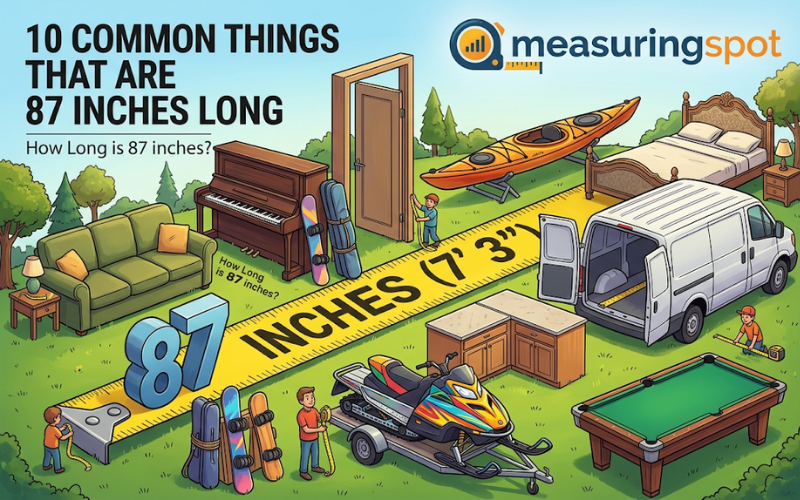
When you look at a measuring tape, 87 inches might sound like an arbitrary measurement. It sits just shy of seven and a half feet, a specific length that appears constantly in interior design, sports, outdoor recreation, and construction. Whether you plan to fit a new piece of furniture through a narrow doorway or calculate clearance space in a cargo van, knowing how this measurement translates to everyday objects makes planning straightforward.
Most people struggle to measure spaces mentally without a physical tape in hand. Having a reliable mental catalog of items that match this exact span saves time, prevents costly purchasing mistakes, and helps you assess spatial dimensions in seconds.
Here is a practical guide covering common items measuring exactly or approximately 87 inches, complete with real-world comparisons, conversions, and tips for spatial planning.
Quick Answer: How Long is 87 Inches?
To answer the core question quickly: 87 inches is exactly 7 feet and 3 inches long, which equals 220.98 centimeters or roughly 2.21 meters.
For quick visual reference, 87 inches is:
- Almost identical to the height of an oversized interior door with its frame.
- Equal to the length of a standard three-cushion living room sofa.
- Exactly three inches taller than NBA legend Shaquille O’Neal.
- The length of two and a half standard skateboard decks laid end to end.
- Equal to 7.25 standard 12-inch rulers aligned straight.
87 Inches at a Glance: Quick Conversion Table
| Measurement Unit | Value | Formula / Relationship |
| Feet & Inches | 7 feet 3 inches | 8712=7.25ft |
| Total Feet | 7.25 feet | Decimal feet representation |
| Yards | 2.416 yards | 8736inchesperyard |
| Centimeters | 220.98 cm | 872.54cmperinch |
| Meters | 2.21 meters | 220.98100cmpermeter |
| Millimeters | 2,209.8 mm | 220.9810mmpercm |
10 Everyday Things That Are 87 Inches Long
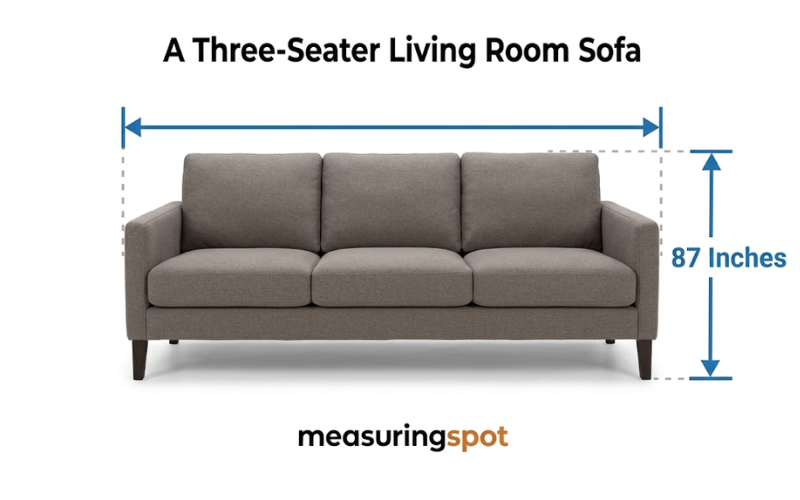
1. Standard Three-Seater Living Room Sofas
Full-sized three-cushion couches commonly measure right around 87 inches in overall width from the outside edge of one armrest to the other. Furniture makers treat 84 to 88 inches as the industry sweet spot for medium-to-large residential living rooms.
An 87-inch sofa provides roughly 72 to 76 inches of clear seating space between the armrests. This interior width lets an average adult lie down flat with ample room to stretch out. When you shop for living room furniture, keep in mind that an 87-inch sofa demands at least 100 to 110 inches of unobstructed wall space so end tables and floor lamps do not crowd the seating area.
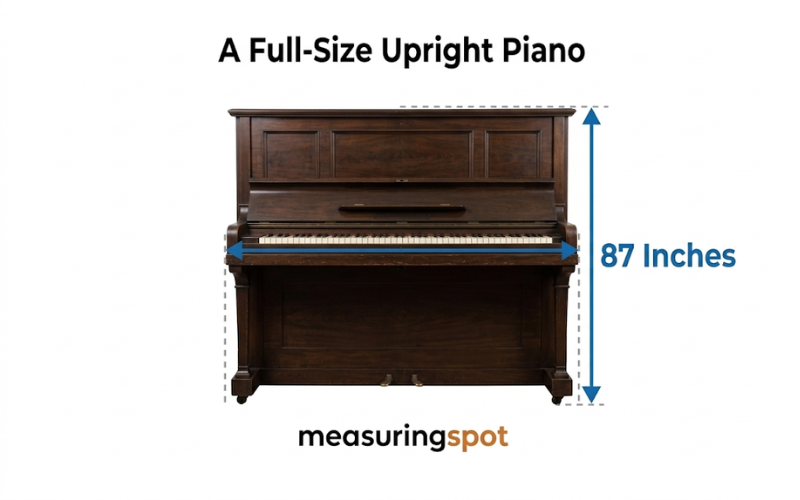
2. Full-Size Acoustic Upright Pianos (Laid on Their Side)
Standard concert upright pianos stand between 48 and 52 inches tall, but vintage full-size cabinet uprights, especially Victorian-era upright grand pianos, frequently measure between 58 and 60 inches tall and run 56 to 62 inches wide. However, when you measure the full diagonal span of a studio upright piano case, or the full length of a standard grand piano shipping crate, 87 inches is a textbook dimension.
A 7-foot-3-inch grand piano model (such as a semi-concert grand) measures approximately 87 to 88 inches from the front keyboard edge to the tail tip. Professional movers regularly design their dollies and ramp clearances around this exact footprint.
3. Extra-Tall Interior Door Frames
Standard modern residential interior doors stand 80 inches tall (known in the construction trade as a 6/8 door, denoting 6 feet 8 inches). However, modern architectural designs with nine-foot or ten-foot ceilings frequently install 84-inch door slabs (7/0 doors).
When you add the rough opening framework, the bottom jamb clearance, and the exterior decorative casing trim around an 84-inch door, the entire assembly reaches right around 87 inches from the subfloor to the top outer edge of the upper molding. If you stand in a newer home with tall ceilings, glancing up at the top edge of a bedroom door frame shows you 87 inches.

4. Touring and Sea Kayaks (Mid-Length Day Tourers)
Recreational kayaks span a broad range of sizes, but compact ocean day-touring models and tandem sit-on-top youth kayaks commonly measure 7 feet 3 inches in total length.
While full expedition sea kayaks can stretch past 14 feet, specialty surf kayaks, whitewater creek boats, and tandem recreational boats built for maneuverability sit right at 87 inches. Outdoor enthusiasts often seek this exact length because it fits comfortably inside the bed of an 8-foot pickup truck with the tailgate closed, or secures neatly onto a standard compact SUV roof rack without requiring rear overhang warning flags.

5. Queen-Size Bed Frames (Headboard to Footboard)
A standard queen mattress measures 60 inches wide by 80 inches long. While the mattress itself stops at 80 inches, the actual furniture structure surrounding it adds significant length.
Platform beds, sleigh beds, and upholstered frame designs feature padded headboards and finished footboards that add between 3 and 7 inches to the total footprint. An upholstered queen bed frame with a button-tufted headboard and thick wooden rails frequently measures exactly 87 inches from the back edge of the headboard to the outermost surface of the footboard. Interior decorators rely on this 87-inch figure when calculating walkway clearance at the foot of the bed.

6. Standard Cargo Van Interior Floor Lengths
Cargo vans serve as mobile workshops and urban delivery vehicles. In standard-wheelbase cargo vans, such as the regular-wheelbase Ford Transit or Mercedes-Benz Sprinter, the usable floor length measured from behind the front cab seats to the interior edge of the rear barn doors regularly lands at roughly 87 to 88 inches.
Carpenters, electricians, and camper-conversion builders memorize this 87-inch benchmark. It dictates the maximum length of prefabricated cabinetry, sleeping platforms, and framing timber that can sit flat along the cargo floor without riding up on the bulkhead or sticking past the rear door latch.

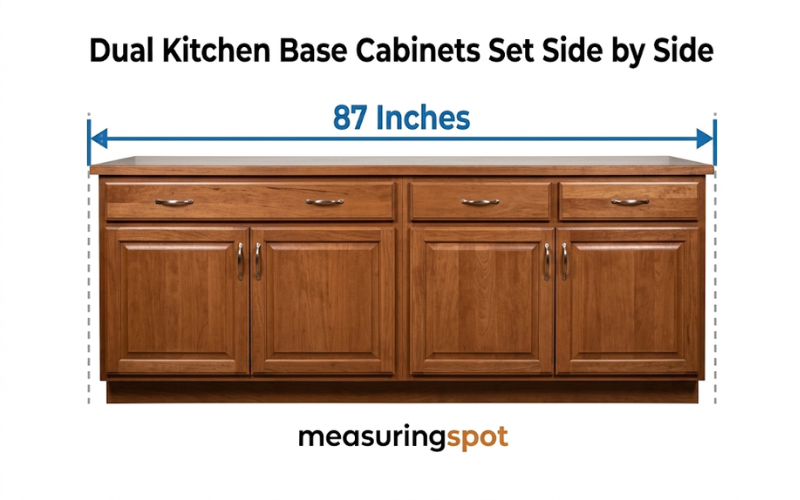
7. Dual Kitchen Base Cabinets Set Side by Side
Standard kitchen base cabinetry follows modular manufacturing standards based on three-inch increments. Two common cabinet configurations combine to create an 87-inch span.
When you install a 48-inch double sink cabinet directly beside a 39-inch triple-drawer bank, the paired boxes measure 87 inches wide. Add a standard 1.5-inch countertop overhang on either exposed end, and modular configurations like a 42-inch corner unit coupled with a 45-inch pantry base achieve this precise span. Home renovators use this target when laying out secondary utility walls and kitchen islands.
8. Compact Snowmobile and Sled Chassis
Entry-level snowmobiles, youth trail sleds, and vintage trail cruisers frequently measure 87 inches from the front tip of their steering skis to the rear edge of the snow flap.
Modern high-performance mountain sleds stretch much longer to accommodate deep-powder tracks, but standard trail sleds maintain a compact wheelbase for tight cornering in wooded trails. This 87-inch chassis length fits neatly across the width of a standard eight-foot utility trailer, enabling powersports haulers to park two machines side-by-side or crosswise.

9. Seven-Foot Pool Table Outer Perimeters
A regulation seven-foot billiard table, commonly known as a “bar box,” features a playing surface that measures 39 inches wide by 78 inches long.
When you account for the solid hardwood rails, cushion rubber, and outer cabinet pockets, the total exterior length of the cabinet expands to between 86 and 88 inches. If you plan to set up a home game room, the exterior 87-inch profile represents the base footprint, around which you must calculate an extra five feet of cue stroke space on all four sides.

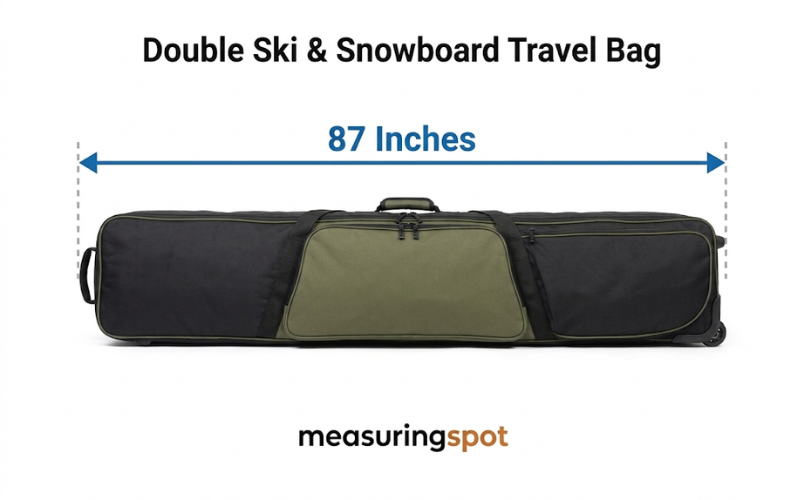
10. Long Recreational Snowboards and Dual-Ski Bundles
While standard individual downhill snowboards range from 55 to 65 inches, specialty tandem snowboards, giant slalom race boards, and split-board travel cases frequently measure 87 inches long.
When skiers pack two pairs of adult powder skis (measuring 185 to 190 cm each) inside a padded hard-shell flight transport case, the protective end caps and gear bumpers expand the total exterior case length to exactly 87 inches (221 cm). Luggage handlers treat this measurement as the threshold for oversized sports baggage allowances.
Technical Biowiki: Dimensions and Spatial Data
| Attribute | Technical Specification |
| Object Dimension Profile | 87 Inches |
| Imperial Units | 7 Feet 3 Inches |
| Metric Units | 220.98 Centimeters / 2.2098 Meters |
| Fractional Foot Value | 7.25 Feet |
| Area Footprint (as a Square) | 52.56 Square Feet (7.25ft7.25ft) |
| Volume (at 12″ x 12″ Column) | 7.25 Cubic Feet |
| Primary Industry Applications | Residential Furniture Design, Carpentry, Automotive Cargo, Sporting Goods |
| Common Transport Threshold | Fits inside an 8-foot truck bed; requires ceiling clearance of 8 feet or higher |
| Direct Comparison Benchmark | 3 inches longer than an NBA regulation backboard (which is 72 inches wide) |
How to Measure 87 Inches Without a Tape Measure
When you find yourself at a flea market, moving truck rental desk, or furniture outlet without measuring tape, using known everyday items provides a reliable estimate.
The Dollar Bill Method
An American currency note measures exactly 6.14 inches long. If you lay 14 dollar bills end to end in a straight line, the total distance comes to 85.96 inches. Add one finger width (roughly an inch), and you reach 87 inches.
The Standard Letter Sheet Technique
A standard piece of printer paper measures 11 inches on its longest edge. Aligning eight sheets of letter paper end to end yields 88 inches. Subtract one inch from the end of the eighth sheet, and you have determined 87 inches within a quarter-inch tolerance.
Human Body Benchmarks
- Arm Span: For a person who stands six feet tall, the natural fingertip-to-fingertip arm span measures roughly 72 inches (6 feet). Adding the distance from your wrist to the tip of your middle finger (around 7.5 to 8 inches) plus half a palm gets you remarkably close to 87 inches.
- Pacing Distance: An average adult stride covers approximately 30 inches from heel to heel. Taking three natural walking steps lands you right at 90 inches, just three inches past 87 inches.
Practical Home Planning: Navigating 87-Inch Items
Transporting and positioning items of this scale presents unique architectural challenges. Before you buy an 87-inch item, examine these practical considerations:
Doorway Swings and Pivot Radii
An 87-inch sofa or table can pass through a standard 32-inch or 36-inch entry doorway only if the hallway allows for a proper turn radius. If the hallway outside the door measures less than 40 inches wide, an 87-inch rigid object will get stuck horizontally. You must carry the item vertically, requiring an entry ceiling height of at least 90 inches to allow hand clearance.
Stairwell Clearances
Moving an 87-inch item up or down a staircase with a 90-degree landing requires careful calculation. If the distance from the landing floor to the overhead ceiling measures less than 96 inches, a rigid 87-inch object cannot tilt around the corner without gouging drywall. Measure the diagonal clearance of the stairwell opening before attempting the move.
Elevator Cab Limits
Standard apartment building elevators feature interior cab heights of 84 to 90 inches and door opening heights of 80 inches. Loading an 87-inch piece of furniture into an elevator often requires tilting the item corner-to-corner across the cab ceiling. Always confirm the cab depth and diagonal ceiling height with building management before scheduling deliveries.
Frequently Asked Questions
How long is 87 inches in feet and inches?
87 inches equals exactly 7 feet and 3 inches. You calculate this by dividing 87 by 12, which gives 7 with a remainder of 3 inches (or 7.25 feet).
Can an 87-inch sofa fit in an 8-foot truck bed?
Yes. A standard long-bed pickup truck features a bed length of 8 feet (96 inches) with the tailgate shut, leaving 9 inches of extra room. In a standard 6.5-foot truck bed (78 inches), an 87-inch sofa fits if you lower the tailgate or lay the sofa diagonally with the end resting securely over the tailgate.
Will an 87-inch piece of furniture fit under an eight-foot ceiling?
Yes. An eight-foot residential ceiling measures 96 inches high. Standing an 87-inch piece of furniture upright leaves 9 inches of clearance beneath the ceiling, which provides adequate room for assembly and decorative moldings.
How many centimeters are in 87 inches?
There are 220.98 centimeters in 87 inches. To convert inches to centimeters manually, multiply the inch value by the standard conversion factor of 2.54 (872.54=220.98).
Is 87 inches considered oversized for airline checked baggage?
Yes. Most commercial airlines establish a maximum checked luggage limit of 62 linear inches (calculated as length + width + height). An item that measures 87 inches on its longest edge exceeds standard checked bag dimensions and requires specialized oversized sports baggage handling or freight shipping.
Related Posts
- 10 Common Things That Are 84 Inches Long
- 10 Common Things That Are 83 Inches Long
- 10 Common Things That Are 82 Inches Long
- 10 Common Things That Are 81 Inches Long
Conclusion
Measuring 87 inches puts an item at seven feet and three inches, a substantial length that bridges the gap between everyday furniture and structural architectural elements. From standard three-cushion living room sofas and extended bed frames to specialized sports transport cases and commercial door jambs, this dimension appears across many industries.
Recognizing how common household objects and body measurements correspond to 87 inches gives you a fast, reliable method for judging physical spaces. It removes the guesswork when you evaluate delivery routes, purchase outdoor gear, or arrange home furnishings.
Whenever you need to verify this measurement on the fly, remember that an 87-inch span equals roughly eight sheets of printer paper or an extra-tall door frame. Keeping these physical references in mind ensures your interior and spatial planning remains accurate every time.
FOR MORE MEASUREMENTS VISIT: MEASURINGSPOT