
Have you ever looked at a dimension on a package, an online store listing, or a technical blueprint and wondered what that size looks like in the real world? Eighty millimeters sounds like a rigid engineering figure, yet items of this exact size surround you every single day.
Whether you need to check shipping box limits, purchase replacement parts, or verify clearance for a home improvement project, finding a physical reference makes measuring effortless. Here is an intuitive breakdown of what 80 millimeters looks like, how it translates into familiar imperial units, and ten common items that match this exact length.
Quick Answer: How Big Is 80 mm?
Eighty millimeters equals exactly 8 centimeters, which converts to roughly 3.15 inches.
To picture this instantly, take a standard plastic credit card out of your wallet. The long edge of the card measures roughly 85.6 mm, which means 80 mm is just about 5.6 millimeters shorter than that edge. You can also look at a standard desktop computer cooling fan or place two regulation ping-pong balls side by side. Both examples represent 80 mm with pinpoint accuracy.
BioWiki Reference Card: 80 mm Specifications
| Specification | Metric / Imperial Value | Practical Context |
| Millimeters (mm) | 80 mm | Exact metric standard |
| Centimeters (cm) | 8.0 cm | Metric base unit (80 divided by 10) |
| Inches (in) | 3.1496 inches | Approximately 3.15 inches (just over 3 and 1/8 inches) |
| Feet (ft) | 0.2625 feet | Slightly over a quarter of a foot |
| Meters (m) | 0.08 meters | Decimal fraction of a standard meter |
| Common Coin Comparison | Roughly 3.3 US Quarters | Edge-to-edge coin alignment in a straight row |
| Credit Card Ratio | ~93.4% of card length | Slightly shorter than an ID or bank card long edge |
| Paper Comparison | ~38% of short side of A4/Letter | Compact handheld pocket dimension |
| Typical Industry Usage | Cooling fans, receipt rolls, pipe fittings | Universal standard in retail POS, consumer PC builds, plumbing |
How Big Is 80 mm in Inches and Centimeters?
Switching between metric and imperial systems often creates unnecessary confusion. You can remove the guesswork by breaking down the math step by step.
Converting 80 mm to Centimeters
Metric conversions remain straightforward because the entire system works on base-10 increments. To convert millimeters to centimeters, you divide the millimeter value by 10:
80 divided by 10 = 8 centimeters
Eight centimeters spans comfortably across the palm of an adult hand. It creates a distance that feels solid enough to grip firmly, yet compact enough to slide neatly into a front pocket.
Converting 80 mm to Inches
Converting metric units into the imperial system requires dividing by 25.4, because one international inch equals exactly 25.4 millimeters:
80 mm divided by 25.4 = 3.1496 inches
In home improvement, woodworking, or casual crafts, you can round this number to 3.15 inches, or think of it as just a hair over 3 and 1/8 inches (3.125 inches). When you inspect a standard tape measure, locate the 3-inch mark and look just past the first eighth-inch line. That exact spot represents 80 mm.
Why 80 mm Matters Across Modern Manufacturing
Standardization governs the global manufacturing landscape. Factories do not pick dimensions at random when stamping out sheet metal, injection-molding plastics, or cutting raw materials. Instead, engineers rely on modular sizing frameworks such as the Renard series, DIN dimensions, and ISO parameters.
Eighty millimeters serves as an established target across several global industries:
- Retail Point-of-Sale Hardware: Register receipt rolls almost exclusively feature 80 mm paper widths across supermarkets, retail stores, and service stations worldwide.
- Computer Cooling Hardware: Before oversized 120 mm and 140 mm case fans became common in liquid-cooled systems, 80 mm cooling fans served as the primary cooling format for desktop chassis, server enclosures, and power supply units.
- Plumbing and Drainage: Outer diameters of mid-range PVC pipes, downspout adapters, and drainage conduits frequently standardize around nominal 80 mm sleeves.
- Optical Equipment and Lenses: High-end camera filter rings, lens caps, and cinema focus rings often settle around 77 mm to 82 mm, placing 80 mm right in the center of professional photography kits.
Recognizing these industry standards means you rarely need to hunt down a ruler when one of these common objects sits nearby.
10 Common Everyday Things That Are 80 mm Big
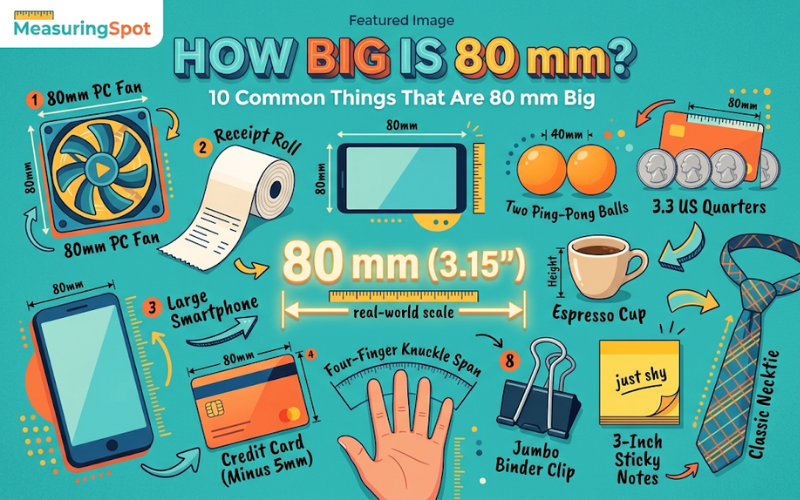
Here are ten common objects you can pick up, inspect, or measure right now to get a reliable grasp of 80 mm.
1. An 80 mm Computer Case Cooling Fan
Open up an older desktop tower, a home stereo receiver, a network switch, or a benchtop power supply, and you will immediately spot an 80 mm axial fan.
Hardware manufacturers measure cooling fans by the outer dimensions of their square plastic frame rather than the spinning blades inside. An 80 mm fan measures exactly 80 millimeters across its top edge and 80 millimeters down its side edge. These frames typically feature screw mounting holes spaced 71.5 millimeters apart from center to center.
Holding one of these fans gives you the exact length, width, and surface footprint of this dimension all at once. Because manufacturers produced billions of these fans over several decades, they serve as one of the most mechanically precise physical references you can find.

2. Standard Retail POS Receipt Paper Rolls
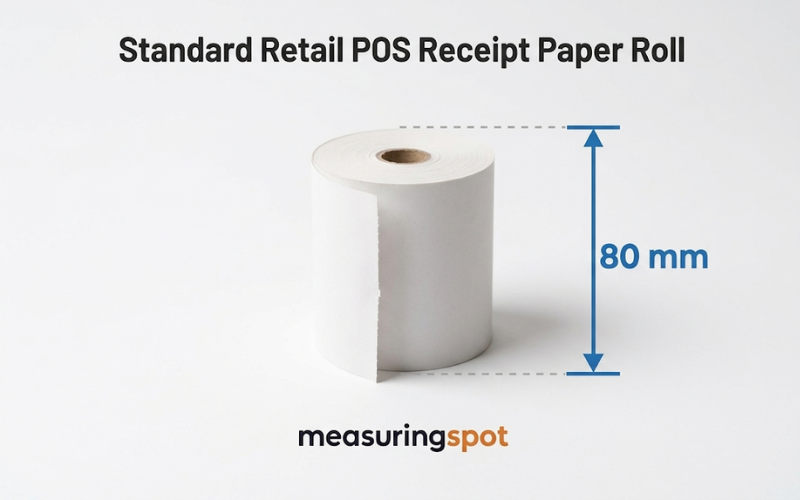
Walk into any grocery store, pharmacy, or restaurant, and watch the cash register when the machine prints your receipt. That long slip of thermal paper measures precisely 80 mm across its width.
The retail point-of-sale industry relies on two global standards: 57 mm rolls for small handheld card payment terminals, and 80 mm rolls for stationary counter printers. When you flatten out a printed receipt, the top and bottom cuts measure 80 mm from the left edge directly to the right edge.
While the total diameter of the roll shrinks as the cashier uses up the paper, the cylinder width never changes. It stays fixed at 80 mm to fit the internal feed track of the printer.
3. The Width of a Large Smartphone
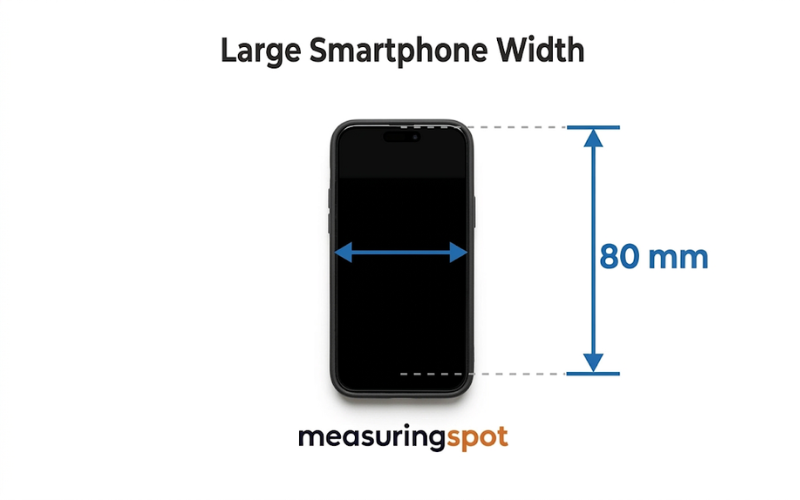
Most adults carry a smartphone every day, making mobile devices an exceptionally convenient comparison tool. While smartphone heights stretch well past 140 mm, modern large phone widths hover right near the 80 mm mark.
Consider these typical device dimensions:
- An iPhone Pro Max model fitted with a slim protective case measures between 79 mm and 81 mm wide.
- A Samsung Galaxy Ultra device measures roughly 78 mm bare and reaches 80.5 mm with a protective bumper case installed.
When you grip a large smartphone across its display between your thumb and index finger, your hand spans roughly 80 mm.
4. A Standard Credit Card (Minus About 5 Millimeters)
Plastic cards follow the international ISO/IEC 7810 ID-1 standard. This rule requires that payment cards, driver licenses, transit cards, and office badges measure 85.60 mm long by 53.98 mm wide.
Because a credit card measures 85.6 mm across its longest edge, you can use it to gauge 80 mm quickly. Place your thumbnail roughly 5.6 millimeters (less than a quarter of an inch) inward from one corner. The remaining length of the card matches 80 mm.
If you need a fast dimensional check while browsing hardware supplies or checking shelf space, your wallet already holds an accurate gauge.

5. Two Regulation Table Tennis Balls Side by Side
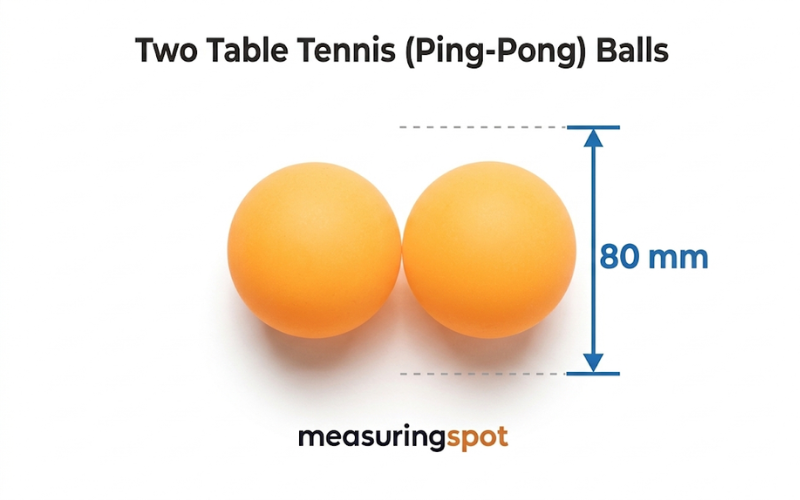
The International Table Tennis Federation enforces strict rules regarding tournament equipment. These regulations state that an official table tennis ball must measure exactly 40 mm in diameter.
Place two official ping-pong balls side by side on a flat table so their outer surfaces touch. The line running from the outer edge of the first ball across to the opposite edge of the second ball measures exactly 80 mm (40 mm multiplied by 2).
Because sports manufacturers maintain tight quality control tolerances on ping-pong balls, this pair creates a symmetrical, clean representation of 80 mm.
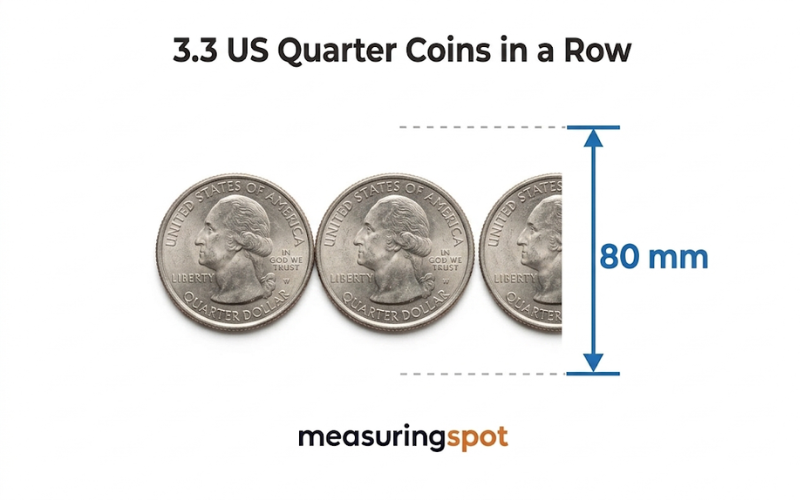
6. Three and a Third US Quarter Coins in a Line
You can also use pocket change to check metric measurements. A United States quarter dollar has an official mint diameter of 24.26 mm.
Line up three quarters in a straight row with their rims touching:
3 multiplied by 24.26 mm = 72.78 mm
Three quarters bring you within 7.2 millimeters of your target. If you picture roughly one-third of a fourth coin added to the end of the line, you reach 80 mm. Four full quarters equal 97 mm, so taking away two-thirds of that fourth coin lands you right on 80 mm.
7. The Height of an Espresso Demitasse Cup
Espresso bars, specialty cafes, and kitchenware brands frequently produce ceramic demitasse cups and flat white mugs that stand 80 mm tall.
Cups built for double shots or traditional macchiatos often utilize an 80 mm rim height so they slide neatly beneath the portafilter spouts of commercial espresso machines. When you pick up a traditional ceramic espresso cup, the vertical distance from the base on the counter to the top drinking lip frequently hits 80 mm.

8. A Jumbo 3-Inch Steel Binder Clip
Office supply cabinets hold several items that bridge metric and imperial sizing. Extra-large metal binder clips, sold commercially as jumbo heavy-duty paper clamps, feature a steel base width of approximately 80 mm.
While typical office binder clips measure 19 mm, 25 mm, or 32 mm wide, archival clips built to hold thick paper stacks measure between 76 mm and 80 mm across their triangular backplate. Clamping one of these heavy clips onto a stack of paperwork covers an 80 mm span along the paper edge.

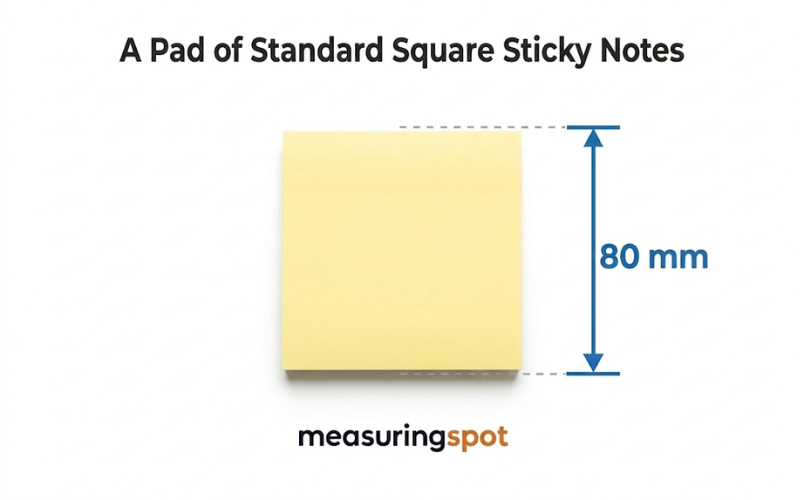
9. Three-Inch Sticky Notes (Plus a Slight Margin)
A classic square Post-it note measures 76 mm by 76 mm (traditionally labeled as 3 inches by 3 inches).
A standard pad of yellow sticky notes provides an immediate visual marker. Both its width and height fall short of 80 mm by only 4 millimeters. If you hold a sticky note pad and visualize adding the thickness of two nickels to the side, you reach 80 mm. Because sticky notes sit on desks worldwide, they serve as a practical everyday anchor.
10. The Width of a Classic Men’s Necktie
Men’s fashion trends shift between ultra-skinny designs and wide vintage lapels, but modern classic neckwear maintains a steady baseline: 80 millimeters.
Classic silk neckties sold by major menswear brands measure between 3.15 and 3.25 inches across the widest point of the lower blade. This width coordinates with standard suit jacket lapel proportions. If you place a modern necktie flat on a table and measure across the widest point of the front triangle, the fabric spans 80 mm across.

Metric Comparison Table: 80 mm vs. Neighboring Sizes
To help you place 80 mm into context against other standard metric dimensions, check this quick reference comparison:
| Measurement | Equivalent Inches | Common Real-World Example |
| 50 mm | 1.97 in | Standard camera lens focal length, height of a golf tee |
| 60 mm | 2.36 in | Standard billiard ball diameter |
| 70 mm | 2.76 in | Standard tennis ball diameter |
| 75 mm | 2.95 in | Diameter of a standard mason jar lid |
| 80 mm | 3.15 in | Square PC cooling fan, 80 mm register receipt roll |
| 85.6 mm | 3.37 in | Length of a standard debit card or driver license |
| 90 mm | 3.54 in | Standard business card length |
| 100 mm | 3.94 in | Base 10 cm metric mark, width of a standard index card |
Practical Ways to Estimate 80 mm Without a Tool
If you need to measure an 80 mm space right now and do not have a tape measure or ruler nearby, you can use your hands and common wallet items to make a reliable estimate.
Method 1: The Four-Finger Knuckle Span
For most adults, the distance across the base knuckles of four fingers (index, middle, ring, and pinky) pressed firmly together measures between 75 mm and 85 mm.
To test your hand:
- Place your hand flat on a desk with your four fingers pressed tight against one another.
- Tuck your thumb inward against your palm.
- Check the distance from the outer edge of your index knuckle across to the outer edge of your pinky knuckle.
On an average adult male hand, this distance hovers between 80 mm and 83 mm. On an average adult female hand, it spans roughly 74 mm to 78 mm. Once you check your own knuckle span against a ruler once, your hand becomes a dependable pocket measuring tool.
Method 2: The Three-Step Thumb Method
The top section of an adult thumb (from the tip of the nail to the first joint) measures roughly 25.4 mm (one inch) for many adults.
If you step your thumb tip three times along a flat surface:
- First step reaches approximately 25.4 mm
- Second step reaches approximately 50.8 mm
- Third step reaches approximately 76.2 mm
Add roughly 4 millimeters (about the thickness of two stacked plastic credit cards) to that third step, and you have marked out 80 mm.
Method 3: The Folded Dollar Bill Technique
Paper currency follows strict manufacturing standards that make field estimation simple. A United States dollar bill measures 156 mm long by 66.3 mm high.
Fold a dollar bill exactly in half across its length:
156 mm divided by 2 = 78 mm
A half-folded bill gives you 78 mm, which sits just two millimeters shy of 80 mm. If you place a folded dollar bill on a surface, you are looking at an object that matches 80 mm for all practical everyday purposes.
Key Industries That Rely on 80 mm Sizing
Designers select 80 mm for practical mechanical reasons rather than picking arbitrary numbers. Multiple engineering, consumer tech, and construction standards rely on this measurement.
Thermal Printing and Paper Manufacturing
Paper mills throughout the world slit master rolls of thermal paper stock into two primary commercial widths: 57 mm and 80 mm. POS hardware manufacturers build cutter bars, heat printheads, and feed rollers designed specifically around 80 mm stock. Because global supply chains produce billions of these rolls every year, maintaining this size prevents costly retrofits in point-of-sale machinery.
Server Racks and Enterprise Computer Hardware
Before home personal computers adopted large liquid-cooling loops, enterprise server racks depended heavily on 80 mm fan cutouts. Rack-mounted servers (especially 2U and 3U server chassis) feature vertical clearances tailored to hold rows of high-speed 80 mm fans. Because server chassis adhere to standard 19-inch rack enclosures, 80 mm fans fit the internal airflow channels without wasting vertical space.
Building Construction and Electrical Installations
In architectural planning and commercial electrical trade, wall openings and drywall cutouts for circular fixtures regularly require 80 mm hole-saw cuts. Electricians keep dedicated 80 mm bi-metal hole saws in their toolkits to install recessed downlights, run desk grommets, and fit ceiling exhaust vents.
Frequently Asked Questions About 80 mm
How big is 80 mm in inches?
Eighty millimeters equals 3.1496 inches. For home improvement, carpentry, or everyday crafting, you can round this to 3.15 inches, which sits just past 3 and 1/8 inches.
Is 80 mm the same as 8 cm?
Yes. Ten millimeters make up one centimeter. When you divide 80 by 10, you get exactly 8 centimeters.
How does 80 mm compare to a credit card?
A standard credit card measures 85.6 mm long by 53.98 mm wide. Eighty millimeters is about 5.6 mm shorter than the card’s long side, and about 26 mm longer than the short side.
How many quarters equal 80 mm?
A US quarter measures 24.26 mm in diameter. Three quarters placed side by side equal 72.78 mm. Adding about one-third of another quarter brings the total length up to 80 mm.
Is 80 mm a common lens size in photography?
Yes. Medium-format portrait photography frequently uses an 80 mm focal length because it produces a natural, lifelike perspective on larger camera sensors. In cinema production, many front lens rings feature an 80 mm outer diameter to attach standard clip-on matte boxes.
Can I use a smartphone to measure 80 mm?
Yes. Most large modern smartphones measure between 78 mm and 81 mm across their width when inside a slim case. Checking your phone width once gives you a portable reference object you carry everywhere.
What does 80 mm feel like in terms of thickness?
When applied to thickness or depth rather than width, 80 mm represents a substantial layer. For example, an 80 mm mattress topper, acoustic foam block, or insulation panel measures roughly 3.15 inches thick, providing noticeable padding and thermal resistance.
Eighty millimeters may look like an unfamiliar number on paper, but it shapes dozens of items you use every day. Translating 80 mm to 3.15 inches or 8 centimeters helps you connect this metric unit to real life. Whether you grab a receipt from a store, pick up a coffee mug, or hold your smartphone, you are interacting directly with this measurement.
Keeping a few simple reference points in mind saves time whenever you need to check dimensions without a ruler. If you ever need to estimate 80 mm on the spot, remember your knuckle width, a folded dollar bill, or a standard credit card. These familiar items turn an abstract measurement into a practical tool you can use anytime.
Related Posts
- 10 Common Things That Are 24 mm Big
- 10 Common Things That Are 23 mm Big
- 10 Common Things That Are 22 mm Big
- 10 Common Things That Are 21 mm Big
Conclusion
Recognizing how big 80 mm is becomes straightforward once you link the measurement to items you handle every single day. A standard payment card’s length, the diameter of an espresso saucer, a baseball, or a standard sticky note all hover right around this 8-centimeter mark. Instead of searching for a ruler every time you need an estimate, you can quickly rely on these familiar objects to gauge dimensions on the spot.
Whether you are shopping for hardware, checking package specifications, or simply trying to verify product dimensions online, keeping a few of these everyday references in mind saves time and eliminates guesswork. Measurement makes far more sense when you anchor numbers to real-world items you already know.
FOR MORE MEASUREMENTS VISIT: MEASURINGSPOT