
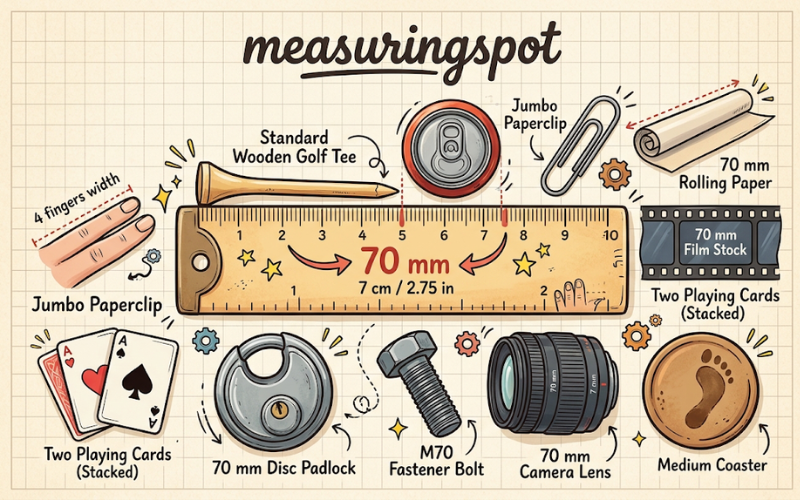
Holding a metric ruler next to everyday household items often leads to surprising discoveries. While centimeters and inches dominate routine conversations, millimeters rule precision manufacturing, tool specifications, packaging standards, and product engineering. When you encounter a measurement like 70 mm on a spec sheet, blueprint, or hardware label, finding an immediate physical frame of reference is rarely straightforward.
Seventy millimeters sits right between fine hardware measurements and hand-sized objects. It represents a functional sweet spot: wide enough to provide structural strength and grip, yet compact enough to slide into a pocket or palm. You handle objects measuring exactly this length daily, often without recognizing the standardized dimensions behind them.
Connecting this metric measurement to physical items in your home, pocket, or desk turns an abstract number into a concrete visual anchor. Here is a definitive breakdown of everyday items that measure approximately 70 mm, along with practical conversion benchmarks.
Quick Answer: How Big Is 70 mm?
Seventy millimeters equals 7 centimeters or roughly 2.76 inches (just over 2 ¾ inches).
To check this size instantly without pulling out a ruler, look at:
- The width of a standard credit card (85.6 mm long by 53.98 mm wide; 70 mm sits about midway between its width and length).
- The outer diameter of an aluminum soda can rim or bottom base.
- The length of a standard wooden golf tee or large paperclip.
- A stack of approximately 40 standard modern US pennies or 30 two-euro coins.
- The width of four average adult fingers held flat together across the knuckles.
Technical Specifications: The 70 mm Biowiki Reference
Before exploring individual items, this biowiki reference sheet details exact mathematical conversions, mechanical properties, and baseline physical values for 70 millimeters.
| Parameter | Metric / Imperial Value | Practical Context |
| Millimeters (mm) | 70.0 mm | Base engineering standard |
| Centimeters (cm) | 7.0 cm | Everyday European/metric unit |
| Meters (m) | 0.07 m | SI base unit representation |
| Inches (in) | 2.75591 in | Fractionally equivalent to ~2 ¾ in |
| Feet (ft) | 0.22966 ft | Decimal foot calculation |
| Standard Paperclip Comparison | ~2.5 standard small clips | Laid end-to-end lengthwise |
| Coin Stack Benchmark | ~40 modern US pennies | Stacked vertically face-to-face |
| Finger Breadth Estimate | ~3.5 to 4 adult fingers | Measured across middle knuckles |
| Volume Displacement (70 mm Cube) | 343 cm³ (0.343 Liters) | Volume of a 70 mm equilateral box |
| Surface Area (70 mm Cube) | 294 cm² | Total external surface |
| Common Industrial Class | Medium-bore / Pocket scale | Fasteners, optics, plumbing, bearings |
1. Standard Wooden Golf Tee
When golfers pull a wooden tee from their bag, they usually handle a 70 mm peg. The classic 2 ¾-inch tee measures 69.85 mm, which rounds cleanly to 70 mm across global manufacturing plants.
Tee design balances ball elevation and swing stability. Modern 460cc drivers feature high crown profiles and elevated sweet spots, requiring golfers to prop the ball higher above turf grass. A 70 mm tee allows a player to bury 20 mm to 25 mm of the pointed shaft securely into the ground while keeping the resting ball elevated 45 mm to 50 mm above ground level.
Manufacturers turn these tees out of birch, maple, and bamboo. The head of the tee flares outwards to roughly 10 mm to 12 mm across, supporting the curved radius of a regulation golf ball. If you keep golf gear around your garage, line one up against a flat edge. The tip to the outer rim sits precisely on the 70 mm mark.
Why Golf Standardized on 2 ¾ Inches (70 mm)
- Driver Face Clearance: Allows clean strikes on the upper half of modern oversized driver faces to minimize spin.
- Ground Anchorage: Offers enough shaft length to maintain upright stability even in dry, hard-packed tee boxes.
- Durability: Thicker birch designs withstand swing impact without snapping at the turf line as easily as shorter alternatives.

2. Standard 12-Ounce Soda Can Diameter
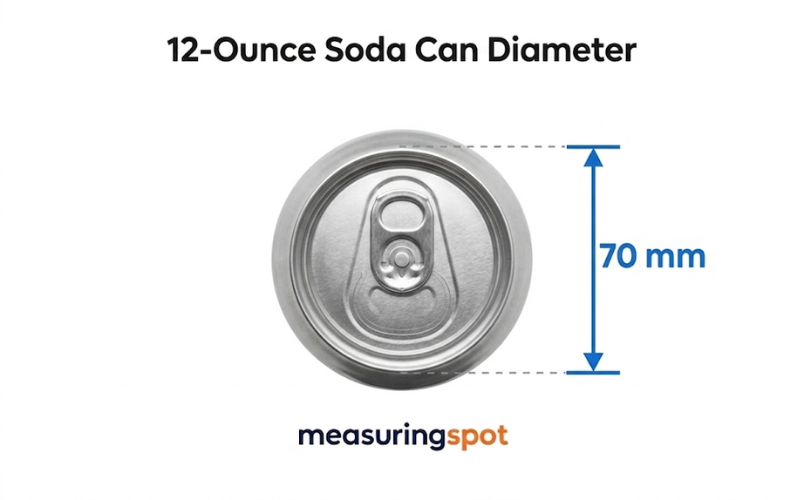
Look down at an unopened aluminum beverage can. While the total height of a standard 12 fl oz (355 ml) or 330 ml can reaches about 122 mm to 123 mm, the widest section of the outer cylindrical body measures right at 66 mm to 70 mm across.
Beverage packaging engineers refer to this standard profile as the “211 can” format, based on imperial trade dimensions (2 inches and 11 sixteenths, or approximately 68.26 mm). Over the decades, can shapes have slightly tapered near the top neck to save metal weight and allow stacking, but the widest circular cross-section, base profile, and secondary nesting ribs sit close to 70 mm.
This circular footprint determines the shape of millions of everyday objects:
- Car cup holder wells (designed around a 70 mm to 75 mm clearance).
- Vending machine tracks and loading bays.
- Refrigerator door shelving and can gravity-feed dispensers.
- Neoprene and foam beverage cozies.
The next time you reach for a soft drink, hold your fingers straight across the circular cross-section of the can body. You are spanning a 70 mm diameter.
3. Large (Jumbo) Vinyl or Metal Paperclip
While the everyday paperclip in office cubicles measures around 28 mm to 33 mm in length, jumbo paperclips measure right at 70 mm from loop tip to base.
Office supply producers use heavy-gauge steel wire—often coated in vinyl plastic or zinc plating—to form these large clips. A standard small paperclip bends or snaps when holding documents thicker than 15 pages. The jumbo 70 mm paperclip relies on expanded torsion loops that flex wider without losing clamping tension, easily binding 50 to 60 sheets of letter paper.
Key Dimensions of a Jumbo Paperclip
- Overall Length: 70 mm (2.75 inches).
- Wire Width: 1.2 mm to 1.4 mm thick steel core.
- Loop Span: 12 mm to 14 mm wide.
- Paper Capacity: 40 to 65 sheets of standard 20 lb bond paper.
Keeping a jumbo paperclip in your desk drawer gives you an instant, portable 70 mm measuring stick.

4. Standard 70 mm Cigarette Rolling Paper
In consumer tobacco and botanical packaging, paper dimensions fall into strict worldwide categories: Single Wide, 1 ¼, 1 ½, Double Wide, and King Size. The classic “Single Wide” paper, established in Spain and France during the 19th century, measures exactly 70 mm in total length.
These papers typically feature dimensions of 70 mm by 36 mm. Rolling machine manufacturers build their metal hand rollers around this 70 mm width. The interior canvas apron, the metal frame, and the rolling hinge align with this length to produce uniform, cylindrical rolls.
If you have a pack of classic rolling papers or an entry-level metal roller nearby, the long side of the sheet delivers an accurate 70 mm benchmark.

5. Professional IMAX and Cinematic 70 mm Film Stock
The cinematic world treats 70 mm as the benchmark for rich visual fidelity. Introduced commercially in high-profile Hollywood formats like Super Panavision 70 and Todd-AO, and later refined by IMAX, 70 mm film delivers vastly superior surface area compared to standard 35 mm strips.
The physical plastic stock measures 70 mm across its entire width, including the perforations (sprocket holes). While the projected image area on standard 70 mm film occupies about 48.5 mm by 22.1 mm (leaving space for multi-channel magnetic audio stripes), 15-perforation IMAX 70 mm runs the film horizontally through the projector. That orientation yields a massive image area across the full width of the strip.
Specifications of 70 mm Film Stock
- Total Physical Film Width: 70.0 mm (+/- 0.05 mm manufacturing tolerance).
- Standard Perforation Pitch: 4.75 mm between sprocket holes.
- Perforations Per Frame: 5 perforations for standard vertical 70 mm; 15 perforations for horizontal IMAX.
- Resolution Equivalent: Estimated by film archivists to rival 12K to 18K digital clarity.
When directors discuss screening a movie in 70 mm, they reference the physical width of the cellulose acetate strip running past the projector lens.

6. The Height of Two Standard Playing Cards Stacked Horizontally
Pick up an ordinary deck of Bicycle playing cards or standard poker cards. A regulation poker card measures 2.5 inches wide by 3.5 inches tall (63.5 mm by 88.9 mm). Bridge cards run slightly narrower at 2.25 inches (57.15 mm).
Neither dimension equals 70 mm on its own. However, if you measure along the short side of a credit card or identify custom novelty cards, you land close to 70 mm. More reliably, if you examine two poker-sized card tuck boxes stacked side-by-side or lay out specific gaming cards (such as vintage collectable tiles and pocket flashcards), manufacturers cut them to a 70 mm square or 70 mm width.
Many board game publisher standards, including standard European square card formats (often used in games like Catan or Carcassonne expansions), print cards at precisely 70 mm by 70 mm. Board game accessory makers sell card sleeves specifically labeled “70 x 70 mm” to protect these square tiles.

7. Heavy-Duty 70 mm Disc Padlock (Round Shield Locks)
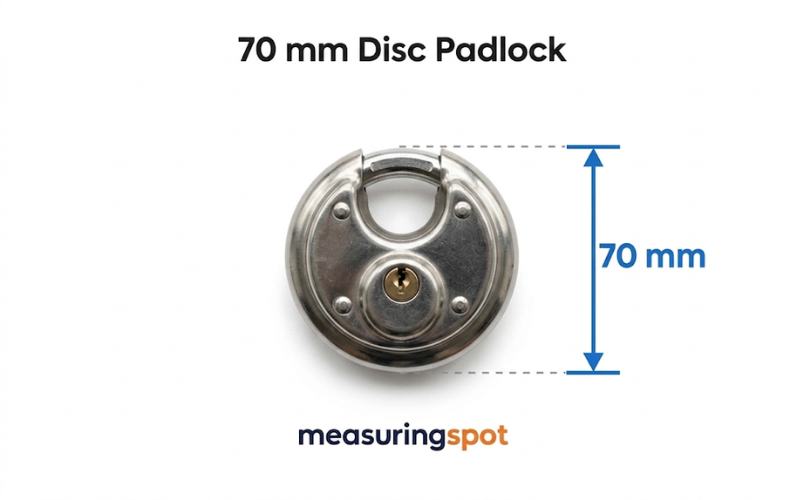
Walk down the security aisle at any home improvement store, and you will spot circular, stainless-steel disc padlocks. Storage locker companies, trailer owners, and utility sheds commonly use these round locks to protect against bolt cutters.
The standard commercial disc padlock spans an outer diameter of exactly 70 mm (often stamped directly on the metal shell or retail packaging as “70 mm Disc Lock”).
The round geometry prevents bolt cutters from gaining purchase on the hardened steel shackle. The shackle itself remains shielded inside the outer rim, exposing only a tiny curved section when locked. The 70 mm diameter provides enough space inside the casing to house a 5-pin tumbler brass cylinder, anti-pick mechanisms, and robust deadbolt locking bars, all while remaining small enough to fit through standard hasps.
Why 70 mm Is the Universal Disc Lock Size
- Cut-Resistance: Minimizes exposed shackle surface area while maximizing internal deadbolt thickness.
- Hasp Compatibility: Fits the standard clearance latch holes on self-storage facility doors.
- Internal Volume: Houses heavy anti-drill plates and weather-sealed dual locking levers without excessive bulk.
8. Threaded M70 Structural and Automotive Fasteners
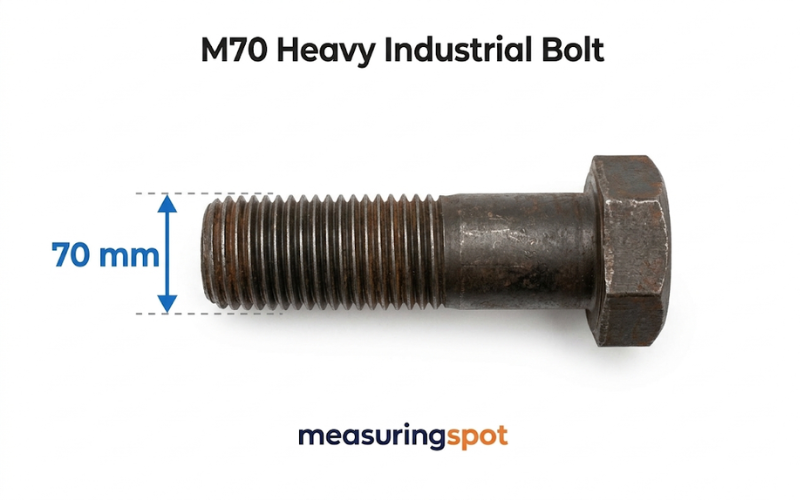
Industrial machinery, bridge assemblies, maritime driveshafts, and automotive wheel hub retaining collars frequently use heavy metric bolts. Under the ISO metric screw thread standard, fasteners carry an “M” designation followed by their nominal major thread diameter in millimeters.
An M70 bolt has a threaded shaft diameter of exactly 70 mm.
At this scale, a bolt no longer resembles a household screw. An M70 bolt represents heavy structural hardware. Mechanics use massive pneumatic torque multipliers or hydraulic tensioners to secure these fasteners onto heavy machinery foundations, wind turbine blade roots, and container crane frames.
Anatomy of an M70 Fastener
- Thread Diameter: 70 mm outer crest-to-crest measurement.
- Standard Thread Pitch: Coarse pitch typically runs 6 mm between adjacent thread peaks.
- Hex Head Wrench Size: Requires an open-end or socket wrench spanning over 105 mm to turn the fastener head.
- Weight Profile: A single steel M70 bolt measuring 200 mm long can weigh well over 6 kilograms (13 pounds).
9. 70 mm Camera Lens Focal Length
Photographers often treat the 70 mm focal length as an essential optical sweet spot. While “focal length” describes the optical distance from the lens’s optical center to the camera sensor rather than the physical length of the metal barrel, standard zoom lenses highlight this exact metric.
The ubiquitous 24-70 mm f/2.8 lens serves as the workhorse lens for wedding, photojournalism, and studio portrait photographers around the world. The top end of this zoom range stops precisely at 70 mm.
At 70 mm on a full-frame sensor:
- The field of view spans roughly 34 degrees diagonally.
- Facial features appear natural and proportional, avoiding the wide-angle barrel distortion that exaggerates the human nose.
- Background elements compress gently without isolating the subject as dramatically as a 135 mm or 200 mm telephoto lens.
- Depth of field stays shallow enough at wide apertures to separate subjects cleanly from busy backgrounds.
Additionally, many high-end camera lens filters feature a thread size close to this mark (such as 72 mm and 77 mm filter rings), giving the front housing of medium-range lenses an external diameter right around 70 mm.

10. Medium-Sized Desktop Coaster
Set your morning coffee mug down, and you likely place it on a coaster. While oversized coasters measure between 90 mm and 100 mm (roughly 4 inches), standard compact round cork, stone, or silicone coasters measure between 70 mm and 75 mm in diameter.
Drinkware designers calculate coaster sizes based on common glassware footings. A standard ceramic mug features a base diameter between 65 mm and 70 mm. A 70 mm coaster matches this footprint closely, preventing condensation rings from staining wooden desks while keeping clutter to a minimum.
Inspect the bottom of your favorite ceramic mug or espresso cup. The unglazed circular ring at the bottom that contacts the table frequently measures around 70 mm across.

Common Objects Grouped by Size Proximity to 70 mm
To put 70 mm into perspective against surrounding measurements, consider where common household items sit along the metric scale:
[ 50 mm ] —- 2-Inch Binder Ring / Golf Ball Diameter (42.7 mm)
[ 60 mm ] —- Standard Pool Cue Ball (57 mm) / Standard Egg Height
[ 70 mm ] <— OUR BENCHMARK: Golf Tee / Can Base / Jumbo Paperclip / Disc Lock
[ 80 mm ] —- Playing Card Width (63.5 mm) to Length (88.9 mm)
[ 85 mm ] —- Standard Credit Card Length (85.6 mm)
By comparing nearby items, you can see that 70 mm sits slightly smaller than the long edge of an ID card, but visibly larger than a regulation golf ball.
Conversions and Everyday Approximations
When you need to visualize or calculate 70 mm without a ruler, use these quick conversion formulas and body references:
Metric to Imperial Conversions
- Exact Inches: 70mm25.4=2.75591inches
- Closest Common Fraction: 2 34inches (which equals 2.750inches, an error of less than $0.2\%$).
- Centimeters: 70mm10=7.0cm.
Body Landmarks for 70 mm
Human bodies offer reliable, built-in measuring tools:
- Four Finger Widths: Across most adult hands, holding the index, middle, ring, and pinky fingers side-by-side produces a span of 68 mm to 74 mm across the first knuckles.
- Thumb Length: On an average adult hand, the distance from the knuckle joint to the tip of the thumb measures between 65 mm and 72 mm.
- Credit Card Shortcut: The short edge of a credit card measures 54 mm. Add the thickness of your index finger (roughly 16 mm) to that edge, and you get an accurate 70 mm estimate.
Frequently Asked Questions
How big is 70 mm compared to an inch?
Seventy millimeters is equal to approximately 2.76 inches. In everyday imperial fractions, it is almost identical to 2 ¾ inches (2.75 inches). The difference between 70 mm and 2 ¾ inches is only about 0.15 mm, making the fraction dependable for home improvement, woodworking, and casual estimates.
Is 70 mm the same as 7 cm?
Yes. There are 10 millimeters in every centimeter. Dividing 70 millimeters by 10 yields exactly 7.0 centimeters.
How does 70 mm compare to a standard credit card?
A standard bank card or driver’s license measures 85.6 mm long by 53.98 mm wide. Seventy millimeters is roughly 16 mm shorter than the card’s long edge, but 16 mm longer than its short edge. It sits almost halfway between the length and width of the card.
How many coins make up 70 mm?
If you stack modern coins face-to-face:
- US Pennies: A standard US penny is 1.52 mm thick. A stack of 46 pennies reaches 70 mm.
- US Quarters: A quarter is 1.75 mm thick. A stack of 40 quarters measures 70 mm tall.
- Euro 1-Cent Coins: Measuring 1.67 mm thick, 42 coins reach 70 mm.
If you lay coins edge-to-edge in a line:
- Three US quarters (each 24.26 mm wide) laid side-by-side measure roughly 72.8 mm across—just a hair larger than 70 mm.
Is 70 mm considered a standard size in construction and engineering?
Yes. The 70 mm standard appears across building materials, plumbing pipelines, and fastener selections. PVC drainage downspouts in many parts of the world feature a 70 mm outer diameter. Stud wall depths in modern European residential framing frequently measure 70 mm thick, designed to accept insulation batts and drywall cladding.
Finding a clear physical match for 70 mm makes technical measurements much easier to manage. Whether you pull out a jumbo paperclip, line up four fingers across your knuckles, or glance at the bottom rim of a soft drink can, you have convenient reference points within reach.
Knowing these real-world equivalents eliminates guesswork whenever you read technical specs, buy household hardware, or review product dimensions. Keep items like a 2 ¾-inch golf tee or a heavy-duty disc lock in mind, and you can size up 70 mm on the spot.
Related Posts
- 10 Common Things That Are 24 mm Big
- 10 Common Things That Are 23 mm Big
- 10 Common Things That Are 22 mm Big
- 10 Common Things That Are 21 mm Big
Conclusion
Connecting abstract metric measurements to everyday objects removes the guesswork from shopping, crafting, and DIY projects. At roughly 2 ¾ inches or 7 centimeters, 70 mm serves as a versatile sweet spot across manufacturing, from the structural strength of heavy disc padlocks to the optical precision of portrait camera lenses.
Keeping a few mental anchors on hand ensures you never need to scramble for a ruler. Whether you glance at the base of a soda can, grab a standard wooden golf tee, or hold four fingers flat across your knuckles, you carry reliable physical references everywhere you go.
FOR MORE MEASUREMENTS VISIT: MEASURINGSPOT