

One hundred meters represents one of the most widely referenced distances on Earth, yet grasping its exact physical footprint without a measuring tape often feels tricky. Whether you track Olympic sprint records or simply try to gauge distances across a construction site, standard units on paper do not always translate naturally to real life.
To master distance estimation, you must tether abstract metrics to objects you see and interact with every day. Breaking down this specific length into familiar, tangible examples gives you an instant mental measuring stick whenever you need to gauge distances accurately.
Quick Answer: How Long is 100 Meters?
100 meters equals exactly 328.084 feet, 109.36 yards, or roughly one-tenth of a kilometer.
If you want a fast mental snapshot:
- It is slightly longer than an American football field from goal line to goal line (which measures 91.44 meters / 100 yards).
- It spans the exact track length of the premier Olympic sprint event.
- A brisk adult walking pace covers 100 meters in roughly 70 to 80 seconds.
- Elite sprinters cross this exact distance in under 10 seconds.
Metric Breakdown and Quick Conversions
Before examining physical objects, look at the base mathematical equivalents. Memorizing these conversions simplifies field measurements across various construction, sporting, and everyday scenarios.
| Measurement Unit | Exact Value | Everyday Approximation |
| Meters | 100 m | Base metric unit |
| Feet | 328.084 ft | Roughly 328 feet |
| Yards | 109.361 yd | A standard football field plus one end zone |
| Inches | 3,937.01 in | Nearly 4,000 standard rulers end-to-end |
| Kilometers | 0.1 km | Exactly one-tenth of a kilometer |
| Miles | 0.0621 miles | Roughly one-sixteenth of a statutory mile |
| Centimeters | 10,000 cm | Standard laboratory conversion factor |
10 Common Everyday Things That Span 100 Meters
Let us bridge the gap between numbers and reality. These ten objects, vehicles, and structures match or sit right at the 100-meter mark.
1. An Olympic Sprint Straightaway
The most universally recognized 100-meter reference sits on an athletic running track. Every standard outdoor running venue features a straight stretch engineered specifically for the 100-meter dash.
Running tracks feature an oval perimeter of 400 meters, meaning a single full lap equals four separate 100-meter dashes. When sprinters step into the starting blocks, they look down an unbroken expanse of polyurethane track surface that terminates right at the finish line. Because track markings follow rigorous international sporting criteria, this distance represents the gold standard for gauging 100 meters in real time.
- Exact length: Exactly 100 meters (328.1 feet).
- Time to cover: 9.58 seconds at world-record speed; 12 to 16 seconds for recreational runners.
- Key visual cue: The stretch running parallel to the main grandstand from start line to finish marker.

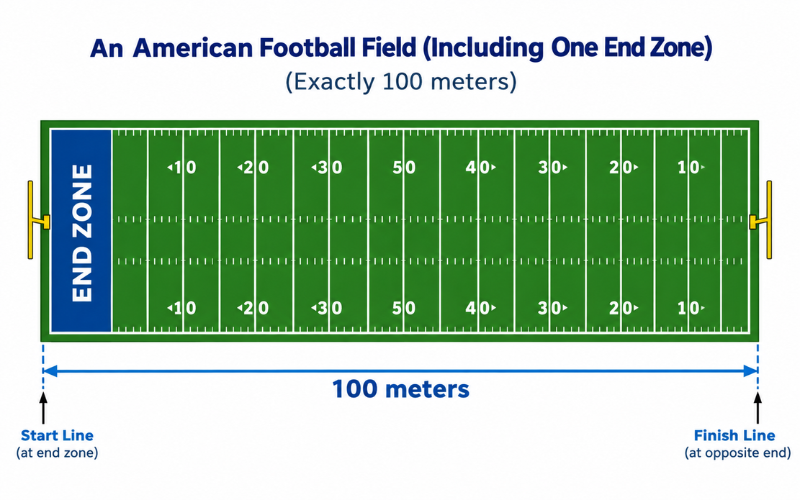
2. An American Football Field (Including One End Zone)
Many people assume a 100-yard football field matches 100 meters, but the math tells a different story. One hundred yards equals 91.44 meters. That leaves an 8.56-meter shortfall between the metric unit and the active playing field.
To find an authentic 100-meter distance on a regulation gridiron, start at the back of one end zone line and look across the field to the opposite goal line. Because each end zone measures 10 yards (9.14 meters), measuring from the outer back boundary through the field of play lands you at roughly 100.58 meters—nearly a pinpoint real-world representation.
- Exact length: 110 yards (100.58 meters).
- Reference points: From the end of one scoring zone to the opposing goal threshold.
- Why it works: Most people have visited or watched a football game, making the layout instantly recognizable.
3. A Standard FIFA Soccer Pitch Width
Association football rules maintained by the International Football Association Board (IFAB) enforce strict pitch dimensions, particularly for international play. While youth and local municipal fields vary widely, top-tier venues must follow standardized measurements.
Premier stadiums maintain a pitch length between 100 and 105 meters, with standard venues like Wembley, Camp Nou, and Old Trafford holding firm at 105 meters. Walk slightly inside the goal lines along the touchline, and you traverse an authentic 100-meter corridor. Looking across the field gives your eyes an instant gauge for what 100 meters of open turf looks like.
- Regulation range: 100 to 110 meters for standard international play (typically set to 105 meters).
- Visible boundaries: The long sideline touchlines between corner flags.
- Visual perspective: Spanning the entire active territory between penalty boxes plus run-off grass.

4. A 25-Story High-Rise Skyscraper
Height matches length in spatial geometry; rotating a vertical structure onto its side clarifies linear distance. Standard commercial and residential buildings dedicate between 3.8 and 4.2 meters of vertical space per story once you factor in floor slabs, ductwork, and ceiling cavities.
A residential tower holding 24 to 26 floors climbs approximately 95 to 105 meters into the city skyline. Famous landmarks illustrate this height well:
- The Statue of Liberty stands 93 meters tall from the bottom of the base foundation to the torch tip.
- Big Ben (Elizabeth Tower) in London measures 96 meters tall.
- St. Patrick’s Cathedral in New York reaches roughly 100 meters at its highest spire.
Tipping any of these towers flat onto city pavement matches the footprint of a 100-meter dash.

5. Ten Full-Size Transit City Buses Parked End-to-End
Urban city commuters spot single-unit municipal buses daily. Standard public transit buses—such as the Gillig Low Floor or New Flyer Xcelsior—measure 40 feet (12.2 meters) from bumper to bumper.
Line eight of these buses bumper-to-bumper, and you reach 97.6 meters. Add the spacing margins left between vehicles parked at red lights, and an unbroken line of eight to nine standard transit buses covers the full 100-meter mark. If you look at articulated “accordion” buses (which measure 60 feet or 18.3 meters), five units parked end-to-end achieve the same exact 91 to 100-meter length.
- Standard bus length: 12 to 12.5 meters.
- Arrangement: 8 standard buses with realistic spacing, or 5 articulated bendy buses.
- Everyday parallel: A dense line of traffic stopped across a major city block.

6. Twenty-Two Standard Mid-Size Sedans
If municipal buses seem too niche, passenger cars provide an even more accessible reference point. The average mid-size family sedan—such as a Toyota Camry, Honda Accord, or Volkswagen Passat—measures roughly 4.8 meters (15.75 feet) in total length.
Line up twenty-one of these cars tightly back bumper to front bumper, and the total span hits 100.8 meters. Factor in standard street-parking spacing, where drivers leave two to three feet of clearance for departure maneuvering, and an ordinary row of sixteen to seventeen parallel-parked cars along a residential street measures precisely 100 meters.
- Average sedan footprint: 4.8 meters long by 1.8 meters wide.
- Tight chain count: 21 vehicles end-to-end.
- Street parking count: 16 to 17 vehicles parked at curbside clearance.

7. Two Olympic-Sized Swimming Pools
Olympic competitive pools operate under rigorous World Aquatics (formerly FINA) specifications. Every host facility constructs these racing pools to an exact length of 50.0 meters (164 feet), maintaining absolute tolerances down to the millimeter to ensure world record legitimacy.
Two Olympic regulation pools laid end-to-end equal 100 meters without a fraction of an inch to spare. When endurance swimmers complete a standard “100-meter freestyle” or “100-meter butterfly” event, they swim to the opposite wall, execute a flip turn, and race back to the electronic touch pad at the original starting block. That two-lap circuit covers the target distance.
- Single pool length: 50.0 meters.
- Total layout: 2 pool basins aligned continuously.
- Lap equivalent: One out-and-back swimming lap in a long-course facility.

8. The Wingtip-to-Wingtip Span of Two Boeing 777 Airliners
Commercial aviation offers dramatic scale markers. The Boeing 777-300ER, one of the most widely flown long-haul twin-engine jets globally, features a wingspan measuring 64.8 meters (212 feet 7 inches). That makes single wingspans too short, but airframe lengths match our target differently.
Consider the classic Boeing 777-200. Its fuselage stretches 63.7 meters long. However, if you examine twin-aisle regional narrowbody jets like the Airbus A320, each measures 37.5 meters from nose radome to tail cone. Park two Airbus A320s and an Airbus A220 together nose-to-tail on a tarmac taxiway, and the continuous aluminum line measures right at 100 meters. Alternatively, the massive Boeing 777X with wingtips unfurled spans nearly 72 meters alone; pair its main body with a smaller regional jet, and the fuselage trail seals the 100-meter distance.
- Fuselage comparative: Roughly 2.5 Airbus A320 jetliners nose-to-tail.
- Wingspan comparative: One and a half Boeing 777 widebody jet airliners.
- Visual zone: Two commercial airport gates positioned side-by-side along a concourse pier.

9. A Train of Five Standard Freight Boxcars
Railroad equipment follows standardized engineering templates across continents. In North America and standard international rail grids, the most common boxcars measure 50 feet to 60 feet in external length (coupler to coupler).
A standard 60-foot exterior excess-height boxcar spans roughly 20.3 meters from coupler pin to coupler pin. When trains stop at road crossings, watch the cars pass:
- Five standard 60-foot boxcars coupled together equal roughly 101.5 meters.
- Six 50-foot legacy grain cars total roughly 99.4 meters.
- A single heavy-haul freight locomotive typically measures 22 meters, meaning four locomotives coupled together create an engine block roughly 88 to 92 meters long.
- Boxcar average: 18 meters to 20 meters per freight car.
- Train segment: 5 modern freight cars coupled together.
- Real-world encounter: A brief freight train passage past an intersection.

10. A Typical American City Block
Urban planning across various metropolitan cities relies on grid designs, though block measurements fluctuate based on regional history. However, numerous major cities utilize blocks calibrated to round fractions of a mile.
In cities like Portland, Oregon, blocks measure almost exactly 60 meters by 60 meters. But in cities like New York (Manhattan), the north-south walking distance between numbered cross streets (such as walking up from 42nd Street to 43rd Street along 5th Avenue) averages roughly 80 meters. Add the width of the roadway crossing, and traversing the block from storefront corner to the opposite street corner totals roughly 90 to 100 meters. In western grid layouts like Salt Lake City or Denver suburbs, half-blocks and neighborhood street segments frequently match 100-meter straightaways.
- Standard distance: One full north-south street step in Manhattan grids including avenue crossings.
- Steps to cross: Roughly 120 to 140 average adult walking paces.
- Transit time: Between one minute and one minute and fifteen seconds of normal foot travel.
Technical Specifications and Metric Dimensions
This reference table outlines the exact physical dimensions, metric specs, and key identifiers of the 100-meter measurement standard.
| Field | Specification |
| Measurement Unit | Meter (Standard SI Base Unit of Length) |
| Target Distance | 100.00 Meters |
| Imperial Equivalent | 328 Feet, 1.008 Inches (328.084 ft) |
| Nautical Equivalent | 0.0539957 Nautical Miles |
| SI Scientific Notation | $1.0 \times 10^2\text{ m}$ |
| Physics Definition | Distance traveled by light in vacuum in $1 / 2,997,924.58$ seconds |
| Average Human Walking Steps | 130 to 150 Steps |
| Average Bicycle Travel Time | 18 to 22 seconds (at 18 km/h or 11 mph) |
| Sound Travel Time | 0.291 seconds (at 20°C sea-level air) |
| Standard Olympic Record | 9.58 seconds (Usain Bolt, 2009) |
How Long Does It Take to Move 100 Meters?
Translating distance into time creates another practical perspective. Depending on the mode of transport, 100 meters feels either like an expansive trek or an instantaneous blur.
Walking Pace
The average adult walks at an active velocity of roughly 1.3 to 1.4 meters per second (roughly 4.7 to 5.0 km/h or 3.0 to 3.1 mph).
- To cross 100 meters on foot, you need roughly 71 to 77 seconds.
- A child or older adult moving at 1.0 meter per second takes roughly 100 seconds (1 minute and 40 seconds).
- An individual walking at this pace takes between 130 and 150 separate foot strikes to clear the threshold.
Running and Sprinting
Human running speeds vary significantly across fitness tiers:
- Casual jogger (9 km/h): Covers 100 meters in 40 seconds.
- Trained amateur runner (15 km/h): Clears 100 meters in 24 seconds.
- High school track athlete: Sprints 100 meters in 11.5 to 13.5 seconds.
- Olympic world champion: Explodes across 100 meters in sub-10 seconds (peaking at maximum velocities over 44 km/h or 27.3 mph).
Motor Vehicles and Transit
At everyday motor vehicle velocities, 100 meters passes faster than most people realize:
- School Zone Speed (30 km/h / 18.6 mph): The vehicle covers 100 meters in 12.0 seconds.
- City Street Speed (50 km/h / 31 mph): The vehicle crosses 100 meters in 7.2 seconds.
- Highway Cruising Speed (100 km/h / 62 mph): The car flashes through 100 meters in just 3.6 seconds.
- High-Speed Bullet Train (300 km/h / 186 mph): The passenger train travels 100 meters in a lightning-quick 1.2 seconds.
Practical Tricks to Measure 100 Meters Without Tools
When you work on landscaping, map property lines, or measure sports grounds without an engineer’s wheel or laser finder, use these field-tested estimation methods.
1. Calibrate Your Personal Stride Pace
Pacing represents the oldest surveying trick in history. Most adult humans maintain a natural walking pace (two individual steps—left plus right) measuring roughly 1.5 meters.
- Walk a known distance and count your natural paces.
- For most individuals, 65 to 70 double-paces (or 130 to 140 single footsteps) measures 100 meters with shocking consistency.
- Practice your stride count on a local high school track to learn your natural pacing variance.
2. The 100-Yard Football Conversion
If you find yourself near any local school field, use the yard markers. Locate the zero-yard goal line and walk toward the opposite end zone:
- Step past the 50-yard line.
- Walk through the opposing goal line (that hits 91.44 meters).
- Take approximately 9 to 10 more long strides into the end zone territory.
- You now stand at 100 meters from your original starting marker.
3. Count Lamp Posts on Roadways
Civil road engineers maintain strict minimum and maximum intervals when installing municipal overhead streetlights. Along straight urban and suburban streets, utility crews space lamp posts between 30 and 35 meters apart to balance illumination coverage and electrical efficiency.
- Spot three full spans between roadway streetlights.
- The gap from the first pole to the fourth pole equals roughly 90 to 105 meters.
100 Meters in Nature: Plants and Animal Scale
Nature builds its own towering representations of the 100-meter mark.
The Giant Redwoods (Sequoia sempervirens)
The ancient coastal redwoods growing along the fog-laden coast of Northern California showcase the biological ceiling of Earth’s plant kingdom. The world’s tallest recorded living tree, a specimen nicknamed Hyperion, stands at an astounding 116.07 meters (380.8 feet) tall.
Multiple mature specimens throughout Redwood National and State Parks climb between 95 and 105 meters into the canopy. The base trunks of these trees measure up to 9 meters in diameter. Standing at the roots and looking straight up the trunk provides an organic view of a living 100-meter vertical tower.
Blue Whale Pods
The blue whale (Balaenoptera musculus) ranks as the largest animal known to have ever lived on Earth, surpassing even the largest titanosaurian dinosaurs. An adult blue whale reaches up to 30 meters (98 feet) in body length from its broad snout to the tip of its horizontal tail flukes.
Three adult blue whales swimming nose-to-tail create an unbroken biological line measuring 90 to 95 meters. Adding a young calf to the migration pod pushes the total pod length directly past the 100-meter threshold.
Frequently Asked Questions About 100-Meter Distances
How many feet are in 100 meters?
One hundred meters contains exactly 328.084 feet. When rounding for everyday field calculations, most builders, surveyors, and sports coordinators use 328 feet and 1 inch.
Is 100 meters the same as 100 yards?
No, 100 meters is noticeably longer than 100 yards. One yard equals 0.9144 meters, which means 100 yards equals only 91.44 meters. Conversely, 100 meters equals 109.36 yards, making the metric distance approximately 9.36 yards (roughly 28 feet) longer.
How many city blocks equal 100 meters?
In most standardized urban grids—such as central Manhattan—one standard short city block measures roughly 80 meters between street corners. When you factor in the crossing width of the street itself, walking one full city block north or south equals approximately 100 meters.
How long does it take an average person to walk 100 meters?
A healthy adult walking at a brisk, steady pace of 4.8 km/h (3.0 mph) takes roughly 70 to 75 seconds to walk 100 meters. That equates to roughly 130 to 140 average steps.
What is the fastest human time over 100 meters?
Usain Bolt of Jamaica holds the men’s world record over 100 meters, clocking an incredible 9.58 seconds at the 2009 World Athletics Championships in Berlin. Florence Griffith-Joyner holds the women’s world record at 10.49 seconds, set in 1988.
Can you see 100 meters clearly without binoculars?
Under normal daylight conditions, a person with 20/20 vision sees large objects across 100 meters with extreme clarity. You can easily recognize a friend’s face, read large vehicular signage, and spot hand gestures at this distance. Reading fine text or identifying minute details requires magnification.
Estimating distances accurately does not require specialized surveyor equipment or complex trigonometry. By linking 100 meters to objects like running straightaways, sports pitches, lines of parked cars, and skyscraper heights, you develop a reliable sense of real-world scale.
The next time you need to estimate a distance on a job site, out on the road, or during a sports broadcast, lean on these everyday mental benchmarks. You can quickly measure space with confidence without pulling out a single tape measure.
Related Posts
- 10 Common Things That Are 90 Meters Long/ Tall
- 10 Common Things That Are 80 Meters Long/ Tall
- 10 Common Things That Are 70 Meters Long/ Tall
- 10 Common Things That Are 60 Meters Long/ Tall
Conclusion
Estimating distances accurately does not require specialized surveyor equipment or complex math. Connecting 100 meters to physical landmarks—like an Olympic sprint straightaway, a football field with an end zone, or a line of city buses—gives you an intuitive grasp of real-world scale.
Once you lock these visual benchmarks into your memory, judging spatial spans becomes second nature. Whether you evaluate a construction layout, pace out property lines, or watch athletes race on television, you can gauge the distance with confidence without ever reaching for a tape measure.
FOR MORE MEASUREMENTS VISIT: MEASURINGSPOT