
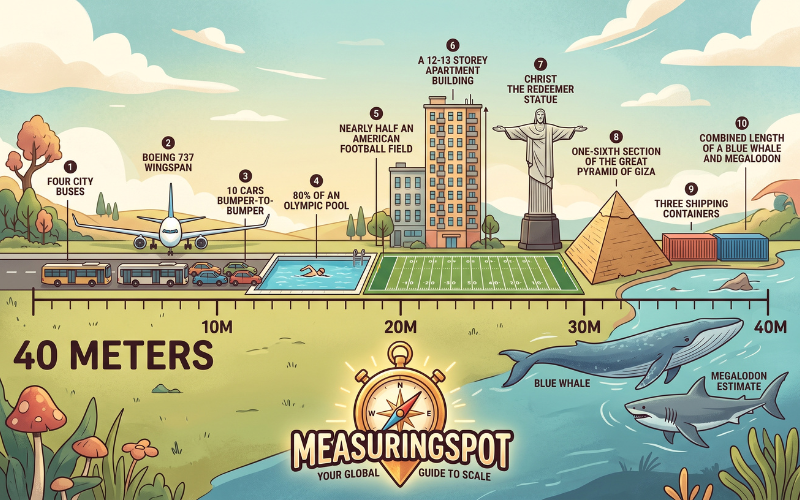
Forty meters equals 131.2 feet or about 43.7 yards. When you stare at a raw metric measurement on a blueprint or read it in a sports manual, it can feel abstract. Most people do not carry a measuring tape in their pocket, nor do they naturally parse triple-digit footages at a glance.
Connecting numbers to everyday physical objects instantly grounds your sense of scale. A length of 40 meters turns out to be a major benchmark in civil infrastructure, athletic fields, marine biology, and commercial aerospace.
Here is a practical breakdown of how long 40 meters actually is, complete with familiar real-world comparisons you can recognize immediately.
Quick Answer: How Long is 40 Meters?
40 meters equals:
- Feet: 131.23 feet
- Yards: 43.74 yards
- Inches: 1,574.8 inches
- Steps: Roughly 52 to 55 normal walking strides for an adult
- Walking Time: About 28 to 32 seconds at a standard pace (5 km/h or 3.1 mph)
If you need an immediate mental yardstick, 40 meters matches the wingspan of a Boeing 737 airliner, the length of an Olympic swimming pool minus two car lengths, or about 10 standard sedans parked bumper-to-bumper.
Fast Reference Specifications: The 40-Meter Dimension Sheet
| Specification Parameter | Metric Value | Imperial / US Standard Value | Everyday Analogy Benchmark |
| Linear Length | 40 meters | 131.23 feet | 4 full city buses in a straight row |
| Yards Equivalent | 43.74 yards | 131.23 feet | Just under half an American football field |
| Inches Equivalent | 4,000 cm | 1,574.8 inches | 130 standard 12-inch school rulers |
| Average Human Strides | ~53 paces | ~53 paces | A half-minute relaxed stroll |
| Sedan Vehicle Lengths | ~8.8 to 9 vehicles | ~8.8 to 9 vehicles | Average mid-size car (4.5m) bumper-to-bumper |
| Telephone Poles | ~3 to 4 poles high | ~3 to 4 poles high | 10 to 12 meter utility poles stacked |
| Vertical Height Equivalency | ~12 to 13 storeys | ~130 vertical feet | A standard mid-rise apartment tower |
10 Common Things That Measure Around 40 Meters
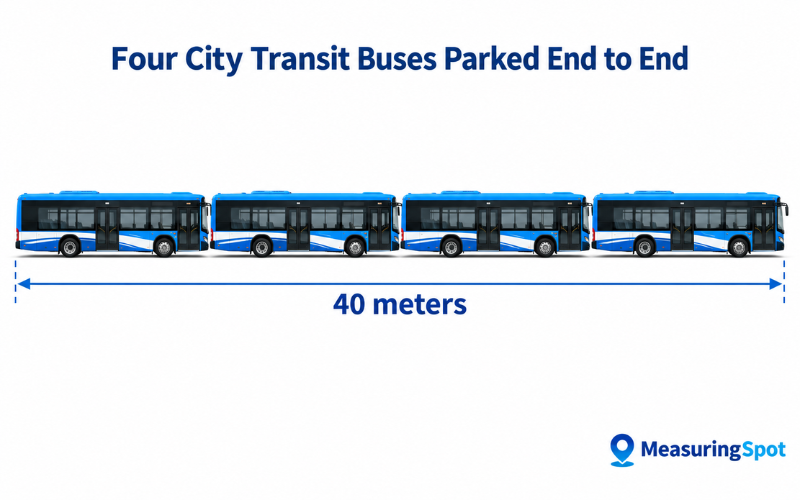
1. Four City Transit Buses Parked End to End
Standard single-unit public transit buses that navigate city avenues measure between 10 meters and 10.5 meters (33 to 35 feet) from front bumper to rear tailpipe.
When a driver pulls right behind another bus at a central station terminal, four of these standard municipal vehicles parked back-to-back stretch across almost exactly 40 meters. If you include the modest foot of clearance drivers leave between bumpers during traffic stops, four buses hit the 40-meter mark on the nose.
Because city buses operate in every urban and suburban core worldwide, they provide one of the most accessible visual references available on city streets.
2. The Wingspan of a Boeing 737-800
The Boeing 737 stands as the most widely produced commercial narrow-body jet airliner in aviation history. While early variations from the late 20th century carried shorter wings, the workhorse of current commercial fleets—the Next-Generation 737-800 and the 737 MAX 8—features modern wing designs with blended winglets.
From the tip of the left winglet across the fuselage to the tip of the right winglet, a Boeing 737-800 measures 35.79 meters without winglets and touches right near 38.8 meters with modern Advanced Technology winglets. Adding the ground marshalling buffer zones around the wing tips brings the aircraft’s operational bay width to 40 meters. When you sit by a boarding gate window at an airport, the metal expanse stretched between the two wingtips gives you an accurate 40-meter perspective.

3. Ten Mid-Size Cars Parked Bumper to Bumper
The average mid-size passenger automobile—such as a Toyota Camry, Honda Accord, or Volkswagen Passat—measures roughly 4.8 to 4.9 meters from its front grille to its rear bumper. Compact passenger sedans and hatchbacks sit closer to 4.3 to 4.5 meters.
Ten compact family sedans parked bumper to bumper along a curb cover roughly 42 meters, while nine mid-size modern vehicles land between 39 and 41 meters. If you glance outside at a curbside residential block or a dealership parking lane, counting out nine to ten consecutive parked vehicles paints an accurate picture of 40 linear meters.

4. Eighty Percent of an Olympic Competition Swimming Pool
Standard competition swimming pools built under World Aquatics (formerly FINA) specifications measure precisely 50 meters (164 feet) in total length from electronic timing pad to timing pad.
Forty meters covers four-fifths of that pool length. When competitive swimmers reach the 40-meter mark during a 50-meter sprint, they enter the final sprint zone, leaving just two body lengths before touching the wall. If you swim laps in a full-sized Olympic facility, swimming from the starting block to the 10-meter warning marker on the opposite side traces an exact 40-meter swim lane.

5. Nearly Half an American Football Field
An official American football gridiron spans 100 yards between the two goal lines, which converts to 91.44 meters. If you include both 10-yard end zones, the field covers 120 yards, or 109.7 meters.
Forty meters converts directly to 43.74 yards. When an offense lines up at their own 20-yard line and executes a pass play down to the opponent’s 36-yard line, the football travels slightly over 40 meters through the air and across the turf. That spans nearly the entire midfield territory between both 30-yard markers.

6. A 12-to-13-Storey Residential Apartment Building
Architects and structural engineers calculate residential floor-to-floor heights at roughly 3.0 meters to 3.2 meters per level. This allowance accounts for eight-to-nine-foot interior ceilings, concrete subfloors, ductwork runs, plumbing, and acoustic insulation layers.
Multiplying 3.1 meters by 13 storeys yields 40.3 meters of structural elevation. When you walk through a downtown core and spot a 12-to-13-storey mid-rise residential building or hotel, its total height from the sidewalk curb to the roof parapet provides a precise vertical scale for 40 meters.

7. The Height of the Famous Christ the Redeemer Statue and Pedestal
Christ the Redeemer stands perched atop Mount Corcovado overlooking Rio de Janeiro, Brazil. While tourists often discuss the statue’s artistic scale, its exact architectural metrics reveal a vertical 40-meter landmark.
The statue itself measures 30 meters (98 feet) from the soles of its stone robes to the top of its head. However, the monument rests upon an 8-meter (26-foot) reinforced concrete pedestal base that houses a chapel. Together with structural foundations and mounting details, the entire monument rises 38 to 40 meters into the Brazilian skyline. This makes it an iconic international benchmark for a 40-meter vertical rise.

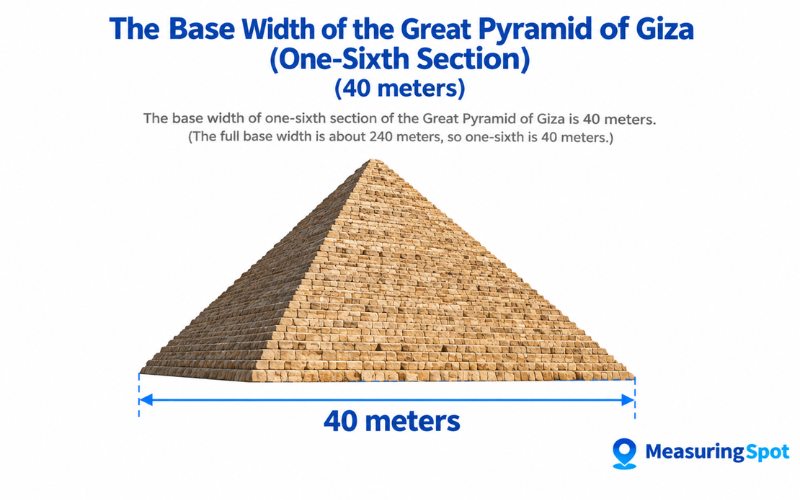
8. The Base Width of the Great Pyramid of Giza (One-Sixth Section)
The Great Pyramid of Giza originally featured square base sides measuring approximately 230.3 meters (755.6 feet) along each perimeter face.
If you divide one face of the pyramid into roughly six equal segments, each segment spans approximately 38.4 to 40 meters along the limestone foundation. Walking 40 meters alongside the base allows an individual to traverse only about one-sixth of a single wall face, which illustrates the massive footprint of the ancient wonder.
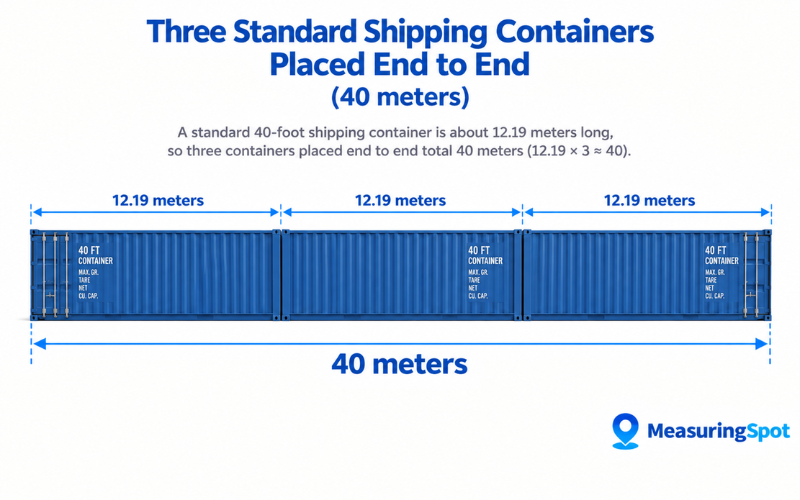
9. Three Standard Shipping Containers Placed End to End
Global cargo shipping relies heavily on standard intermodal steel containers certified by the International Organization for Standardization (ISO). The standard maritime freight unit is the 40-foot container (FEU).
A single 40-foot intermodal cargo container measures 12.19 meters (40 feet) in exterior length. Placing three of these standard steel cargo units end to end generates a line measuring 36.57 meters. If you add three 45-foot high-cube containers (each measuring 13.71 meters long), three units placed end to end total 41.13 meters. When walking alongside freight trains or container yards at a seaport, three rail cars carrying 40-foot freight containers represent an unmistakable 40-meter line.
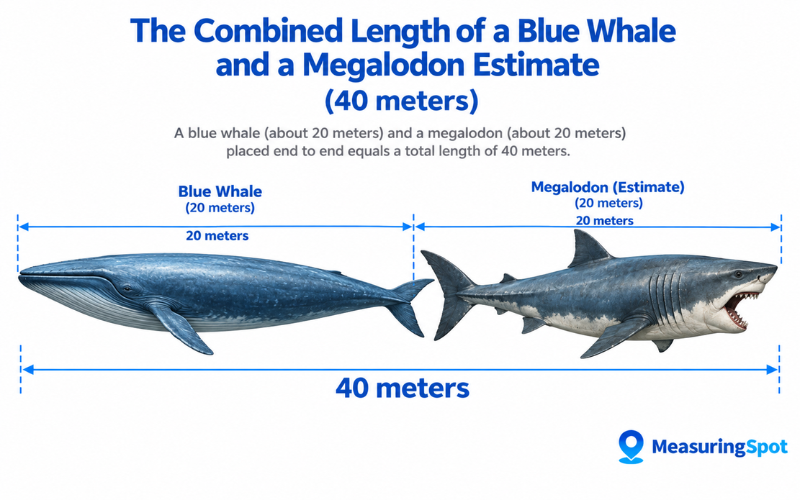
10. The Combined Length of a Blue Whale and a Megalodon Estimate
The blue whale (Balaenoptera musculus) ranks as the largest known animal ever to inhabit Earth. The longest scientifically validated blue whale specimens recorded by Antarctic whaling stations measured between 30 and 33 meters (98 to 108 feet) in total length from rostrum tip to fluke notch.
Prehistoric marine predators like the Otodus megalodon reached estimated maximum lengths around 15 meters to 18 meters. While a single modern blue whale stretches 30 meters, pairing an average 25-meter adult female blue whale with a medium-sized whale shark (12 meters to 14 meters) spans roughly 38 to 40 meters of continuous marine life.
Metric Conversions: 40 Meters Across Other Units
Architects, builders, survey crews, and athletes often convert meters into other measurement systems. Here is how 40 meters translates across international and traditional units:
- Kilometers: 0.04 km
- Centimeters: 4,000 cm
- Millimeters: 40,000 mm
- Feet: 131.233 ft (131 feet, 2.8 inches)
- Yards: 43.744 yd
- Statute Miles: 0.02485 miles
- Nautical Miles: 0.02159 NM
- Rods: 7.954 rods
- Fathoms (Maritime): 21.87 fathoms
How Far Is 40 Meters on Foot?
The average adult stride length measures approximately 0.75 meters (2.46 feet) from the heel strike of one foot to the heel strike of the opposite foot. Taller individuals naturally post longer strides near 0.8 meters, while shorter walkers record paces near 0.7 meters.
To cover 40 meters along a straight, flat sidewalk, a person takes between 50 and 55 normal walking steps. If you walk at an average commuter speed of 4.8 km/h (3.0 mph), you cover approximately 1.33 meters per second. This means you will walk 40 meters in roughly 30 seconds.
Running shifts this calculation dramatically. An amateur runner moving at a brisk 5-minute per kilometer pace (12 km/h) covers 40 meters in 12 seconds. An elite 100-meter sprinter covers that initial 40 meters out of the starting blocks in under 4.5 seconds.
Why the 40-Meter Mark Matters Across Industries
Architecture and Urban Planning
Municipal building codes frequently establish critical threshold requirements at 40 meters. In many zoning districts, structures exceeding 40 meters in vertical height trigger mandatory high-rise fire suppression protocols, including dedicated pressurization stairwells, backup generator networks, and secondary emergency access elevators.
On ground level, 40 meters often marks the standard street-to-street setback or maximum lot depth for urban commercial properties.
Athletics and Sports Science
While track and field features the iconic 100-meter and 200-meter events, 40 meters serves as a crucial acceleration testing distance in European soccer academies and rugby training facilities. Scouts track 40-meter sprint times because this distance reveals whether a player possesses true top-end breakaway speed after completing their initial drive phase.
In American sports, coaches evaluate the closely related 40-yard dash (36.57 meters) during NFL draft combines to gauge burst capabilities.
Telecommunications and Utility Transmission
High-voltage electrical transmission towers and commercial 5G wireless cell towers commonly target structural heights between 35 and 45 meters. A 40-meter tower clears forest canopies, surrounding low-rise rooftops, and minor hills, allowing technicians to beam microwave relay links and broadcast cellular coverage without line-of-sight terrain interference.
Frequently Asked Questions About 40 Meters
How many feet make up 40 meters?
Forty meters equals exactly 131.233 feet. To convert any meter figure into feet manually, multiply the meter count by 3.28084.
How many seconds does it take to run 40 meters?
A world-class track athlete covers 40 meters from the starting blocks in roughly 4.3 to 4.7 seconds. An active amateur athlete typically runs the distance in 6 to 7.5 seconds, while an average person running in casual footwear finishes in roughly 8 to 10 seconds.
Is 40 meters close to half a soccer field?
Yes. An official FIFA regulation soccer pitch measures between 100 and 110 meters in total touchline length. Therefore, half the length of a professional field spans 50 to 55 meters. A distance of 40 meters represents roughly 75% to 80% of an entire half-pitch.
How many steps does an adult take to walk 40 meters?
An average adult takes between 50 and 55 normal steps to walk 40 meters, assuming an average step length of roughly 0.75 meters (30 inches).
Can you see 40 meters clearly with normal vision?
Yes. Human eyes with standard 20/20 visual acuity resolve vehicle silhouettes, distinct body gestures, facial expressions, and large street signage text effortlessly across a 40-meter distance in daylight.
Forty meters represents a substantial real-world span that appears regularly across everyday transportation, modern high-rise architecture, and professional athletics. Whenever you need to gauge this measurement without tools, remember the length of four city buses, the wingspan of a commercial jetliner, or thirty seconds of brisk walking down the street.
Related Post
- 10 Common Things That Are 30 Meters Long / Tall
- 10 Everyday Things That Are 20 Meters Long/ Tall
- 10 Common Things That Are 19 Meters Long/ Tall
- 10 Everyday Things That are 18 Meters Long/ Tall
Conclusion
Forty meters represents a practical, functional scale in modern infrastructure, transport, and athletic design. When stripped of raw mathematical digits, the span translates into familiar items you encounter daily, from the full breadth of a passenger jetliner’s wings to a string of parked passenger sedans.
Using these tangible benchmarks eliminates guesswork whenever blueprints, land plots, or project plans demand an accurate spatial estimate. Whether you pace out fifty quick strides along a city sidewalk or gaze upward at a twelve-storey residential building, you now have a reliable frame of reference for how long forty meters truly is.
FOR MORE MEASUREMENTS VISIT: MEASURINGSPOT