
Have you ever tried to rearrange a bedroom or order a piece of flat-pack furniture online, only to realize your tape measure is missing? Estimating length with the naked eye is notoriously tricky. Unless you work in carpentry or architecture, numbers like “100 centimeters” or “3.28 feet” feel abstract when you are staring at a blank wall or an open trunk.
So, how long is 1 meter in everyday terms?
A meter is not just an arbitrary notch on a scientific ruler. It is one of the foundational dimensions of our modern built world. Once you connect this unit of measurement to familiar objects sitting around your living room, kitchen, and closet, you will never need to scramble for a ruler again.
The Quick Answer: How Long is 1 Meter?
If you need an instant mental benchmark right now:
- In Imperial Units: Exactly 39.37 inches, or roughly 3 feet and 3⅜ inches. That makes it slightly longer than an imperial yard (36 inches).
- In Metric Units: Exactly 100 centimeters or 1,000 millimeters.
- On Your Body: For an average adult, one meter is roughly the distance from the center of your chest to the tip of your outstretched fingers, or the height from the floor straight up to your belt buckle.
- On the Street: An intentional, slightly exaggerated walking stride taken by an adult covers almost dead-on one meter.
Biowiki Reference: The Meter at a Glance
Here is a consolidated reference card breaking down the core specifications, conversions, and historical anchors of the meter.
| Specification Attribute | Details & Real-World Value 📌 |
| Unit Name | Meter (US) / Metre (International / SI) |
| Symbol | m |
| Primary System | International System of Units (SI Base Unit) |
| Length in Inches | 39.3701 inches |
| Length in Feet | 3.28084 feet (approx. 3 ft, 3.37 in) |
| Length in Yards | 1.09361 yards |
| Length in Centimeters | 100 cm |
| Length in Millimeters | 1,000 mm |
| Current Scientific Definition | The distance light travels in a vacuum in 1/299,792,458 of a second |
| Original 1791 Definition | One ten-millionth of the distance from the Earth’s Equator to the North Pole |
| Human Benchmark | Floor to doorknob / adult waistband height |
| Everyday Comparison | A full guitar case, a kitchen countertop height |
Why “How Long is 1 Meter” Trips People Up
Many people who grew up using imperial units mistakenly treat 1 meter and 1 yard as identical twins. While they are close cousins, they are definitely not twins.
An imperial yard is fixed at 36 inches (3 feet). A meter sits at 39.37 inches.
That extra 3.37 inches might not sound like a huge deal on paper, but if you are measuring curtains, fitting a desk between two walls, or checking airline baggage limits, those extra ~8.5 centimeters can easily turn a project into a headache.
The meter was deliberately engineered during the French Revolution to replace hundreds of conflicting regional measuring rods with an objective, earth-based standard. Today, nearly every country on the planet relies on the metric system for trade, science, and everyday commerce. Understanding its base scale gives you an intuitive sense of space anywhere in the world.
10 Common Things That Are 1 Meter Long or Tall
Here are ten reliable, everyday items that hit the one-meter mark so closely you can use them as physical stand-ins whenever you need to check a dimension.
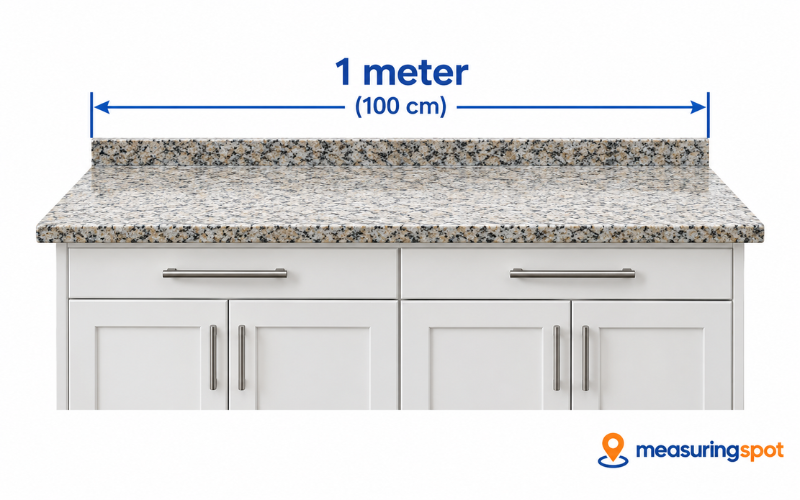
1. Standard Kitchen Countertops
Walk into almost any modern residential kitchen, and the counters will stand between 90 and 92 centimeters from the finished subfloor. Once you account for a standard 1.5-inch stone or laminate countertop slab and a short back lip, the work surface sits right around 95 to 100 centimeters (approximately 36 to 39 inches).
Architects and ergonomic designers established this height because it allows the average person to chop, stir, and prep food without hunching their spine or elevating their shoulders uncomfortably. If you stand right next to your counter, the top edge lands just below your hip bone—giving you an instant one-meter vertical reference.
2. A Full-Size Acoustic Guitar or Hard Case
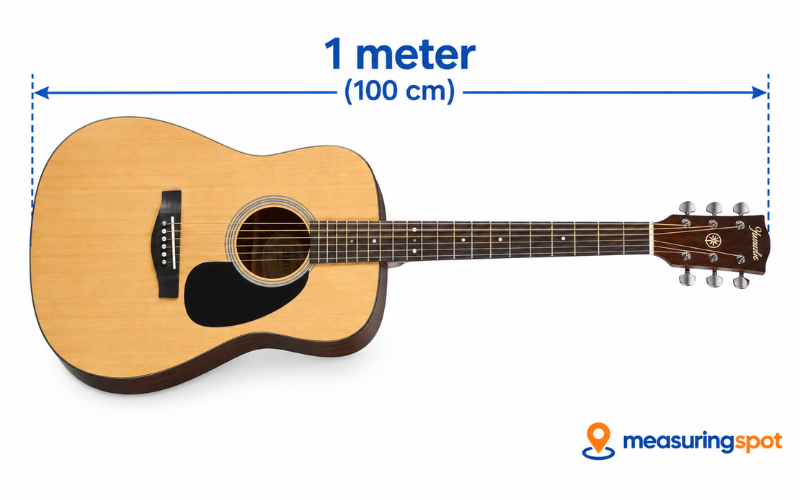
If you or someone in your home plays music, grab an acoustic guitar. A standard “dreadnought” or classical guitar measures between 100 and 102 centimeters (roughly 39.5 to 40 inches) from the top of the headstock to the bottom base of the lower bout.
The molded hard-shell case used to carry that guitar is virtually identical in exterior length. Laying a guitar case flat along the floor is one of the most reliable ways to mark out a meter when planning where a new bookshelf or shoe rack should sit.
3. A Standard Interior Doorknob Height
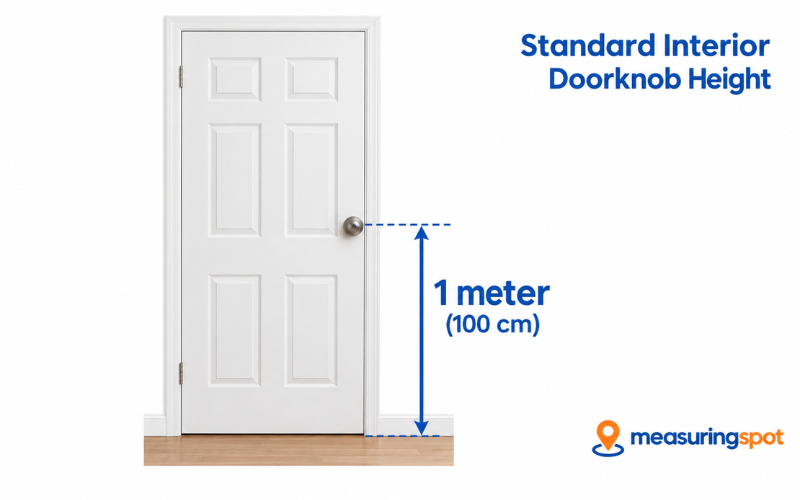
Building codes across North America and Europe mandate that residential door hardware must be easily accessible to both adults and children, as well as compliant with accessibility guidelines.
As a standard rule of thumb:
- Most residential door latch mechanisms and handles are drilled at 36 inches (91.4 cm) on center.
- Commercial doors and modern European hardware are often positioned slightly higher, between 95 and 100 centimeters above the threshold.
If you reach out to open a typical room door, your hand is gripping hardware that sits almost exactly one meter above the floor.
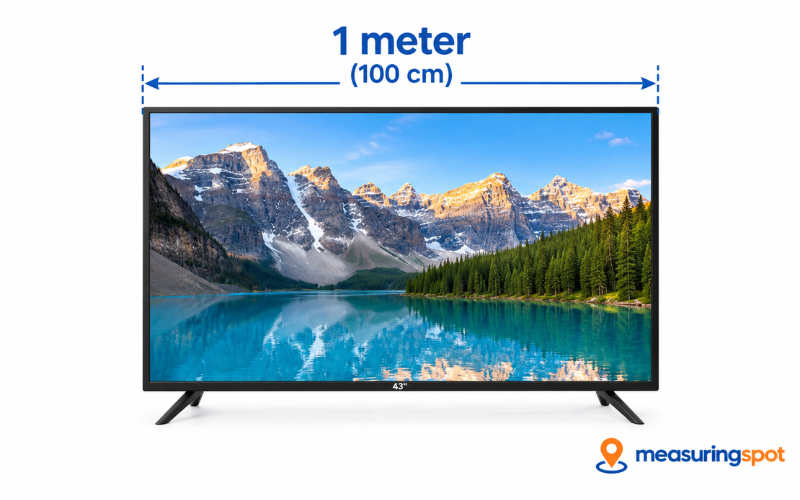
4. A 43-Inch Flat-Screen Television (Width)
When you shop for a television, the advertised screen size (such as 43″, 55″, or 65″) refers strictly to the diagonal measurement across the glass.
However, modern 16:9 aspect ratio televisions have very predictable exterior dimensions:
- A 43-inch television has a screen width of roughly 37.5 inches.
- With a slim outer bezel and side chassis, the total left-to-right horizontal width comes out to between 96 and 98 centimeters—practically one meter.
If you want to know whether a three-foot wall space can handle a medium TV, or if you need to visualize a meter horizontally along an entertainment console, think of that familiar 43-inch screen.
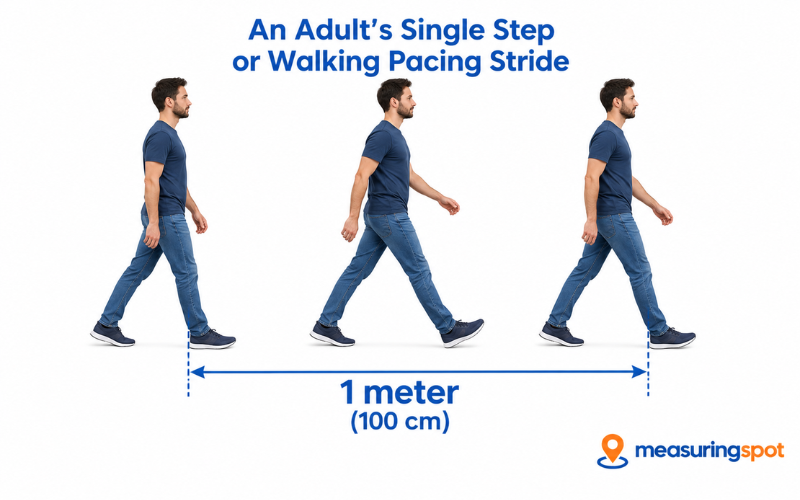
5. An Adult’s Single Step or Walking Pacing Stride
When you walk at a relaxed cadence, an average adult step is around 2.2 to 2.5 feet (70–75 cm). However, when you make a deliberate effort to take a long, purposeful step—stretching from the heel of your back foot to the toe of your front foot—you cover right around 1 meter (100 cm).
Land surveyors and builders have used this “pacing” method for centuries. By calibrating your own natural stride against a sidewalk crack or known distance once or twice, you can easily walk off room lengths, garden plots, or fence lines with surprising accuracy.
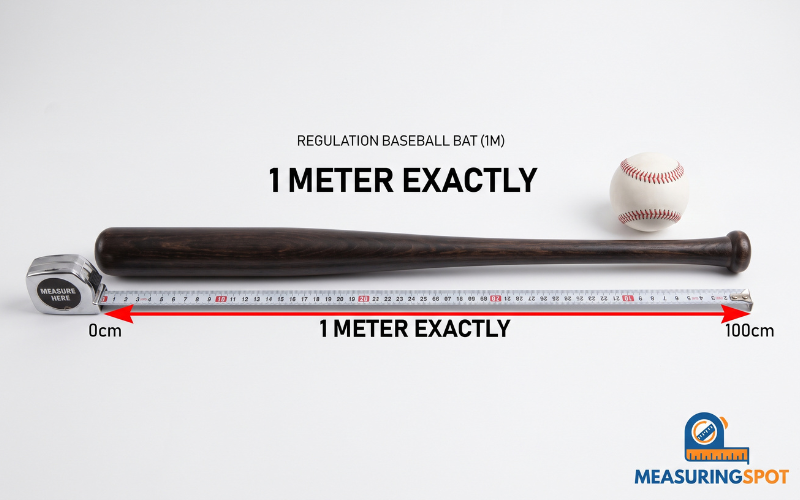
6. A Golf Driver or Regulation Baseball Bat (Plus Ball)
Sports gear is built to stringent manufacturing tolerances, making sporting goods excellent makeshift measuring sticks:
- A Golf Driver: The typical men’s driver shaft plus clubhead measures between 45 and 45.75 inches—which is about 1.15 meters. However, standard 3-woods and hybrid clubs run shorter, right around 40 to 41 inches (101 to 104 cm).
- A Baseball Bat with a Ball: A full-size adult baseball bat tops out at 33 to 34 inches (84 to 86 cm). Set a standard baseball or softball (roughly 3 inches wide) right at the tip of the barrel, and the combined length hits 37 to 39 inches—within a whisper of one meter.
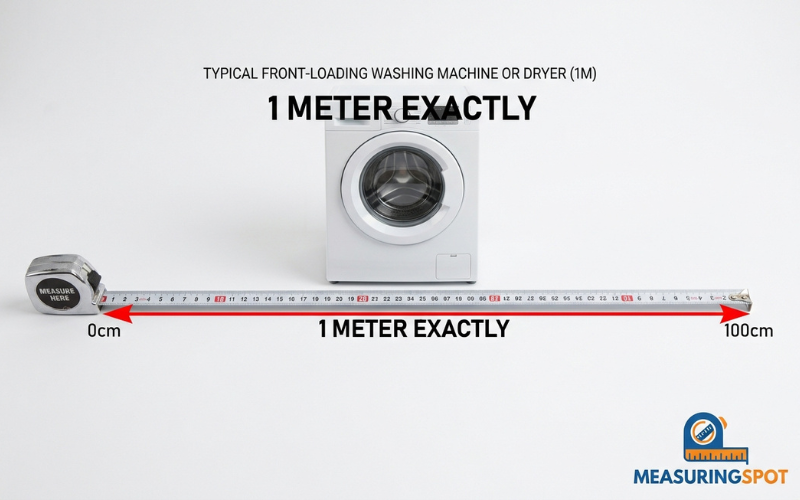
7. A Typical Front-Loading Washing Machine or Dryer
Appliances must fit through standard interior entryways and sit flush beneath modern laundry cabinetry. Because of this, global appliance manufacturers build full-sized washers and dryers to standard modular blocks:
- Height: 85 to 90 centimeters (about 33.5 to 35.4 inches).
- With adjustable leveling feet fully extended, or when placed on a low vibration-dampening tray, they stand right around 95 to 100 centimeters tall.
- Furthermore, the combined depth of the machine plus the rear exhaust hose clearance is usually right at 1 meter.
If you are trying to visualize how far a sofa will stick out from a wall, picture the footprint of your laundry dryer.
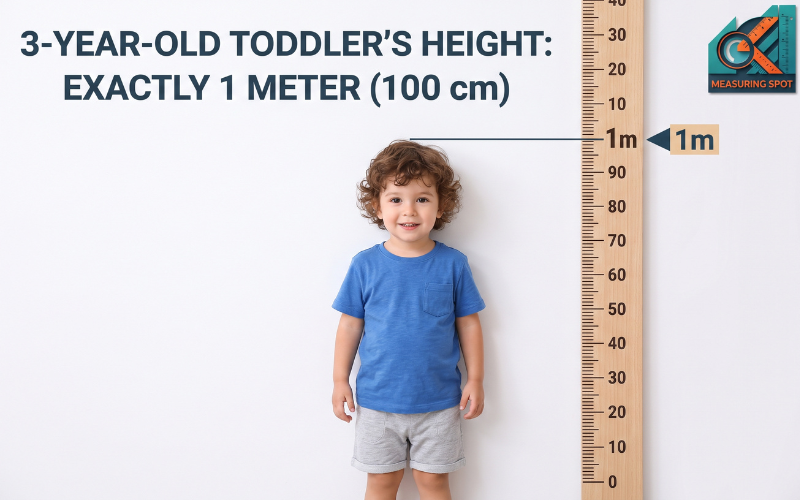
8. A 3-Year-Old Toddler’s Height
According to pediatric growth charts published by the World Health Organization (WHO) and the Centers for Disease Control and Prevention (CDC):
- The median height for a healthy 36-month-old (3-year-old) child is almost exactly 95 to 97 centimeters.
- By age three and a half, the average child passes 100 centimeters (1 meter).
If you have toddlers running around, or remember when your kids were that age, that classic waist-high stage of childhood marks a walking, talking one-meter benchmark.
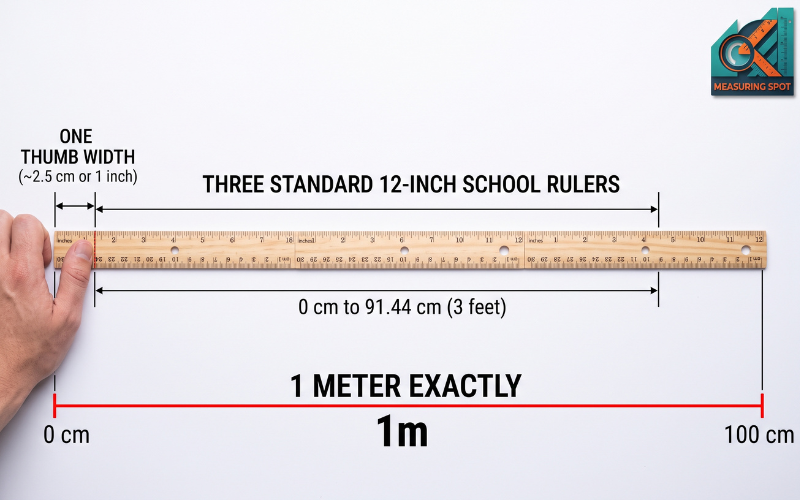
9. Three Standard 12-Inch School Rulers (Plus a Thumb Width)
Almost everyone has used a standard 12-inch (30.48 cm) plastic or wooden school ruler.
Line up three of those rulers end to end:
$$\text{3 rulers} \times 30.48\text{ cm} = 91.44\text{ cm}$$
To reach a true meter (100 cm), you only need another 8.56 centimeters (about 3.37 inches). That is roughly the length of a standard business card or the width of an adult palm across the knuckles. Lay down three rulers, add your palm width, and you have assembled a meter from scratch.
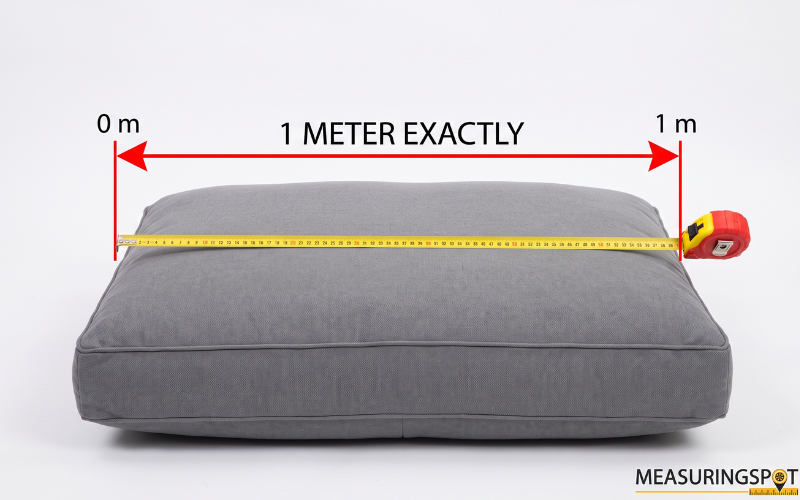
10. The Width of a Wide Armchair or Small Loveseat Cushion
A standard deep-cushion accent chair or armchair often features a seat cushion that spans between 85 and 100 centimeters from exterior arm to exterior arm. Similarly, a standard two-seater loveseat has an internal seating well that spans approximately 1 to 1.2 meters.
Sitting in your favorite reading chair gives you an immediate physical intuition for what a one-meter width feels like around your body.
Metric vs. Imperial: Why the Difference Matters
To see why understanding 1 meter is so practical, it helps to compare it directly against the units you might already have memorized.
0 in 12 in 24 in 36 in (1 Yard) 39.37 in (1 Meter)
|————-|————-|————-|—————-|
0 cm 30.48 cm 60.96 cm 91.44 cm 100 cm
Notice that gap between 36 inches and 39.37 inches. In construction or interior decorating, that 3.37-inch difference can mean:
- A curtain panel dragging on the floor rather than skimming it.
- A refrigerator failing to slide into a pre-built cabinet alcove.
- Paying oversize freight fees on international shipments because a box exceeded the standard 1-meter dimension threshold.
Quick Practical Hacks: How to Measure 1 Meter Without Any Tools
When you are out shopping at a flea market, strolling through a hardware store, or inspecting a rental property without a tape measure in your pocket, use these quick body and environmental tricks.
The Sternum-to-Fingertip Reach
Turn your head straight forward, extend one arm straight out to the side parallel to the ground, and measure from the center of your chest (the sternum) to the very tip of your middle finger. For a person of average height (around 5’8″ to 5’10” / 173–178 cm), this distance is within 2 to 3 centimeters of a meter.
(Tip: Taller individuals will find this reaches their knuckles, while shorter individuals may reach past the wrist of an outstretched hand.)
Floor Tile Counting
In commercial buildings, grocery stores, and hospitals, floor tiles are almost universally manufactured in two standard modular sizes:
- 12 × 12 inches (30.5 × 30.5 cm): Three full tiles plus about two fingers’ width equals one meter.
- 50 × 50 centimeters: Extremely common in European retail settings; exactly two tiles equal one meter.
- 60 × 60 centimeters: Common in modern porcelain residential flooring; one and two-thirds tiles equal one meter.
Standard Printer Paper Stacking
If you have access to standard letter or A4 copy paper:
- A4 Paper (Global Standard): Measures 29.7 cm long. Three sheets placed long-end to short-end span 89.1 cm. Add the short edge of a fourth sheet (21 cm), and you can calibrate exact meter markings.
- US Letter Paper: Measures 11 inches (27.94 cm) long. Three sheets laid end-to-end measure 33 inches (83.8 cm). Four sheets measure 44 inches (111.7 cm).
Why 1 Meter Is the Anchor of the Metric System
The meter is not just a measure of length—it is the master key that connects the entire International System of Units (SI). The metric system was created so that length, volume, and mass would all interlock logically using powers of 10:
- Length: Take a line that is $\frac{1}{10}$ of a meter long (1 decimeter or 10 centimeters).
- Volume: Build a cube that measures 10 cm on every side. That cube has a volume of exactly 1 Liter ($1,000\text{ cm}^3$).
- Mass: Fill that one-liter cube with pure water at 4°C. The water weighs exactly 1 Kilogram ($1,000\text{ grams}$).
This simplicity is the reason scientists, engineers, and everyday consumers around the world appreciate the meter: once you know how long 1 meter is, you also know what makes a liter and a kilogram.
❓ Frequently Asked Questions
How long is 1 meter compared to a yardstick?
A meter is slightly longer than a yardstick. A standard yardstick measures 36 inches (3 feet), whereas a meter stick measures 39.37 inches (roughly 3 feet, 3⅜ inches). A meter is approximately 9% longer than a yard.
How many steps is 1 meter?
For a typical adult walking at a standard pace, one natural step is roughly 0.7 to 0.75 meters. That means it takes about 1.3 to 1.4 normal steps to cover one meter. However, if you deliberately take an elongated stride, a single step covers one meter.
Is a guitar always 1 meter long?
Most standard full-size dreadnought acoustic guitars and standard electric guitars sit between 99 and 104 centimeters (39 to 41 inches) from headstock to strap button. Classical guitars are occasionally slightly shorter (around 98 cm), but full-size models generally hover around the 1-meter mark.
How high is 1 meter on the human body?
For an adult of average height (around 5 feet 9 inches or 175 cm), one meter from the floor reaches roughly to the beltline or hip socket. If measured from the shoulder down, one meter reaches past the knees.
How many inches is 1 meter exactly?
One meter is defined as exactly 39.37007874 inches. For almost all practical DIY, home decor, and construction estimates, rounding to 39.37 inches (or 39⅜ inches) is more than accurate enough.
Related Posts
- 12 Common Things That Are 10 Inches Long
- 10 Common Things That Are 1 Inch Long
- 11 Common Things That Are 2 Inches Long
- 10 Common Things That Are 3 Inches Long
Conclusion
Understanding how long is 1 meter without reaching for a tape measure comes down to recognizing the standard dimensions built into the world around you. Whether you gauge the distance using the height of your kitchen countertop, the reach from your chest to your fingertips, the length of an acoustic guitar case, or a single purposeful stride across the floor, you now have reliable physical anchors to make quick, accurate spatial judgments anywhere you go.
FOR MORE MEASUREMENTS VISIT: MEASURINGSPOT