
When you look at a blueprint, order jewelry online, or pick up a wrench in your garage, metric numbers can feel detached from physical reality. You might see how big is 16 mm listed on a product page and pause to wonder what that looks like in your hand. Without a physical ruler nearby, small metric numbers often blur together.
Sixteen millimeters sits right between tiny hardware fasteners and palm-sized household tools. It equals roughly 5/8 of an inch, making it a standard measurement across film archives, board games, jewelry crafting, home plumbing, and carpentry.
Once you match this measurement with objects sitting on your desk or tucked inside your kitchen drawers, you can judge 16mm instantly. Here is everything you need to know about this size, how to measure it, and ten common items that match it.
Quick Answer: How Big is 16mm?
16 millimeters equals exactly 1.6 centimeters or roughly 0.6299 inches (practically 5/8 of an inch).
If you want an immediate reference point:
- It is slightly smaller than an American dime (which measures 17.91mm across).
- It matches the edge length of a standard board game die.
- It equals the exact width of a regular film reel strip from classic movie stock.
- It roughly matches the thickness of ten pennies stacked together.
Biowiki Reference Profile: 16 Millimeters
| Attribute | Specification |
| Measurement (Metric) | 16 mm (1.6 cm) |
| Measurement (Imperial) | 0.6299 inches (~5/8 inch) |
| Fractional Approximation | Just under 5/8 inch (0.625 in vs 0.6299 in) |
| Equivalent in Meters | 0.016 m |
| Volume of a 16mm Sphere | ~2.14 cubic centimeters (2,144mm3) |
| Surface Area of a 16mm Sphere | ~804.25 square millimeters (8.04cm2) |
| Closest US Coin | US Dime (17.91 mm; 16mm is ~11% smaller) |
| Closest Euro Coin | 1 Euro Cent (16.25 mm; near-exact match) |
| Closest UK Coin | 5 Pence (18.0 mm; 16mm is slightly smaller) |
| Common Industrial Role | Rebar diameter (#5 rebar metric), standard socket size, PEX tubing |
| Standard Consumer Role | Playing dice, jewelry gauges (5/8″), classic cinema film |
10 Common Things That Are 16mm Big
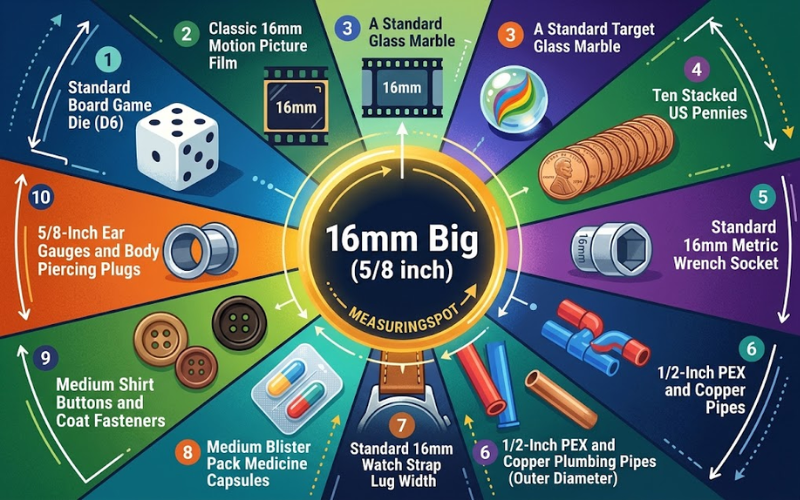
1. Standard Board Game Dice (D6)
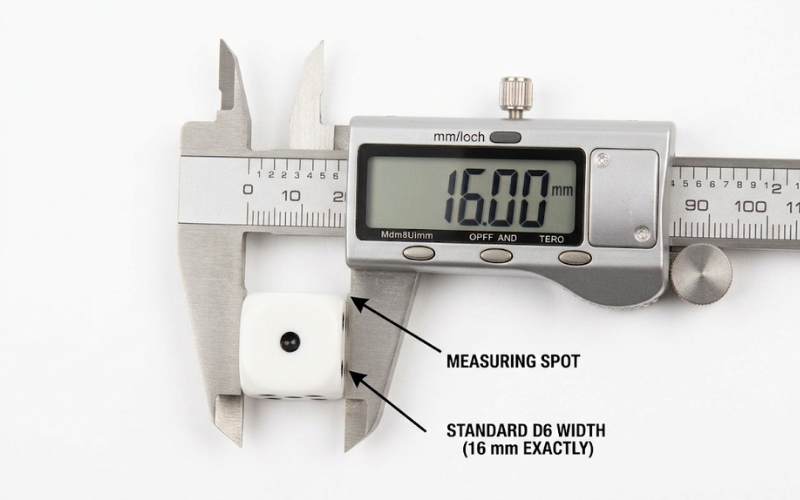
If you reach into a classic Monopoly, Yahtzee, or Risk box, you will hold a six-sided die that measures 16mm along each edge. Manufacturers around the world have treated 16mm (roughly 0.63 inches) as the worldwide baseline for six-sided game dice for decades.
This dimension strikes a balance for human hands. A 16mm cube fits comfortably between your fingers, shakes inside a cup without jamming, and rolls across a tabletop with enough heft to stay flat. If you place a die flat on a table, its height, width, and depth all represent 16mm.
2. Classic 16mm Motion Picture Film
Before digital cameras took over cinema and television, film rolls ruled visual production. In 1923, Eastman Kodak introduced 16mm film as an inexpensive, safe alternative to professional 35mm formats. The entire width of this physical film strip measures 16mm from edge to edge.
Documentary makers, news crews, and independent directors used this format for decades because portable cameras could hold 16mm rolls easily. Even modern music videos and indie films still shoot on 16mm stock to capture its organic grain. If you pick up a strip of this vintage reel, you are holding the exact physical definition of 16mm width.

3. A Standard Target Glass Marble
Toy marbles come in many varieties, but player marbles used in traditional playground ring games generally feature a 16mm diameter (5/8 inch). While the larger shooter marbles reach 19mm to 25mm, the target spheres inside the chalk circle measure 16mm across.
This uniform sphere offers an intuitive reference for three-dimensional volume. Rolling one of these small glass orbs between your thumb and index finger gives you a reliable physical sense of what a 16mm diameter feels like.
How Big Is 16 mm

4. Ten Stacked US Pennies
A single United States one-cent coin has an official thickness of 1.52mm. When you stack ten pennies flat on your desk, the small tower reaches roughly 15.2mm to 16mm tall, depending on surface wear and stamping variations.
Coins work well because almost everyone has spare change nearby. If you want to check if a small gap, drill hole, or mounting bracket can clear 16mm, ten stacked pennies provide a fast physical gauge without a ruler.

5. Standard 16mm Metric Wrench Socket
Anyone who works on cars, bicycles, or home machinery knows the 16mm socket. Mechanics frequently use a 16mm socket or combination spanner to tighten suspension hardware, spark plugs, and chassis bolts.
The opening inside the socket measures 16mm across opposite flat edges, built to wrap around a matching hex bolt head. If you keep a small tool set in your trunk or garage, opening your socket tray lets you view 16mm steel hardware immediately.

6. 1/2-Inch PEX and Copper Plumbing Pipes (Outer Diameter)
Plumbing standards confuse many homeowners because pipe sizing refers to inner fluid flow rather than outer boundaries. For example, standard residential 1/2-inch PEX (cross-linked polyethylene) and nominal 1/2-inch copper pipes have an outer diameter of roughly 5/8 of an inch, or approximately 15.88mm to 16mm.
When you slide a mounting clamp, wall bracket, or drill bit around 1/2-inch water tubing under your kitchen sink, you are securing a pipe that spans 16mm on the outside.

7. Standard 16mm Watch Strap Lug Width
Watch bands connect to the timepiece case via tiny spring bars seated between two metal horns called lugs. While oversized sports watches often demand 20mm or 22mm bands, dress watches, vintage timepieces, and women’s wristwatches standardly use 16mm straps.
If you swap leather or canvas bands on a slim wristwatch, you will frequently purchase a 16mm strap. The distance between the internal edges of the lugs spans 16mm, making it an everyday benchmark in watchmaking.

8. Medium Blister Pack Medicine Capsules
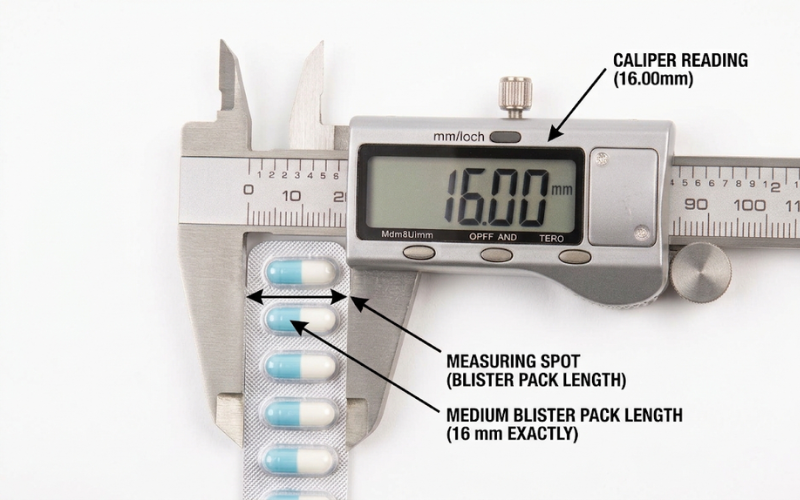
Pharmaceutical companies pack many over-the-counter and prescription capsules inside foil blister packs. A standard size 1 or size 2 gelatin capsule measures between 15.5mm and 17.5mm in total length, placing the common median right at 16mm.
If you have allergy capsules, dietary supplements, or pain relievers in your medicine cabinet, measure the long axis of the pill. You will find that several brands match this length so adults can swallow them comfortably.
9. Medium Shirt Buttons and Coat Fasteners
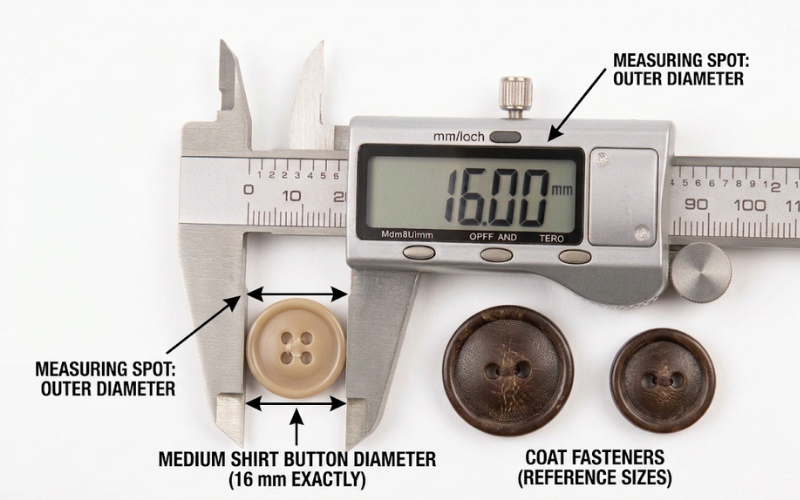
In the garment industry, button manufacturers measure sizes using an old system called “lignes,” where one ligne equals 0.635mm. A classic 24-ligne or 26-ligne button spans 15.2mm to 16.5mm across.
These medium circular fasteners appear on light denim shirts, polo plackets, cardigan fronts, and jacket cuff closures. If you pinch a cuff button on a casual jacket, you are holding a flat plastic or horn disc that spans 16mm.
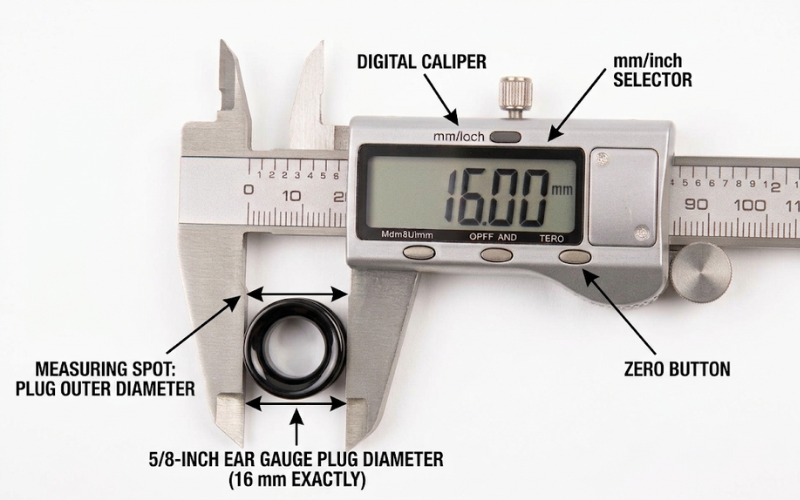
10. 5/8-Inch Ear Gauges and Body Piercing Plugs
In body modification and piercing culture, stretched earlobes follow gauge sizes up to 00g, after which studios switch to direct fractional inch measurements. A popular mid-to-large milestone for ear stretching is the 5/8-inch gauge, which body jewelry studios label interchangeably as 16mm.
A 16mm plug or tunnel matches the thickness of a thick marker body. Piercing fans treat 16mm as a significant milestone because jewelry designs at this diameter can carry detailed inlays, carved wood, or stone facets.
Why Understanding 16mm Matters
Knowing the scale of 16mm saves time across various tasks. When you buy goods online from international sellers, dimensions often appear in metric millimeters. If you only think in inches, you risk purchasing screws that fall through mounting brackets or ordering picture-hanging hardware that snaps under pressure.
Hardware and Construction Projects
In home improvement, drill bits often come in metric gradations. A 16mm spade bit or masonry drill creates the hole needed to route cables, run low-voltage landscape lighting, or set drop-in anchors for concrete. If you pick the wrong bit, you ruin drywall or create loose anchors.
Online Retail and Jewelry Orders
Jewelry buyers face constant sizing errors. Pendant diameters, earring hoop widths, and necklace beads frequently list metric dimensions. A 16mm pendant looks balanced on an everyday necklace, whereas a 25mm piece makes a bold statement. Recognizing 16mm prevents surprise returns when the package arrives.
Creative Crafts and 3D Printing
Hobbyists working with 3D printers, laser cutters, or silicone molds constantly model components at the millimeter scale. Tolerances of 0.5mm make the difference between a peg fitting snug into a hole or binding entirely. Keeping a physical baseline for 16mm makes desktop design drafting much faster.
How to Measure 16mm Without a Metric Ruler
You do not need a precision stainless-steel caliper to find 16mm. When you are standing in a store aisle or working in your basement, everyday substitutes can give you an accurate check.
Use an Imperial Tape Measure
Most home toolboxes contain imperial tape measures divided into sixteenths of an inch. Pull out your tape measure and look at the 5/8-inch mark.
- 5/8 of an inch equals 0.625 inches.
- 16mm equals 0.6299 inches.
The difference between the two measurements is less than five thousandths of an inch (0.12mm), which is thinner than a sheet of printer paper. For woodworking, crafts, and general repairs, 5/8 inch is a direct swap for 16mm.
Use International Coins
Coins make durable measurement standards because governments mint them with strict metallurgical tolerances:
- Eurozone: A 1 Euro Cent coin measures 16.25mm across. It gives you an immediate physical sample of 16mm with negligible difference.
- United States: A US Dime measures 17.91mm in diameter. If you imagine a circle slightly smaller than a dime, you have 16mm.
- United Kingdom: A 1 Penny coin has a diameter of 20.3mm, while the 5 Pence coin measures 18mm. A 16mm circle sits just inside the boundary of the 5p coin.
Frequently Asked Questions
How big is 16mm compared to an inch?
16mm equals approximately 0.6299 inches. In practical terms, this matches 5/8 of an inch on any standard household tape measure or woodworking ruler.
Is 16mm the same as 5/8 inch?
Yes, for almost all practical purposes. 5/8 inch converts to 15.875mm, which sits within 0.125mm of 16mm. Unless you are machining aerospace components, 16mm and 5/8 inch swap cleanly.
Is 16mm bigger than a US dime?
No, a US dime is larger than 16mm. A standard US dime has a diameter of 17.91mm. Therefore, 16mm is roughly two millimeters smaller than a dime.
How many centimeters are in 16mm?
There are 1.6 centimeters in 16 millimeters. You find this by dividing the millimeter count by 10.
What socket size replaces a 16mm socket?
A 5/8-inch socket matches a 16mm socket very closely. While mechanics prefer exact metric sockets to prevent rounding bolt heads under high torque, a 5/8-inch wrench fits a 16mm fastener in an emergency.
Putting 16 Millimeters in Everyday Context
Small measurements do not have to remain abstract numbers on a screen. Once you connect 16 millimeters to the face of a gaming die, a vintage film reel, or ten stacked pennies, you build a dependable mental scale you can use anywhere.
Whether you are sizing plumbing pipes for a weekend renovation, buying watch accessories online, or picking drill bits in your workshop, remember that 16mm is practically 5/8 of an inch. Keep a die or a stack of coins in mind, and you will never need to second-guess this measurement again.
Related Posts
- 10 Common Things That Are 12 mm Big
- 10 Common Things That Are 11 mm Big
- 10 Common Things That Are 10 mm Big
- 10 Common Things That Are 9 mm Big
Conclusion
Bridging the gap between metric measurements and everyday items turns abstract numbers into practical reference points. Whether you picture a standard six-sided die, the outer boundary of half-inch plumbing pipe, or ten pennies stacked on your desk, you now have reliable physical benchmarks to gauge 16 millimeters instantly.
Remembering that 16mm sits just under five-eighths of an inch eliminates guesswork across home improvement projects, online shopping, and DIY crafts. Keep these familiar references in mind, and you will judge this common measurement accurately without reaching for a ruler.
FOR MORE MEASUREMENTS VISIT: MEASURINGSPOT