
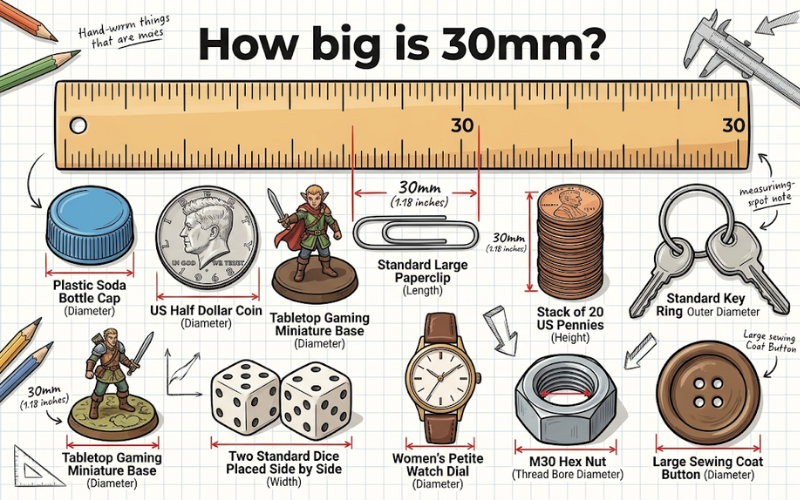
Finding a ruler or caliper in the middle of a DIY project, online shopping session, or jewelry purchase is not always possible. Metric figures look clean on paper, yet estimating how a specific measurement translates to real life often leaves people guessing. When you see a product labeled with a 30mm dimension, you need an instant reference point to judge whether it fits your purpose.
Thirty millimeters sits in a unique middle ground of everyday measurement. It is slightly larger than an inch, compact enough to hold between two fingers, yet broad enough to serve as a standard size for hardware, game pieces, camera accessories, and personal accessories. Comparing this length against standard objects in your pocket, kitchen drawer, or tool shed makes judging size straightforward.
This guide breaks down exactly how big 30mm is through practical conversions and 10 familiar household items that measure right around this mark.
Quick Answer: How Big Is 30mm?
Thirty millimeters equals 3 centimeters or roughly 1.18 inches (slightly under 1 and 3/16 inches).
If you want a fast mental snapshot, 30mm matches:
- The diameter of a standard plastic soda bottle cap across its top edge.
- The diameter of a US Half Dollar coin (which measures 30.61mm).
- The thickness of a stack of about 17 to 18 US pennies or standard credit cards pressed flat together.
- The length of a standard large plastic paperclip.
Whenever you encounter 30mm on a spec sheet, picture an object that spans just under an inch and a quarter.
30mm Quick Conversion and Spec Table
The table below compiles core metric, imperial, and physical conversion benchmarks for 30 millimeters.
| Specification / Unit | Value / Measurement | Real-World Equivalence |
| Millimeters (mm) | 30 mm | Base metric measurement |
| Centimeters (cm) | 3.0 cm | Exactly one-tenth of a standard 30cm ruler |
| Meters (m) | 0.03 m | Engineering scale factor |
| Inches (Decimal) | 1.1811 in | Slightly larger than 1 and 1/8 inches |
| Inches (Fractional) | ~1 3/16 in | Common carpentry nearest fractional match |
| Feet (ft) | 0.0984 ft | Architectural scale equivalent |
| Points (Typography) | ~85.04 pt | Large display headline font size |
| US Coin Comparison | 30.61 mm | US Half Dollar (Kennedy half dollar) |
| UK Coin Comparison | 28.4 mm | UK 5-pound commemorative crown size territory |
| Stack Height | ~17.1 mm coins | 18 modern zinc pennies stacked vertically |
| Gauge / Hardware | 1.181 in | Standard M30 bolt nominal shank diameter |
Understanding the Scale: Millimeters vs Inches
Most people in countries using the imperial system struggle to map metric increments smaller than a decimeter onto daily tasks. A millimeter is roughly the thickness of a standard plastic loyalty card or fingernail edge. Ten of those make up a single centimeter.
When you scale up to 30mm, you cross the 1-inch threshold. One inch measures exactly 25.4 millimeters. Therefore, 30 millimeters contains that full inch plus another 4.6 millimeters (roughly 0.181 inches). Because 0.1875 inches equals 3/16 of an inch, 30mm sits just a hair under 1-3/16 inches.
Knowing this conversion saves you time in numerous real-life applications:
- Watch Cases: In horology, a 30mm case represents a classic vintage or women’s petite dress watch diameter.
- Jewelry and Piercings: Hoop earrings and ear gauge plugs use millimeter ratings; 30mm hoops sit just below the jawline or hug lower lobes loosely.
- Camera Filters: Lens thread diameters such as 30mm or 30.5mm appear on compact camcorders and vintage rangefinders.
- Plumbing and Pipe Fittings: Metric PVC tubing often specifies outer diameters in increments like 25mm, 32mm, or 30mm conduit tubing.
10 Common Everyday Things That Are 30mm Big
Here are 10 familiar objects you can observe right now to check the size of 30 millimeters without using measuring tools.
1. A Plastic Soda Bottle Cap (Diameter)
The standard screw-on plastic cap found on personal 16-ounce or 20-ounce bottles of soda, sparkling water, and iced tea measures right around 30mm across its widest outer diameter. The threaded inner mouth of the bottle (known across the packaging industry as the PCO 1881 or 28mm finish) has a neck diameter of roughly 28mm, while the protective plastic cap itself stretches out to roughly 30mm to 31mm across its outer knurled ridges.
When you look down directly at the cap while holding it flat, the edge-to-edge distance across the top circle gives you an instant, tangible model for 30mm. It sits comfortably inside the palm and represents one of the most accessible references anywhere in the world.

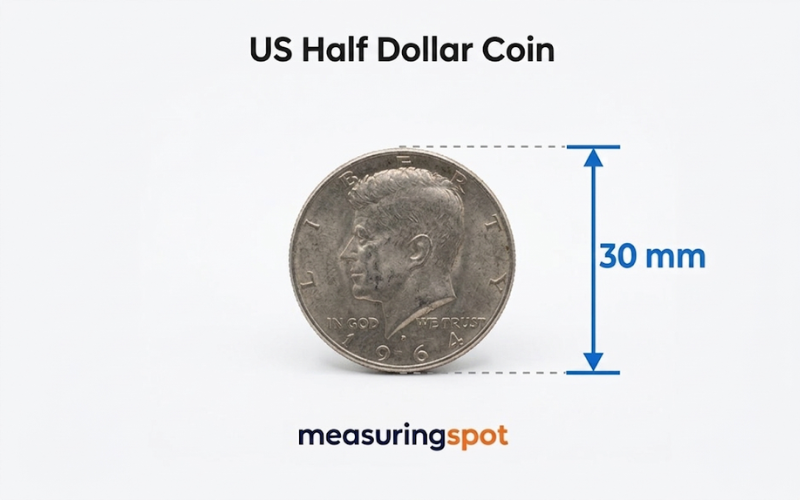
2. A US Half Dollar Coin (Diameter)
If you have a collection of loose change or an old coin jar, look for a Kennedy Half Dollar. The United States Mint specifies the diameter of the half dollar coin at exactly 30.61 millimeters (1.205 inches).
While slightly larger than 30mm by a fractional fraction of a millimeter (0.61mm, roughly the thickness of a sheet of light cardstock), the half dollar is the closest single coin in American circulation to the 30mm mark. Compare it against standard pocket change:
- A US Quarter measures 24.26mm.
- A US Nickel measures 21.21mm.
- A US Penny measures 19.05mm.
The Half Dollar clearly dwarfs the quarter, showing you how much space 30mm actually commands in physical currency.
3. A Tabletop Gaming Miniature Base (30mm Warmachine / Round Lip Base)
Tabletop wargamers and hobby painters interact with millimeter increments constantly. While Warhammer 40k commonly uses 25mm, 28mm, and 32mm bases, games like Warmachine, Hordes, and Malifaux built their core rules around standard 30mm round-lip bases.
A 30mm miniature base offers sufficient balance for human-sized character figures, tactical troopers, and display models. If you hold one of these circular plastic platforms between your thumb and forefinger, the circular base rim represents 30mm across the bottom footprint. Hobbyists also rely on this diameter to gauge battlefield engagement distances and line-of-sight templates.

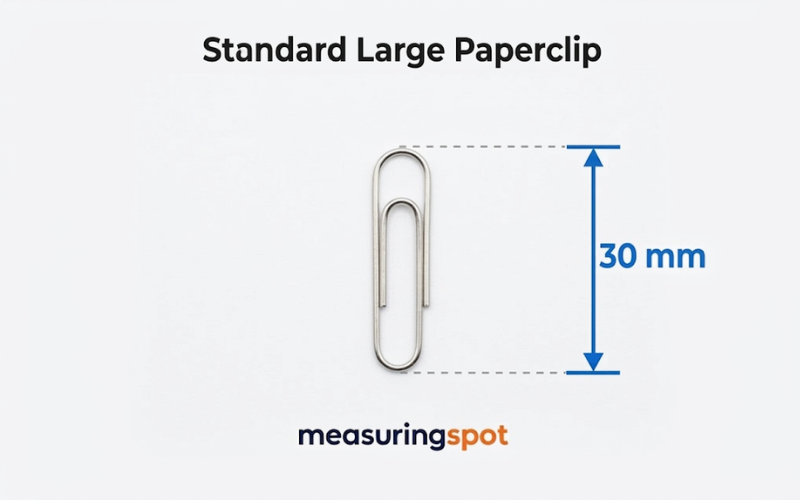
4. A Standard Large Paperclip (Length)
Small metal paperclips measure about 25mm (1 inch) in length. However, standard jumbo or large vinyl-coated paperclips measure around 30mm to 33mm from top loop to bottom bend.
If you pick up a medium-to-large plastic-coated wire clip from an office drawer, lay it down flat against a sheet of lined paper. The straight span between the rounded ends matches 30 millimeters. It provides a slender, linear visualization of 30mm as opposed to circular discs and coins, making it helpful when you need to visualize length rather than width or diameter.
5. A Stack of 18 US Pennies (Height)
You can construct a reliable 30mm vertical gauge on your desk using pocket change. A standard US one-cent coin (minted with copper-plated zinc since 1982) features an official thickness of 1.52 millimeters.
When you stack 18 pennies on top of each other on a flat surface, their combined vertical thickness equals:
$$18 \times 1.52\text{ mm} = 27.36\text{ mm}$$
Add two more pennies (20 total), and the stack reaches 30.40 millimeters, which sits within half a millimeter of the target. A stack of 19 to 20 pennies creates a sturdy three-dimensional tower that shows you how thick 30mm looks when assessing clearances, door gaps, or mechanical offsets.

6. A Standard Key Ring Outer Diameter (Width)
The flat, split-steel rings that hold car keys and house keys together come in standardized external widths. The most common medium-large size sold in retail hardware stores is the 1.25-inch split ring, which features an outer diameter between 30mm and 32mm.
The inner hole of these rings typically measures 25mm (one inch), while the hardened steel coils add 2.5mm of thickness on each side. If you slide your thumb into a standard keyring, the outermost edge-to-edge span provides an accurate handheld representation of 30mm.

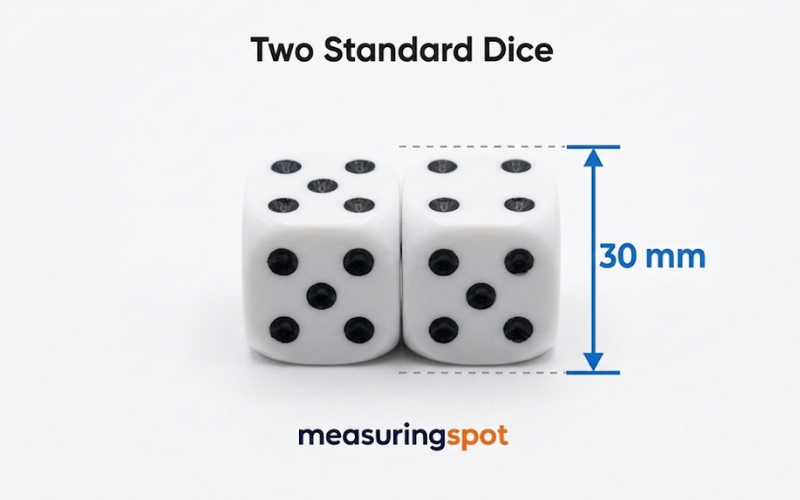
7. Two Standard Dice Placed Side by Side (Width)
Board game dice (specifically standard D6 six-sided dice used in Monopoly, Yahtzee, and Risk) have a globally recognized edge length of 16 millimeters.
If you align two standard dice side-by-side along a straight edge, their combined width measures 32 millimeters:
$$16\text{ mm} + 16\text{ mm} = 32\text{ mm}$$
Subtract just two millimeters (the thickness of a coin), and you have 30mm. This trick gives gamers and families an immediate visual baseline without searching for tools. If you use slightly smaller 15mm casino-style specialty dice, placing two side-by-side hits 30mm on the dot.
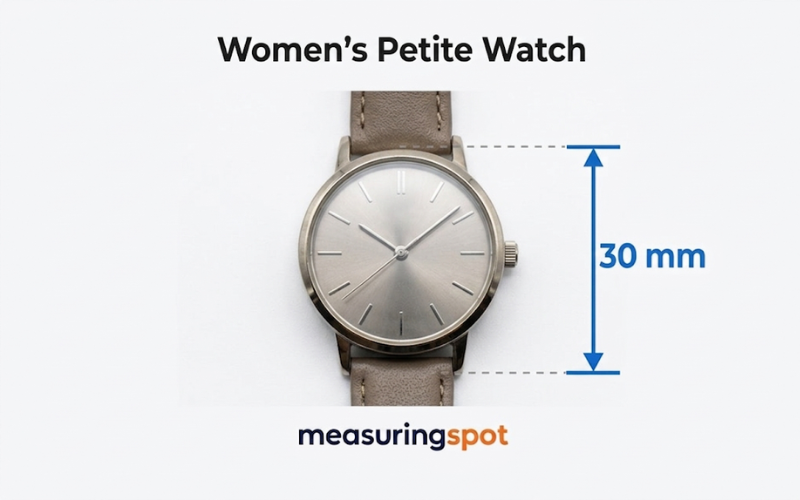
8. A Women’s Petite Watch Dial / Case (Lug-to-Lug or Diameter)
Watch collectors describe timepieces strictly in millimeter diameters. While modern men’s sport watches generally range between 38mm and 44mm, traditional mid-century dress watches and contemporary women’s elegant timepieces frequently feature 30mm cases.
A 30mm watch case rests lightly on the wrist, taking up about half the width of an average wrist top. When jewelry designers create minimalist watches, 30mm represents the sweet spot between easy legibility and a subtle, non-bulky profile.
9. An M30 Hex Nut (Thread Bore Diameter)
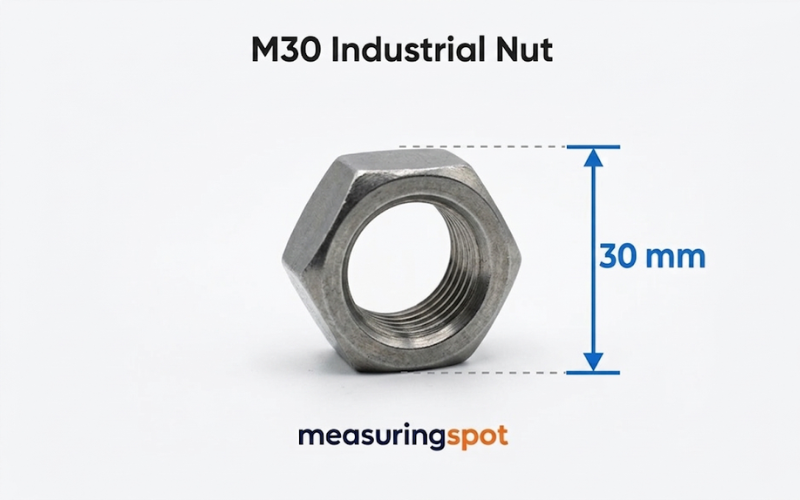
Builders, mechanics, and industrial workers frequently encounter metric fasteners. Metric bolts follow the “M” naming system, where the number following the letter indicates the outer nominal thread diameter of the bolt shank in millimeters.
An M30 bolt features an external thread shaft that measures exactly 30mm in diameter. Correspondingly, an M30 hex nut features an internal threaded bore built to receive that 30mm shaft. The exterior flat-to-flat width of an M30 nut is much larger (measuring 46mm across the wrench flats), but the circular opening in the middle represents a 30mm diameter circle in steel.
10. A Large Sewing Coat Button (Diameter)
Small shirt buttons generally measure 10mm to 12mm across. Jacket buttons range between 18mm and 20mm. Heavy winter coats, peacoats, and trench coats rely on large statement buttons to anchor thick wool fabrics and withstand winter winds.
Tailors categorize button sizes using both ligne measurements and millimeters. A 48-ligne button measures almost exactly 30.48 millimeters (1.2 inches). If you grab a winter overcoat or double-breasted pea coat from your closet, the wide front closure buttons will match 30mm across their outer circular rim.

Visual Comparison Table of 30mm Common Objects
The table below groups these 10 common items by their dimension type, exact size, and accessibility level.
| Item Name | Primary Dimension Measured | Measured Dimension (mm) | Variance from 30mm | Everyday Availability |
| Plastic Soda Bottle Cap | Outer Diameter | ~30.0 mm | 0.0 mm | Very High (Kitchen / Pantry) |
| US Half Dollar Coin | Outer Diameter | 30.61 mm | +0.61 mm | Moderate (Banks / Coin collections) |
| 30mm Wargaming Base | Base Edge Diameter | 30.0 mm | 0.0 mm | Moderate (Hobby / Game shops) |
| Large Coated Paperclip | Total Length | ~31.0 mm | +1.0 mm | Very High (Office desks / Drawers) |
| Stack of 20 US Pennies | Vertical Height | ~30.4 mm | +0.4 mm | High (Pocket change) |
| Standard Split Key Ring | External Diameter | ~30.5 mm | +0.5 mm | Very High (Keychains) |
| Two Standard Dice (D6) | Combined Width | ~32.0 mm | +2.0 mm | High (Board games) |
| Petite Watch Case | Case Diameter | 30.0 mm | 0.0 mm | High (Jewelry boxes) |
| M30 Industrial Nut | Inner Thread Bore | 30.0 mm | 0.0 mm | Moderate (Toolboxes / Hardware shops) |
| Heavy Winter Coat Button | Outer Diameter | ~30.5 mm | +0.5 mm | High (Closets / Wardrobes) |
When Does 30mm Matter Most?
Understanding small millimeter measurements matters across diverse fields, from home improvement to personal style.
1. Photography and Optics
Camera lens manufacturers specify optical filter threads in millimeters. While full-frame DSLR lenses utilize large 67mm, 77mm, or 82mm filters, compact action cams, industrial inspection lenses, and vintage rangefinder lenses use 30mm or 30.5mm threaded step rings. Using the wrong size causes cross-threading or vignetting on wide-angle shots.
2. Cabinetry, Carpentry, and Fasteners
Woodworkers and furniture assemblers deal with 30mm frequently. Standard kitchen cabinet doors typically feature thicknesses between 18mm and 22mm, which means 30mm wood screws provide the ideal depth to fasten hinges securely without puncturing the front decorative veneer. In European cabinetry systems (the 32mm cabinet system), hole patterns and shelf spacing revolve around standardized 32mm and 30mm intervals.
3. Body Jewelry and Piercings
In body modification, 30mm marks a substantial milestone for ear stretching. In the gauge sizing system, plugs transition from numbered gauge sizes (like 00 gauge at 10mm) directly to millimeter increments. A 30mm plug represents roughly 1 and 3/16 inches, demanding significant earlobe elasticity and custom jewelry sizing.
4. Sports and Fitness Equipment
Table tennis balls originally measured 38mm before expanding to the modern 40mm standard, but several specialized training balls, tabletop foosball balls, and pinball bearings hover close to 30mm. In barbell lifting, standard weight plate barbell sleeves measure 28mm to 30mm in diameter, whereas Olympic weightlifting sleeves measure 50mm. Buying 30mm plates for a 50mm Olympic bar results in gear that fails to fit.
Step-by-Step Guide: How to Measure 30mm Without a Ruler
If you must confirm a 30mm gap or component immediately and lack measurement tools, use the finger joint method or credit card trick outlined below.
The Thumb Joint Width Method
Human hand dimensions vary, yet adult fingers provide reliable baseline estimates:
- Lay your dominant thumb flat on a table.
- Measure across the widest part of your thumb knuckle (interphalangeal joint).
- The average adult male thumb knuckle measures between 25mm and 28mm wide. The average female thumb knuckle measures between 21mm and 24mm wide.
- If you have an average adult male hand, your thumb joint plus the thickness of two credit cards alongside it equals almost exactly 30mm.
The Credit Card Ratio Method
A standard financial credit card, debit card, or driver’s license conforms strictly to the international ISO/IEC 7810 ID-1 standard:
- Length: 85.60 mm (3.37 inches)
- Width: 53.98 mm (2.12 inches)
- Thickness: 0.76 mm
To estimate 30mm:
- Divide the card’s short width (roughly 54mm) slightly past its halfway point.
- Half of 54mm is 27mm.
- Mark the halfway point along the short edge of the card, then add about 3 millimeters (the thickness of four stacked cards).
- That combined distance yields an accurate 30mm benchmark.
BioWiki: Measurement Profile for 30 Millimeters
The reference card below summarizes the technical specifications, system equivalents, and physical attributes of the 30mm measurement for quick retrieval.
| Metric Attribute | Data Value |
| System | International System of Units (SI) |
| Base Quantity | Length ($L$) |
| Symbol | mm |
| Base Calculation | $30 \times 10^{-3}\text{ m} = 0.03\text{ meters}$ |
| Equivalent in Centimeters | 3.0 cm |
| Equivalent in Decimeters | 0.3 dm |
| Exact Inch Conversion | 1.18110236 inches |
| Fractional Inch Approximate | 1 3/16 inches (error margin: +0.006 in) |
| Thousandths of an Inch (Thou / Mil) | 1,181.1 mils |
| Pica Equivalent | ~7.086 picas |
| Typographic Point Equivalent | ~85.039 points |
| Wavelength Category (EM Spectrum) | Extremely High Frequency (EHF / Millimeter Wave, ~10 GHz) |
| Primary Industry Applications | Fastener sizing, horology, cabinetry, hobby modeling, plumbing |
| Closest Standard Coin | US Half Dollar (30.61 mm) |
| Closest Common Tool Gauge | 30mm metric combination wrench / socket |
Frequently Asked Questions About 30mm
How big is 30mm compared to an inch?
Thirty millimeters is larger than an inch. One inch equals 25.4 millimeters. Therefore, 30mm equals 1 inch plus 4.6 millimeters, which converts to approximately 1.18 inches or slightly less than 1 and 3/16 inches.
Is 30mm the same as 3cm?
Yes. Ten millimeters make up one centimeter. When you divide 30 by 10, the result is exactly 3 centimeters.
What US coin is closest to 30mm?
The Kennedy Half Dollar is the closest US coin to 30mm. Its official minted diameter is 30.61 millimeters, making it only 0.61mm larger than 30mm.
How big is a 30mm watch on a wrist?
A 30mm watch fits within the petite to mid-size range. It is a standard diameter for women’s dress watches and vintage men’s watches from the early 20th century. On an average wrist, a 30mm watch covers roughly half the wrist width and sits comfortably flush without looking bulky.
How many credit cards thick is 30mm?
A standard plastic credit card is 0.76 millimeters thick. To reach a thickness of 30mm, you must stack roughly 39 to 40 credit cards flat on top of each other.
Is 30mm considered small or large for earrings?
For hoop earrings, 30mm (about 1.2 inches) ranks as a medium hoop. It hangs down noticeably past the earlobe without brushing the shoulder, making it one of the most versatile sizes for daily casual and business wear.
What socket wrench size corresponds to 30mm?
A 30mm metric socket has an internal hex opening of 30 millimeters. Its closest fractional imperial counterpart is a 1-3/16 inch socket (which measures 30.16mm). While 1-3/16 inches fits loosely over a 30mm bolt, mechanics recommend using an exact 30mm socket to avoid rounding off fastener edges.
Final Thoughts on Visualizing 30mm
Estimating 30 millimeters becomes intuitive once you tie the number to practical items around your house. Instead of puzzling over metric conversion charts or hunting down a ruler, remember that 30mm spans just under an inch and a quarter.
Whenever you need a fast sanity check for a project, look for a plastic soda bottle cap, a Kennedy half dollar, or a couple of dice from a board game. These everyday items confirm the scale instantly and keep your home repairs, creative crafts, and shopping decisions accurate.
Related Posts
- 10 Common Things That Are 24 mm Big
- 10 Common Things That Are 23 mm Big
- 10 Common Things That Are 22 mm Big
- 10 Common Things That Are 21 mm Big
Conclusion
Estimating 28mm without a ruler is simple once you know what to look for. Whether you reference a standard soda bottle cap, a modern road bike tire, or a tabletop miniature, this measurement is already sitting around your house.
When measuring tools aren’t handy, keep the golden rule in mind: 28mm sits just past one inch (roughly 1.1 inches). Using that quick mental anchor takes the friction out of hardware runs, DIY repairs, and sizing decisions.
FOR MORE MEASUREMENTS VISIT: MEASURINGSPOT