
When you need to measure a space in a pinch, pulling out a tape measure isn’t always an option. Knowing how long is 1 feet (or 1 foot) using everyday reference points is one of the most practical spatial skills you can build.
In standard imperial units, 1 foot equals exactly 12 inches, 30.48 centimeters, or 0.3048 meters. While that mathematical definition is simple enough, conceptualizing what a single foot looks like in the real world makes estimating furniture layouts, package dimensions, or DIY cuts much easier.
Below is a complete guide to everyday items that measure exactly or nearly one foot in length, along with measurement tricks, conversion references, and practical tips for estimating distance without tools.
Quick Reference: 1-Foot Visual Guide ⚡
If you need an immediate reference point to gauge 12 inches right now, use these instant markers:
- 📏 A Standard School Ruler: Exactly 12 inches (30.48 cm).
- 📄 US Letter Paper (Long Side): 11 inches long (add roughly 1 thumb-width to reach 1 foot).
- 🍾 Standard Wine Bottle: Typically 11.5 to 12 inches tall.
- ⌨️ Standard Computer Keyboard: Roughly 18 inches wide (two-thirds of the width equals 1 foot).
- 🥫 Two Standard Soda Cans Stacked: Almost exactly 9.6 to 10 inches tall (add half a can for 12 inches).
Technical Specifications: 1 Foot at a Glance 📊
Here is the essential breakdown of units, conversions, and reference data for 1 foot:
| Measurement Metric | Imperial / Metric Value | Notes & Practical Context |
| Inches | 12 in | Base imperial unit definition |
| Centimeters | 30.48 cm | Exact international standard since 1959 |
| Millimeters | 304.8 mm | Standard engineering metric conversion |
| Meters | 0.3048 m | Less than one-third of a meter |
| Yards | 0.333 yd | Exactly 1/3 of a standard yard |
| Miles | 0.00018939 mi | 1/5,280th of a statutory mile |
| Origin | Human foot length | Historically based on King Henry I / Roman standard |
| Common Symbol | ft or ′ (prime) | Often written as 1 ft or 1′ |
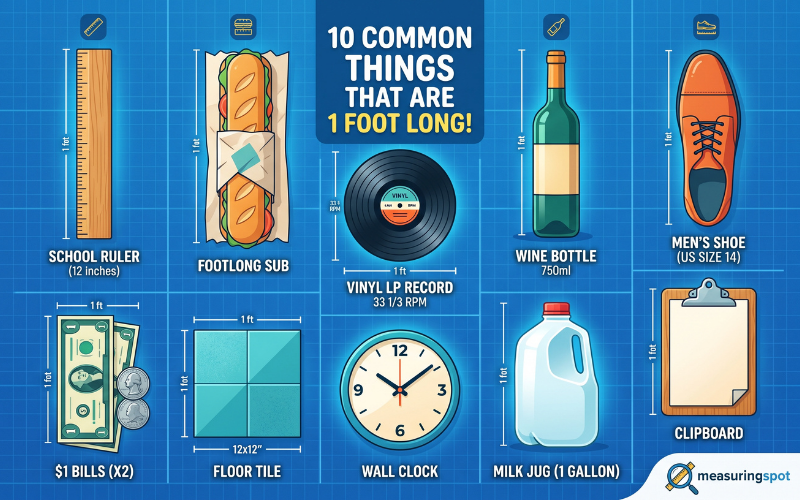
10 Common Everyday Things That Measure 1 Foot 🎒
Finding a 12-inch reference around the house or office is straightforward when you know where to look.
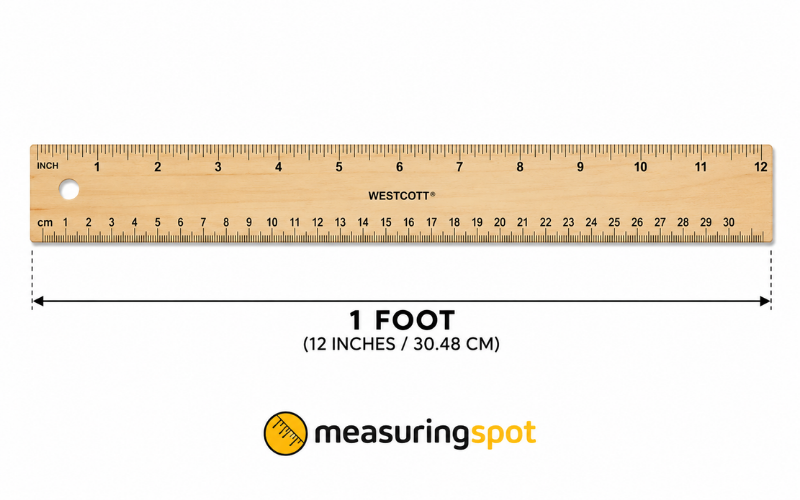
1. A Standard School Ruler 📏
The most precise reference for 12 inches is a traditional wooden or plastic school ruler.
Manufactured across the world to standard specifications, a regular desk ruler measures exactly 12 inches on one edge and 30 centimeters on the opposite edge (with a tiny 4.8 mm margin at the end to match the exact 30.48 cm mark). It serves as the physical benchmark for all everyday household measurements.
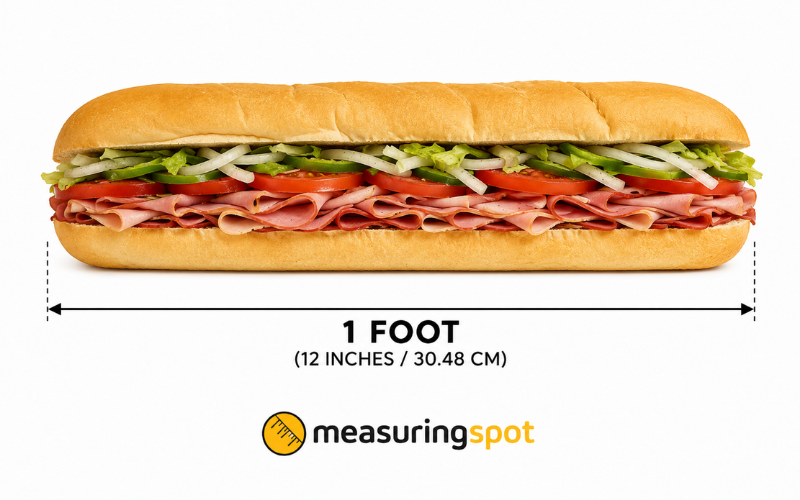
2. A 12-Inch Submarine Sandwich 🥪
The classic “footlong” sub is one of the most recognizable cultural benchmarks for length.
While baking variations can cause slight shrinkage or expansion, standard footlong sandwich loaves are proofed and baked in dedicated 12-inch bread forms. If you hold out a regular footlong sandwich, you are looking at an approximate 12-inch physical span from crust to crust.
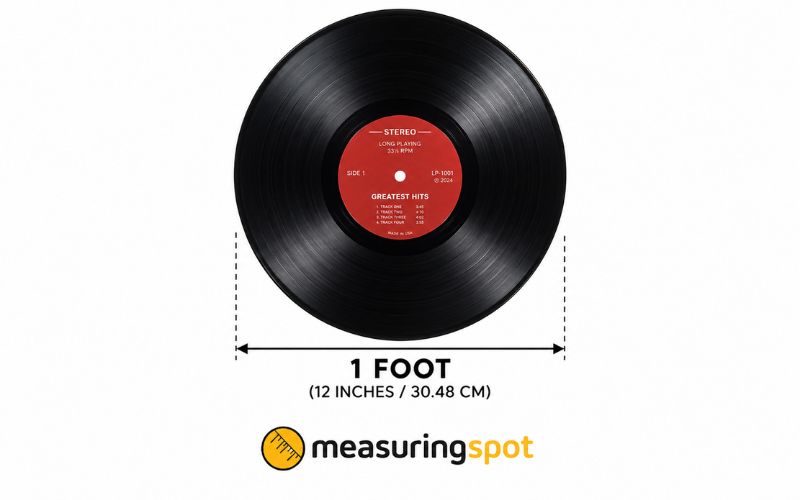
3. A 12-Inch Vinyl Record (LP) 🎵
Long-playing vinyl records (LPs) are pressed with strict manufacturing tolerances.
From outer edge to outer edge across the center spindle hole, a standard full-size LP album measures exactly 12 inches in diameter. The outer cardboard sleeve is slightly larger (around 12.375 inches square), making either the record or its jacket a reliable benchmark for 1 foot.
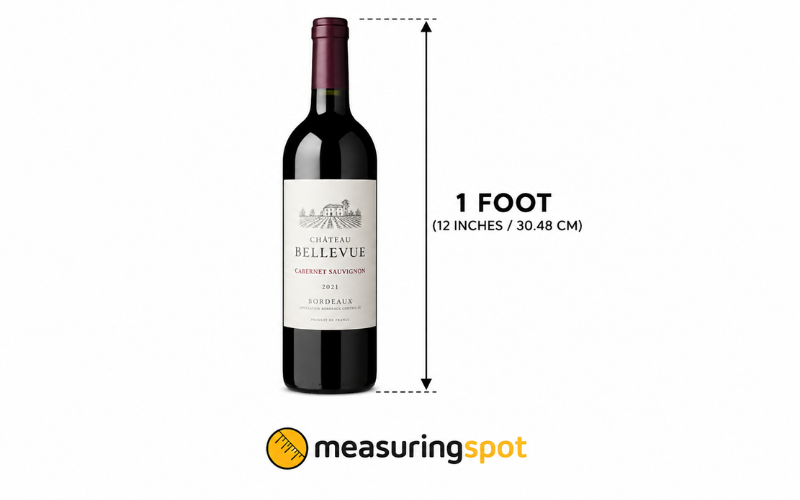
4. A Standard Wine Bottle 🍷
Standard 750 ml wine bottles follow very consistent glassmaking dimensions.
A standard Bordeaux or Cabernet wine bottle stands between 11.5 and 12 inches tall. When standing upright on a shelf or tabletop, the vertical span from the flat base to the top of the cork rim provides an almost perfect 1-foot estimation.
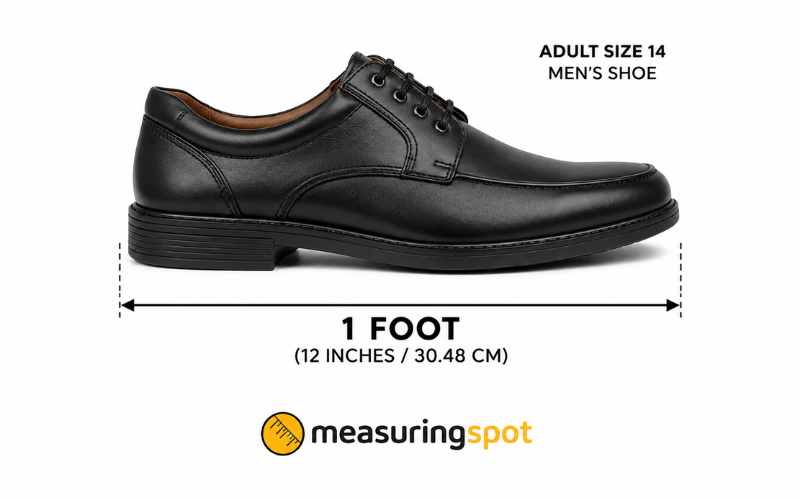
5. An Adult Size 14 Men’s Shoe 👟
While human feet vary, standard shoe sizing follows fixed mathematical increments.
In US sizing, a men’s size 14 shoe has an outsole length of roughly 12 inches. For smaller shoe sizes, a men’s size 9 to 10 shoe outsole typically measures around 11 to 11.25 inches. Knowing your personal shoe length gives you a built-in measuring tool wherever you walk.
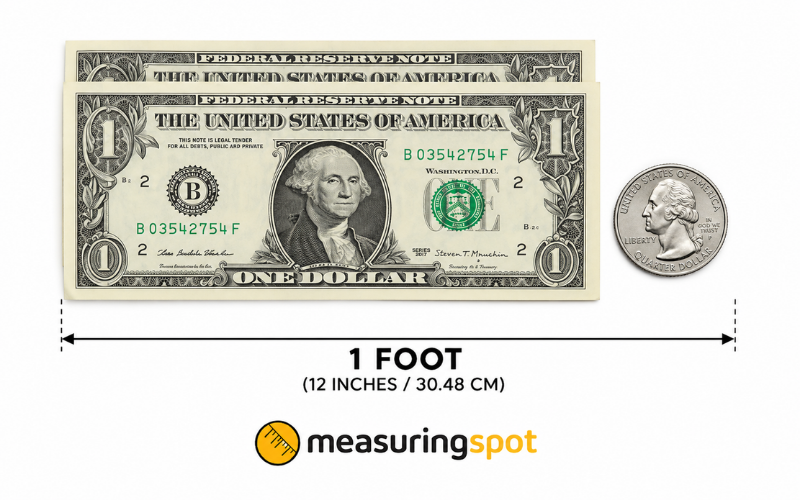
6. Two Stacked $1 Dollar Bills (Plus a Quarter) 💵
United States paper currency is produced to strict specifications by the Bureau of Engraving and Printing.
Every standard US banknote ($1, $5, $20, $100) measures 6.14 inches long. Laying two paper bills end-to-end creates a line measuring 12.28 inches. This is within a quarter-inch of 1 foot, making a pair of bills an accessible wallet-sized ruler.
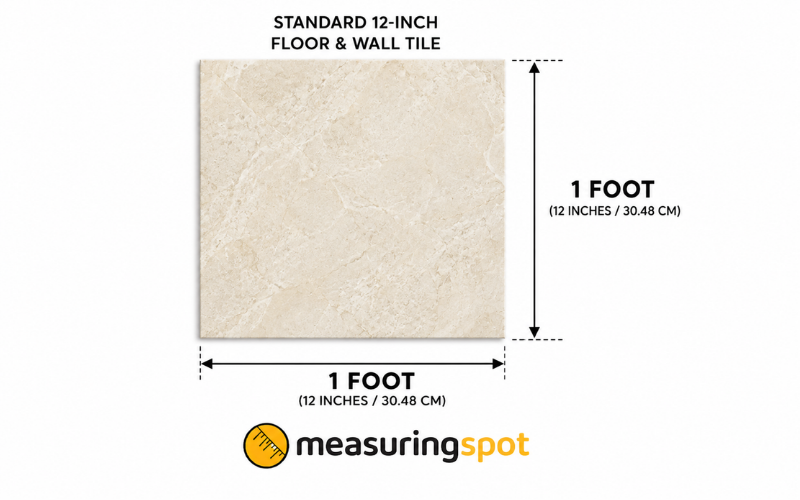
7. Standard 12-Inch Floor and Wall Tiles 🧱
Ceramic, porcelain, and vinyl floor tiles are widely manufactured in square foot modules.
A standard residential or commercial square floor tile measures 12 inches by 12 inches (1 square foot). Looking down at a tiled kitchen, bathroom, or office floor often gives you an immediate grid where each square represents 1 foot in width and length.
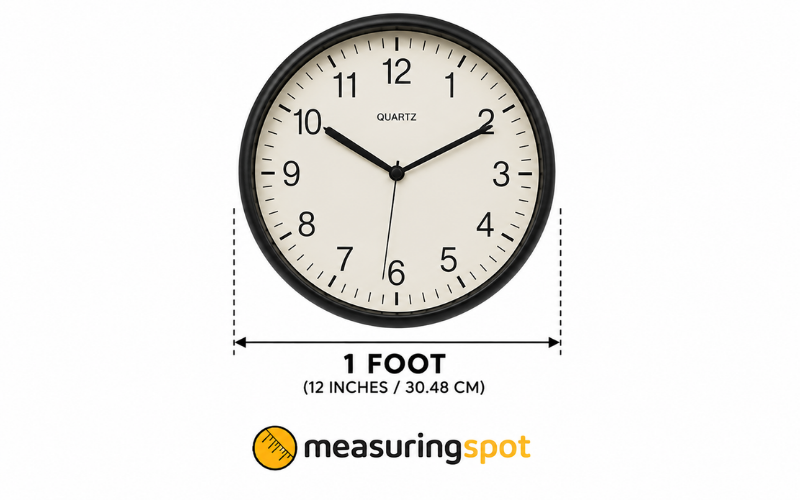
8. A Large Wall Clock ⏰
Medium-to-large round wall clocks commonly found in classrooms, offices, and kitchens are typically built inside 12-inch bezels.
The diameter from the 12 o’clock marker to the 6 o’clock marker on a standard round analog clock measures 12 inches across.
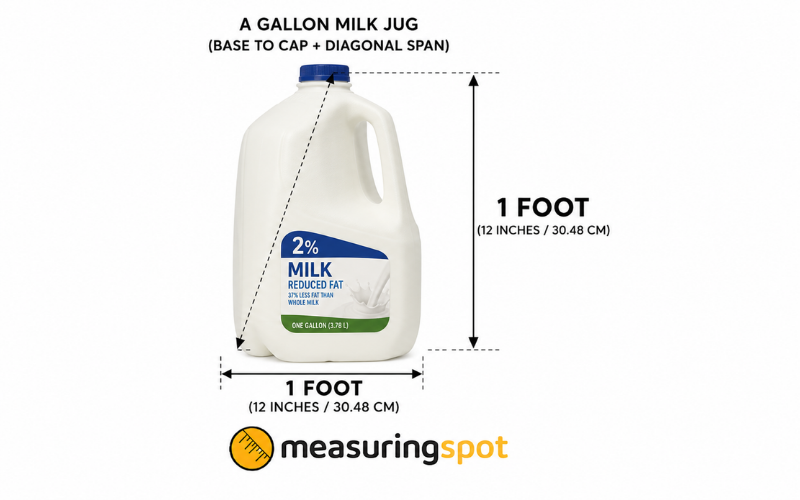
9. A Gallon Milk Jug (Base to Cap + Diagonal Span) 🥛
A standard rectangular 1-gallon plastic milk jug stands roughly 10.5 to 11 inches tall, but its corner-to-corner diagonal dimension or upright height with handle profile reaches approximately 12 inches.
Placing a gallon jug next to a piece of furniture gives a fast estimation of a single foot of clearance.
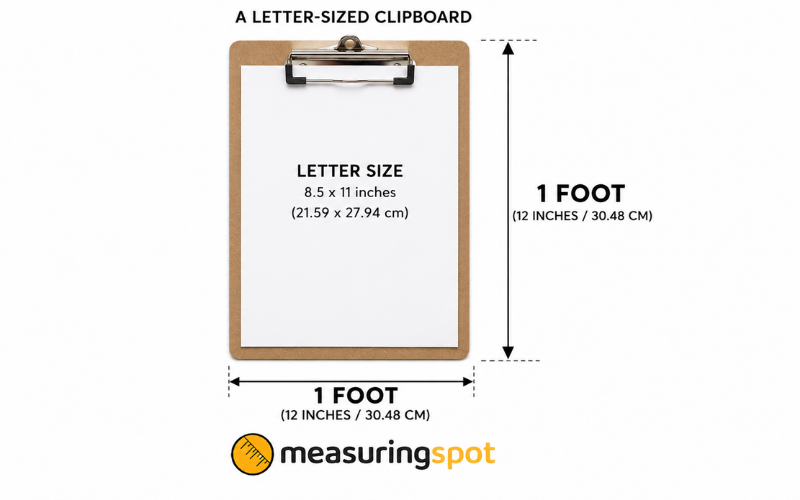
10. A Letter-Sized Clipboard 📋
Office clipboards designed to hold standard 8.5 x 11-inch printer paper are built with an extra inch of framing to protect paper corners and house the metal clip.
Most standard wooden, acrylic, or aluminum clipboards measure 9 inches wide by 12.5 inches long, making the long edge a close surrogate for a 1-foot ruler.
How Long Is 1 Feet Compared to Other Dimensions? 📐
To better visualize how 1 foot fits into spatial layouts, here is how 12 inches scales against adjacent metric and imperial units:
- 1 Foot vs. 1 Meter: A meter (39.37 inches) is more than three times the length of 1 foot (12 inches).
- 1 Foot vs. 1 Yard: A yard consists of exactly 3 feet (36 inches).
- 1 Foot vs. 1 Centimeter: A single centimeter is small (roughly the width of an average pencil or fingernail); 1 foot contains roughly 30.5 centimeters.
- 1 Foot vs. 1 Hand Span: An average adult male hand span (from thumb tip to pinky tip when fully spread) is 8.5 to 9 inches, meaning 1 foot is about 1.3 hand spans.
Built-In Body Hacks: How to Measure 1 Foot Using Your Body 🖐️
When no objects or tape measures are available, using your body dimensions is the fastest way to estimate distance.
The Foot-to-Forearm Rule
For most adults, the distance from the inside crease of your elbow to the base of your wrist equals the length of your bare foot. For individuals of average height, this forearm segment measures between 10 and 11.5 inches.
The Spread Hand Span (Span Technique)
- Spread your dominant hand out as wide as possible on a flat surface.
- Measure the distance from the tip of your thumb to the tip of your little finger.
- If your span is 8 inches, 1 foot is your full hand span plus the width of two knuckles.
- If your span is 9 inches, add roughly 3 finger-widths to equal 1 foot.
The Pacing Method
Walking heel-to-toe gives an instant linear measurement. If you know your shoe measures roughly 11 inches (typical for size 9-10), stepping heel-to-toe 12 times covers roughly 11 feet of floor distance.
Frequently Asked Questions (FAQs) ❓
Is it correct to say “1 feet” or “1 foot”?
In standard English grammar, the singular form is 1 foot, while distances greater or lesser than one (or plural references) use feet (e.g., 2 feet, 0.5 feet, 12 feet). While phrases like how long is 1 feet are commonly searched online, the standard grammatical phrasing is 1 foot.
How many centimeters are in 1 foot?
There are 30.48 centimeters in 1 foot. To convert feet to centimeters quickly in your head, multiply the number of feet by 30.
How many inches make up 1 foot?
There are exactly 12 inches in 1 foot.
What is 1 square foot?
A square foot ($1\text{ ft}^2$) is an area measurement representing a square with sides that are each 1 foot (12 inches) long. It equals 144 square inches ($12 \times 12$) or roughly 0.0929 square meters.
Why did a “foot” become a standard measurement unit?
The unit originated in antiquity from the physical human foot. Ancient Greeks, Romans, Chinese, and Anglo-Saxons all had variations of a “foot” measurement, typically ranging between 11 and 13 inches. In 1959, the International Yard and Pound Agreement standardized the international foot to exactly 0.3048 meters.
Practical Takeaway for Estimating 1 Foot 💡
Whenever you need to visualize 1 foot on the fly, remember these three everyday anchors:
- The School Ruler: Exact 12-inch baseline.
- The Vinyl LP Record: Exact 12-inch diameter circle.
- The Long Edge of a Standard Document: 11 inches long (add a small margin to reach 12).
Having these real-world benchmarks in mind makes spatial estimation simple, accurate, and practical without needing a toolbox.
Related Posts
- 12 Common Things That Are 10 Inches Long
- 10 Common Things That Are 1 Inch Long
- 11 Common Things That Are 2 Inches Long
- 10 Common Things That Are 3 Inches Long
Conclusion 📌
Mastering everyday visual benchmarks makes understanding how long is 1 feet intuitive and practical in any situation where a ruler or measuring tape is out of reach. Whether you are relying on the familiar length of a standard school ruler, checking the diameter of a classic 12-inch vinyl record, or using your own shoe size as an on-the-go reference, having these physical objects in mind bridges the gap between raw numbers and real-world spatial awareness. With standard dimensions like 12 inches or 30.48 centimeters mapped to everyday household items, estimating space, sizing furniture, and planning DIY projects becomes fast, reliable, and effortless.
FOR MORE MEASUREMENTS VISIT: MEASURINGSPOT